
Editor’s Note: HaystackID’s dual Band 2 recognition in the 2026 Chambers Crisis & Risk Management Guide and Chambers Litigation Support Guide points to a larger shift in how cyber incidents, privacy reviews, regulatory response and eDiscovery now converge inside the same compressed matter timeline. For cybersecurity, data privacy, regulatory compliance and eDiscovery professionals, the significance is not only the ranking itself, but what it reflects: buyers increasingly need providers that can move from forensic triage to document review, AI-assisted analytics, disclosure support and defensible workflow documentation without losing continuity.
The recognition also lands as HaystackID integrates generative AI capabilities following its acquisition of eDiscovery AI and operates under new CEO Chad Pinson, adding both technology and leadership context to its market position.
The practical takeaway for legal and compliance teams is clear: provider evaluation should focus on integration, validation, handoff discipline and the judgment behind the technology, not simply the speed of the tools deployed.
Disclosure: ComplexDiscovery OÜ’s editor and managing director, Rob Robinson, also serves as chief marketing officer of HaystackID and covers events for Newsline by HaystackID.
Content Assessment: HaystackID earns Band 2 rankings in two 2026 Chambers guides
Information - 94%
Insight - 90%
Relevance - 90%
Objectivity - 88%
Authority - 92%
91%
Excellent
A short percentage-based assessment of the qualitative benefit expressed as a percentage of positive reception of the recent article from ComplexDiscovery OÜ titled, "HaystackID earns Band 2 rankings in two 2026 Chambers guides."
Industry News – eDiscovery Beat
HaystackID earns Band 2 rankings in two 2026 Chambers guides
ComplexDiscovery Staff
The call rarely lands at a convenient hour. A breach surfaces, a clock starts, and within days the same matter has become a forensic investigation, a privacy review and a regulatory disclosure question all at once. Handling every piece of that under one roof, fast and defensibly, is hard work, and this year it earned HaystackID recognition from Chambers and Partners twice.
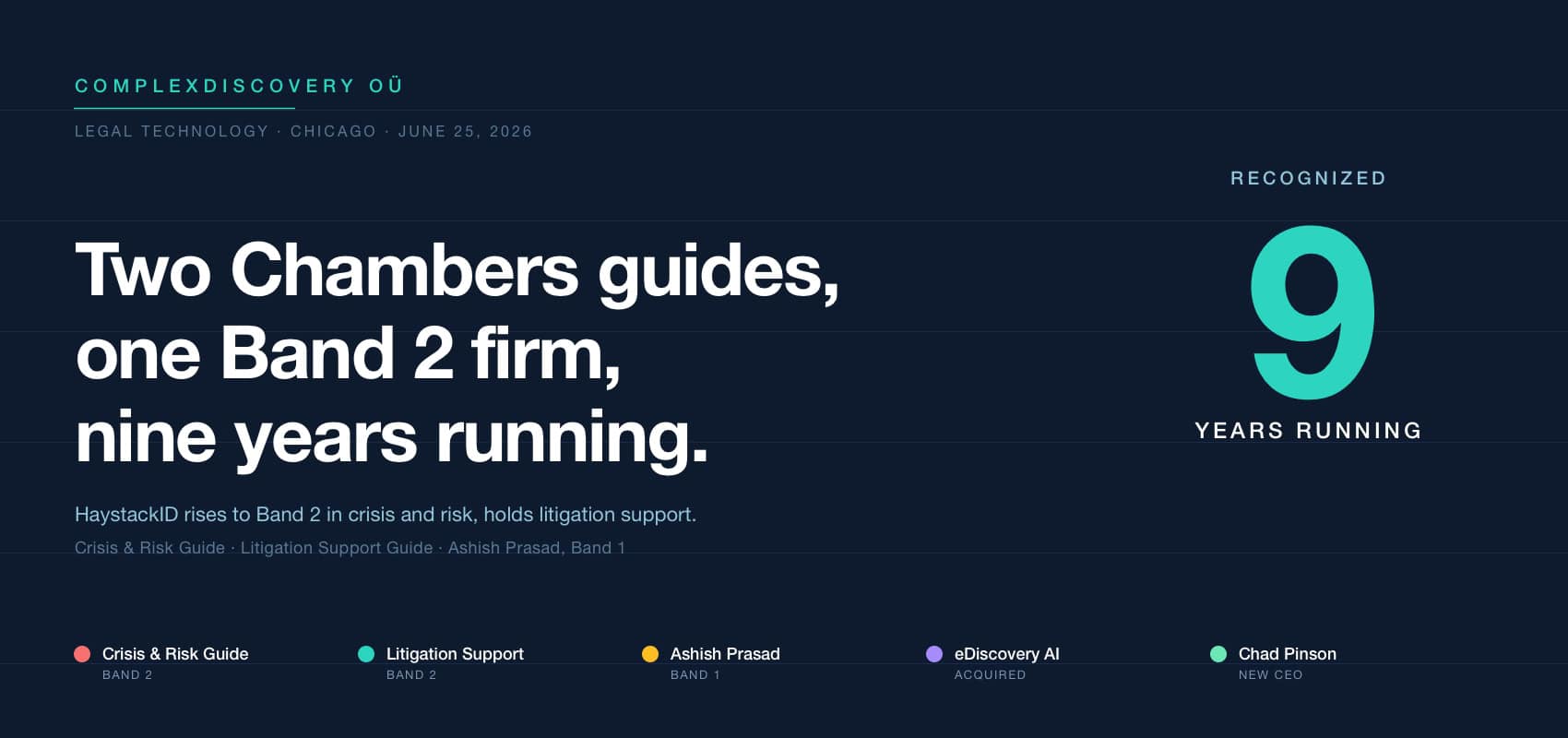
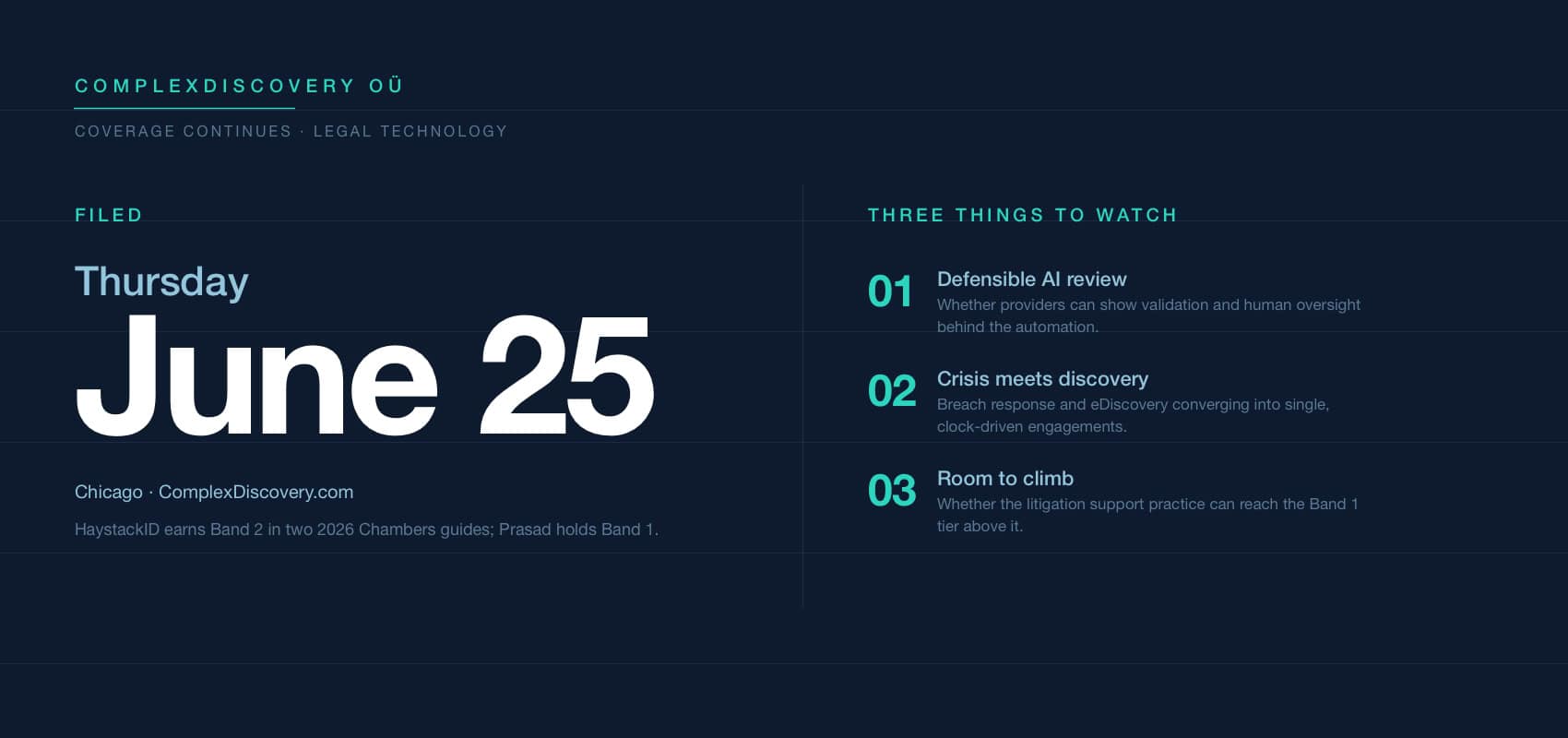
HaystackID advanced to Band 2 in the 2026 Chambers Crisis & Risk Management Guide and held Band 2 in the Chambers Litigation Support Guide, the company said June 25, extending a nine-year run of recognition. The dual standing places one provider in two distinct Chambers categories in the same cycle, a position few eDiscovery and cyber firms occupy.
Two guides, one upward trajectory
Recognition in both guides reflects work that increasingly overlaps. A ransomware event becomes a forensic investigation, then a privacy review, then a regulatory disclosure question, often inside the same matter and the same compressed timeline. HaystackID framed its crisis and risk gain around that convergence.
“Cybersecurity incidents demand rapid, highly coordinated responses that balance containment and technology deployment with legal defensibility,” said Anya Korolyov, executive vice president of cyber and legal data intelligence strategy at HaystackID, in a company announcement. Korolyov said the firm’s incident response teams handle the full lifecycle of digital threats, from detection and triage to forensic investigation and disclosure guidance.
For the litigation support side, Chambers cited end-to-end capabilities across the e-discovery spectrum, from digital forensics and data processing to managed review and strategic consulting, according to HaystackID. The directory also pointed to the firm’s use of AI-accelerated classification, analytics and review tools.
Inside the Chambers method
The Chambers banding system rewards the qualities buyers of legal services tend to weigh: technical ability, professional conduct, client service, commercial judgment, diligence and commitment. Bands run from 1, the highest, to 6. The rankings draw on independent market research, including interviews with clients and peers, rather than on submissions alone, which is part of why general counsel and compliance leaders treat the guides as a screening tool.
That methodology is worth keeping in view when reading any vendor’s announcement of its own results. The band itself comes from Chambers research; the framing, the quotes and the emphasis come from the company. Both can be true and useful, but readers evaluating providers should separate the third-party assessment from the promotional packaging around it.
AI moves to the center of review
The recognition arrives months after HaystackID reshaped part of its technology stack. In February, the firm acquired eDiscovery AI, a generative AI legal technology company, in a deal whose terms were not disclosed. Jim Sullivan stayed on as chief executive of eDiscovery AI, which HaystackID said it would continue to operate as a separate entity for existing clients while embedding the technology into its own managed review and data intelligence offerings.
That acquisition gives the Chambers nod a sharper edge. The directory’s emphasis on AI-accelerated classification and analytics tracks an industry shift toward generative tools that triage documents, surface privileged material and accelerate first-pass review. For corporate legal and compliance teams evaluating outside support, the practical question is no longer whether a provider uses AI but whether it can show defensible workflows, documented validation and human oversight behind the automation.
“Our strength lies in our ability to integrate and scale the most advanced technologies and best practices across all matters and investigations,” said Michael Sarlo, chief innovation officer and president of global investigations and cyber incident response services at HaystackID, in a company statement. Sarlo said the same approach applies whether the firm is responding to compromised endpoints across multiple jurisdictions or identifying sensitive information across complex data types.
Leadership recognition and a new chief executive
On the individual side, Ashish Prasad, vice president and general counsel at HaystackID, again earned a Band 1 ranking in the litigation support guide, his ninth appearance. Chambers’ own profile describes Prasad as a respected figure in eDiscovery, well known for his expertise in document review. “Our clients rely on us to deliver excellence and support them on cases of every size and complexity, especially when the timelines are short and the margin for error is zero,” Prasad said in the announcement.
The recognitions also land during a leadership change. HaystackID named Chad Pinson chief executive in January, with former chief executive Hal Brooks moving to executive chairman. Pinson, who previously led digital forensics and incident response work at Stroz Friedberg, tied the litigation support result to client expectations. “Earning Band 2 recognition for a second consecutive year reflects the standard our team strives to achieve for every client on every matter,” he said.
Where the cyber practice meets the market
The timing aligns with a growing market. ComplexDiscovery’s 2025 to 2030 market model puts global eDiscovery spending at $19.61 billion in 2025, rising to $28.08 billion by 2030, with figures current as of June 2026. Cyber incident response and breach-driven data review sit among the faster-moving segments, pulled by ransomware, regulatory disclosure deadlines and cross-border data complexity.
In the litigation support guide, Chambers reserved Band 1 for a small group of providers, the tier above HaystackID. The competitive picture matters for buyers: a Band 2 firm recognized in two guides offers a different value proposition than a single-category specialist, particularly for organizations that want forensic, review and advisory capability under one roof during a crisis.
Signals worth tracking
For practitioners, the through-line is integration. The firms gaining ground are the ones erasing the seams between cyber response, data review and legal advisory, because that is how real matters unfold. Compliance officers and litigation teams should press providers on how AI review is validated, how incident response and eDiscovery hand off to each other, and how defensibility is documented when a regulator asks.
Which brings it back to that inconvenient hour. When the call comes and the clock starts, the providers that matter are the ones who can move quickly without bending what has to hold up later, when a regulator or a court asks how the work was done. As the lines between a breach, an investigation and a discovery obligation keep blurring, which will define the next tier of providers: the speed of the technology, or the judgment guiding how it gets used?
News sources
- HaystackID Earns Band 2 Ranking in the 2026 Chambers Litigation Support Guide for Second Consecutive Year (HaystackID)
- HaystackID, Litigation Support 2026 (Chambers and Partners)
- HaystackID, Crisis & Risk Management 2026 (Chambers and Partners)
- Ashish Prasad, Litigation Support (Chambers and Partners)
- Complete Look: ComplexDiscovery OÜ’s 2025 to 2030 eDiscovery Market Size Mashup (ComplexDiscovery)
- HaystackID Acquires eDiscovery AI to Accelerate Client-Driven GenAI Workflows (Legal IT Insider)
- HaystackID Announces Transition of CEO Hal Brooks to Executive Chair; Names Chad Pinson New Chief Executive (HaystackID)





Assisted by GAI and LLM Technologies
Additional reading
- EDRM expands IGRM v4.1 guidance for AI-era information governance
- An Oxford tutorial for cybersecurity, governance and eDiscovery
- Estonia aims to be first to give AI agents official digital IDs
- Parliament hits pause on high-risk AI rules and bans nudifier apps
- Europe’s AI labeling rules arrive with a voluntary code and a hard deadline
- AI is becoming an advisor, and it is rewriting how buyers find you
- What marketing confidence actually looks like
- When credibility comes first, capability sells itself: The case for news-led marketing
- The one question that reveals whether your marketing plan is actually a plan
- How Prompt Marketing Is Redefining Thought Leadership In The AI Era
- Raising The Age Ceiling: How AI Is Extending Executive Leadership
- Staying Curious: One Practical Defense Against Creative Burnout
- From Longbows To AI: Lessons In Embracing Technology
- 20 Ways Creative Professionals Battle Burnout And Find Fresh Ideas
- 14 Points For Brands To Consider Before Making Sociopolitical Statements
Source: ComplexDiscovery OÜ

ComplexDiscovery’s mission is to enable clarity for complex decisions by providing independent, data‑driven reporting, research, and commentary that make digital risk, legal technology, and regulatory change more legible for practitioners, policymakers, and business leaders.