

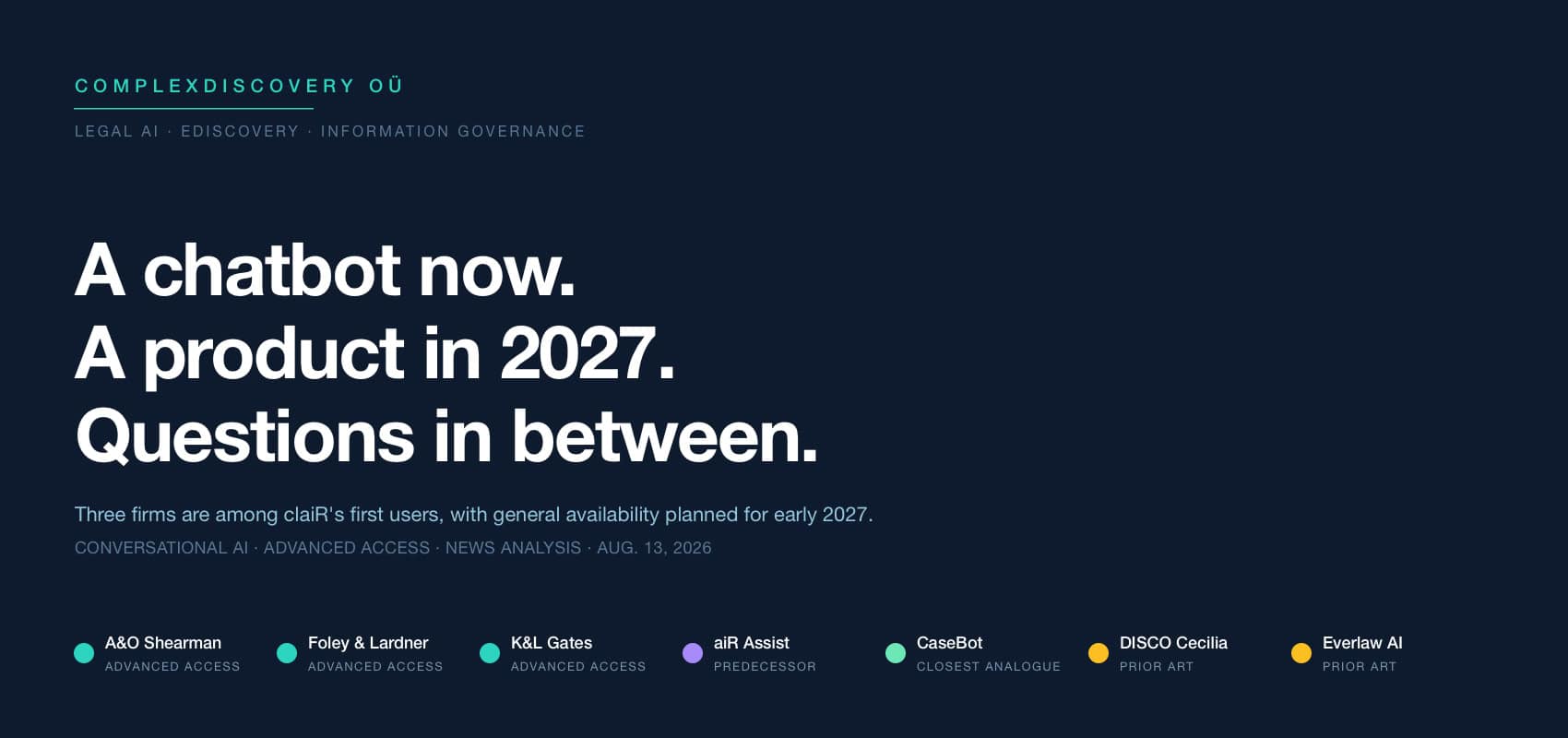
Editor’s Note: Conversational AI reached the lawyer’s desk this week, and the interesting part is what Relativity did not say about it. The company launched claiR on Aug. 12, a plain-language interface to RelativityOne matter data, naming A&O Shearman, Foley & Lardner and K&L Gates among the first in its Advanced Access program, with general availability planned for early 2027.
Three disciplines have homework before general availability. Security teams get a vendor claim that sensitive material never leaves the platform, plus open questions about permission inheritance, log export and inference location. Compliance and privacy teams get a design choice a Colorado federal court made relevant in March, amending a protective order over which AI tools may touch confidential material. Information governance teams get a retention question.
That last one is the harder question, and Relativity’s own documentation frames it. For the predecessor product, aiR Assist, conversation history is saved across sessions while the audit trail expressly does not record the content of a question or answer. If claiR works the same way, a matter accumulates prompts and answers the audit log will not show.
Relativity has published no capacity or retention specifications for claiR. Watch ILTACON and RelFest Chicago for them.
Disclosure: ComplexDiscovery’s publisher is also chief marketing officer of HaystackID, which acquired eDiscovery AI in February 2026. The CaseBot facts in this article come from eDiscovery AI’s own announcements, linked in News Sources, and no non-public information was used.
Content Assessment: Relativity puts a chatbot on the matter record, then asks lawyers to wait as key questions remain
Information - 92%
Insight - 91%
Relevance - 91%
Objectivity - 88%
Authority - 90%
90%
Excellent
A short percentage-based assessment of the qualitative benefit expressed as a percentage of positive reception of the recent article from ComplexDiscovery OÜ titled, "Relativity puts a chatbot on the matter record, then asks lawyers to wait as key questions remain."
News Analysis – Artificial Intelligence Beat
Relativity puts a chatbot on the matter record, then asks lawyers to wait as key questions remain
ComplexDiscovery OÜ Staff
Relativity announced a conversational AI interface for lawyers Wednesday and said general availability is planned for early 2027, about five months out at the earliest.
Three law firms are named among the first to use it.
The product is Relativity claiR, and the company describes it as a conversational experience built specifically for lawyers. Relativity has traditionally required users to work through a more technical eDiscovery interface; claiR is intended to give lawyers a simpler, conversational way to interact directly with matter data.
Among the first firms working with it, through what Relativity calls its Advanced Access program, are A&O Shearman, Foley & Lardner and K&L Gates, according to the company’s Aug. 12 announcement. Phil Saunders, CEO of Relativity, said claiR is “a fundamentally new way to get them straight to the answers in their most consequential legal data.”
That framing is worth taking seriously, and worth testing.
What the architecture claim actually says
Relativity’s central technical assertion is about location. Competing tools, the company said in its announcement, oblige customers to copy data somewhere else before a model can touch it. claiR does the reverse, running against matter data already resident in RelativityOne, leaving the platform’s permission model, security and defensibility in place. Chris Brown, president of Relativity, said in the same announcement that the tool neither exports nor samples the material, and that every answer is drawn from the stored record.
Strip the marketing and a real design decision remains. Bringing a model to governed data rather than shipping governed data to a model changes the exposure surface, the audit trail and, potentially, the answer to a protective-order question about where privileged material has traveled.
That last point is no longer hypothetical. In Morgan v. V2X Inc., a Colorado federal court in March amended a protective order to keep confidential material away from AI tools whose vendors are not contractually barred from training on that data or disclosing it, according to a Jones Walker account of the ruling. Vendor architecture has started showing up in discovery orders, which is the practical stake in Relativity’s claim, whether or not the announcement frames it that way.
Security reviewers should treat the claim as a starting point rather than a finding, and note what it covers: the assurance runs to the underlying documents. Relativity’s own description of RelativityOne lists data breach response among its use cases, so a conversational layer can sit over breach-response material, not only over document review.
For the predecessor product the documentation is partly explicit: aiR Assist evaluates every interaction against the requesting user’s document security permissions, and does not carry knowledge between users’ conversations. No equivalent statement exists for claiR.
The announcement does not say whether the prompts and generated answers a session creates inherit the permissions applied to the documents behind them, whether session logs can be exported into a customer’s own monitoring, or where inference runs. It also does not identify which foundation model powers claiR, how citations are generated or validated, or what the error profile looks like.
Relativity disclosed none of it. Neither did the launch coverage reviewed for this article.
Advanced Access is a label, not a specification
The claiR announcement describes Advanced Access functionally, saying participating firms shape the product ahead of general availability. It does not publish the program’s terms: what participants commit to, how their data and feedback are used, or what service levels apply.
Legal IT Insider headlined its coverage a beta launch. Relativity’s own release does not use that word. The distinction is not pedantic. Firms weighing whether to raise their hands for a later cohort should ask which set of contractual obligations attaches, because “beta” and “Advanced Access” carry different commercial connotations and neither is defined in the public record.
The firms already inside the program are not naive buyers, which is worth saying plainly. Calum Burnett, partner and global co-head of litigation and investigations at A&O Shearman, said in the announcement that his firm took RelativityOne in-house back in 2017, and that it adopted generative AI across the firm early in 2023. David Simon, a Foley & Lardner litigation partner and member of that firm’s AI Steering Committee, said the appeal is getting to facts faster and identifying issues sooner within existing workflows.
Both are customer testimonials in a vendor release, and only A&O Shearman’s nine-year platform history is documented in it. Even so, an AI Steering Committee seat and the co-leadership of a global litigation and investigations practice are not the profiles of people accepting a demo.
Buyers should also read the pricing signal carefully. Relativity said it expects the tool to carry no separate charge once the product is generally available, folded into what the company calls RelativityOne integrated pricing.
How deep is the full depth of a matter
Here the announcement invites a measurement it does not supply. Relativity said claiR reasons at the full scale of a matter, which the announcement fills out as millions of documents plus their metadata and the relationships among them, and said it takes aiR Assist past indexed document sets to the whole of a matter.
Relativity’s published aiR Assist documentation, reviewed Aug. 13, 2026, puts numbers on the thing being extended. A workspace tops out at five built indexes, each holding up to 300,000 documents, which is the 1.5 million documents per workspace Relativity cited when it announced the product’s general rollout in June.
Read the aiR Assist prompting documentation, though, and that workspace figure is aggregate capacity, not reach. A user sets one index before asking a question and switches indexes between questions, so the population behind any single answer is one index of up to 300,000 documents, not the 1.5 million a workspace can hold.
The documentation adds that individual documents are capped at 5 MB of extracted text, that documents without extracted text are never indexed, and that the tool searches by similarity instead of reviewing everything, so some matching documents may not surface in a response.
Those are aiR Assist’s documented limits, not claiR’s. Relativity has published no equivalent figures for claiR.
Relativity is claiming to remove the indexed-subset constraint of aiR Assist and expose the complete governed matter record conversationally. But it has not yet published enough about scope, retrieval architecture, retention, auditability or validation to evaluate what that claim means in practice.
The limits matter for a second reason. aiR Assist is the product Relativity has already announced as generally available. That announcement came in June and said the capability would become standard in the RelativityOne offering by the end of that month. Individual users still need Prompting permission granted before they can ask anything.
Teams that want conversational querying this quarter are choosing indexed sets with published ceilings, and that is a far easier thing to write into a discovery protocol than a capability whose scope has been described only in adjectives.
Conversational eDiscovery is not a new category
Relativity is not opening this category. DISCO announced Cecilia in March 2023 as an AI chatbot for large-scale eDiscovery, describing it in those words as a way to let lawyers interrogate their data, and launched the platform in Europe in October 2024. Everlaw shipped its AI Assistant and later added Deep Dive. Its August 2025 announcement said the assistant’s FedRAMP authorization was expected the following month, with full agency authorization still in progress, on a platform already authorized.
The closest analogue is CaseBot. eDiscovery AI describes it as a way to interrogate case data in natural language and get answers cited back to source documents, which is the same promise Relativity is making for claiR. HaystackID acquired eDiscovery AI in February 2026.
CaseBot’s own record is worth reading closely. eDiscovery AI announced it in September 2025 as launched and integrated into its early case intelligence product, with no stated availability limits. Its May 11, 2026 release then described the same assistant as having been in limited release with founding partners since January 2026, and available to every customer as of that day.
The claim Relativity is actually making is about scope rather than sequence: whole-matter reasoning, metadata and inter-document relationships included, instead of querying an indexed subset. That is a real distinction if it holds. Relativity has not published capacity limits or comparable specifications for claiR, so the distinction will stay untestable until either the numbers appear or the product does. None of the launch coverage reviewed for this article, from LawSites, Legal IT Insider and Artificial Lawyer, drew a competitive comparison.
The conversation itself has to live somewhere
Now the part that should interest information governance and eDiscovery professionals most, and the part the launch coverage reviewed for this article went past: Relativity has not said what claiR keeps.
The announcement does not address it. Relativity’s aiR Assist documentation does, and it repays a close read, because claiR is described as an extension of that product.
Conversation history is saved across sessions and, the documentation says, retained as long as the workspace exists unless the conversation is deleted. The audit application logs the creation of a question and an answer, and the creation, editing, viewing and deletion of a conversation. It also states, twice and plainly, that audit does not record the content of the question or the content of the answer.
Read that pairing carefully. The exchange persists as something a user can revisit and delete. The audit trail shows that it happened, not what was said. If claiR inherits that design, a matter will accumulate prompts and generated answers that are neither part of the document set nor legible in the audit log, and somebody has to decide what they are.
Julie Anne Halter, Seattle office managing partner at K&L Gates and practice group coordinator for the firm’s e-Discovery Analysis & Technology practice, appears in Relativity’s announcement praising the tool’s governance framing. Halter also authored a K&L Gates client publication in February arguing that relevant generative AI data, including user prompts, model outputs and activity logs showing when and how tools were used, is discoverable and should be treated as electronically stored information like any other.
That publication states it is for informational purposes and does not contain or convey legal advice, and like most firm alerts it serves client development as well as analysis.
Courts have begun sorting this out through July 2026, and they have not landed in one place. The decisions that follow are described from trade reporting and law firm alerts; none of the underlying opinions were obtained for this article.
Justice Rhonda Fischer of the New York Supreme Court in Nassau County quashed a subpoena to non-party OpenAI in June that sought a self-represented defendant’s entire ChatGPT account, holding the material could qualify for work-product protection. Judge Grant Dorfman of the Texas Business Court reached a comparable result a day earlier for chats by a represented party’s non-lawyer principal, while still ordering that party to identify every discovery document it had fed into the tool.
Work-product protection is not absolute. Ordinary work product may be discoverable upon a showing of substantial need and undue hardship, while opinion work product reflecting mental impressions, conclusions, opinions or legal theories receives heightened protection. Both decisions are trial-level, and both left waiver analysis fact-specific.
The protective line runs wider than those two rulings. Federal courts in Michigan and Colorado reached the same result, in Warner v. Gilbarco and in the Morgan protective-order case above, and Jones Walker counts all four civil decisions together as holding that using an AI tool does not waive work product.
It calls the one decision the other way, United States v. Heppner, the lone outlier, and a criminal matter the civil courts have distinguished on its facts.
U.S. Magistrate Judge Thomas O. Farrish in Connecticut ordered on May 18, 2026 that Conservation Law Foundation revise its discovery responses to disclose any AI prompts or queries its expert, Naomi Oreskes, used in preparing a Clean Water Act report, and say so after a diligent search if nothing further existed. The reasoning was that an expert’s methodology is fair ground for discovery under Federal Rule of Civil Procedure 26. That is expert disclosure, not party work product, so it sits beside the other decisions rather than against them.
Conservation Law Foundation moved to stay that order. Shell opposed the motion in June, and a Spencer Fane alert in July described the order as stayed pending resolution of an objection.
None of that reaches an in-platform claiR exchange. The cited decisions concern consumer AI accounts, litigation preparation, waiver and expert methodology, not conversation history retained inside an eDiscovery system of record. Nothing reviewed for this article addresses that question, and claiR’s general availability is not planned until early 2027.
It may be presented eventually. Rule 26(b)(1) reaches nonprivileged matter that is relevant to any party’s claim or defense and proportional to the needs of the case, and a retained conversation can meet that description. Whether a particular one does is a fact question, not a foregone conclusion. Relativity sells auditability as a feature. What the predecessor’s audit trail captures, and what it does not, is a retention decision the announcement never mentions.
Questions worth asking before Nashville
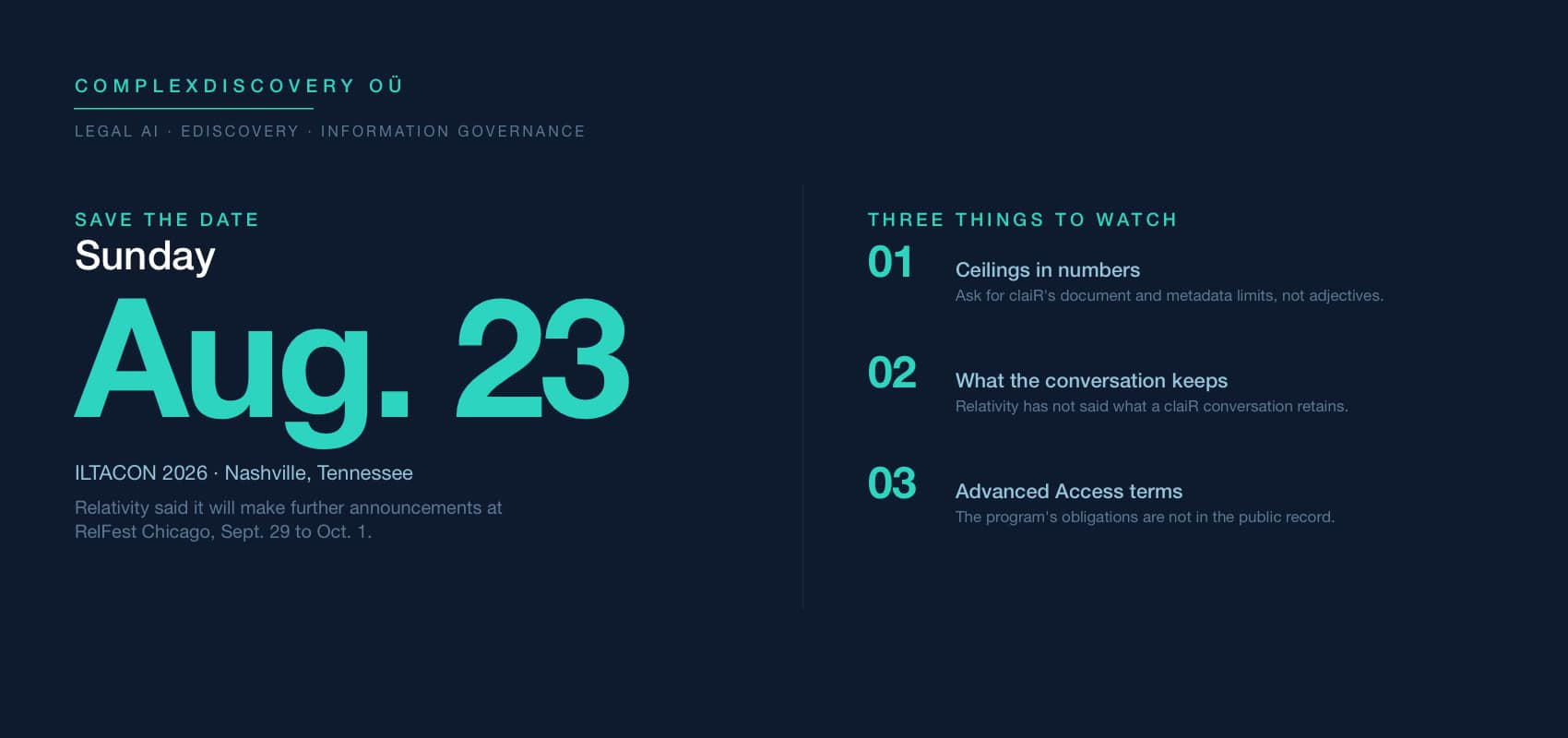
ILTACON opens Aug. 23 in Nashville, Tennessee, 11 days after the announcement, and Relativity said it will make further announcements at RelFest Chicago from Sept. 29 to Oct. 1. Both are demo opportunities, and both are the right venue for the questions the release left open.
Practitioners walking a booth should ask for claiR’s document and metadata ceilings in numbers, not adjectives. Ask whether conversations persist the way aiR Assist conversations do, whether the audit trail captures content or only the fact of a question, for how long either is kept, and whether a client can have them exported or purged. Ask how citations are verified, and what happens when the model cannot find support. Ask what the Advanced Access agreement actually obligates a firm to do.
Information governance teams should find out where their platforms retain prompts, outputs and activity logs, and fold potentially relevant generative AI data into ESI inventories, retention policies and legal hold procedures now, which is what the K&L Gates publication recommended six months ago, rather than after a request for production names it.
The architecture argument Relativity is making is a good one, and the prospect of allowing lawyers to work with sensitive data without moving the underlying matter record into a separate application deserves attention.
So here is the question worth carrying into Nashville: if claiR keeps what a lawyer asked and what it answered, who owns that exchange when the other side comes looking?
News sources
- Relativity Launches claiR, Giving Lawyers Conversational Command of the Full Depth of Their Legal Data (PR Newswire)
- Relativity Announces claiR, A Conversational AI for Lawyers, But You’ll Have to Wait Awhile to Chat with It (LawSites)
- Relativity launches beta conversational AI capability for lawyers (Legal IT Insider)
- Relativity Develops claiR Conversational AI System (Artificial Lawyer)
- aiR Assist product documentation (Relativity Documentation)
- Index Management for aiR Assist (Relativity Documentation)
- Prompting and conversations in aiR Assist (Relativity Documentation)
- Relativity Announces aiR Assist General Roll Out (Artificial Lawyer)
- Litigation Minute: Is AI-Generated Content Discoverable? What Companies Need to Know in 2026 (K&L Gates)
- When Your Litigation Team Uses ChatGPT: Texas and New York Courts Protect AI Work Product and Break With Heppner (Jones Walker)
- Courts Begin Shielding AI Prompts and Outputs From Discovery (Spencer Fane)
- Enviro Group Can’t Delay Handing Over AI Prompts, Shell Contends (eDiscovery Today)
- AI Prompts Used by Expert Are Subject to Compelled Discovery (The Volokh Conspiracy)
- DISCO Announces Cecilia: an AI Chatbot for Large-Scale Ediscovery, Designed to Let Lawyers Interrogate Their Data (Business Wire)
- Everlaw Announces FedRAMP Certification of EverlawAI Assistant (Business Wire)
- eDiscovery AI Launches CaseBot to Deliver Unlimited Insights, Instantly (EIN Presswire)
- eDiscovery AI Officially Releases CaseBot (PR Newswire)
- eDiscovery AI Launches CaseBot, a Conversational AI Assistant for Case Data (LawSites)
- ILTACON 2026 Agenda Overview (ILTACON)

Assisted by GAI and LLM Technologies
Additional reading
- Federal magistrate judge treats LinkedIn’s Relativity aiR workflow as TAR
- One benchmark, three directions: 2026 legal rates rise, flatten and fall at once
- Confidence cools, commitment holds: full results from the 1H 2026 eDiscovery Business Confidence Survey
- Complete look: ComplexDiscovery OÜ’s 2025 to 2030 eDiscovery market size mashup
- The workstream of eDiscovery: Considering processes and tasks
- Andrew Haslam’s eDisclosure Systems Buyers Guide at 14: What the 1H 2026 update reveals
- A Complete Analysis of the Winter 2026 eDiscovery Pricing Survey
- The M&A Risk of Confusing Market Velocity with Marketing Capability
Source: ComplexDiscovery OÜ

ComplexDiscovery’s mission is to enable clarity for complex decisions by providing independent, data‑driven reporting, research, and commentary that make digital risk, legal technology, and regulatory change more understandable for practitioners, policymakers, and business leaders.