

Editor’s Note: A launch review that ends in quick, complete agreement should make leaders pause. Launch failure is hard to measure, and the widely cited statistics are directional rather than definitive, but the pattern they point toward recurs: launches can falter because of campaign design and narrowed decision-making, not only because of product quality. This analysis assembles a working framework from sources that rarely share a page: Clausewitz’s questions of objective, concentration, and the point at which further push risks reversal; Sun Tzu’s positioning and intelligence discipline; the technology adoption lifecycle and the chasm Geoffrey Moore mapped between early believers and mainstream buyers; and lifecycle stage gates that carry an offering from first customer to graceful exit. The piece is explicit that business is not war; only the structure of the thinking transfers.
One caution for readers tempted to dismiss the framework as overthinking: deliberate analysis belongs inside planning, not outside it. Teams sprinting toward alignment often treat structured questioning as a delay, when the questions are the work, and skipping them is how unanimous rooms make confident mistakes. The relevance for cybersecurity, information governance, and eDiscovery professionals runs in both directions, vendor and buyer alike, and the industry’s own experience with technology-assisted review shows the adoption pattern in practice. Watch for the gate questions at the end, and one in particular: who was not in the room?
Content Assessment: The unanimous launch review is a strategic warning sign
Information - 94%
Insight - 95%
Relevance - 92%
Objectivity - 90%
Authority - 90%
92%
Excellent
A short percentage-based assessment of the qualitative benefit expressed as a percentage of positive reception of the recent article from ComplexDiscovery OÜ titled, "The unanimous launch review is a strategic warning sign."
Industry Research – Technology Beat
The unanimous launch review is a strategic warning sign
ComplexDiscovery OÜ Staff
Consider a composite launch review, drawn from a pattern familiar across B2B technology rather than from any single company: a new offering clears its final review without a single objection. The unanimity feels like strength. It may instead be the first warning sign, an indication that everyone in the room is viewing the market from the same institutional seat.
How often launches disappoint is genuinely difficult to measure. Trade and consulting sources cite high failure rates, but their definitions, samples, and methods differ and are rarely disclosed. A Dreamdata article cites estimates that 50 to 70 percent of B2B product launches fail, without identifying the underlying studies, and the consultancy Arkaro, citing a 2015 SiriusDecisions study that is not publicly available for independent review, reports that only a quarter of B2B launches met their revenue targets. The two figures measure different outcomes and are best treated as directional estimates rather than comparable benchmarks. Taken cautiously, both estimates point to recurring launch underperformance. This analysis examines one possible contributor: weaknesses in strategic discipline, market intelligence, and decision structure rather than deficiencies in individual talent. Two thinkers whose work offers a useful framework for that pattern wrote centuries before the modern corporation existed. Carl von Clausewitz, the Prussian officer whose treatise “On War” appeared posthumously in 1832, and Sun Tzu, the Chinese general credited with “The Art of War” around the fifth century B.C., both wrote about the space between wanting a victory and designing one.
A word before borrowing from them. Business is not war. No product launch carries war’s existential gravity, no competitor is an enemy, and no customer is territory to be taken. What transfers from the military literature is not the stakes but the structure: two influential bodies of strategic thought about acting under uncertainty, meeting resistance, concentrating limited resources, and choosing the moment to move. This analysis borrows the enduring concepts and leaves the gravity where it belongs. Combined with modern product lifecycle management, adoption theory, and market entry doctrine, those concepts form a working playbook for technology leaders, entrepreneurs, and dreamers bringing new offerings to demanding B2B buyers, and the playbook ends where the story began, back in that composite conference room.
Strategy first: the business objective before the pipeline
Clausewitz’s frequently cited idea holds that war is the continuation of policy by other means. In commercial translation, no launch is self-justifying. A new offering must serve a defined business objective, whether revenue, market position, or strategic optionality, and every member of the launch team should be able to state that objective in one sentence. When they cannot, the launch drifts, budgets balloon, and the organization discovers too late that it won deals while losing the market.
Clausewitz also supplied the center of gravity, the focal point on which an opposing position depends. Antulio Echevarria II, who has written on the concept for the U.S. Army War College, argued that the center of gravity is best understood as a focal point that holds a system together rather than a simple strength or weakness. A possible commercial analogue is the account segment, use case, channel, or buying trigger that gives coherence to the broader market entry strategy. Identify it with evidence, concentrate resources against it, and resist the temptation to spread effort across adjacent markets before the first one is won.
Two further ideas from the same source belong in every launch plan. Friction, the accumulation of small difficulties that degrades every plan in execution, shows up commercially as security reviews, procurement cycles, integration delays, and champion turnover; plans that assume ideal execution are plans to miss the quarter. And the culminating point, the point at which an advance can no longer sustain its advantage and further push risks reversing the position, appears in pipeline data long before it reaches the profit and loss statement; in commercial terms, it is the point at which additional launch investment no longer improves, and may begin to weaken, the company’s standing. Leaders who define those indicators in advance, and who write stop criteria with a named decision owner, avoid an expensive failure mode in product strategy: pushing a stalled initiative because nobody had permission to stop it.
Positioning wins before the evaluation begins
Sun Tzu’s contribution operates one level down, at the art of positioning. His widely known counsel, that supreme excellence lies in prevailing without a direct contest, is sometimes read as conflict avoidance. In market terms it means winning the evaluation before the evaluation begins. Analyst relations, standards participation, design partnerships, and sustained thought leadership are groundwork laid months before general availability, so that by the time a request for proposal arrives, the short list is already tilted.
The same text supplies the intelligence discipline launches usually lack. Sun Tzu’s injunction to know yourself and know the other side translates into two audits that must be honest to be useful: what the product actually does today, as distinct from the roadmap narrative, and how incumbents historically respond to new entrants, whether through pricing, fear-based messaging, bundling, or acquisition. Win-loss analysis, churn interviews, and partner channel insight are the modern intelligence function, and their findings must reach decision-makers unfiltered, a point this story returns to before it ends.
Segment selection completes the positioning picture. Sun Tzu classified terrain and matched tactics to it; the commercial equivalent is choosing a beachhead segment narrow enough to dominate, defensible once taken, and connected to larger territory. A widely used map of that commercial terrain already exists, and it was drawn by a social scientist before it was adopted by strategists.
Reading the adoption curve as a market map
Everett Rogers, the communication scholar whose 1962 book “Diffusion of Innovations” formalized how new ideas spread through populations, classified adopters into five categories based on their relative timing of adoption: innovators, early adopters, early majority, late majority, and laggards. Geoffrey Moore adapted that curve for technology markets in “Crossing the Chasm,” first published in 1991, and gave each group a buying psychology that B2B leaders will recognize from their own pipelines.
Innovators are technology enthusiasts who will forgive bugs for the privilege of being first and want direct access to the engineers. Early adopters are visionaries who buy strategic leaps, imagine re-engineering their operations around a new capability, and trust their own judgment over peer opinion. The early majority are pragmatists who buy measurable productivity improvement and wait for proof that buyers like them have gone first. The late majority are conservatives who adopt once a technology becomes a standard with mature support, and laggards resist until no alternative remains. Each group demands different evidence, different messaging, different packaging, and often a different sales channel, which means a launch is never one campaign. It is a sequence of campaigns across changing terrain, and the message that won the last segment can lose the next one.
Crossing the chasm without falling in
The dangerous ground sits between the visionaries and the pragmatists. Moore’s central claim is that the adoption curve is not continuous: a gap, the chasm, separates the early market from the mainstream because the two sides do not reference each other. Visionaries look to themselves for guidance. Pragmatists look to other pragmatists and often wait until they see comparable peers from their own industry moving, a dynamic Moore has compared to coaxing the first couples onto the floor at a junior high dance. The startup that scaled its sales force on the strength of visionary enthusiasm discovers that the reference base it built is precisely the one mainstream buyers distrust.
Moore borrowed the military framing deliberately, describing the crossing as a D-Day-style landing on a chosen beachhead. Pick a single segment, big enough to matter and small enough to win, and concentrate everything on it, a doctrine Clausewitz would recognize as concentration of force and Sun Tzu as choosing the ground. In eDiscovery terms, think of the platform that first dominates one demanding niche, such as antitrust second requests with their compressed timelines and unforgiving deadlines, and only then expands into broader litigation work carrying references no marketing budget could buy. Target what Moore calls pragmatists in pain, buyers who would normally wait but whose broken business process forces them to accept risk early. Deliver the whole product, the complete solution the use case requires, because pragmatists will not assemble integrations, services, and support themselves the way enthusiasts will; work backward from the target customer’s workflow and fill the gaps through development or partnership. In B2B software the whole product now extends to security documentation, compliance attestations, and procurement-ready contract terms. Position against established alternatives, because pragmatists compare before they buy, and speak the language of industry standard rather than state of the art. Then secure a distribution channel mainstream buyers trust, and price to motivate that channel. Once the beachhead is held, expand into adjacent segments the way bowling pins fall, each won segment supplying the references that unlock the next.
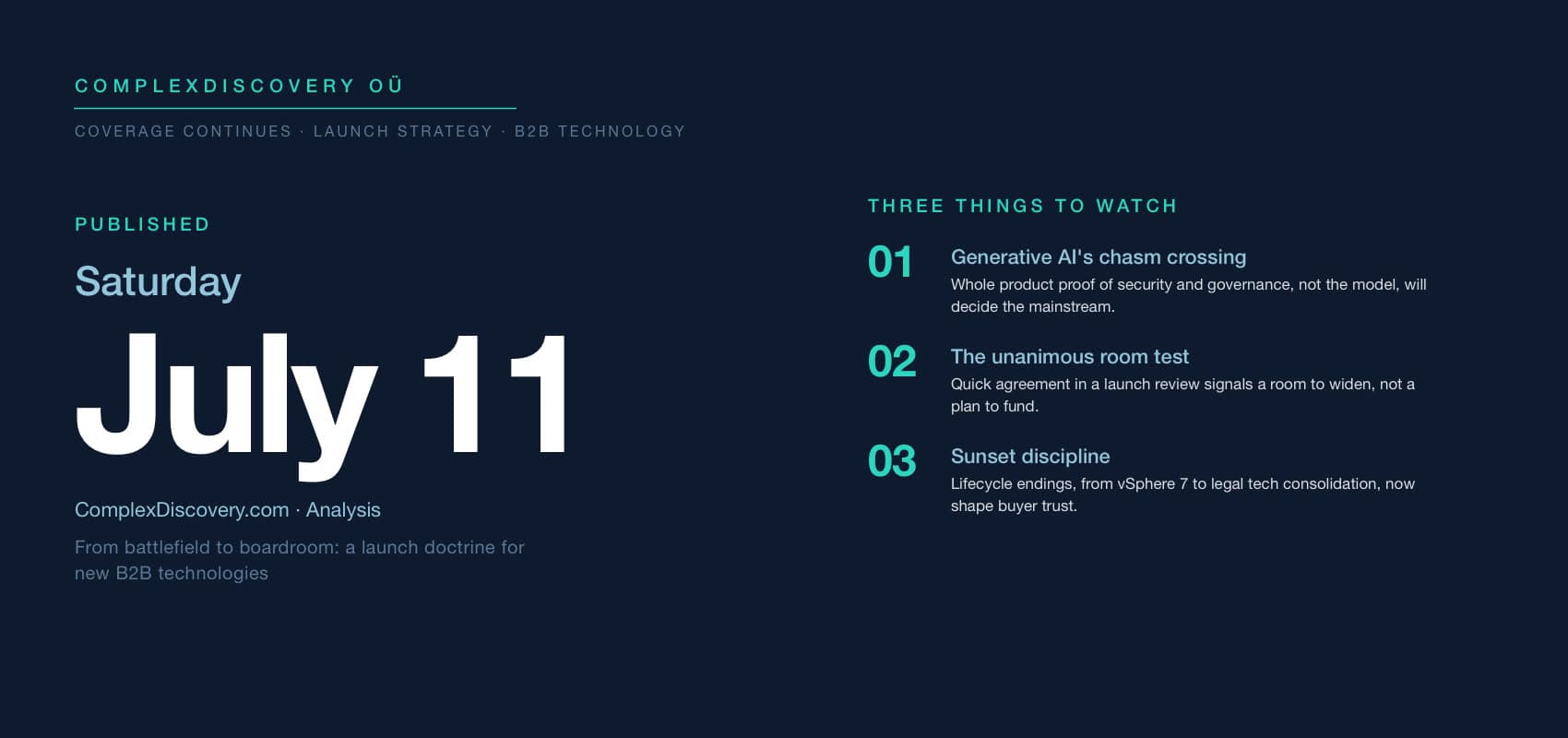
The eDiscovery market has already lived a version of this crossing. Technology-assisted review spent its early years as a visionary experiment championed by a small circle of litigation support pioneers, while the pragmatist majority of law firms and corporate legal departments held back, waiting for proof no vendor pitch could supply. That proof arrived in institutional form when courts began endorsing computer-assisted review as a defensible option in appropriate cases, and judicial acceptance worked in a way consistent with Moore’s model of peer evidence: over the following years the approach became broadly accepted as judicially defensible, even as its actual use remained far from universal, a reminder that judicial acceptance and market adoption are related but distinct measures. Generative AI review tools may now face a comparable transition, as vendors work to convert early enthusiasm into evidence of accuracy, defensibility, and process transparency acceptable to mainstream legal buyers. If anything, the whole product bar sits higher this round: generative AI tools face security, data governance, and confidentiality expectations that earlier analytics never confronted in the same form, which makes the whole product, not the underlying model, the likely deciding ground of the crossing.
Moore has said the chasm framework remains, three decades on, fundamentally a B2B model, and he limits it to discontinuous innovations that force buyers to change behavior; incremental improvements face no chasm because the behavior already exists. The framework has critics: Rogers himself questioned whether a chasm between adopter categories exists at all, saying past diffusion research showed no support for a gap between adopter groups, a reminder that the chasm is a practitioner’s heuristic rather than settled diffusion science. The framework’s intellectual provenance has also been disputed, with independent corroboration of the competing account limited. Whatever the historical resolution, the practical distinction survives the dispute: mainstream B2B buyers demand different evidence than early enthusiasts, and planning for that transition may materially improve a vendor’s prospects. For the founders and dreamers in the audience, the sequence carries one further lesson. The early market runs on belief, and selling a dream to buyers who want one is honest work. The mainstream runs on evidence, and the discipline lies in knowing the moment the currency changes.
Lifecycle discipline from first customer to graceful exit
Product lifecycle management supplies the instrumentation that keeps the sequence honest. The classic four stages of introduction, growth, maturity, and decline map cleanly onto business phases: validation with design partners and lighthouse accounts, scale through a repeatable sales motion, defense of won accounts through retention and expansion, and finally renewal or an orderly exit. Each stage transition should be a decision gate tied to evidence rather than the calendar, with entry and exit criteria defined before the launch, not negotiated during it.
The neglected end of the lifecycle deserves particular attention. In a paper whose title borrows from Hemingway, “The Sun Also Sets: Ending the Life of a Software Product,” Slinger Jansen, a software production researcher at Utrecht University, and his co-authors observed that sunsetting has been a blind spot in software product management literature despite its operational complexity. The Pragmatic Institute, a product management training firm, recommends planning for product retirement as early as the concept phase. Merger-driven portfolio overlap is a common retirement trigger, the firm notes, a dynamic familiar to buyers across the consolidating legal technology market. Recent history shows why sunset execution matters. After Broadcom’s acquisition of VMware, Broadcom’s lifecycle notice set the end of general support for the widely deployed vSphere 7 platform, and the law firm Pillsbury Winthrop Shaw Pittman argued in a client analysis that the deadline, combined with changes to bundles and licensing models, exposed some customers to compressed migration decisions and unplanned costs. Vendors that publish end-of-life policies, provide migration paths, and communicate timelines plainly protect both their customers and their own credibility. In B2B software, the minimum sellable offering also includes artifacts that many consumer products do not require in the same form: security posture documentation, compliance attestations, support service level agreements, and contract terms that survive procurement review. Those are table stakes, not features, and their absence is friction in its purest form, a burden that has grown as buyers subject AI-enabled offerings to expanded security and governance review before adoption.
Startups, enterprises, and the four growth routes
The growth matrix Igor Ansoff introduced in his 1957 Harvard Business Review article, “Strategies for Diversification,” still sorts the market entry options usefully: selling existing offerings deeper into existing markets, taking existing offerings into new geographies or verticals, developing new offerings for the installed base, or diversifying into both a new offering and a new market at once. Each route carries a different resource requirement, and the requirement changes with who is traveling it.
For the startup with a new offering, everything rides on one bet, and the chasm is the defining test of the company’s life. The advantages are real: speed, focus, freedom from portfolio politics, and the ability to build the whole product around a single use case without negotiating with a legacy business. The obligations are equally real. The beachhead must be chosen with evidence rather than ambition, the funding runway must be matched to pragmatist sales cycles that run longer than many pitch decks assume, and the founder’s conviction, the fuel of the early market, becomes a liability at the crossing if it starts to override what the win-loss data says. In an early review of over 100 startup postmortems, the research firm CB Insights found lack of market need among the most frequently cited factors. In a newer analysis of 431 VC-backed shutdowns, CB Insights reported that running out of capital was the most common immediate cause, while poor product-market fit was the leading underlying problem it highlighted. Because the accounts were self-reported and companies could cite multiple reasons, the findings describe recurring themes rather than population-level failure rates, but the pattern still argues for testing demand before betting the runway on it.
For the enterprise adding an offering to an existing portfolio, the natural route is developing new offerings for the installed base, and the head start is genuine: customer trust, distribution, references, and brand permission that a startup spends years assembling. The hazards are internal. Clayton Christensen’s “The Innovator’s Dilemma,” published in 1997, documented how established firms allocate resources toward the demands of their current customers and starve the new offering that serves a market too small to matter yet. Portfolio politics, cannibalization fear, and the quiet pull of the existing revenue line can smother a promising launch without anyone deciding to smother it. Moore addressed the enterprise side of this problem directly in his later book “Zone to Win,” which argues that disruptive bets inside large companies need separate governance, funding, and performance metrics if they are to survive proximity to the core business. And diversification, the double unknown of new offering and new market at once, should be resourced and governed as a new venture rather than a new product line, with its own intelligence estimate, its own beachhead, and its own stop criteria.
One caution applies to every route into occupied territory. Clausewitz observed that defense is the stronger form of contest, and the commercial translation holds: displacing an incumbent requires disproportionate resources, because feature parity alone rarely overcomes switching costs, data gravity, and workflow embedding. The corollary is to design those defenses into a new offering from day one, so that the position, once won, can be held.
The unanimous room: when agreement hides blind spots
Which returns the story to the launch review that opened it. The room was full of capable people, the analysis was internally consistent, and the decision was right by every measure the room could see. That last clause is the problem. A decision made inside a silo can be entirely correct relative to the understanding of the people making it and still be wrong relative to the market, because the market grades against the full picture, not the version the room happened to contain.
The launch failure research keeps arriving at this same door. The AIM Institute, a B2B research firm, argues the leading cause of failed launches is failed customer insight formed years before the launch itself. Market Logic Software, which sells market insight platforms, attributes stubborn failure rates to blind spots that leave organizations with incomplete market understanding despite heavy research investment. And the consultancy Arkaro, reviewing recurring failure patterns across B2B launches, identified collaborative capability gaps among the systemic themes. Each of those sources has a commercial interest in the diagnosis, which is disclosed by naming their businesses here, and the convergence of three commercially aligned voices is suggestive rather than proof. The independent literature, though, points the same direction with more rigor: a meta-analysis by Lisa Troy, Tanawat Hirunyawipada, and Audhesh Paswan, published in the Journal of Marketing in 2008 and covering 25 studies and 146 correlations, found cross-functional integration associated with new product success, while cautioning that the strength of the link depends on how integration is combined with other factors. The association is documented but contingent, not automatic, which matches what Sun Tzu built an intelligence doctrine around: leaders struggle when the picture that reaches them has been narrowed, filtered, or flattered before it arrives.
The remedy is composition before analysis. A launch decision deserves a deciding audience that spans product, marketing, sales, customer success, finance, and, in regulated B2B markets, the legal, security, and compliance voices who know what procurement will actually ask. It deserves win-loss and churn findings delivered raw rather than summarized into comfort. It deserves structured dissent, whether a premortem, a technique research psychologist Gary Klein described in Harvard Business Review, in which the team assumes the launch has failed and works backward to explain why, or a designated challenger whose job is to argue the market’s side of the case. And it deserves a leader who understands that composing the room is a decision that precedes and outranks every decision the room will make. Clausewitz prized the commander’s coup d’oeil, the trained eye that reads a situation at a glance; organizations build the institutional version through after-action reviews, honest retrospectives, and the habit of asking who was not consulted. Quick unanimity is not evidence of alignment. It is a signal to widen the room.
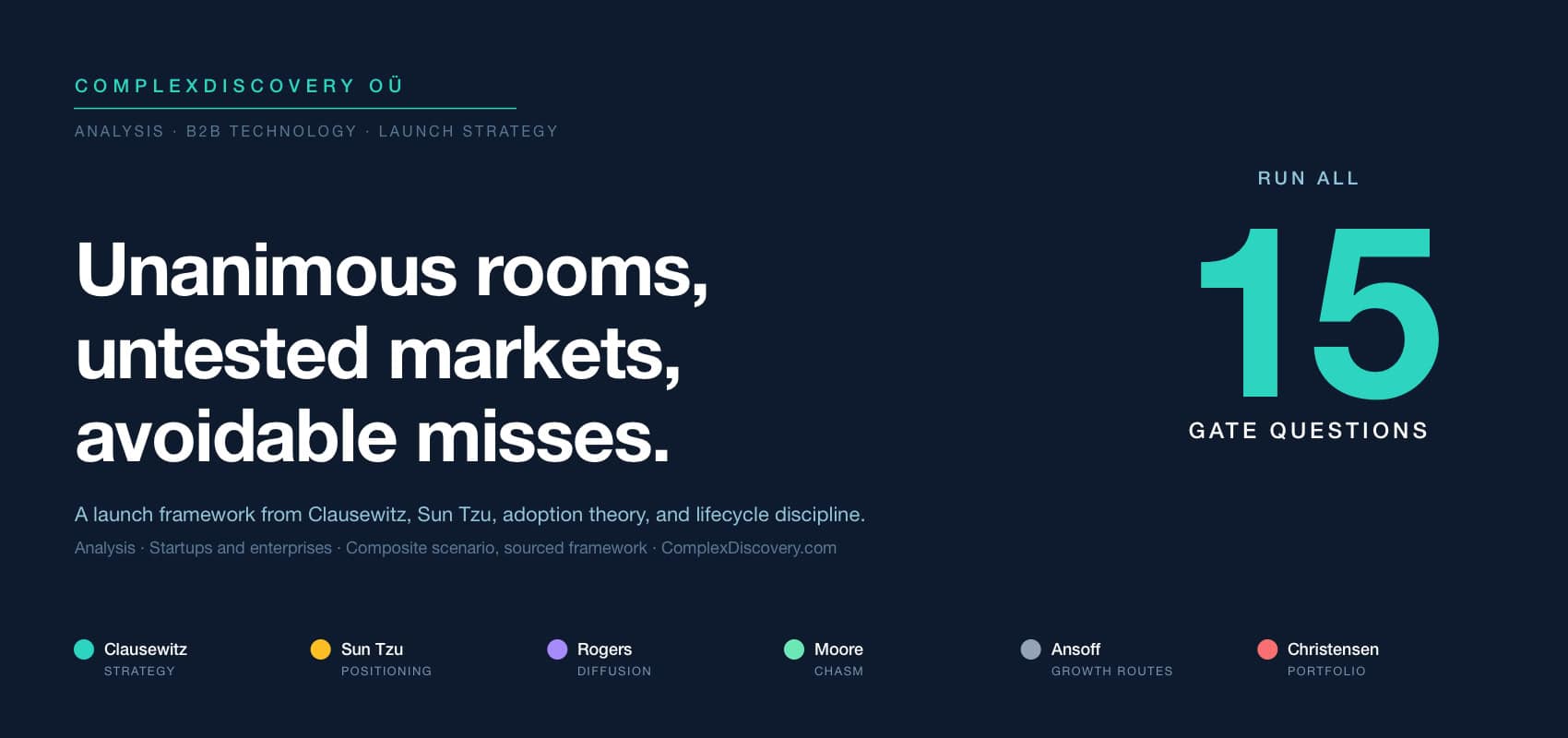
The full doctrine condenses into questions any team can run before committing resources. On strategy: can the team state the launch objective in one sentence, has the market’s center of gravity been identified with evidence, and are stop criteria written down with a named owner? On positioning: has an honest capability audit separated product truth from roadmap narrative, is there a response playbook for each likely incumbent counter, and is the intelligence function of win-loss and churn analysis actually running?
On the adoption curve: which buyer population is purchasing today, what evidence will the next population demand, and is a whole product plan written for the pragmatist segment? On lifecycle: are stage gates tied to evidence, is the minimum sellable offering complete including security and compliance artifacts, and does a sunset and migration policy exist for every offering in the portfolio? And on the room itself: who was in it, who was not, and did the agreement come too easily?
Launch Doctrine 15 Gate Questions
Clausewitz never saw a software contract and Sun Tzu never sat through a procurement review, yet both would recognize a recurring pattern behind failed launches: initiatives pursued without a campaign, campaigns pursued without an objective, and decisions ratified by rooms too narrow to know what they did not know. The framework is available for testing and application, the concepts have endured, and the stakes, mercifully, are only commercial. So the next time a launch review ends in quick and complete agreement, will you read it as alignment, or as a room too small for the decision it just made?
Article sources
- Product launch failure: 7 hidden root causes in B2B (Arkaro)
- Why B2B product commercialization fails and how to fix it (Dreamdata)
- Clausewitz’s center of gravity: changing our warfighting doctrine, again! (Strategic Studies Institute, U.S. Army War College)
- Crossing the enterprise chasm and into the mainstream: lessons from Geoffrey Moore (Unusual Ventures)
- Full transcript for Giant Robots episode 248 with Geoffrey A. Moore (thoughtbot)
- Why Geoffrey Moore’s Crossing the Chasm is a must-read for ambitious startup founders (Greatness)
- The sun also sets: ending the life of a software product (Utrecht University)
- Product EOL and the product life cycle (Pragmatic Institute)
- Lessons from a major software sunsetting: contractual and post-contractual best practices (Pillsbury Winthrop Shaw Pittman, January 2026)
- The centre of gravity concept: contemporary theories, comparison, and implications (Defence Studies)
- B2B product launch: how to get it right (The AIM Institute)
- Understanding product launch failure (Market Logic Software)
- Product launch failure: Arkaro’s 4-step innovation solution (Arkaro)
- The Da Silva Moore case ten years later (eDiscovery Today)
- Cross-functional integration and new product success: an empirical investigation of the findings (Journal of Marketing)
- End of general support for vSphere 7.0 (Broadcom)
- Why startups fail: top reasons (CB Insights)
- The top 20 reasons startups fail (CB Insights)
- Positioning (GeoffreyAMoore.com)
Works referenced
- Carl von Clausewitz, “On War” (1832); Michael Howard and Peter Paret translation, Princeton University Press, 1976.
- Sun Tzu, “The Art of War” (circa fifth century B.C.); multiple English translations consulted in secondary treatment.
- Everett M. Rogers, “Diffusion of Innovations,” Free Press, 1962.
- Geoffrey A. Moore, “Crossing the Chasm: Marketing and Selling High-Tech Products to Mainstream Customers,” HarperBusiness, 1991; third edition, HarperCollins, 2014.
- Clayton M. Christensen, “The Innovator’s Dilemma: When New Technologies Cause Great Firms to Fail,” Harvard Business School Press, 1997.
- Geoffrey A. Moore, “Zone to Win: Organizing to Compete in an Age of Disruption,” Diversion Books, 2015.
- Igor Ansoff, “Strategies for Diversification,” Harvard Business Review 35(5), 1957, pages 113-124.
- Gary Klein, “Performing a Project Premortem,” Harvard Business Review 85(9), September 2007, pages 18-19.
- Lisa C. Troy, Tanawat Hirunyawipada and Audhesh K. Paswan, “Cross-Functional Integration and New Product Success: An Empirical Investigation of the Findings,” Journal of Marketing 72(6), 2008, pages 132-146.
- Slinger Jansen, Karl Michael Popp and Peter Buxmann, “The Sun Also Sets: Ending the Life of a Software Product,” in Software Business: Second International Conference, ICSOB 2011, Brussels, Lecture Notes in Business Information Processing vol. 80, Springer, 2011, pages 154-167.
Assisted by GAI and LLM Technologies
Additional reading
- The Battlefield of eDiscovery: Strategic Considerations for Buyers and Providers in the Digital Age
- From deployment to discipline: AI and governance in the 1H 2026 eDiscovery Business Confidence Survey
- Complete look: ComplexDiscovery OÜ’s 2025 to 2030 eDiscovery market size mashup
- The workstream of eDiscovery: Considering processes and tasks
- Andrew Haslam’s eDisclosure Systems Buyers Guide at 14: What the 1H 2026 update reveals
- A Complete Analysis of the Winter 2026 eDiscovery Pricing Survey
- The M&A Risk of Confusing Market Velocity with Marketing Capability
- Confidence Meets Complexity: Full Results from the 2H 2025 eDiscovery Business Confidence Survey
Source: ComplexDiscovery OÜ

ComplexDiscovery’s mission is to enable clarity for complex decisions by providing independent, data‑driven reporting, research, and commentary that make digital risk, legal technology, and regulatory change more understandable for practitioners, policymakers, and business leaders.