

Editor’s Note: Sentiment and spending just parted ways in the eDiscovery market. The opening installment of our 1H 2026 survey series tracks a 20-point drop in good-conditions readings alongside revenue and profit expectations that barely moved, and it explains why the answer may lie in who took the survey as much as in the market itself.
For professionals across cybersecurity, privacy, compliance, and eDiscovery, the divergence carries budget-season weight. A tactical-heavy respondent pool rated conditions cooler than last autumn’s leadership-heavy pool; receivables are visibly stretching, and yet profit pessimism sits at its lowest point since Fall 2024. Vendor managers, practice leaders, and finance partners will each read a different mandate in those numbers.
This report is Part 1 of a five-part series on the 1H 2026 eDiscovery Business Confidence Survey; a complete-look overview of the full results closes the series.
Content Assessment: Steady money, softer mood: financial outlooks in the 1H 2026 eDiscovery Business Confidence Survey
Information - 94%
Insight - 94%
Relevance - 95%
Objectivity - 93%
Authority - 93%
94%
Excellent
A short percentage-based assessment of the qualitative benefit expressed as a percentage of positive reception of the recent article from ComplexDiscovery OÜ titled, "Steady money, softer mood: financial outlooks in the 1H 2026 eDiscovery Business Confidence Survey."
Industry Research Beat
Steady money, softer mood: financial outlooks in the 1H 2026 eDiscovery Business Confidence Survey
ComplexDiscovery OÜ Staff
Six months ago, eDiscovery professionals delivered the sunniest conditions reading in recent survey memory. This spring, they took most of it back.
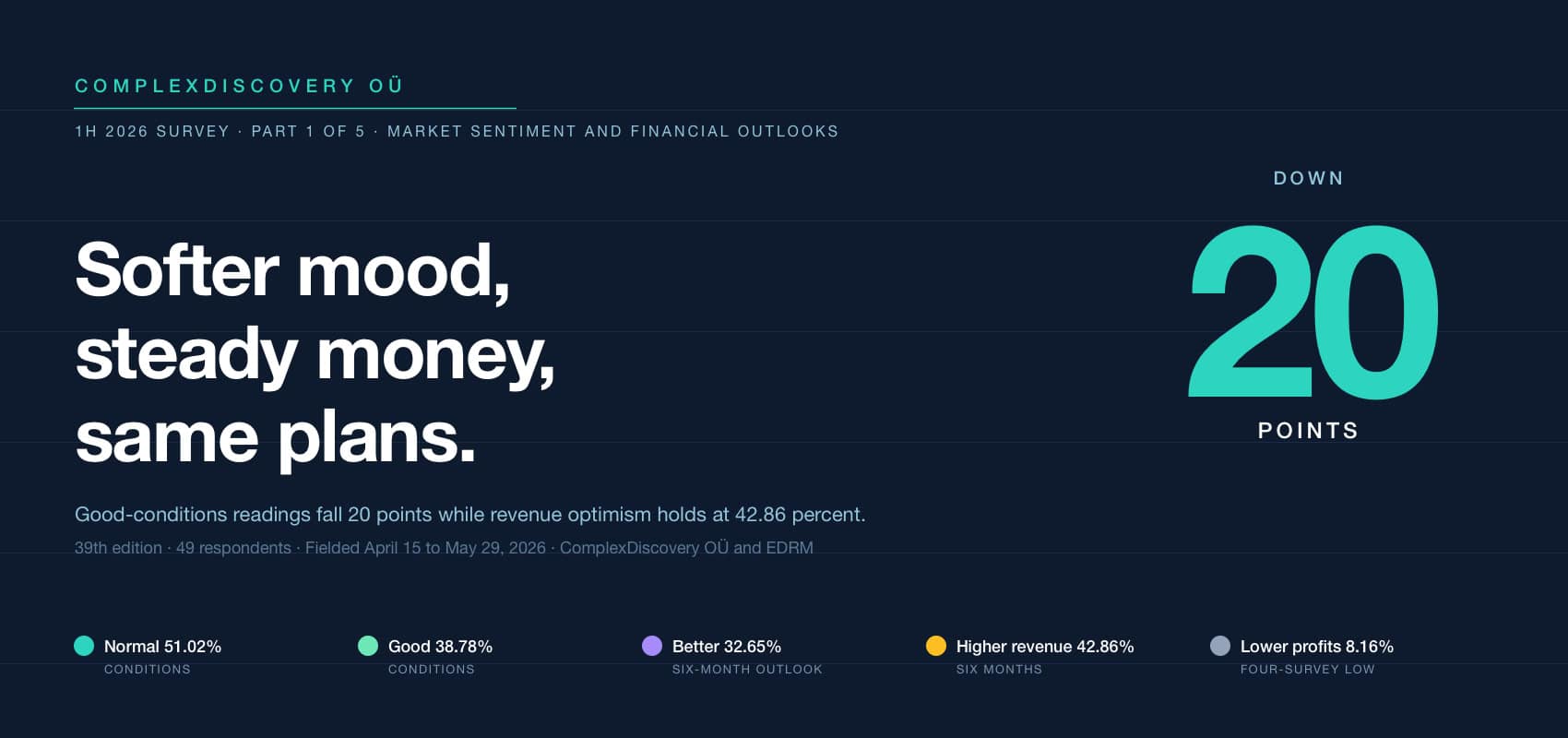
The 1H 2026 eDiscovery Business Confidence Survey, conducted April 15 through May 29, 2026 by ComplexDiscovery OÜ in collaboration with EDRM, finds 38.78 percent of 49 respondents rating current business conditions as good, down from 59.38 percent in the 2H 2025 edition. The share calling conditions bad tripled to 10.20 percent from 3.13 percent, and normal reclaimed the majority at 51.02 percent. The instrument asks each professional to rate “the current general business conditions for eDiscovery” in their own segment, a scope note worth keeping in view: these are readings of each respondent’s corner of the market, not the industry in aggregate. Yet the same respondents kept their revenue and profit expectations essentially intact, a split verdict that says as much about who answered as about what changed.
A different room, a different reading
Survey demographics shifted meaningfully between cycles, and readers should hold that shift in view before interpreting the sentiment drop. Law firms again supplied the largest respondent block at 34.69 percent, with software and services providers at 32.65 percent, consultancies at 12.24 percent, corporations and media or research organizations at 8.16 percent each, and governmental entities at 4.08 percent. Legal and litigation support professionals accounted for 69.39 percent of the pool by function.
Seniority is where the ground moved. Tactical execution roles led at 38.78 percent, followed by operational management at 32.65 percent and executive leadership at 28.57 percent. The 2H 2025 survey drew nearly three-quarters of its respondents from executive and operational ranks. Practitioners closest to processing queues, review deadlines, and collection logistics answered this survey in greater proportion than the leaders who set strategy, and front-line sentiment tends to price in friction that executive sentiment discounts. This cycle’s own cross-tabulation bears that out: none of the 14 executive respondents rated conditions bad, while three of the 19 tactical respondents did. The pool also spread across seven countries, including respondents in the United Kingdom, Canada, Germany, South Africa, South Korea, and India, though 91.84 percent still conduct business primarily in the United States.
Survey Respondents by Organizational Segment 1H26
Survey Respondents by Level of Support 1H26
The seesaw takes shape
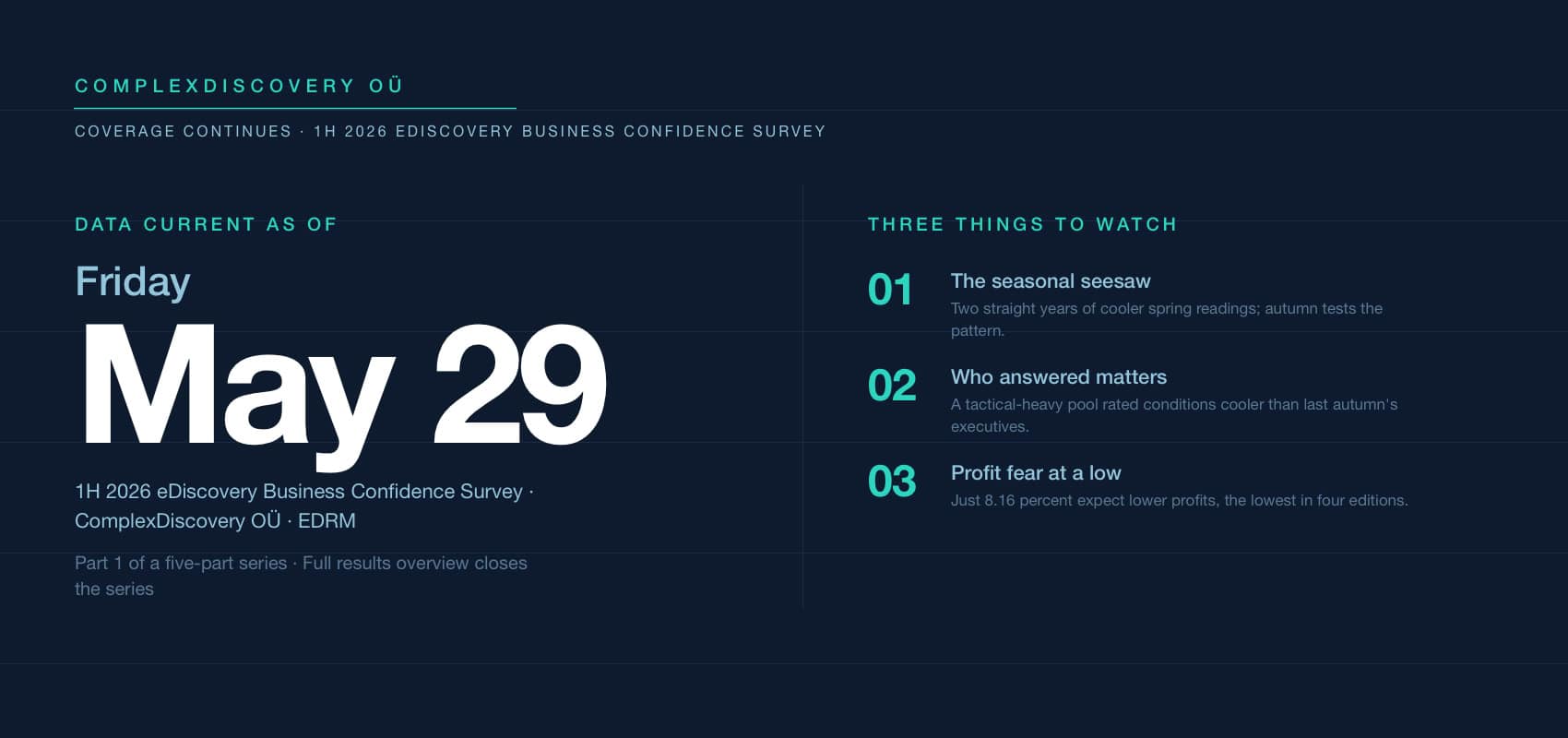
Across the last four editions, good-conditions readings have traced a distinct zigzag: 54.10 percent in Fall 2024, 37.66 percent in 1H 2025, 59.38 percent in 2H 2025, and now 38.78 percent. Bad-conditions readings mirror it, rising each spring to around 10 percent and receding each fall. Two annual cycles are thin evidence for a structural claim, and the survey’s own composition swings complicate the picture, but the pattern invites a practical interpretation: first-half surveys land amid budget resets, matter transitions, and post-holiday collections slowdowns, while second-half surveys catch the industry at full litigation throttle.
Expectations for the coming six months support continuity over correction. Asked how they think business conditions in their segment will look “six months from now,” a majority of 59.18 percent expect conditions to stay the same, 32.65 percent expect better, and 8.16 percent expect worse, a distribution nearly unchanged from 2H 2025, when approximately 58 percent expected the same and 6.25 percent worse. The better camp has held in the low-to-mid 30s for three consecutive surveys after Fall 2024’s exuberant 52.46 percent.
Current Business Climate Overview 1H26
Business Climate Overview + Six Months 1H26
Revenue expectations refuse to blink
The financial outlook questions returned the survey’s most durable numbers. The instrument’s wording is deliberately modest here, asking respondents to “guess” how revenue and profits “in your segment of the eDiscovery ecosystem” will look six months from now; these are informed expectations, not audited forecasts. Respondents expecting higher segment revenue over the next six months came in at 42.86 percent, statistically level with 2H 2025’s 42.19 percent and far above the 31.17 percent recorded in 1H 2025. The lower-revenue camp doubled to 12.24 percent from 6.25 percent, but the growth camp held, meaning the newly pessimistic migrated from the middle rather than from the optimists.
Profit expectations actually improved. The higher-profit share edged up to 38.78 percent from 37.50 percent, while the lower-profit share fell to 8.16 percent from 12.50 percent. This cycle, profit pessimism runs below revenue pessimism, reversing the margin-squeeze signal that ran through the 2H 2025 findings, when twice as many respondents feared falling profits as falling revenue. One reading is that efficiency gains, disciplined hiring, or moderated infrastructure spending are helping protect margins even where top lines flatten, though the survey does not measure those drivers directly.
Leaders planning 2H 2026 budgets can put these numbers to work. A market where 87.76 percent expect flat-or-better revenue supports normal investment cadence, but the tripling of bad-conditions sentiment among front-line respondents argues for watching utilization and matter-intake metrics weekly rather than quarterly, and for pressure-testing pricing on the segments where budget constraints bite hardest.
UPDATE Revenue Overview + Six Months 1H26
Profits Overview + Six Months 1H26
What cooled, and what did not
Read together, the sentiment and financial findings describe a market that has downgraded its mood without downgrading its plans. Conditions feel more ordinary than they did in November, receivables are stretching, with 29.17 percent of respondents reporting slowing payments against 2.08 percent reporting faster ones, and budget pressure ranks near the top of the issue table. But the money questions, revenue, profits, and the six-month outlook, all cluster around stability with a growth tilt, and profit fear sits at its lowest point since Fall 2024.
The survey, now in its 39th edition and tenth year with 3,641 responses collected since 2016, has captured this divergence before; sentiment moves faster than spending in both directions. If the seasonal pattern holds, the 2H 2026 edition should bring warmer readings. If it does not, the front line may have seen something the corner office has not yet priced in. Which signal deserves your budget’s trust this fall: the mood on the floor or the momentum in the forecast?
News sources
- 1H 2026 eDiscovery Business Confidence Survey Launches With Expanded AI and Revenue Focus (ComplexDiscovery)
- Steady Ground, Higher Ground: eDiscovery Business Confidence and Financial Outlooks in 2H 2025 (ComplexDiscovery)
- Confidence Meets Complexity: Full Results from the 2H 2025 eDiscovery Business Confidence Survey (ComplexDiscovery)
- 1H 2025 eDiscovery Business Confidence Survey Results Released by ComplexDiscovery OÜ and EDRM (ComplexDiscovery)
- Optimism and Innovation in eDiscovery: Fall 2024 Business Confidence Survey Insights (ComplexDiscovery)
- EDRM: Empowering the Global Leaders of eDiscovery (EDRM)

Assisted by GAI and LLM Technologies
Additional reading
- Complete look: ComplexDiscovery OÜ’s 2025 to 2030 eDiscovery market size mashup
- The workstream of eDiscovery: Considering processes and tasks (ComplexDiscovery)
- Andrew Haslam’s eDisclosure Systems Buyers Guide at 14: What the 1H 2026 update reveals
- A Complete Analysis of the Winter 2026 eDiscovery Pricing Survey
- The M&A Risk of Confusing Market Velocity with Marketing Capability
- Confidence Meets Complexity: Full Results from the 2H 2025 eDiscovery Business Confidence Survey
Source: ComplexDiscovery OÜ

ComplexDiscovery’s mission is to enable clarity for complex decisions by providing independent, data‑driven reporting, research, and commentary that make digital risk, legal technology, and regulatory change more understandable for practitioners, policymakers, and business leaders.