

Editor’s Note: Many operating leaders will recognize the deal review where the quarter and the strategy give opposite orders, and organizations without an explicit ranking tend to resolve the conflict the same way: whichever gravity is loudest that week wins. The companion article The Unanimous Launch Review Is a Strategic Warning Sign argues that the condition has a name and a doctrine.
Clausewitz counseled reducing centers of gravity to one wherever possible and treating what cannot be reduced as separate ventures. Goodhart’s law explains what can happen when a revenue target is promoted to a job it cannot hold. Gyroscopic precession, offered explicitly as an analytical device rather than an organizational law, provides the central image for the analysis: pressure that surfaces somewhere other than where it was applied. A counterargument section takes the strongest objection seriously: for public companies and cash-constrained startups, revenue gravity may become externally constrained rather than freely chosen.
The caution from the companion article carries over. Deliberate analysis of this kind belongs inside planning, not outside it, and readers tempted to dismiss the discussion as overthinking should note that the two-gravity wobble is what undeliberated strategy can look like from the inside. The opening scene is hypothetical, drawn from recurring patterns rather than any documented case. Watch for the three-question diagnostic at the end, and especially the second question: Where did last quarter’s pressure surface this quarter?
Content Assessment: A strategy needs one dominant center of gravity
Information - 94%
Insight - 95%
Relevance - 92%
Objectivity - 90%
Authority - 92%
93%
Excellent
A short percentage-based assessment of the qualitative benefit expressed as a percentage of positive reception of the recent article from ComplexDiscovery OÜ titled, "A strategy needs one dominant center of gravity."
Industry Research – Technology Beat
A strategy needs one dominant center of gravity
ComplexDiscovery OÜ Staff
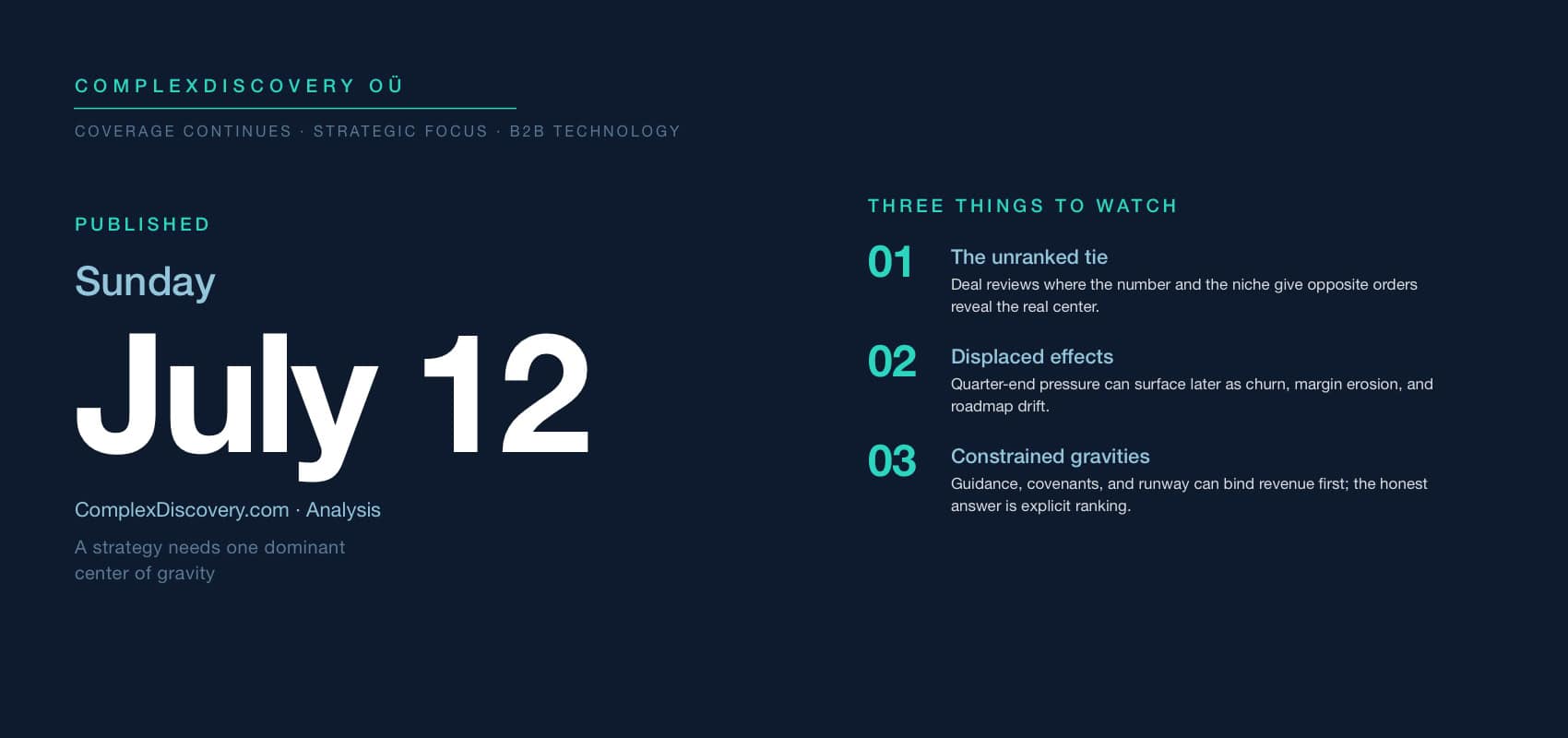
Consider a hypothetical deal review, drawn from recurring patterns across B2B technology rather than from any documented case. The quarter needs one more win, and the pipeline offers one: a large opportunity from a segment the strategy deliberately declined to serve. The revenue plan says take it. The market focus says the custom work will fracture the whole product, dilute the reference base, and stall the mainstream crossing the company spent two years engineering. Both answers are correct by the logic that produced them, which is precisely the problem. The organization is orbiting two centers of gravity, and sooner or later it can obey only one.
This analysis extends the companion article, “The unanimous launch review is a strategic warning sign,” which borrowed Carl von Clausewitz’s center of gravity for commercial use: the focal point that holds a system together, in the reading Antulio Echevarria II developed for the U.S. Army War College. That reading is influential but not uncontested; Eystein L. Meyer’s survey of contemporary theories in Defence Studies shows the concept’s definition remains in genuine doctrinal dispute, and this analysis adopts Echevarria’s version as its working lens rather than as settled scholarship.
The companion article pointed the concept outward, asking which single point in the market the strategy depends on most, so resources can concentrate against it. This analysis turns the concept inward and asks a harder question: what is the focal point inside the company, and what happens when there are two candidates for the job?
One caution travels with the borrowing, here as in the companion analysis. Business is not war, and the gyroscope that appears later in this analysis is an analytical device, not a demonstrated law of organizations. What the metaphors offer is structure: a disciplined way to think about why organizations chasing two focal points at once can experience effects that arrive late, surface in the wrong department, and compound with every correction. The two candidates deserve names first.

Two pretenders to the same throne
This analysis distinguishes two ideal types that can compete inside a technology company, often without anyone consciously choosing between them. In a revenue-gravity company, the thing that holds the system together is the number. The quarterly target organizes the pipeline reviews, the compensation plans, the board narratives, and eventually the product roadmap, because whatever closes deals gets built. In a focus-gravity company, the thing that holds the system together is a chosen offering-and-market intersection: the beachhead segment, the whole product built for it, and the reference base accumulating within it, the discipline Geoffrey Moore’s chasm framework prescribes.
Each gravity produces coherent behavior on its own terms, and that internal coherence is what makes the condition hard to see from inside. The trouble emerges at decision points where the two issue opposite orders. The revenue gravity says take the off-segment deal that makes the quarter, discount to close, and staff the custom work. The focus gravity says decline the deal, hold the price that signals category position, and spend the engineering quarter deepening the whole product. Clayton Christensen’s resource-allocation framework in “The Innovator’s Dilemma” helps explain the institutional version of this pull: allocation tends to follow the revenue that current customers represent, and a strategic bet can be starved without anyone explicitly deciding to starve it. A company that has not chosen between them rarely splits the difference. It tends to obey whichever gravity is loudest that week, and the strategy risks becoming the residue of the deal calendar.
One dominant center, or two honest strategies
Clausewitz’s framework offers a close analogy for that unranked condition, and his prescription was unusually direct. In the war plans book of “On War,” he advised reducing the enemy’s power into “as few centres of gravity as possible,” and into one if it could be done, in the 1873 Graham translation; the Howard and Paret rendering likewise makes tracing centers of gravity back to a single one the first task in planning for war. Echevarria’s monograph stresses the same discipline from the original German: trace the full weight of force to as few centers as possible. Where the reduction to one center cannot be made, Clausewitz concluded, the conflict is better understood as two separate wars, each with its own objective.
The commercial translation is both uncomfortable and clarifying. Within this framework, an organization claiming two centers of gravity has ranked neither, and what it holds in practice is an oscillation; its strategy documents describe a company that does not exist on any given Tuesday. The resolution is a hierarchy rather than compromise. For a single-market growth strategy, the kind the companion analysis maps, this analysis treats the offering and market focus as the center of gravity, because it is the thing that gives every other activity coherence: what to build, whom to reference, where to price, which deals to decline. The revenue target is instrumentation, the gauge that reports whether the gravity is working and when the plan needs revision. Gauges matter; instrument flying depends on them. But no pilot confuses the altimeter with the destination, and the deal review that opened this analysis resolves in one sentence once the hierarchy is explicit: the deal is evaluated by what it does to the focus, not by what it does to the quarter.
Goodhart’s law and the promoted metric
A named principle explains what happens when the hierarchy inverts. The economist Charles Goodhart observed in 1975 that statistical regularities tend to collapse once pressure is placed on them for control purposes, an observation drawn from monetary policy, where indicators that reliably tracked inflation stopped tracking it after central banks adopted them as targets. The anthropologist Marilyn Strathern later gave the principle the phrasing most people quote, in a 1997 paper on audit culture in British universities: “When a measure becomes a target, it ceases to be a good measure.” Goodhart himself has credited her generalization.
A revenue target promoted to center of gravity risks becoming Goodhart’s law running at company scale. The number can stop measuring the business and start deforming it: discounting concentrating at quarter’s end, off-segment custom work colonizing the roadmap, a reference base filling with customers the whole product was never built for, and a metric that once reported strategic health reporting mainly the organization’s skill at feeding it. The pattern need not involve fraud or deliberate misconduct; it can arise from rational, lawful responses to the incentives leadership created, which is why the risk of distortion is predictable and recurring. The gauge was asked to be the destination, and it obliged.
Rigidity, precession, and the widening wobble
The physics of spinning bodies offers two behaviors that map onto the two company conditions described above, and both are standard fare in aviation training literature. The first is rigidity in space: a body spinning around a single axis resists forces that would change its orientation, with resistance that grows with the rotor’s angular momentum, a function of rotational speed and how its mass is distributed. That is the reward of one center of gravity. A company aligned around a single focus, hit by a competitor’s price cut, a lost lighthouse account, or a bad quarter, can wobble and right itself, because every function is already oriented to the same axis and knows which corrections are in bounds.
The second behavior is gyroscopic precession, and it is the more illuminating of the two. As flight training handbooks and pilot associations describe it, a force applied to a spinning body does not produce its maximum effect at the point of application; in the simplified gyroscopic model, the response appears approximately 90 degrees around the plane of rotation, in the direction of spin. Push on one point of the spinning disc and the movement appears a quarter turn away. Helicopter rotor-control systems account for this phase relationship by placing control inputs ahead of the desired response; simplified training explanations commonly describe the offset as approximately 90 degrees. One boundary matters before borrowing further: that 90-degree displacement is spatial, not temporal. The suggestion that organizational consequences emerge quarters later is a separate analytical analogy layered onto the image, not a prediction derived from the physics.
Translated carefully, and again as device rather than law, the borrowed image describes something many operating executives will recognize: pressure applied to an organization often produces its effect somewhere other than where the pressure lands, and often on a delay. Leadership leans on the number in the third quarter, discounting and admitting off-segment deals, and the effect may not appear as third-quarter revenue health. It can surface quarters later and departments away, as churn among customers the product was never meant for, as margin erosion the pricing team inherits, as a roadmap bent toward one large account, as a reference base that confuses the next prospect. Push on pipeline volume and the strain can emerge in customer success. Push on price and it can emerge in product. When the effect is displaced and delayed, the org chart tends to assign the symptom to the wrong owner and treat it with a second push.
The dual-gravity company can experience this as a widening oscillation. A correction made in service of one gravity can create strain on the other, prompting a harder counter-correction, which displaces further: sales pressure bends the product, product discipline reasserts itself and the quarter is missed, and the miss produces more sales pressure. The cycle can widen until leadership either re-chooses a single axis or the oscillation overwhelms the strategy. If that happens, the result may later be recorded as a strategy that failed, when what may actually have failed was the decision to have one.
When revenue is the binding constraint
The strongest counterargument deserves the floor before the close, because revenue is not always instrumentation, and for some companies it cannot be. A public company operates under fiduciary obligations and may issue guidance that shapes market expectations and heightens disclosure risk, while debt covenants or liquidity requirements can make near-term financial performance a binding constraint; a cash-constrained startup nearing the end of its runway faces a similar constraint for survival reasons. In those situations, revenue gravity may become externally constrained rather than freely chosen. The off-segment deal has honest defenses of its own: sometimes the large out-of-profile customer is not a distraction but a discovery, early evidence of a better market than the one in the plan, and sometimes custom work finances product development the focused strategy could not otherwise afford. And diversified enterprises legitimately run several strategies at once, funding an emerging bet from a mature line.
The framework’s answer to each of these is not denial but disclosure, and it echoes both Clausewitz’s separate-wars condition and the governance separation Geoffrey Moore’s “Zone to Win” prescribes for enterprises. Where one center cannot lead, declare the condition explicitly: rank the priorities for the period the constraint governs, treat a genuinely promising off-segment deal as a deliberate strategy question rather than a quarter-end reflex, and give distinct ventures distinct governance rather than letting an undeclared tie be broken deal by deal. The failure mode this analysis targets is not the company that consciously ranks revenue first for a defined season under a binding constraint. It is the company that never ranked at all.
Three questions to find your axis
How does a leadership team learn which company it is? The diagnostic condenses to three questions in the companion piece’s idiom. First, when your revenue target and your market focus last gave opposite orders in a deal review, which one won, and who decided, because the honest answer names your actual center of gravity regardless of what the strategy document claims. Second, where did last quarter’s applied pressure surface this quarter, because tracing one pressure-and-effect cycle through your own organization is the fastest way to make the displacement visible and to reassign symptoms to their true causes. Third, does your company describe itself by its number or by its market, because the language of self-description is where the real gravity hides in plain sight.
one-center-of-gravity-three-questions
The companion analysis argued that a launch review reaching quick unanimity is a room too small for its decision. The two-gravity company is the same failure at a larger scale: internal logic, locally coherent, mistaken for market truth, with the correction arriving late and landing somewhere unexpected. Clausewitz’s counsel scales down without losing its edge. Reduce to one center if it can be done, and if it cannot, admit that you are running two ventures and resource them honestly as two. So the next time the number and the niche give opposite orders, which will your organization obey, and did anyone decide that in advance?
Article sources
- On War, Book 8, Chapter 9 (Graham translation, 1873) (ClausewitzStudies.org)
- On War, Book 8, Chapter 4 (Graham translation, 1873) (ClausewitzStudies.org)
- Reference compilation of On War passages in the Howard and Paret rendering (Clausewitz.com)
- Clausewitz’s center of gravity: changing our warfighting doctrine, again! (Strategic Studies Institute, U.S. Army War College)
- The centre of gravity concept: contemporary theories, comparison, and implications (Defence Studies)
- Gyroscopic precession (Aircraft Owners and Pilots Association)
- Gyroscopic flight instruments (SKYbrary)
- The unanimous launch review is a strategic warning sign (companion analysis) (ComplexDiscovery OU)
- Complete look: ComplexDiscovery OU’s 2025 to 2030 eDiscovery market size mashup (ComplexDiscovery OU)
- Reliance on metrics is a fundamental challenge for AI (Cell Press)
Works referenced
- Carl von Clausewitz, “On War” (1832); Michael Howard and Peter Paret translation, Princeton University Press, 1976 (modern standard English edition); J.J. Graham translation, 1873 (public domain, used for verbatim quotation).
- Charles Goodhart, “Problems of Monetary Management: The U.K. Experience” (1975); the principle restated in his entry in The Encyclopedia of Central Banking (2015).
- Marilyn Strathern, “Improving Ratings: Audit in the British University System,” European Review 5(3), 1997.
- Geoffrey A. Moore, “Crossing the Chasm,” HarperBusiness, 1991; third edition, HarperCollins, 2014.
- Clayton M. Christensen, “The Innovator’s Dilemma,” Harvard Business School Press, 1997.
- Geoffrey A. Moore, “Zone to Win: Organizing to Compete in an Age of Disruption,” Diversion Books, 2015.
- David Manheim and Scott Garrabrant, “Categorizing Variants of Goodhart’s Law,” arXiv preprint, 2018.
Assisted by GAI and LLM Technologies
Additional reading
- The unanimous launch review is a strategic warning sign
- The Battlefield of eDiscovery: Strategic Considerations for Buyers and Providers in the Digital Age
- From deployment to discipline: AI and governance in the 1H 2026 eDiscovery Business Confidence Survey
- Complete look: ComplexDiscovery OÜ’s 2025 to 2030 eDiscovery market size mashup
- The workstream of eDiscovery: Considering processes and tasks
- Andrew Haslam’s eDisclosure Systems Buyers Guide at 14: What the 1H 2026 update reveals
- A Complete Analysis of the Winter 2026 eDiscovery Pricing Survey
- The M&A Risk of Confusing Market Velocity with Marketing Capability
- Confidence Meets Complexity: Full Results from the 2H 2025 eDiscovery Business Confidence Survey
Source: ComplexDiscovery OÜ

ComplexDiscovery’s mission is to enable clarity for complex decisions by providing independent, data‑driven reporting, research, and commentary that make digital risk, legal technology, and regulatory change more understandable for practitioners, policymakers, and business leaders.