

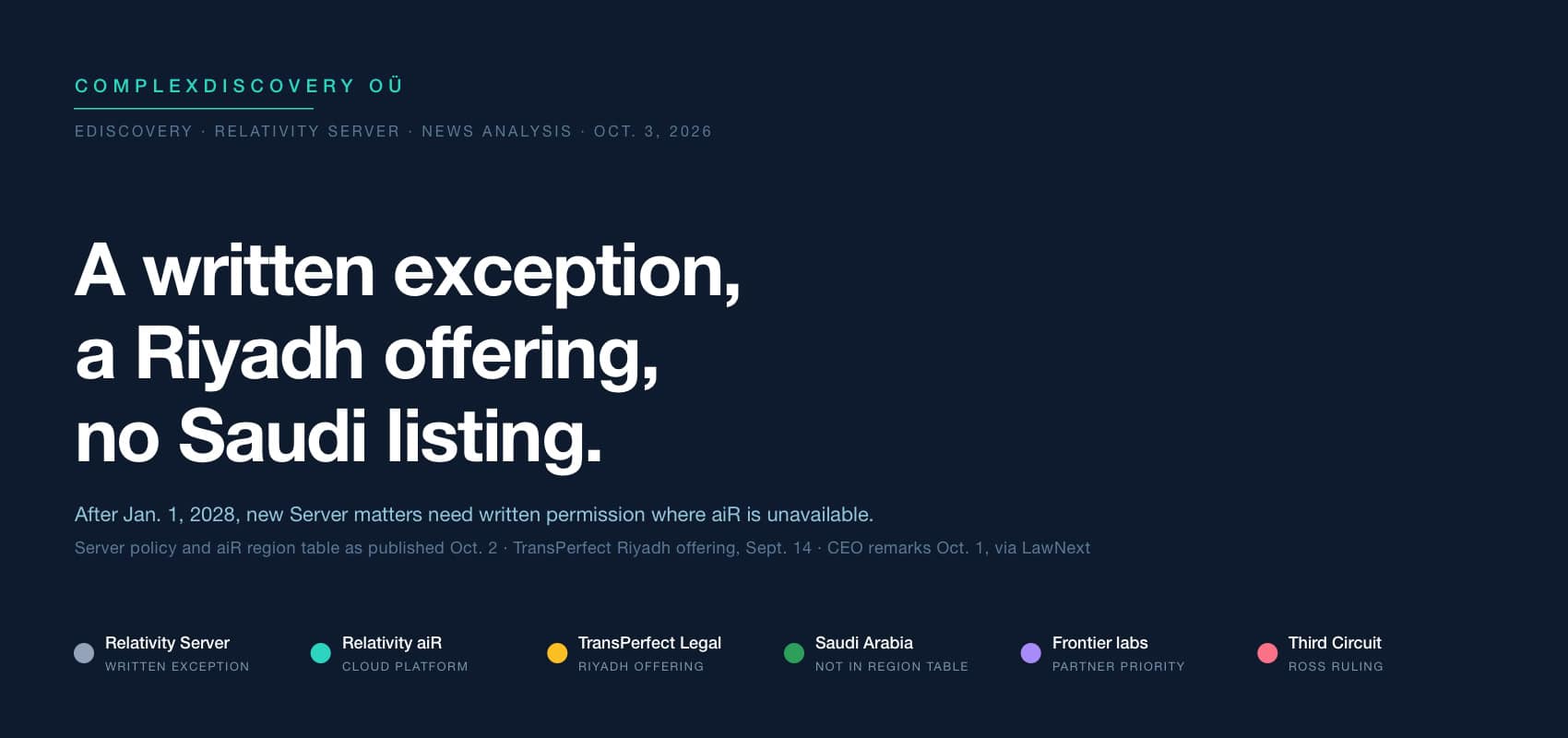
Editor’s Note: TransPerfect Legal launched an in-country eDiscovery offering in Riyadh in September that includes Relativity Server, in a country Relativity’s cloud region table, as published Oct. 2, does not list. Relativity’s written policy allows new Server matters after Jan. 1, 2028, only with the company’s written permission where its cloud platform, Relativity aiR, is unavailable. On Oct. 1, Relativity’s chief executive said the cutoff stands and that the company makes “a lot less money” on its cloud than on Server.
For eDiscovery providers, the exception clause and Server version support dates set the calendar. For corporate legal, information governance, privacy and security teams, Relativity’s own documentation raises two contract questions: how aiR Units and thresholds define “included” AI, and where AI inference runs relative to where data is stored.
Watch how Relativity applies written exceptions as 2028 approaches, whether its published region table adds an in-Kingdom aiR instance, and how renewal terms describe AI allotments.
Disclosure: ComplexDiscovery founder and managing editor Rob Robinson is also chief marketing officer of HaystackID, an eDiscovery and legal technology services provider that competes with TransPerfect Legal and works with Relativity’s platforms. HaystackID had no role in the reporting, editing or review of this article.
Content Assessment: Relativity's 2028 Server exception meets a Riyadh deployment in a country its cloud region table does not list
Information - 92%
Insight - 91%
Relevance - 94%
Objectivity - 90%
Authority - 90%
91%
Excellent
A short percentage-based assessment of the qualitative benefit expressed as a percentage of positive reception of the recent article from ComplexDiscovery OÜ titled, "Relativity's 2028 Server exception meets a Riyadh deployment outside its cloud region table."
News Analysis – eDiscovery Beat
Relativity’s 2028 Server exception meets a Riyadh deployment outside its cloud region table
ComplexDiscovery OÜ Staff
TransPerfect Legal launched an eDiscovery offering in Riyadh running Relativity Server in September, about 15 months before Relativity closes Server to most new matters and in a country its cloud region table does not list.
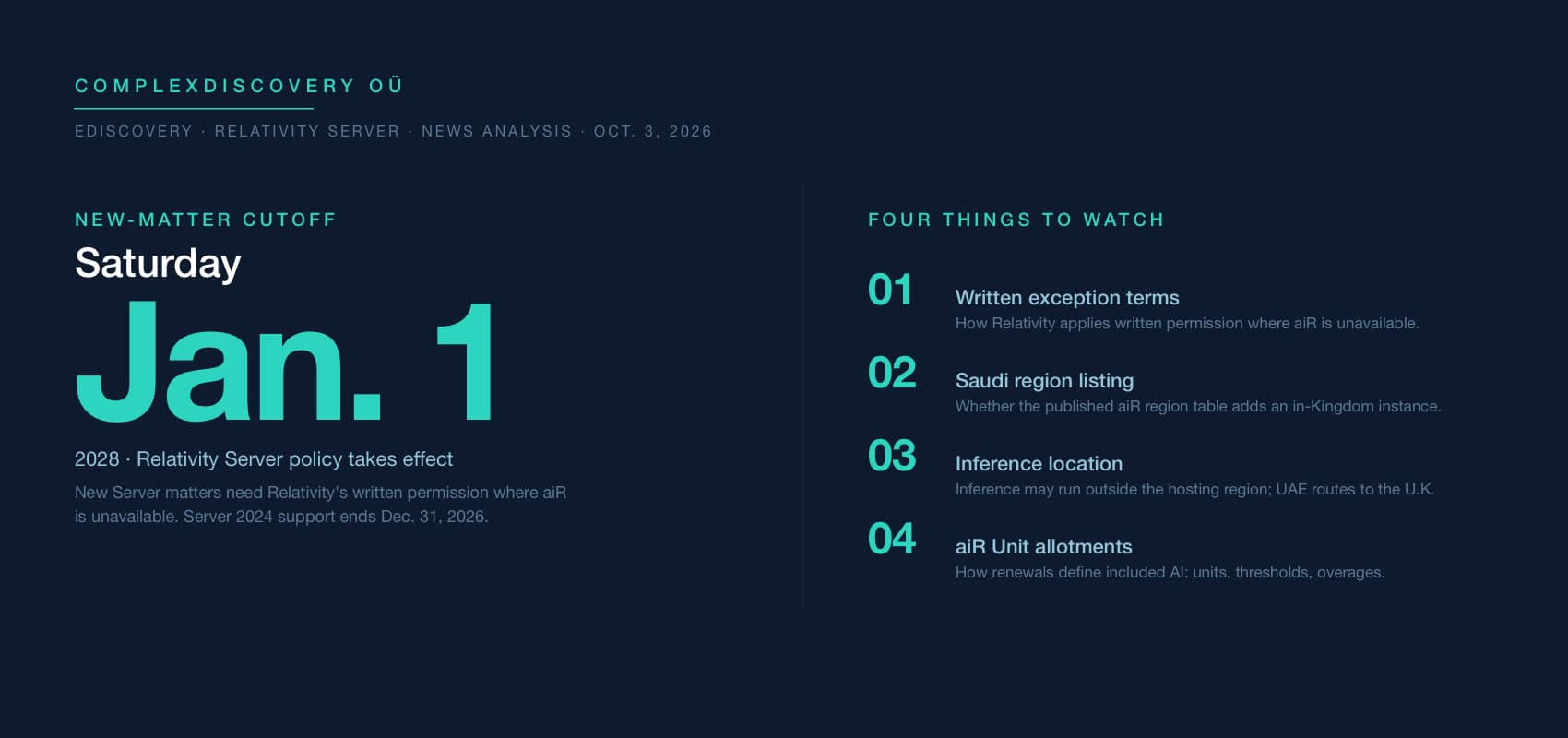
Relativity’s written policy allows new Server matters after Jan. 1, 2028, only with the company’s written permission where its cloud platform is unavailable. On Oct. 1, Relativity Chief Executive Phil Saunders said the 2028 cutoff stands, and he added that the company makes “a lot less money” on its cloud than on Server.
Saunders spoke at a media briefing on the final day of Relativity Fest in Chicago, alongside President Chris Brown, according to an account published Oct. 2 by Bob Ambrogi of LawNext’s LawSites. Every quotation from the briefing in this article comes from that account. Asked by Ambrogi whether the company still stood behind the cutoff first set in January 2025, Saunders answered, “Yes.” He then drew the line precisely. “The policy is not to end the life of Server,” he said. “The policy is to make sure that no net new matter is going to Server effective Jan. 1.”
Riyadh raises the exception question
The exception sits in the policy’s own text. Relativity’s Server support page says that after Jan. 1, 2028, customers may not create new workspaces or new matters, or repurpose existing workspaces, in Relativity Server, “Except as otherwise specifically permitted by Relativity in writing where Relativity aiR is not available for use by a customer.” Relativity aiR is the cloud platform formerly called RelativityOne, renamed on Sept. 16 with the name the company had used for its AI tools.
The policy’s wording has shifted since Saunders announced it in a Jan. 23, 2025, blog post. That post described “limited geographical and use case exceptions,” said Server matters created on or before Dec. 31, 2027, would continue to be supported, and applied the cutoff to matters created “on or after January 1, 2028.” The current support page says “after 1 January 2028,” so the two wordings differ on matters opened on Jan. 1 itself, and Saunders’ “effective Jan. 1” at the briefing tracks the earlier version. A June 2025 company blog post added that exceptions would be made only where regulatory or similar requirements demand them.
Regulatory requirements are also what TransPerfect Legal cites for its Riyadh offering. Its Sept. 14 announcement describes an in-country offering hosted in Riyadh that brings together Relativity Server, Brainspace and TransPerfect’s Reef Discovery. Karim Makhani, general manager for TransPerfect KSA, said in the release that keeping information within the Kingdom matters “not only to satisfy regulatory requirements, but also because our clients expect world-class legal technology delivered locally.” The release does not name a specific statute.
Relativity’s region table offers a public guide to where aiR is available. The platform’s AI documentation lists aiR instance regions in the United States, four European Union countries, the United Kingdom, the United Arab Emirates, Switzerland, Brazil, South Africa, Australia, Canada, four Asian markets and India. Saudi Arabia does not appear in that table as published Oct. 2. Even where an instance is hosted in-region, the page says AI inference “may take place outside the Microsoft Azure region where your Relativity aiR instance is hosted,” and the table, which the page says may change with model availability, routes inference for instances in the United Arab Emirates to the United Kingdom. Instances in Brazil and South Africa send it to the EU Data Boundary. Stored data stays in the selected region, the page says.
Read together, the documents leave an open question for new Saudi matters after Jan. 1, 2028. They could go to Server under the written exception, to an in-Kingdom aiR instance, which the sources reviewed neither list nor rule out, or somewhere else. ComplexDiscovery did not put that question to Relativity or TransPerfect before publication. Counsel running cross-border matters in the region should put it to their providers now, along with a narrower one about where AI inference would run against in-Kingdom data.
Partners and the Server version clock
For partners elsewhere, the support page sets dates that arrive before the policy does. Technical support and critical patches for Server 2024 end Dec. 31, 2026, and Server 2025 support runs 12 months past the Server 2026 release, which the page lists for the fourth quarter of 2026.
Competitors are already marketing to that calendar. Reveal, a rival review platform, published a February post pitching Relativity Server customers on running its platform on their own infrastructure or in private cloud.
Saunders addressed the same calendar from the partner side at the briefing. He described a spectrum, with “super duper aligned” partners already putting new workspaces in the cloud at one end, partners that are “just not aligned” at the other and hybrids that split work between the two. The holdouts, in his account, built their businesses on Server as a capital purchase they depreciate. Relativity has budgeted “credits and money and effort” to help partners shift to an operating-expense model, he said. His message to partners not on board was blunter: “Know we’re going to run through you.”
What “a lot less money” can and cannot mean
Saunders’ remark about cloud economics came in that partner discussion. “We make a lot less money on Relativity aiR than we do on Server, like a lot less,” he said. “But it doesn’t matter. It’s about disrupting yourself to service where the market and business is going.” The LawNext account presents the remark as a statement about the cloud platform.
Saunders did not say which measure he had in mind, and the LawNext account does not say whether he meant revenue per customer, revenue per matter or profit. His own disclosure rules out one reading. He said nearly 84 percent of Relativity’s annual recurring revenue sat in Relativity aiR as of the end of June, so on LawNext’s reading the remark cannot mean the cloud brings in less total recurring revenue. Which measure he did mean remains unstated.
LawNext’s account sets that share beside the figure Relativity cited with its 2025 deadline announcement, above 75 percent. Saunders’ January 2025 post framed the figure as a share “of our business with partners and customers,” while a promotional panel on the same page and the June 2025 post described it in terms of customers who had moved to the cloud. Neither 2025 wording names annual recurring revenue, so the two figures may not measure the same thing.
LawNext reported one more figure from the briefing, separately from the remark: Relativity’s annual research and development spending of over $200 million, a share of revenue Saunders said exceeds what most companies put back. He said the company is over budget this year with the board’s support. Relativity confidentially submitted a draft registration statement for an initial public offering in March, and Saunders said no firm date has been set.
The remark also lands two weeks after the Sept. 16 rebrand. LawNext reported Sept. 16 that the AI capabilities are included in the platform’s current pricing for customers on the 2026 pricing plan. Relativity said in a Sept. 29 release that claiR, its conversational AI interface, is expected to be included in integrated pricing at no additional cost when it reaches general availability in early 2027.
Relativity’s own documentation draws the line more carefully. Its help page on AI products, last updated Oct. 2, says some aiR products and features “may consume aiR Units or incur fees for use of aiR products as explained in a customer’s contract.” A companion page, addressed to customers whose “Relativity aiR subscription includes aiR access and aiR Units,” meters most aiR Review and Privilege work at one aiR Unit per document and points to separate material on thresholds. The same AI page reserves Relativity’s right to rate-limit, queue, prioritize or restrict AI features, which it says depend on shared platform resources and third-party model providers with finite capacity.
Those statements and the “included” framing can both hold, because included access can come with allotments a contract defines. For buyers, the practical reading is that “included” is settled in the contract rather than the announcement. Buyers heading into renewals should get aiR Unit allotments, overage rates and rate-limit terms in writing, and should model their AI-heavy review volumes against those allotments.
Frontier labs first, Harvey and Legora later
The third-party model providers behind those AI features are also where Saunders said Relativity’s partnership priority lies, ahead of legal AI companies. “Our strategy, at least at this point, is to spend a lot of time with the frontier models,” he said, naming Anthropic, OpenAI and Google. “It doesn’t mean that we wouldn’t consider Harvey or Legora, but prioritization is probably at the frontier labs at this point.” LawNext reported his reasoning in two parts: corporate clients say they already use several frontier models, often with Harvey or Legora in the mix, and he considers the labs the safest long-term bet. He said talks with both legal AI companies’ founders continue.
Brown said the intent had always been to go “to the frontier models, frontier labs first.” He said Relativity will open matter intelligence to outside assistants through its MCP connector in 2027, letting a permitted user interrogate a matter from a tool like Claude. Relativity’s documentation already lists Relativity MCP as an interface for AI assistants. It also says aiR currently runs on GPT models, including GPT-4o and GPT-5.2, through Microsoft Azure services.
The stated priority puts connections to general-purpose model makers ahead of alliances with legal AI specialists, and it arrives the same week an appeals court ruled on AI training data. On Sept. 29, the U.S. Court of Appeals for the Third Circuit affirmed a ruling that rejected ROSS Intelligence’s fair use defense for copying Westlaw headnotes to train a legal research tool that returned existing judicial passages rather than generating new text. An Oct. 2 client alert from law firm Ballard Spahr said the panel found harm to a developing market for licensing headnotes as AI training data, and that the opinion leaves the generative AI questions unresolved. On a related training-data point, Relativity’s documentation says data processed by aiR is not used to train third-party models.
Questions to settle before 2028
Whichever models Relativity connects to, the Server calendar is already in writing. For eDiscovery providers, it runs from version support dates to the Jan. 1, 2028, new-matter cutoff, with an exception that requires Relativity’s written permission and applies only where Relativity aiR is not available to the customer. Corporate legal and information governance teams face contract questions, including aiR Unit allotments, the inference location for each hosting region and the exception path for jurisdictions without an aiR instance. Security and privacy teams that run cross-border transfer assessments should add the inference-location table to their data maps, since it can place AI processing in a different country from storage.
Saunders cast making “a lot less money” on the cloud as the cost of disrupting his own business. For providers with matters in Riyadh, or anywhere else Relativity’s cloud table does not list, what will that written permission need to say?
News sources
- Relativity CEO Says 2028 Server Deadline Stands; Will Prioritize Partnering with Frontier Labs Over Legal AI Companies (LawNext)
- RelativityOne Gets A New Name To Reflect Its Increasing Capabilities Around AI and Data (LawNext)
- Server Support Policy (Relativity)
- AI Products and Features in Relativity aiR (Relativity)
- aiR Units in Relativity aiR Standard Workspaces (Relativity)
- At RelFest Chicago, Relativity Announces KPMG and Three Global Law Firms to Join Relativity claiR Advanced Access Program (PR Newswire)
- TransPerfect Legal Launches eDiscovery and Investigations Capabilities in Saudi Arabia (PR Newswire)
- Third Circuit Addresses Fair Use in AI Training, But Leaves Generative AI Questions Unresolved (Ballard Spahr)
- Signed, Sealed, Affirmed: Third Circuit Backs Thomson Reuters over ROSS (Copyright Lately)
- Putting a Nail in the Coffin of Its On-Prem Product, Relativity Sets 2028 Deadline for All New Cases to Move to the Cloud (LawNext)
- Embracing the Future of Legal Data in 2025 and Beyond (Relativity)
- Reach New Heights: Paving the Way for Your Journey to the Cloud (Relativity)
- Relativity Announces Confidential Submission of Draft Registration Statement for Proposed Initial Public Offering (AAP/Cision)
- Relativity Server Sunset: Your On-Prem eDiscovery Path Forward with Reveal (Reveal)

Assisted by GAI and LLM Technologies
Additional reading
- ENISA Threat Landscape 2026 finds DDoS leads incident counts while ransomware stays most impactful in the short term
- Cyber Resilience Act reporting starts Sept. 11 on an unfinished platform
- Europe’s draft cloud rule would put vendor ownership in the audit file
- The eight-hour clock starts today: EU e-evidence orders now land on covered U.S. providers’ EU addressees
- California’s AI Transparency Act arrives alongside Europe’s Article 50
- Federal magistrate judge treats LinkedIn’s Relativity aiR workflow as TAR
- One benchmark, three directions: 2026 legal rates rise, flatten and fall at once
- Confidence cools, commitment holds: full results from the 1H 2026 eDiscovery Business Confidence Survey
- Complete look: ComplexDiscovery OÜ’s 2025 to 2030 eDiscovery market size mashup
- The workstream of eDiscovery: Considering processes and tasks
Source: ComplexDiscovery OÜ

ComplexDiscovery’s mission is to enable clarity for complex decisions by providing independent, data‑driven reporting, research, and commentary that make digital risk, legal technology, and regulatory change more understandable for practitioners, policymakers, and business leaders.