

Editor’s Note: HSR reported transactions stepped back to 193 in June 2026, and the retreat is the least interesting number in this month’s data. The preliminary FY2026 series now totals 1,858 through nine months — 22.3% ahead of the comparable preliminary FY2025 period, and 29.7% ahead of the finalized prior-year figures, two measures that differ because the FY2025 monthly counts were revised downward when finalized.
The FY2025 HSR annual report, released July 2, supplies the baseline: 41 Second Requests at a 2.1% rate, with transactions above $10 billion drawing a 21.1% rate. The macro picture improved on revision, with the BEA’s third estimate lifting first-quarter GDP growth to 2.1% and revising the quarterly increase in corporate profits upward by $34.0 billion, to $74.4 billion. A note on method: monthly HSR counts are preliminary, comparisons are same-vintage unless flagged, and forward-looking figures are planning scenarios rather than forecasts.
For eDiscovery and legal operations leaders, volume at this level, combined with FY2025’s concentration in larger transactions, supports planning for the possibility of a heavier Second Request docket extending into 2027.
Content Assessment: HSR filings ease to 193 in June 2026 as FY2026 sits one month from passing FY2025's full-year total
Information - 93%
Insight - 92%
Relevance - 92%
Objectivity - 93%
Authority - 94%
93%
Excellent
A short percentage-based assessment of the qualitative benefit expressed as a percentage of positive reception of the recent article from ComplexDiscovery OÜ titled, "June HSR reported transactions fall to 193 as preliminary FY2026 total reaches 1,858."
Industry News – Antitrust Beat
June HSR reported transactions fall to 193 as preliminary FY2026 total reaches 1,858
ComplexDiscovery Staff
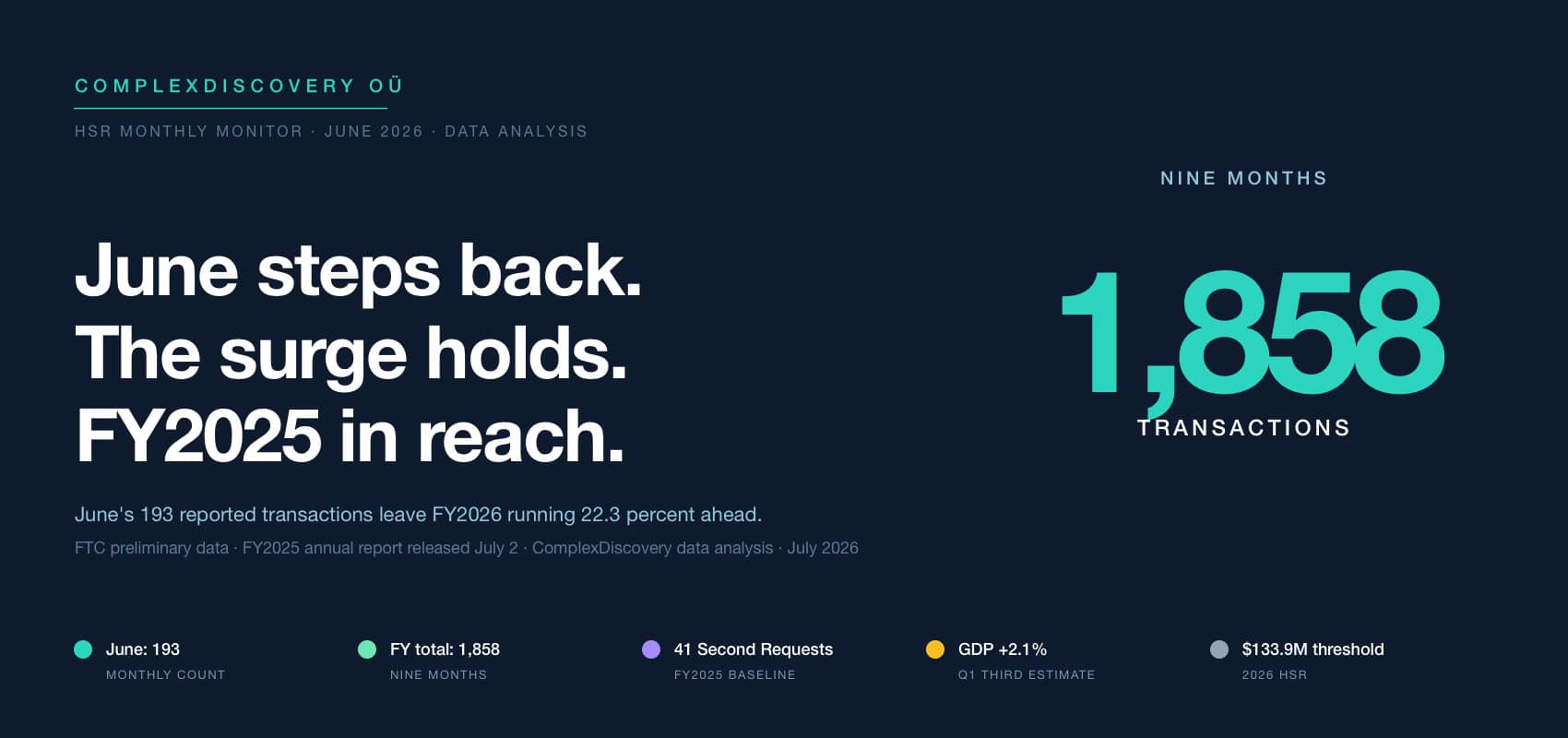
The FTC’s Premerger Notification Office recorded 193 HSR-reported transactions in June 2026, a 17.9% step down from May’s 235 — the highest monthly total since December 2021 — according to preliminary monthly data. The measure counts transactions reported under the Hart-Scott-Rodino Act, not individual party filings, and monthly figures remain preliminary until finalized in the agencies’ annual report. The June pullback does little to change the year’s trajectory: on comparable preliminary data, activity still runs 22.9% above the 157 transactions the same series showed for June 2025.
Nine months in, a lead that holds on either measure
Through the first nine months of FY2026 — October 2025 through June 2026 — the preliminary series totals 1,858 reported transactions, up 22.3% from the 1,519 the same preliminary series showed for the comparable FY2025 period. The finalized FY2025 annual report later trimmed that prior-year October-through-June total to 1,433; measured against the final figure, the current preliminary total runs 29.7% ahead, though that comparison mixes data vintages: the FY2025 final counts were lower than the preliminary series, which makes the mixed-vintage comparison look stronger for FY2026. On either measure, the direction is the same. The monthly average stands at 206, a pace that would yield roughly 2,480 reported transactions for the fiscal year: below FY2021’s 3,520 and FY2022’s 3,152, but above every year since, including FY2024’s 2,031 and FY2025’s 2,006.
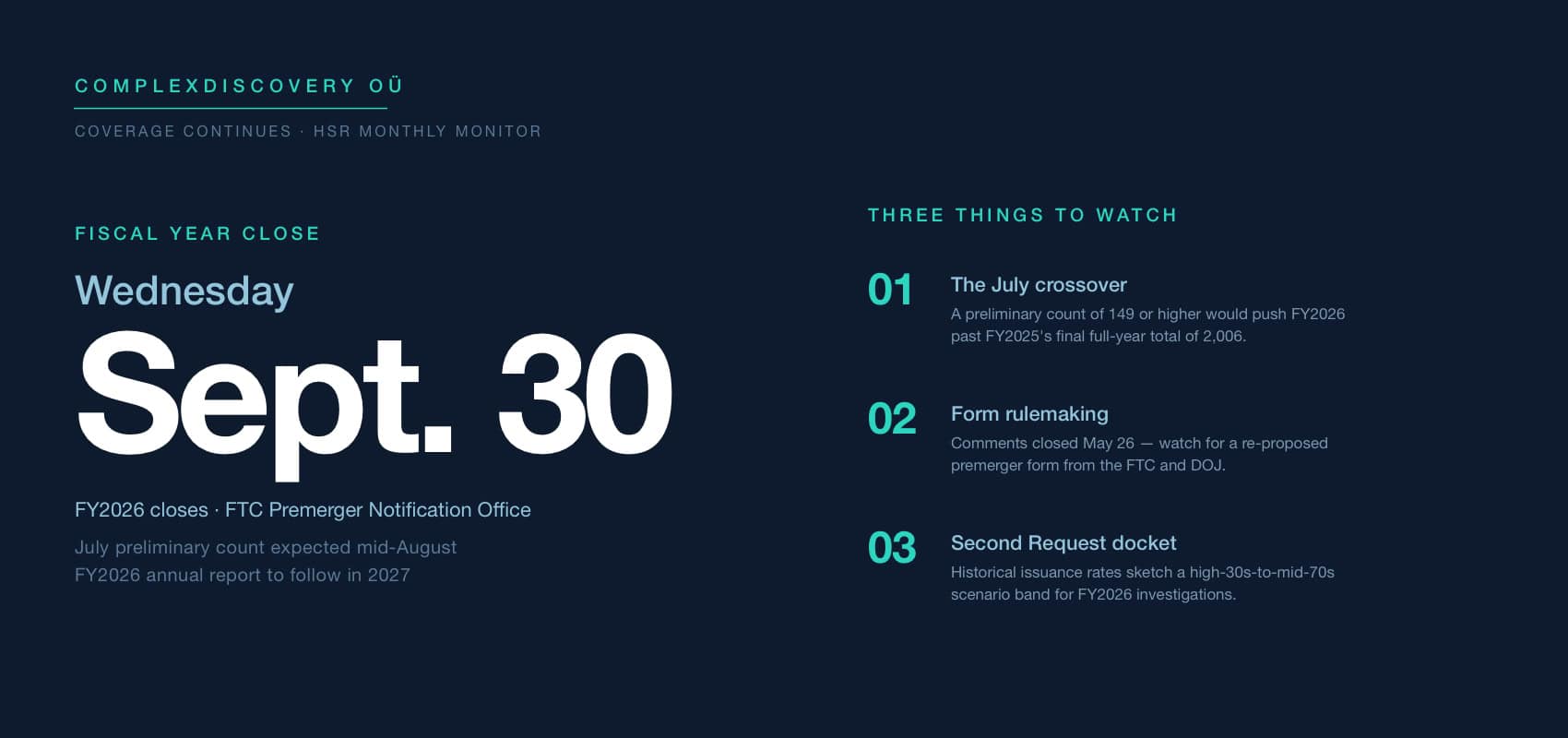
The consistency is the story as much as the level. Every month of FY2026 has posted at least 180 reported transactions on the preliminary series. FY2025, by contrast, swung from a preliminary 230 in February to 89 in March after the expanded reporting form took effect, then spent six months climbing back. The arithmetic ahead is close: a July preliminary count of at least 149 would move FY2026’s running total past FY2025’s final full-year count of 2,006 — although subsequent revisions could change that comparison.
HSR Act Merger Transactions Reported - FY 2026 - June 26
FY2025 annual report resets the Second Request baseline
The FTC and Department of Justice released the FY2025 HSR annual report July 2, and the Premerger Notification Office highlighted it on its site July 6. FY2025 produced 2,006 reported transactions (1,944 adjusted), off slightly from FY2024’s 2,031. The agencies issued 41 Second Requests — 20 from the FTC, 21 from the DOJ Antitrust Division — a 2.1% rate against adjusted transactions, down from 3.0% in FY2024. Deal size skewed large: 31.8% of reported transactions were valued above $1 billion, and aggregate reported deal value reached $2.5 trillion. The size gradient matters most at the very top: the report shows a combined Second Request rate of 2.7% for transactions between $1 billion and $10 billion, jumping to 21.1% — four investigations among 19 adjusted transactions — for deals above $10 billion.
History argues for caution in converting transaction volume into investigation counts. Second Request issuance held between 37 and 66 per year across FY2016 through FY2025 — an average near 51 — even as annual volume swung from 1,637 to 3,520, a pattern suggesting agency capacity and enforcement priorities constrain issuance at least as much as deal flow does. Applying the decade’s issuance rates of roughly 1.6% to 3.0% to a 2,400-to-2,500 transaction year sketches a band from the high 30s to the mid 70s, but the official rates are computed against adjusted transaction counts that are not yet knowable for FY2026, and final adjusted totals, deal mix and agency priorities will determine where the year lands. Treat the band as a planning scenario, not a forecast.
HSR Act Merger Transactions Reported - June - 2000 - 2026
Regulatory watch: A restored form and a pending rulemaking
June activity occurred under a regime in which the HSR form in place before Feb. 10, 2025, was again the standard form — restored March 19, 2026, after the Fifth Circuit declined to stay a federal district court’s February vacatur of the expanded 2025 form — while the agencies have said they will continue to accept voluntary submissions on the 2025 form. The FTC and DOJ closed the public comment period in their joint inquiry on the premerger notification form May 26, and practitioners now watch whether the agencies re-propose expanded disclosure requirements through new rulemaking. The 2026 jurisdictional thresholds remain in effect: under the FTC’s annual adjustment, the minimum size-of-transaction test stands at $133.9 million, effective Feb. 17, 2026, with filing fees topping out at $2.46 million for deals valued at $5.869 billion or above.
An economy sending friendlier signals than a month ago
The macro backdrop looks firmer than it did when May’s numbers were published. The Bureau of Economic Analysis’ third estimate, released June 25, put first-quarter 2026 real GDP growth at 2.1% annualized — revised up half a point from the second estimate’s 1.6% and a marked acceleration from the fourth quarter’s 0.5%. Corporate profits rose $74.4 billion in the quarter, revised up $34.0 billion. The underlying picture stays mixed: real final sales to private domestic purchasers grew just 1.7%, revised down 0.7 percentage point, and the first-quarter PCE price index ran at 4.6%, with the core index at 4.4%.
Monthly data extend the pattern. The BEA’s May personal income and outlays release showed income and spending each up 0.7%, PCE prices up 4.1% from a year earlier (3.4% core), and a personal saving rate of 3.0%. The goods and services trade deficit widened 42.2% in May to $77.6 billion, per the BEA and Census Bureau, as imports climbed 3.3% and exports fell 3.2% — though the year-to-date deficit remains 40.6% below the same period of 2025. The Supreme Court’s February ruling that certain tariffs were unlawful adds a wrinkle: the BEA treats the resulting refunds as a capital transfer with no effect on first-quarter GDP.
Deal value concentrates where scrutiny lives
M&A advisers describe a market of fewer, bigger deals within the transaction populations they track. PwC counted 4,653 U.S. deals worth about $1.2 trillion in the first five months of 2026 — down 4% in volume from 4,851 deals in the same 2025 period, but nearly double that period’s $603 billion in value. The firm counts 39 announced megadeals of $5 billion or more so far in 2026, 50% above the comparable prior-year period. EY-Parthenon reports U.S. deals above $100 million rose 44% in value and 16% in volume year over year from March through May, and forecasts 8% volume growth in 2026 for that above-$100 million segment. Concentration at the top matters for review workloads: FY2025 data show transactions above $10 billion drew Second Requests at 21.1%, roughly ten times the overall rate.
For legal service providers: an analyst’s read
What follows is analysis, not reported fact. The mechanics of the HSR process set the timeline: Second Requests issue during the initial waiting period — typically 30 days, and 15 days for cash tender offers or bankruptcy transactions — so June’s reported transactions help define the pool from which investigations and Second Requests may emerge into late summer, and substantial compliance work typically extends months beyond issuance, pushing associated review work into late 2026 and 2027.
Second Request compliance can produce some of the largest discrete eDiscovery engagements in the market, particularly when substantial collection, review, privilege and production obligations arise — though not every investigation produces a large outsourced review. If FY2026’s docket lands in the upper half of the historical band, more simultaneous engagements would compete for experienced antitrust review teams. The FY2025 size mix, with nearly a third of reported transactions above $1 billion, may increase the likelihood of broader custodian populations or cross-border collection requirements, depending on a transaction’s industry, geographic reach, structure and integration complexity. On pricing: in informal ComplexDiscovery observations of publicly promoted and privately quoted offerings — not a systematic or statistically representative survey — some generative AI review offers have clustered between 26 and 50 cents per document; comparisons with traditional review pricing are not necessarily like-for-like, because hosting, validation, privilege review, project management and production support may be priced separately. The planning takeaway is conditional rather than urgent: providers expecting to compete for this work have nine months of trendline arguing for early decisions on review capacity, hosting headroom and AI workflow validation. Watch three dates: the July count in mid-August, the FTC’s next move on form rulemaking, and the fiscal year close Sept. 30.
If the preliminary series finishes near 2,480 and Second Request issuance lands in the upper half of its ten-year band, is your second-half capacity plan built for that docket — or for the quieter averages of the last three years?





News sources
- Premerger Notification Program (Federal Trade Commission)
- Hart-Scott-Rodino Annual Report for Fiscal Year 2025 (Federal Trade Commission)
- FTC and DOJ Issue Fiscal Year 2025 Hart-Scott-Rodino Annual Report (Federal Trade Commission)
- FTC Announces 2026 Update of Jurisdictional and Fee Thresholds for Premerger Notification Filings (Federal Trade Commission)
- Federal Trade Commission and Department of Justice Seek Public Comment on the Premerger Notification and Report Form (Federal Trade Commission)
- Premerger Notification Program Notice on the Restored HSR Form, March 19, 2026 (Federal Trade Commission)
- Premerger Notification and the Merger Review Process (Federal Trade Commission)
- Order Denying Stay, Chamber of Commerce v. FTC, No. 26-40094 (5th Cir. Mar. 19, 2026) (U.S. Court of Appeals for the Fifth Circuit; docket via Katten Muchin Rosenman LLP)
- Learning Resources, Inc. v. Trump, No. 24-1287, slip op. (U.S. Feb. 20, 2026), consolidated with Trump v. V.O.S. Selections, Inc. (Supreme Court of the United States)
- GDP (Third Estimate), Industries, Corporate Profits, State GDP, and State Personal Income, 1st Quarter 2026 (U.S. Bureau of Economic Analysis)
- Personal Income and Outlays, May 2026 (U.S. Bureau of Economic Analysis)
- U.S. International Trade in Goods and Services, May 2026 (U.S. Bureau of Economic Analysis)
- HSR Filings Hit 235 in May 2026, the Highest Monthly Total Since December 2021 (ComplexDiscovery)
- The Second Request Pulse: What FY2025’s 41 Investigations Signal for FY2026 (ComplexDiscovery)
- FTC Announces Annual Updates to US HSR Thresholds; Highest Filing Fees Now $2.46 Million (White & Case LLP)
- US Deals 2026 Midyear Outlook (PwC)
- M&A Activity Insights: May 2026 (EY-Parthenon)
Assisted by GAI and LLM Technologies
Additional Reading
- HSR Act Reporting: A ComplexDiscovery Chronology
- FTC Annual Competition Reports (Hart-Scott-Rodino Act Reports)
Source: ComplexDiscovery OÜ

ComplexDiscovery’s mission is to enable clarity for complex decisions by providing independent, data‑driven reporting, research, and commentary that make digital risk, legal technology, and regulatory change more legible for practitioners, policymakers, and business leaders.