

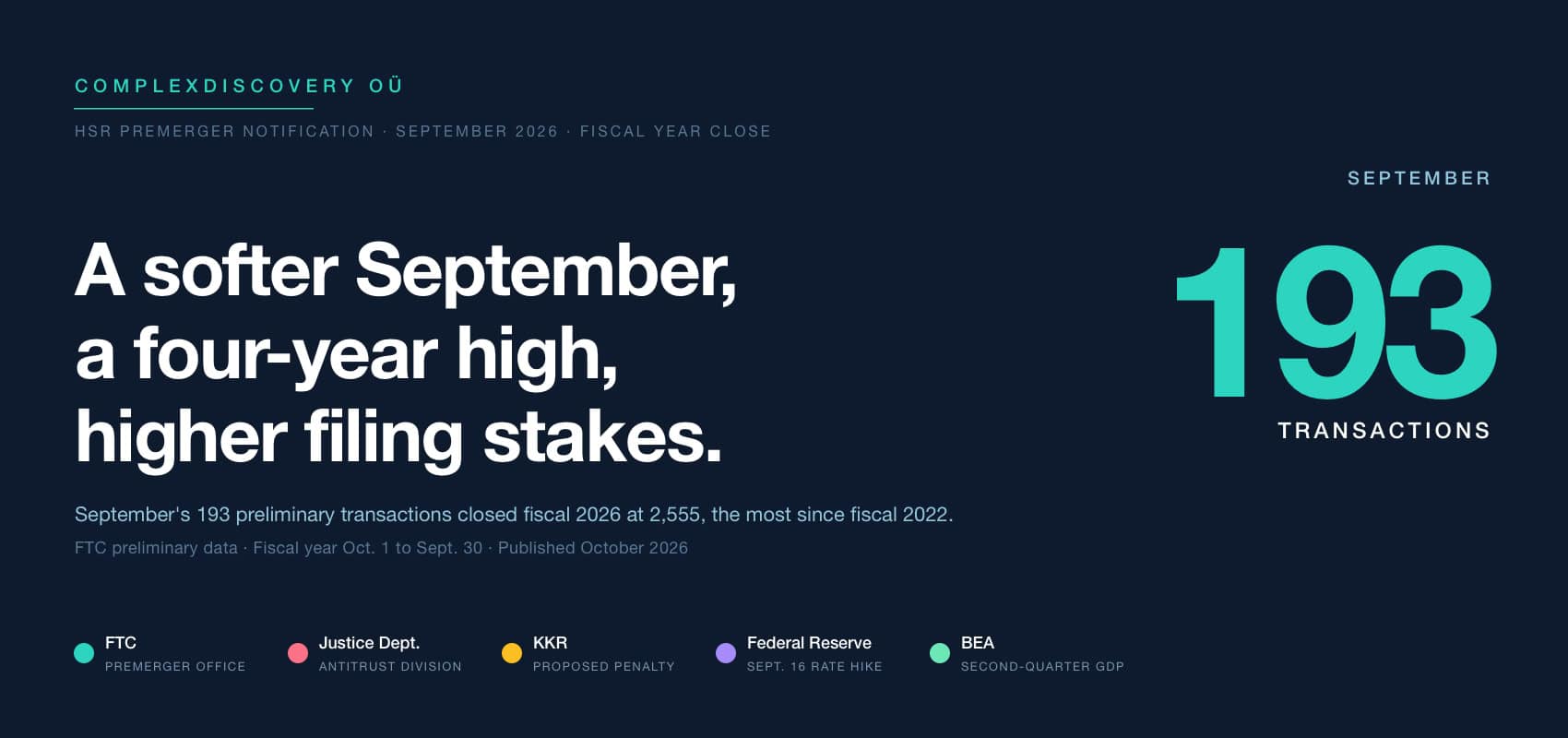
Editor’s Note: September’s 193 preliminary HSR transactions closed fiscal 2026 at 2,555, the Premerger Notification Program’s largest annual total since fiscal 2022 and 27.4 percent above fiscal 2025’s finalized count. The month itself cooled, falling 28.8 percent from August and 4.0 percent below September 2025. The cause appears to lie less in the economy, which grew at a 2.2 percent rate in the second quarter, than in financing and market conditions: the Federal Reserve raised rates on Sept. 16, the 10-year Treasury yield climbed to its highest level since 2002, and global third-quarter M&A fell 41 percent from the second quarter. Enforcement moved the other way. The Justice Department’s proposed record $250 million settlement with KKR made filing documents a nine-figure risk, and its return to targeted second requests front-loads priority productions under a timing agreement.
For eDiscovery providers and the legal teams they support, that means more work at the filing stage, faster first productions in investigations, compliance work on fiscal 2026 second requests running into 2027, and flexible capacity for new intake that may run thinner.
Content Assessment: September HSR reported transactions slip to 193 as fiscal 2026 closes at 2,555, its largest total since 2022
Information - 96%
Insight - 95%
Relevance - 92%
Objectivity - 95%
Authority - 96%
95%
Excellent
A short percentage-based assessment of the qualitative benefit expressed as a percentage of positive reception of the recent article from ComplexDiscovery OÜ titled, "September HSR reported transactions slip to 193 as fiscal 2026 closes at 2,555, its largest total since 2022."
News Analysis – Antitrust Beat
September HSR reported transactions slip to 193 as fiscal 2026 closes at 2,555, its largest total since 2022
ComplexDiscovery Staff
The Premerger Notification Program logged 193 reported transactions in September 2026, according to preliminary data from the Federal Trade Commission, a 28.8 percent drop from August’s fiscal-year high of 271. The decline closed a fiscal year that finished with 2,555 preliminary transactions, the largest annual count since fiscal 2022 and 27.4 percent above fiscal 2025’s final total of 2,006.
September also came in 4.0 percent below the 201 transactions reported in September 2025, according to the fiscal 2025 Hart-Scott-Rodino annual report issued by the FTC and the Justice Department. That is only the second year-over-year decline of fiscal 2026. The first came in February, when 188 transactions trailed the 213 recorded in February 2025. A&O Shearman called that earlier peak, followed by 75 transactions in March 2025, “a telling indication that parties rushed to file” before the expanded HSR form took effect Feb. 10, 2025.
One caveat applies throughout: the FTC labels its monthly counts preliminary, so fiscal 2026’s figures are being measured against fiscal 2025’s finalized numbers. The difference can be material. Fiscal 2025’s monthly postings summed to 2,101 before the annual report settled the year at 2,006, about 4.5 percent lower. A revision of similar size would trim fiscal 2026’s gain to roughly 22 percent, though the year would still post the largest total since fiscal 2022.
A strong final quarter softens September’s step back
Viewed by quarter, the slowdown looks less abrupt. July, August and September together produced 697 transactions, the strongest quarter of fiscal 2026 and 21.6 percent above the 573 reported in the same months of 2025. September’s 193 matched June’s count and was the lowest since April’s 185, roughly 20 below the fiscal year’s monthly average of about 213.
The full-year total cleared fiscal 2024’s 2,031 transactions by 524 and fiscal 2025’s 2,006 by 549. It remains well short of fiscal 2022’s 3,152, which the FTC described at the time as the second-highest count of the prior decade. Why September cooled after so strong a summer is harder to pin down, but the economic data and the financing markets supply the context.
HSR Act Merger Transactions Reported - September 2026
Growth continues as financing tightens and deal signings cool
The economy continued to expand. The Bureau of Economic Analysis’ third estimate, released Sept. 30 with the 2026 annual update of the national accounts, put second-quarter real GDP growth at a 2.2 percent annual rate, revised up 0.7 percentage point from the second estimate’s 1.5 percent. That was a touch slower than the first quarter, which was revised to 2.5 percent, up 0.4 point. Real final sales to private domestic purchasers, a gauge of underlying private demand, rose 4.6 percent, revised up 0.4 point. Corporate profits from current production increased $384.0 billion in the quarter, though that figure was revised down $16.9 billion, leaving corporate buyers with earnings support even as financing tightened.
Consumers kept spending, but inflation eased only at the margin. In the same third estimate, the PCE price index rose at a 5.0 percent annual rate in the second quarter and core PCE at 3.3 percent, each revised down 0.3 point. Monthly data for August, also released Sept. 30, showed the PCE price index up 0.3 percent from July and 3.4 percent from a year earlier, with core PCE up 3.0 percent from a year earlier. Real consumer spending rose 0.6 percent in August while real disposable income was unchanged, so spending outpaced income and the personal saving rate stood at 4.1 percent.
Trade sent a mixed signal. The August goods and services deficit widened $12.7 billion to $105.6 billion as imports rose $17.2 billion to $420.8 billion and exports rose $4.5 billion to $315.2 billion, according to BEA data released Oct. 6. Year to date, the deficit remained $138.2 billion, or 19.9 percent, below the same period of 2025. None of those readings points to a stalling economy. Financing conditions told a different story.
With inflation still running above its target, the Federal Reserve tightened. After holding its target range at 3.5 percent to 3.75 percent in July, the Fed raised it by a quarter point to 3.75 percent to 4 percent on Sept. 16, stating that “inflation remains elevated.” Longer-term borrowing costs climbed as well. The 10-year Treasury yield posted its biggest quarterly rise this century in the three months to September and reached 5.34 percent on Oct. 1, its highest since 2002, Reuters reported.
Dealmaking slowed. Global M&A fell 41 percent from the second quarter to $993 billion in the third quarter, the first quarter under $1 trillion since the second quarter of 2025, according to LSEG data reported by Reuters. Only 10 deals topped $10 billion, the fewest since the fourth quarter of 2024. Nine-month value still reached $3.9 trillion, up 28 percent and the highest for the period since 2001, even as the number of deals fell 8 percent, a pattern that points to fewer but larger transactions carrying the year.
The U.S. pullback was steeper. Third-quarter M&A fell by nearly half to $535 billion, according to Mergermarket data reported by Yahoo Finance, which pointed to a mix of pressures: a typical summer lull, market conditions that tightened through September as the Fed raised rates and Treasury yields reached multidecade highs, calls to slow the artificial intelligence race, and the toll of the U.S. war in Iran on energy and other prices. Because HSR filings generally follow signed agreements, a quieter quarter of announcements could surface in the first months of fiscal 2027, and September’s dip may be an early sign of that lag. Fewer deals do not mean lighter scrutiny, however. Over the summer, enforcers raised expectations for the filings that do arrive and changed how they investigate them.
Enforcers raise the stakes on premerger documents
The clearest signal came Aug. 26, when the Justice Department announced a proposed settlement under which KKR would pay a $250 million civil penalty to resolve allegations that it failed to make complete and accurate premerger filings for at least 16 transactions in 2021 and 2022. According to the department, KKR altered documents in filings for at least eight of those transactions, omitted required documents in at least 10 and made no filing at all for at least two. The department called it the largest civil penalty ever assessed for violating the HSR Act and over 20 times any prior HSR penalty it had obtained. It came weeks after the FTC announced a proposed final judgment requiring $12 million in penalties from Edwards Lifesciences and Genesis MedTech, which the commission called the largest ever for failing to make an HSR filing.
In a filing with the Securities and Exchange Commission the same day, KKR said, “We strongly disagree with the Antitrust Division’s characterization of this matter,” adding that it “acted in good faith at all times under our prior filing process” and that the penalty “will be fully reimbursed by outside law firms.” The settlement still requires court approval. The stakes also accrue by the day: FTC rules set the maximum HSR civil penalty at $53,088 for each day a party is in violation.
The investigations that follow a filing are changing as well. On July 23, the Antitrust Division said it had returned to targeted second requests, in which the parties sign a timing agreement that prioritizes certain information and documents that “could resolve the Division’s questions prior to full compliance.” After reviewing that material, the division may close its investigation, modify the second request or require full compliance. On Aug. 19, the division closed its review of the Seismic Software and Highspot merger after a timing agreement that prioritized evidence on competition from AI-native firms, which BakerHostetler described as the first closure under the targeted framework. BakerHostetler also noted that if the expedited process does not produce clearance, the model timing agreement requires more time before the deal can close.
The FTC is also watching influence that stops short of a full merger. On Sept. 16, it voted 2-0 to issue a complaint and accept for public comment a proposed consent order involving Beretta Holding, which is seeking to raise its stake in Sturm, Ruger & Co. to as much as 25 percent. The commission alleged that Beretta’s right to appoint two Ruger directors would create an interlocking directorate in violation of Section 8 of the Clayton Act. The order bars Beretta from placing anyone on Ruger’s board who is not independent of Beretta.
Filing requirements themselves have held steady since March, when the agencies again began accepting the pre-February 2025 form after a federal court vacated the expanded version. The agencies also continue to accept the February 2025 form from filers who choose to use it. The FTC has said it aims to publish any notice of proposed rulemaking by the end of 2026. Until then, the pressure falls less on what a filing must contain than on getting it right.
What the shifts mean for eDiscovery providers
Taken together, filing volume, financing conditions and enforcement changes reshape the work for eDiscovery providers supporting merging parties and their counsel. Start with timing. Second requests are issued after the agencies’ preliminary review and extend the initial waiting period, typically 30 days, so most tied to fiscal 2026 filings have already been issued; what carries into 2027 is the compliance work, plus any requests from the year’s last filings. The agencies issued 41 second requests in fiscal 2025, 20 by the FTC and 21 by the Justice Department, or 2.1 percent of the 1,944 eligible transactions, according to the annual report. The same rate applied to fiscal 2026, adjusting for ineligible transactions in the same proportion, implies about 52; fiscal 2024’s 3.0 percent rate implies about 74. Set against slowing signings, those scenarios favor flexible capacity over fixed commitments.
The work is also moving earlier. Most of the KKR allegations involve what BakerHostetler identifies as Item 4 documents, the competition-related analyses prepared by or for officers and directors that accompany the HSR form; the rest involve missed filings. Cooley urges filers to “sweep broadly and comprehensively” for documents that belong in the filing. The KKR matter shows that altered or withheld filing documents can carry nine-figure consequences, and KKR’s statement that outside law firms will reimburse the penalty puts that exposure in front of filing advisers. Targeted second requests compress the front end of an investigation, rewarding providers that can deliver a defensible priority production, including structured data, on a short clock and then scale to full compliance if required.
What to watch as fiscal 2027 begins
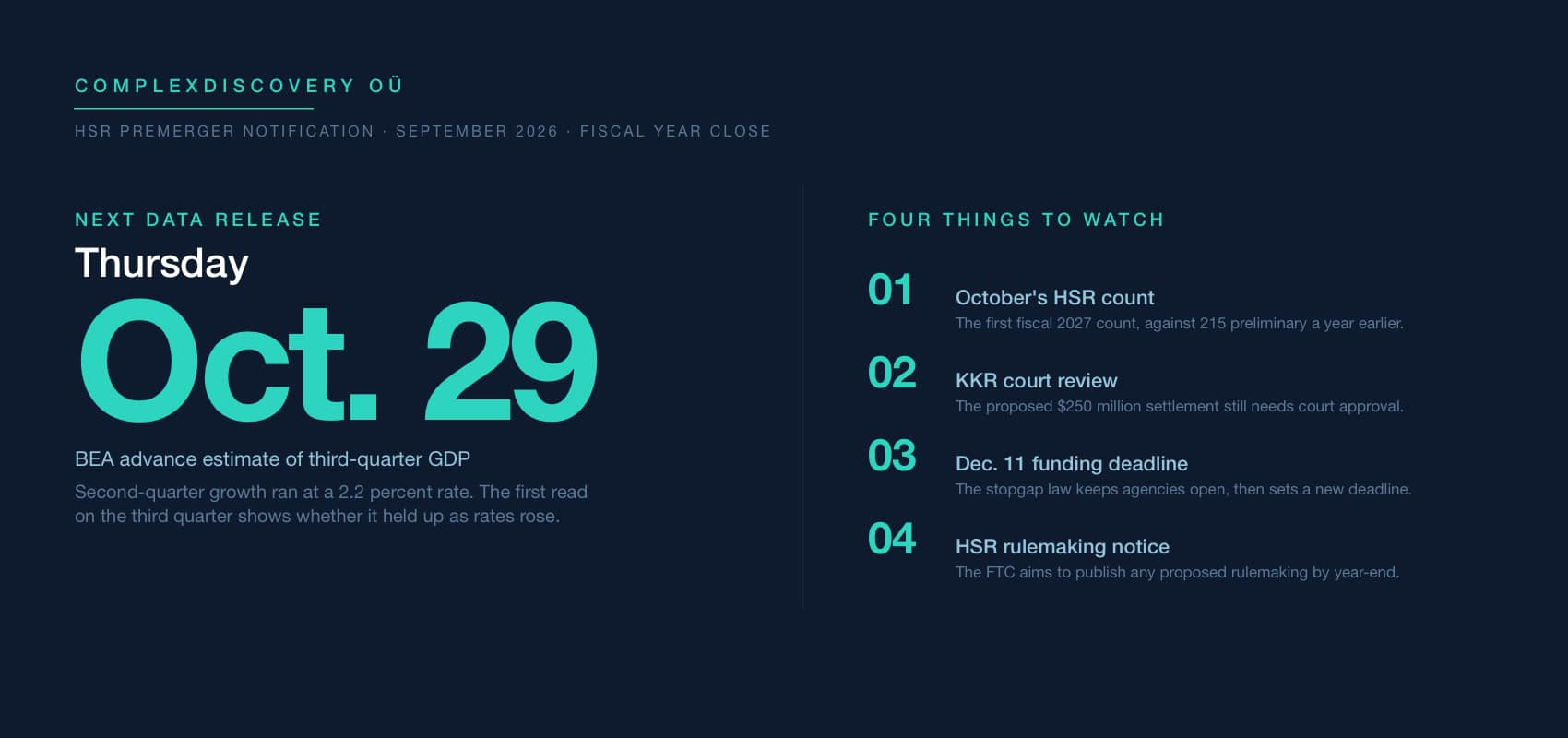
Several markers will show whether the slowdown deepens. The FTC’s October count, the first of fiscal 2027, will be measured against October 2025’s 215 preliminary transactions. The BEA’s advance estimate of third-quarter GDP, scheduled for Oct. 29, will show whether growth held up as rates rose. A stopgap spending law signed in early September funds the government through Dec. 11, keeping the agencies open into the new fiscal year without the lapse in appropriations that opened last October, but setting another funding deadline before year-end. The FTC’s year-end target for a notice of proposed rulemaking on the HSR form and court review of the KKR settlement round out the calendar.
For legal operations and eDiscovery leaders, the signals point in two directions. The deepest pool of reportable transactions in four years feeds second request compliance work into 2027, while rising rates and a slower quarter of signings suggest new intake may moderate. What will not moderate is the expectation that filing documents be complete, accurate and ready to defend.
With enforcers scrutinizing filing documents before any second request issues and the Justice Department front-loading priority productions, is your team preparing for the filing stage as deliberately as it prepares for the investigation that may follow?
HSR Act Merger Transactions Reported - FY 2026 - September 2026





News sources
- Premerger Notification Program: HSR Transactions by Month (Federal Trade Commission)
- Hart-Scott-Rodino Annual Report for Fiscal Year 2025 (Federal Trade Commission and Department of Justice)
- FTC and DOJ Issue Fiscal Year 2025 Hart-Scott-Rodino Annual Report (Federal Trade Commission)
- Hart-Scott-Rodino Annual Report for Fiscal Year 2024 (Federal Trade Commission and Department of Justice)
- FTC, DOJ Issue Fiscal Year 2022 Hart-Scott-Rodino Notification Report (Federal Trade Commission)
- Filing volumes stabilize and consent decrees return: what the FY2025 HSR annual report reveals about Trump-era merger review (A&O Shearman)
- Premerger Notification and the Merger Review Process (Federal Trade Commission)
- GDP (Third Estimate), Industries, Corporate Profits, State GDP, and State Personal Income, 2nd Quarter 2026; State PCE, 2025 (U.S. Bureau of Economic Analysis)
- Personal Income and Outlays, August 2026 (U.S. Bureau of Economic Analysis)
- S. International Trade in Goods and Services, August 2026 (U.S. Bureau of Economic Analysis)
- Federal Reserve issues FOMC statement (Federal Reserve Board, July 29, 2026)
- Federal Reserve issues FOMC statement (Federal Reserve Board, Sept. 16, 2026)
- Global M&A deal rush fades in third quarter as rising borrowing costs bite (Reuters via Investing.com)
- Wall Street’s merger frenzy takes a third quarter breather: Chart of the Day (Yahoo Finance)
- KKR Agrees to Pay Record $250M Penalty for Serial Violations of Federal Premerger Review Law (Department of Justice)
- Form 8-K, Current Report (KKR & Co. Inc. via SEC EDGAR)
- DOJ Announces ‘Historic’ $250 Million Penalty for HSR Filing Violations (Cooley)
- FTC Secures $12 Million in Penalties for Pre-Merger Reporting Act Violations (Federal Trade Commission)
- United States v. Edwards LifeSciences Corp. and Genesis MedTech Group Limited; Proposed Final Judgment and Competitive Impact Statement (Federal Register)
- 16 CFR 1.98, Adjustment of civil monetary penalty amounts (Electronic Code of Federal Regulations)
- Justice Department Resumes Targeted HSR Merger Review Process (Department of Justice)
- Statement of the Department of Justice Antitrust Division on the Closing of Its Investigation of the Merger of Seismic Software Inc. and Highspot Inc. (Department of Justice)
- HSR Developments at DOJ: Streamlined Second Requests and Settlement of Allegations Against KKR (BakerHostetler)
- FTC Takes Action to Prevent Anticompetitive Arrangement in Beretta, Ruger Deal (Federal Trade Commission)
- Pre-2025 HSR rules to stay in place for now, new proposed changes expected by end of 2026 (DLA Piper)
- Stopgap funding bill delays OMB grants rule until December 11 (Ballotpedia News)
- President Trump Signs Continuing Resolution to Fund Government Through December 11 (American Association of Colleges of Osteopathic Medicine)
- US Government Shutdown Impact on Antitrust Enforcement – Expect Delays in Merger Review, Investigations, Litigation (Cooley)
- July HSR reported transactions climb to 233 as fiscal 2026 passes 2,000 with two months to spare (ComplexDiscovery)
- August HSR reported transactions jump to 271 as fiscal 2026 heads for its largest total since 2022 (ComplexDiscovery)
Assisted by GAI and LLM Technologies
Additional Reading
- HSR Act Reporting: A ComplexDiscovery Chronology
- FTC Annual Competition Reports (Hart-Scott-Rodino Act Reports)
Source: ComplexDiscovery OÜ

ComplexDiscovery’s mission is to enable clarity for complex decisions by providing independent, data‑driven reporting, research, and commentary that make digital risk, legal technology, and regulatory change more legible for practitioners, policymakers, and business leaders.