

Editor’s Note: Cooley and Google Cloud said Oct. 8 that Cooley is the launch partner for an agent being built on Gemini Enterprise to flag confidential information in court filings and recommend redactions, with attorneys deciding every redaction. Google’s blog the same day placed the agent on Gemini Enterprise for Legal. The agent is still in development, and the announcement carries no availability date, price or error rate. That last gap matters most to practitioners. Rule 5.2’s 2007 committee note puts the duty to redact on counsel and the filing party, not the clerk, so a protected identifier left in a public filing produces a disclosure. The agent also sits beside redaction tools that review platforms such as Relativity aiR, formerly RelativityOne, have sold for discovery data sets.
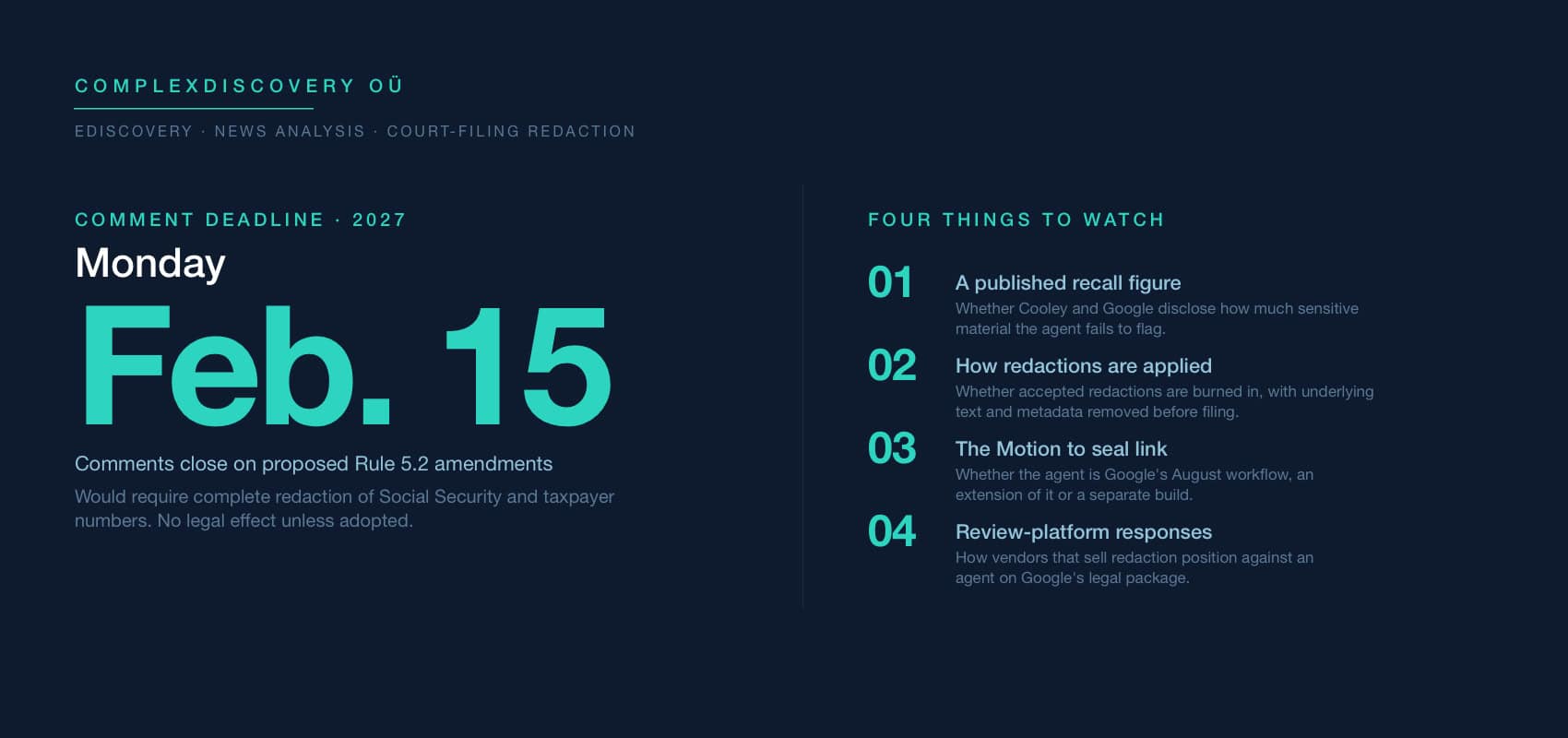
For cybersecurity, data privacy, regulatory compliance and eDiscovery professionals, the piece sets out what the announcement establishes, why recall is the detection figure to request, and four questions to ask any redaction vendor before a pilot. Watch the proposed Rule 5.2 amendments, open for comment through Feb. 15, 2027, which would require complete redaction of Social Security and taxpayer identification numbers.
Disclosure: ComplexDiscovery OÜ founder Rob Robinson is chief marketing officer of HaystackID, an eDiscovery services provider that offers redaction services. HaystackID had no role in the preparation of this article, which is based solely on publicly available information.
Content Assessment: Cooley and Google Cloud are building a court-filing redaction agent without a published error rate
Information - 93%
Insight - 91%
Relevance - 91%
Objectivity - 90%
Authority - 92%
91%
Excellent
A short percentage-based assessment of the qualitative benefit expressed as a percentage of positive reception of the recent article from ComplexDiscovery OÜ titled, "Cooley and Google Cloud are building a court-filing redaction agent without a published error rate."
News Analysis – eDiscovery Beat
Cooley and Google Cloud are building a court-filing redaction agent without a published error rate
ComplexDiscovery OÜ Staff
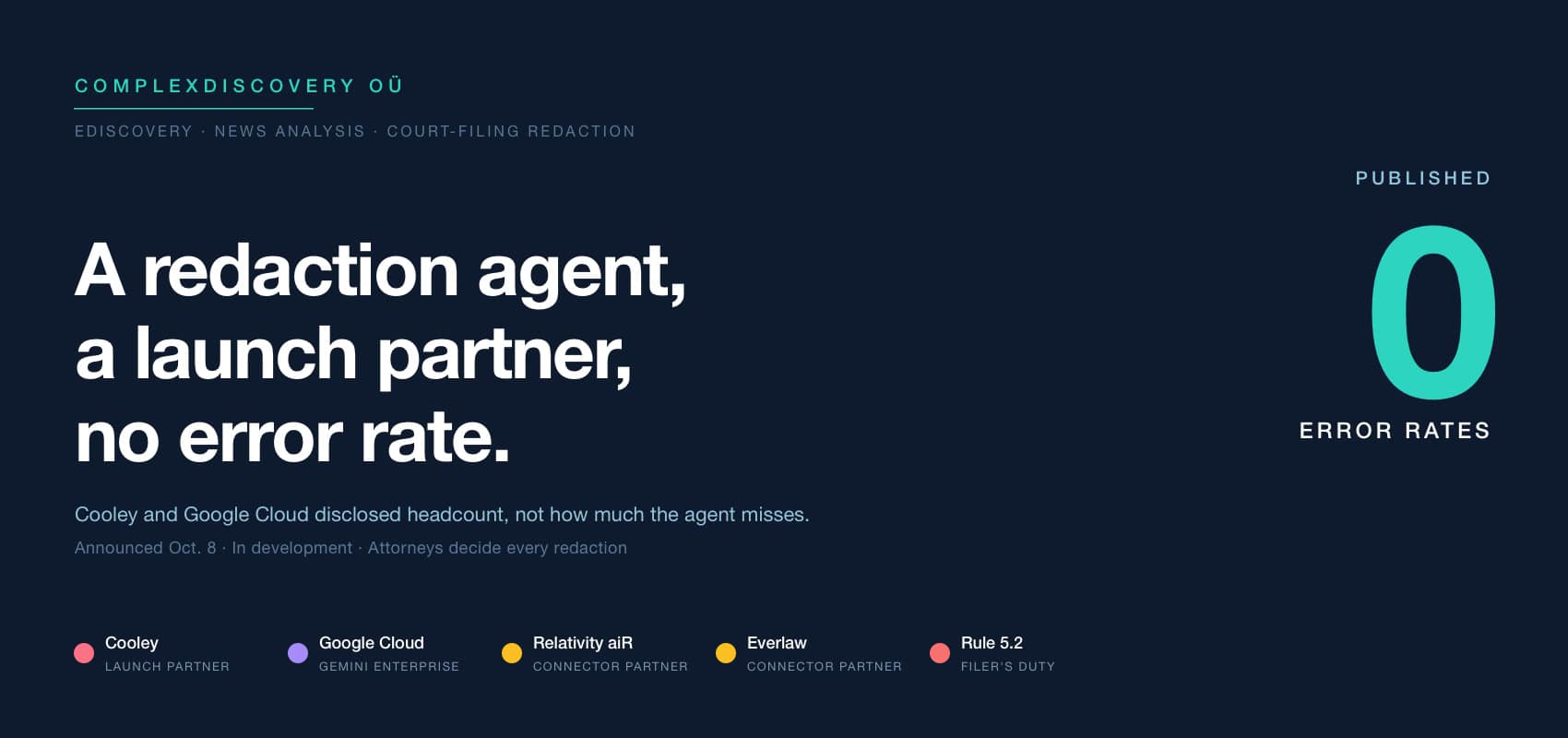
Cooley is the launch partner for an agent being built on Google Cloud’s Gemini Enterprise to help lawyers find confidential information in court filings and draft proposed redactions, the firm and Google said Oct. 8.
The announcement says how many lawyers and offices Cooley has. It does not say how often the agent misses sensitive information, which is the number a buyer most needs.
What Cooley and Google announced
In parallel releases posted by Cooley and by the Google Cloud Press Corner, the two said the agent recommends “targeted redactions of personally identifiable information (PII), technical information and other potentially confidential material for attorney review.” Attorneys decide every redaction before anything is filed, according to the releases. The agent is still in development, and neither release names an availability date or a price.
As launch partner, Cooley steers the product and feeds its litigators’ reactions back to engineers, who, the releases said, will shape the workflow to fit complex litigation. The firm also has a long history with its partner. “Cooley has long collaborated with Google as litigation counsel,” said Ian Shapiro, chair of Cooley’s global litigation department, in the firm’s release.
Satish Thomas, a vice president at Google Cloud, cast the arrangement as a test bed. “The most effective AI tools are built by validating technology against demanding, real-world use cases,” Thomas said. Legaltech News reported that Cooley approached Google after identifying redaction as a strong candidate for agentic AI that would nonetheless demand substantial engineering work. The outlet counted the deal among a quickly growing number of tie-ups between large firms and large technology companies.
Other firms have taken similar seats. When Google introduced Gemini Enterprise for Legal in August, Ramona Nee, Weil’s incoming executive partner, said in Google’s release that the firm’s collaboration gave it early access to new capabilities and a hand in shaping the platform. The figures the October announcement does disclose all describe Cooley: nearly 1,400 lawyers across 19 offices and a workforce of over 3,000, according to the releases’ boilerplate.
Where the agent sits in Google’s legal push
That August launch is where the redaction story starts. Google Cloud released Gemini Enterprise for Legal in preview on Aug. 25, and its announcement named six workflows the package would accelerate. One, labeled “Motion to seal,” would take the manual burden out of “preparing court filings and redacting legal documents” by flagging sensitive terms and PII for a practitioner to confirm, Google said.
The Oct. 8 releases describe only “a new Gemini Enterprise AI agent.” Google’s blog post for its Gemini at Work event the same day was more specific: it said Cooley “is building a confidential information redaction agent on Gemini Enterprise for Legal” that “automates redactions” before filings go public. The two accounts can be read together. The releases add a step the blog’s one-sentence summary leaves out, which is that attorneys make every redaction decision before filing.
What none of the three sources says is whether the agent is the August “Motion to seal” workflow, an extension of it or a separate build. Buyers should treat that relationship as unstated rather than assume an answer.
Data handling is the other open item, and security and information governance teams will raise it early. Google’s August release said client data, prompts and outputs remain within the organization’s private cloud perimeter and that Google does not train its base models on customer data. None of the October materials restate those terms for this agent, so whether they carry over belongs on any pilot checklist.
Next door to the review platforms
If the agent lives inside the legal package, as Google’s blog says, it also sits beside review platforms that already sell redaction. Relativity’s own materials show how that product line works. In a 2023 post, Hannah Caywood, then a senior product manager at Relativity, described the two redaction options RelativityOne offered at the time. Redact, released in 2021, applied rules built on regular expressions and came at no additional cost; Personal Information Detect was an AI add-on with over 120 pre-trained detectors, sold at extra cost. Redact ended in a human quality-control pass in which reviewers approved or rejected its markups, a posture close to the attorney review the Cooley agent describes.
Those tools were built for discovery data sets, the documents a party collects, reviews and produces. The Cooley agent is aimed at court filings, the briefs and exhibits a lawyer puts on the docket. The two jobs sit side by side in the same matter, and an agent built for one lands next door to the vendors selling the other.
Google’s August partner list makes the proximity concrete. RelativityOne, which Relativity renamed Relativity aiR in September, and Everlaw were among 11 platforms Google named as Model Context Protocol connectors for Gemini Enterprise for Legal. Relativity’s announcement, posted on Google’s press site, said its connector lets administrators stand up matters and manage access through natural language. Relativity President Chris Brown said users would orchestrate work inside the platform, with “the substantive analysis staying within Relativity aiR.” In August that name belonged to Relativity’s suite of AI tools; LawSites reported that the company gave it to the whole platform on Sept. 16.
Everlaw’s announcement described Everlaw as “the defensible system of record” for evidence while Gemini Enterprise adds synthesis. Its boilerplate lists CapitalG, Alphabet’s independent growth fund, among Everlaw’s investors.
That proximity raises a positioning question for every vendor that sells redaction inside a review platform: how does it compete now that a major cloud provider is co-developing a redaction agent with a large litigation firm? Discovery teams can put a version of the same question to their own vendors: is filing redaction in scope, or only production redaction?
Why the miss rate outweighs the speed
Whichever tool ends up doing the work, the job is the one the releases describe. Redacting a filing “can consume days of lawyers’ time” with “little margin for error,” they said. The announcement proposes a workflow for the first half and offers a principle, attorney review, for the second, rather than a measurement.
Federal Rule of Civil Procedure 5.2 explains why the second half carries the weight. Unless the court orders otherwise, and subject to listed exemptions, the rule allows a filing to show only the last four digits of Social Security, taxpayer-identification and financial-account numbers. Birth dates shrink to the year and minors’ names to initials. The rule’s 2007 committee note says clerks need not check filings for compliance and that the duty to redact falls on counsel and on the filing party. It also warns that personal information not protected by sealing or redaction “will be made available over the internet.”
That allocation is why recall, the share of sensitive items a tool actually catches, is the detection figure a buyer needs most. An overcautious tool costs reviewer time. A tool that leaves a protected account number unredacted in a publicly accessible filing produces a disclosure, and the committee note’s answer for a mistaken filing is that the filer can ask the court for relief.
The Cooley agent’s stated scope widens the problem. Rule 5.2 lists five categories, four of them numbers or dates. “Technical information” and “other potentially confidential material” are not on that list. Their protection comes, if at all, from a protective order under Rule 5.2(e) or Rule 26(c), or from sealing standards that courts have developed themselves, so whether an item qualifies depends on the order and on judgment. A recall figure for that category is harder to define, which is a reason to ask for one rather than a reason to go without.
In August, Google Cloud Chief Executive Thomas Kurian said ensuring agentic legal workflows are accurate, factual and grounded in legal authority “is of critical importance.” The October announcement does not say how that standard will be measured for this agent.
Two ways a redaction fails
Recall covers only one failure mode; the other is applying the redaction so it holds. In a 2019 column for the American Bar Association’s Judges’ Journal, Herbert B. Dixon Jr. described filings by Paul Manafort’s lawyers in which black boxes sat over text that readers recovered by copying and pasting it. Dixon also wrote that a 2008 Public.Resource.org audit of PACER documents found 1,600 cases in which litigants filed unredacted Social Security numbers, along with filings where a black box had been laid over a number left intact underneath.
The Cooley releases describe recommending redactions for attorney review, and Google’s blog says the agent automates them. None of the three describes how accepted redactions are applied, whether underlying text and metadata are removed, or whether the agent checks the output before filing. A tool that flags every item correctly and then masks it with a drawn box could produce the same kind of recoverable-text failure Dixon described.
A proposed rule change that could raise the stakes
The redaction burden could also grow. In August, the federal judiciary’s rules committees published proposed amendments that would require complete redaction of Social Security numbers and of individual, employer and adoption taxpayer identification numbers in civil cases. The proposals would also replace minors’ initials with pseudonyms and clarify that the requirements apply to every document in a filing, including exhibits and attachments. These details come from the August preliminary draft and the rules committee’s September report to the Judicial Conference. Comments are due Feb. 15, 2027, and the proposals have no legal effect unless adopted.
If adopted, the changes would end the four-digit allowance for Social Security and taxpayer identification numbers, and any redaction tool, this one included, would have to be tested against the new rules rather than the old ones. That brings the question back to measurement. Firms evaluating this agent, or any competitor, can ask four things before a pilot. What recall and precision did the developer measure, on what document set and by whom? How does the detection logic define “technical information”? How are accepted redactions burned in and verified? And what audit record shows which recommendations an attorney accepted or rejected?
Cooley and Google have described a collaboration, a launch-partner role and a principle that attorneys decide, but they have not yet described a result. When a redaction agent’s error rate is finally published, will your firm treat it as a vendor claim to test, or as the standard your own reviewers must beat?
News sources
- Cooley Collaborates With Google Cloud to Develop AI Agent for Complex Litigation (Cooley)
- Cooley Collaborates With Google Cloud to Develop AI Agent for Complex Litigation (Google Cloud Press Corner)
- Welcome to Gemini at Work 2026: Introducing the Gemini agent (Google Cloud Blog)
- Google Cloud Launches Gemini Enterprise for Legal (Google Cloud)
- Google Cloud Press Corner: Gemini Enterprise for Legal (Google Cloud Press Corner)
- Relativity Accelerates Enterprise AI Transformation with Google Cloud’s Gemini Enterprise for Legal (Relativity via Google Cloud Press Corner)
- Everlaw and Google Cloud Ground Legal AI in Trusted Evidence with Gemini Enterprise (Everlaw via Google Cloud Press Corner)
- Rule 5.2. Privacy Protection For Filings Made with the Court (Legal Information Institute, Cornell Law School)
- Preliminary Draft: Proposed Amendments to the Federal Rules of Appellate, Bankruptcy, Civil, and Criminal Procedure, and the Federal Rules of Evidence (Committee on Rules of Practice and Procedure, U.S. Courts)
- Summary of the Report of the Judicial Conference Committee on Rules of Practice and Procedure (U.S. Courts, September 2026)
- Cooley Teams Up With Google to Co-Develop Agentic AI Redaction Tool (Law.com Legaltech News)
- RelativityOne Gets A New Name To Reflect Its Increasing Capabilities Around AI and Data (LawSites)
- Embarrassing Redaction Failures (American Bar Association)
- Comprehensive Personal Information Protection in RelativityOne (Relativity)
- CapitalG is Alphabet’s independent growth fund. (CapitalG)

Assisted by GAI and LLM Technologies
Additional reading
- Relativity’s 2028 Server exception meets a Riyadh deployment outside its cloud region table
- ENISA Threat Landscape 2026 finds DDoS leads incident counts while ransomware stays most impactful in the short term
- Cyber Resilience Act reporting starts Sept. 11 on an unfinished platform
- Europe’s draft cloud rule would put vendor ownership in the audit file
- The eight-hour clock starts today: EU e-evidence orders now land on covered U.S. providers’ EU addressees
- California’s AI Transparency Act arrives alongside Europe’s Article 50
- Federal magistrate judge treats LinkedIn’s Relativity aiR workflow as TAR
- One benchmark, three directions: 2026 legal rates rise, flatten and fall at once
- Confidence cools, commitment holds: full results from the 1H 2026 eDiscovery Business Confidence Survey
- Complete look: ComplexDiscovery OÜ’s 2025 to 2030 eDiscovery market size mashup
- The workstream of eDiscovery: Considering processes and tasks
Source: ComplexDiscovery OÜ

ComplexDiscovery’s mission is to enable clarity for complex decisions by providing independent, data‑driven reporting, research, and commentary that make digital risk, legal technology, and regulatory change more understandable for practitioners, policymakers, and business leaders.