
Editor’s Note: A stolen login, not a breached firewall, put Stadler Rail in an extortion gang’s sights this month. The Swiss train builder confirmed July 21 that criminals reached a data-exchange platform it uses with a supplier, took technical files belonging to that supplier, and demanded 10 million Swiss francs, about $12.3 million. Stadler refused, filed a criminal complaint with Thurgau cantonal police, and said its own systems, production and in-service vehicles were untouched.
Security, privacy, compliance and eDiscovery teams should read this as a third-party governance story rather than a rail story. The incident centered on a file-exchange platform between two companies and involved compromised credentials. That is a related interorganizational data-transfer risk of the kind that produced the Accellion and MOVEit dockets, and it lands on questions practitioners already own: who provisions supplier credentials, who holds the access logs, who owes a regulator a report within 24 hours, and how far a legal hold reaches once a proceeding becomes reasonably anticipated.
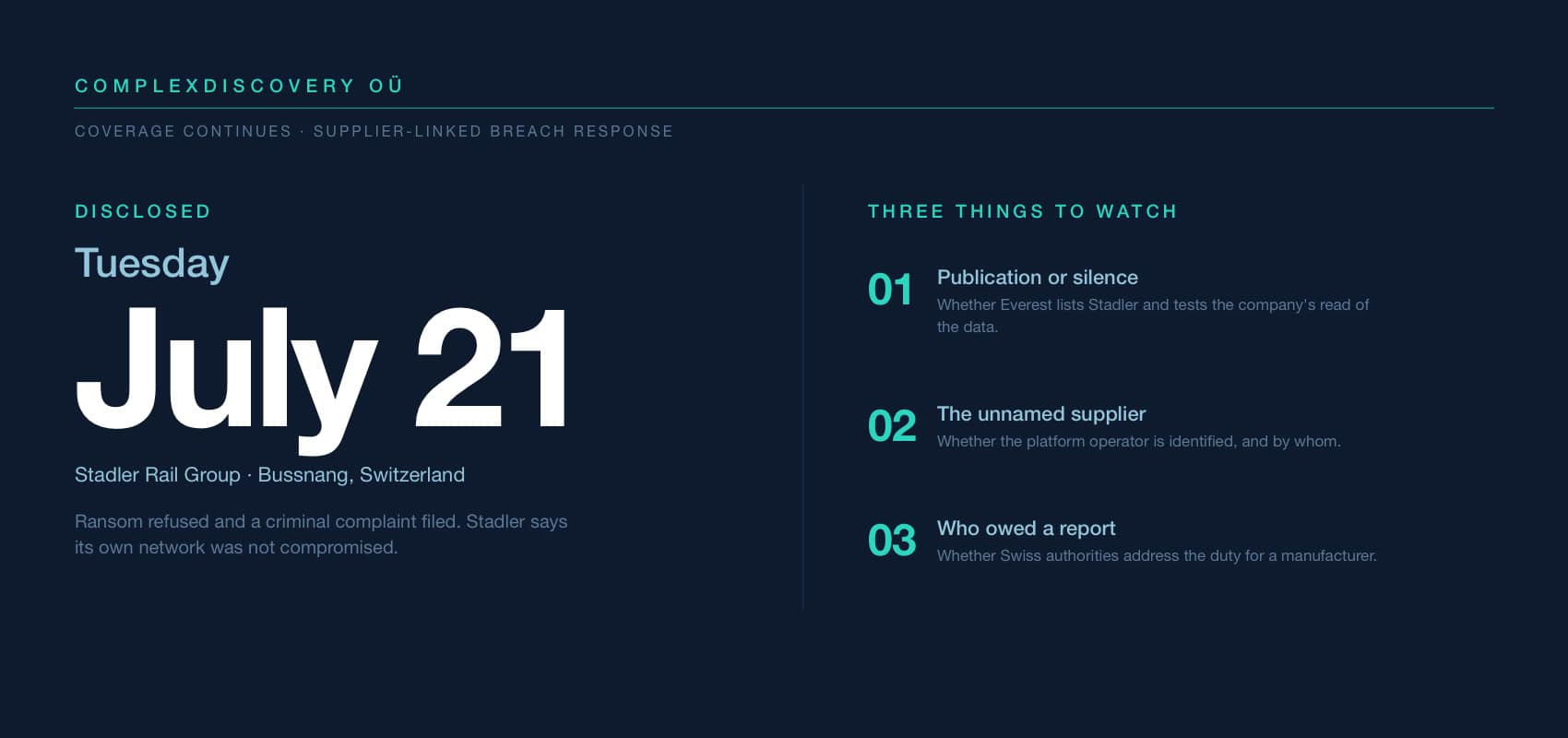
Watch three things. Whether Everest publishes and tests Stadler’s read of the data. Whether the unnamed supplier surfaces. And whether Swiss authorities address who, if anyone, owed a report on a platform neither party has claimed.
Content Assessment: Stadler rejects $12.3 million ransom after supplier-linked platform breach
Information - 100%
Insight - 91%
Relevance - 92%
Objectivity - 90%
Authority - 90%
93%
Excellent
A short percentage-based assessment of the qualitative benefit expressed as a percentage of positive reception of the recent article from ComplexDiscovery OÜ titled, "Stadler rejects $12.3 million ransom after supplier-linked platform breach."
Industry News – Cybersecurity Beat
Stadler rejects $12.3 million ransom after supplier-linked platform breach
ComplexDiscovery Staff
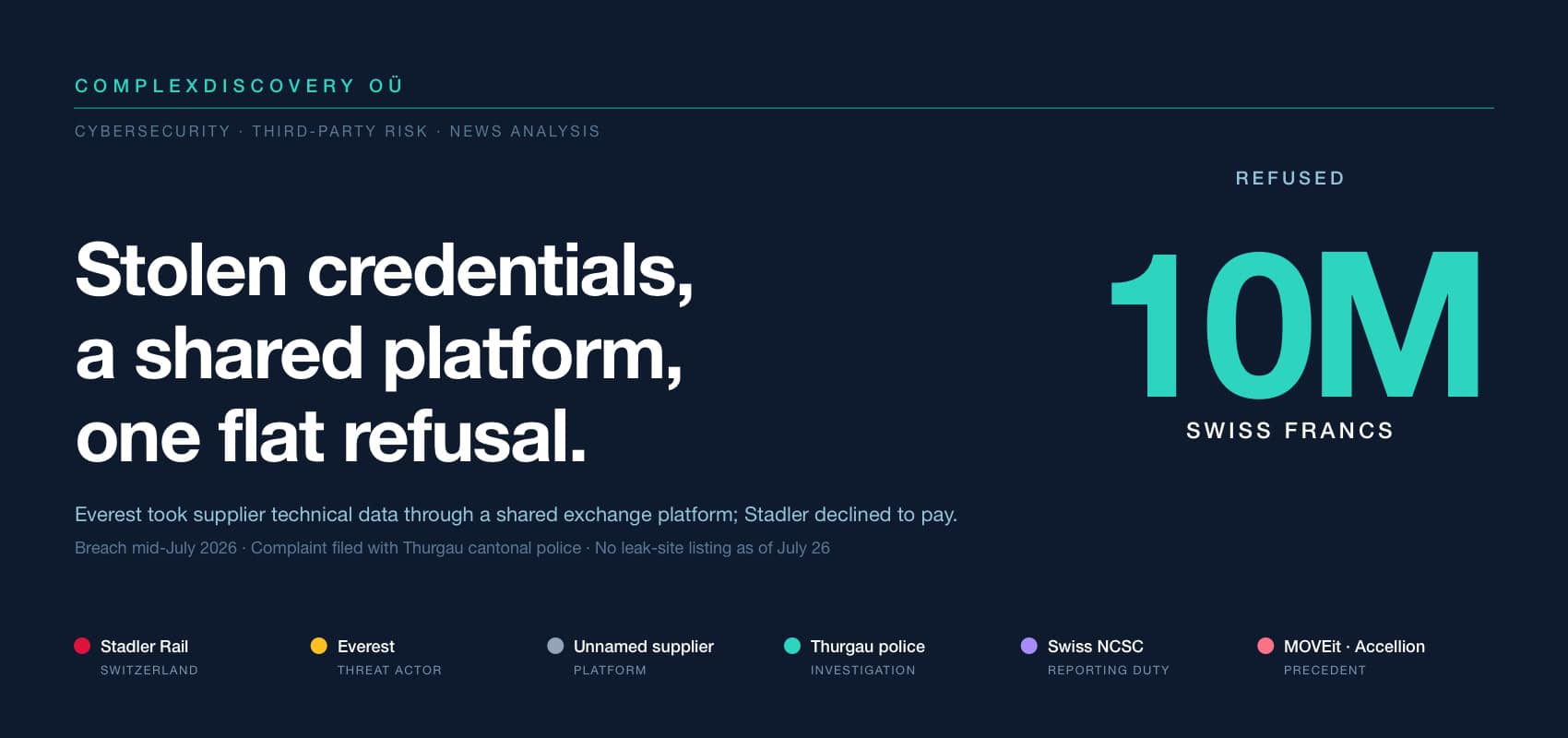
Swiss train builder Stadler Rail refused to pay a 10 million Swiss franc ransom in July after criminals used stolen credentials to raid a data-exchange platform it uses with a supplier.
Stadler says its own network was not compromised. The seam where that network meets a supplier’s is another matter.
That distinction is the whole story, and it is the one most breach notices bury.
Stadler published its account on July 21 under a headline that doubled as a defense: “Cybervorfall: IT-Systeme von Stadler nicht kompromittiert.” Criminals reached the shared platform using compromised login credentials, the company said. What they took was technical information belonging to a supplier, material Stadler characterized as not safety-relevant, with no relevant personal data involved. Rail vehicles in service worldwide were untouched. Production continued. The group calling itself Everest demanded 10 million francs, about $12.3 million, and Stadler answered in a single sentence: the company pays no ransom under any circumstances and is therefore not open to extortion.
Then it filed a criminal complaint with the Thurgau cantonal police, whose cybercrime unit opened an investigation. Police spokesman Robin Bernhardsgrütter confirmed the case to Swiss outlet 20 Minuten and declined to say anything further.
This is not a marginal target. Stadler reported 3.68 billion Swiss francs in net revenue for 2025 against an order backlog of 32.3 billion francs, with an average workforce of 17,119 full-time equivalents, according to the company’s 2025 annual report. Its trains run in dozens of countries. The gap between that scale and the limited scope Stadler reports is the point worth studying.
The seam between two networks
Strip away the rail-industry framing and what remains is among the most ordinary breach patterns in the modern catalog. No exploit or malware on Stadler systems has been disclosed. Stadler says access to the exchange platform came through compromised credentials, used the way credentials are meant to be used, against a platform that existed precisely so two companies could hand files back and forth.
Verizon’s 2026 Data Breach Investigations Report, published May 19, examined over 31,000 security incidents, including over 22,000 confirmed breaches across 145 countries. Third-party involvement appeared in 48 percent of breaches, a rise of 60 percent from the prior dataset, while credential abuse accounted for 13 percent of known initial-access vectors, displaced at the top for the first time in 19 years by vulnerability exploitation at 31 percent. The limited facts Stadler disclosed resemble both patterns, although the incidents Verizon covers took place between Nov. 1, 2024 and Oct. 31, 2025, so the July 2026 breach is not among them.
Note what Stadler’s statement does not settle: who ran the platform, and whose credentials were compromised. The company’s release describes a data-exchange platform with a Stadler supplier and says its own systems stayed intact. Several trade outlets, including Railway Gazette International and the Swiss technology publication Inside IT, reported that the platform was operated on the supplier’s side. Stadler has not said so in its own words, has not identified whose credentials were compromised, and the supplier has not been named. That ambiguity is not a detail. It decides who owns the logs, who owns the notification duty, and who answers the first subpoena.
Practitioners who want to act on this should start with an inventory question, not a technology one: which file-exchange platforms does the organization touch that it does not administer? Most companies can name their own systems. Far fewer can produce a list of the supplier-hosted portals their engineers log into weekly, who provisioned those accounts, whether multifactor authentication is enforced on the supplier side, and who receives the access logs. Contract language helps only if someone reads the logs. Where a supplier operates the platform, the notification clause should name a person and a deadline, not a department.
Everest works the credential market
Everest surfaced in December 2020 and has since built a business with three revenue streams instead of one. Picus Security researcher Umut Bayram, writing in a July 10, 2026 post on the vendor’s blog, described a group that encrypts files with a .everest extension, sells network access as an initial access broker, and since October 2023 has openly recruited insiders. Picus describes several credential-based access paths used by Everest, including internet-exposed remote desktop without multifactor authentication, vulnerable VPN endpoints, and credentials bought from brokers or harvested through stuffing attacks. Those paths are consistent with the limited vector Stadler disclosed, but the public record does not establish how these credentials were obtained. Picus sells security-validation software, a commercial interest readers should weigh.
The group has also claimed victims positioned inside supply chains. Last year it claimed passenger data associated with the Collins Aerospace supplier incident that disrupted check-in at several European airports, putting the figure at 1.5 million Dublin Airport records. Its role in the operational disruption and the claimed record count both remain unverified.
As of July 24, reporting by BleepingComputer, Cybernews and the third-party risk vendor Rescana placed no Stadler entry on Everest’s leak site, and the group had not publicly claimed the attack. No later listing had been reported as of July 26. The risk of publication remained unresolved.
Stadler has been here before
The company’s refusal is not a first-time posture. In May 2020, Stadler disclosed that attackers had put malware on its network and were demanding payment, and it said then that it was not and never had been willing to pay or to negotiate. It held. The attackers, identified by analyst Brett Callow as the Nefilim group, published about 4 gigabytes of internal documents, as International Railway Journal and Railway Age both reported, and Callow said at the time that the release looked like a warning shot rather than the full dump.
Anyone tempted to read the 2026 statement as a costless win should sit with that history. Refusal is a defensible strategy and arguably the correct one, but it trades one exposure for another. By refusing, Stadler accepts the possibility of publication rather than paying 10 million francs. That trade has to be weighed before the demand arrives, with the board already briefed, or it gets weighed badly under a countdown clock.
Outside advisers reach for a different frame, and the gap is instructive. S-RM, a UK-registered intelligence and cyber security consultancy, covered the refusal in a July 24 briefing by researcher Houren Lee. Organizations with working backups are far less likely to pay, the firm’s own data shows, and companies weighing extortion should seek specialist support. S-RM also sells incident-response services, a relevant commercial interest. The finding has a limit here in any case. Backups answer an encryption event, and Stadler has not described one. The disclosed pressure is threatened publication, and backups do not mitigate that publication risk.
A second point deserves the same scrutiny. Every characterization of the stolen files as not safety-relevant and free of personal data comes from Stadler, describing data that belongs to somebody else, at a moment when the company has an obvious interest in the assessment. No regulator, forensic firm or supplier statement has corroborated it publicly. Reporters and risk teams should treat it as the company’s position rather than an established fact, and should watch what appears if Everest publishes.
Where the Swiss reporting duty stops
Switzerland has required operators of critical infrastructure to report cyberattacks to the National Cyber Security Centre within 24 hours of discovery since April 1, 2025, under the Information Security Act. Sanctions took effect Oct. 1, 2025, and operators who fail to report may be fined up to 100,000 francs, the federal government said in a Sept. 29, 2025 release. The mechanism is not automatic. If the NCSC has evidence that a report was not filed, it must contact the operator first, and only if the operator fails to respond to that contact and a subsequent order can it file a criminal complaint. The agency’s 2025 annual report describes the same sequence as appropriate warning procedures, and points to Article 74b of the act for the entities covered and Article 16 of the Cybersecurity Ordinance for the exceptions.
Here is where practitioners should look closely. The statutory categories reach operators: energy, water, health care, finance, transport, telecommunications, public administration. Neither the CMS alert nor a parallel bratschiLetter analysis by Adrian Bieri of Bratschi enumerates manufacturers or software suppliers to critical infrastructure as directly obligated parties. Both are law-firm publications that serve as analysis and as client development, and neither substitutes for counsel on a specific entity. Stadler builds the trains; it does not run the railway. Whether the reporting duty reached this incident at all, and whether it reached the supplier whose data was taken, is a question the public record does not answer, and Stadler’s statement does not mention a federal report.
Compliance teams should map that question now, entity by entity, not at hour three of an incident. The answer determines who has 24 hours and who has none.
Litigation follows the file-transfer platform
For the eDiscovery and information governance side of the house, the shape of this incident should look familiar to the point of discomfort.
Start with the orders that belong on the reading list of every vendor risk program. On July 31, 2025, U.S. District Judge Allison D. Burroughs issued two rulings in In re MOVEit Customer Data Security Breach Litigation, MDL No. 3083, in the District of Massachusetts. Both produced mixed results, granting some counts and denying others, while letting the central negligence theories proceed.
The first order concerned Progress Software, which built the file-transfer product. The data itself sat on customers’ servers. That did not spare Progress: the court let a duty theory proceed, writing that the company “was uniquely well-situated to prevent the harm allegedly visited upon Plaintiffs.” Indiana was the exception. There the court granted dismissal of the negligence claim, a reminder that duty is a question of state law and does not answer the same way everywhere. The second order reached the customers. Companies that hire vendors to handle data are what the court called vendor contracting entities. Hiring someone, on the court’s reading at this stage, does not discharge your own duty, and foreseeable breach risk obliges you to check what the vendor is actually doing. The same order declined to treat a zero-day as an answer to proximate causation. It also dismissed privacy tort, breach of confidence and bailment claims across several defendant groups. The consolidated complaint puts the records at issue above 93 million.
None of that is a finding of liability. Both orders decide one question: whether the allegations are plausible enough to go forward. The case has kept moving since. On June 26, 2026, Burroughs held that the economic-loss doctrine did not require dismissal of negligence claims at this stage under California, Indiana, Michigan and Ohio law, Bloomberg Law reported.
Taken together, the orders show that under certain state laws and at the pleading stage, duty theories may proceed against a software provider, against direct users and against companies that selected vendors. They do not establish liability, and they do not determine who would bear responsibility for the Stadler incident, which involves a different vector and a different jurisdiction.
The older docket points the same direction from a different angle. In re Accellion, Inc. Data Breach Litigation has run in the Northern District of California before Judge Edward J. Davila since 2021, built on zero-day exploitation of Accellion’s File Transfer Appliance in December 2020 and January 2021. Liability theories survived there, but broad class treatment did not. The court certified several narrow subclasses rather than the broad negligence class plaintiffs sought. On July 14, 2026, Alston & Bird attorneys Donald Houser, Gavin Reinke and Elizabeth Robinson reported that the court refused to modify its certification order to admit a new damages expert, leaving part of the case pointed at nominal damages. Surviving a motion to dismiss and getting a class certified are different problems.
The vectors differ, and the difference matters. Accellion and MOVEit turned on product vulnerabilities; Stadler disclosed credential abuse, and no U.S. court has been asked to allocate anything here. What the three share is an interorganizational transfer point. The MOVEit orders show that courts may examine security and governance practices across that relationship; they do not establish a rule independent of the attack vector.
The practical consequence lands on legal hold. If litigation, regulatory enforcement or another formal proceeding is reasonably anticipated, preservation may extend to relevant records and logs held in a supplier-hosted repository. Records custodians should already know which supplier-hosted repositories hold company work product, what the retention terms say, whether the supplier can preserve on request, and how quickly it can export. Discovering that a vendor purged its logs at 90 days is a bad thing to learn during a meet-and-confer.
Watch three things over the next several weeks. Whether Everest lists Stadler and publishes, which would test the company’s read of the data. Whether the supplier is identified, by Stadler, by the attackers or by its own customers. And whether Swiss authorities say anything about who, if anyone, owed a report.
Stadler’s answer to Everest was clean, fast and public, and it stands as a counter-model to quiet negotiation. The harder work sits earlier in the timeline, in whoever decided how much scrutiny a supplier-linked file-exchange portal deserved, and how much of that decision was ever written down.
So here is the question worth arguing about at your next vendor risk review: if the platform holding your technical data is one you reach through a supplier relationship, is entered with credentials nobody has publicly accounted for, and is emptied by a group whose route in ran through someone else’s system, whose incident is it?
News sources
- Cybervorfall: IT-Systeme von Stadler nicht kompromittiert (Stadler Rail)
- Swiss rail giant Stadler rejects $12.3M ransom demand after cyberattack (BleepingComputer)
- Stadler refuses to pay SFr10m cyberattack ransom (Railway Gazette International)
- Swiss rail manufacturer Stadler refuses to pay $12.3 million ransom after cyberattack (Help Net Security)
- Stadler gibt Entwarnung nach Cyberangriff (Inside IT)
- Cyberangriff auf Stadler: Kriminelle fordern 10 Millionen Franken Lösegeld (20 Minuten)
- Swiss train maker refuses to pay hackers, citing minimal data impact (Cybernews)
- Internal documents published after Stadler refuses $US 6m ransom (International Railway Journal)
- Order on Progress Software motion to dismiss, In re MOVEit Customer Data Security Breach Litigation (U.S. District Court, D. Mass.)
- MDL Order No. 23 on bellwether defendants motions to dismiss (U.S. District Court, D. Mass.)

Assisted by GAI and LLM technologies
Additional reading
- SharePoint attackers are stealing the keys, and patching alone will not evict them
- UK and EU impose first simultaneous cyber sanctions as Poland attack is attributed to the FSB
- The negotiator was the leak: insider who betrayed ransomware victims gets 70 months
- Why a single Signal recovery key is a preservation problem
- Europe’s critical sectors are maturing, but seven still sit in ENISA’s risk zone
- When the worm targets the assistant: Miasma turns AI coding agents into the trigger
- Glasswing widens: Anthropic puts Mythos inside power, water and hospital operators across more than 15 countries
- Canvas breach moves from disclosure to demand as ShinyHunters sets May 12 deadline
- CISA’s CI Fortify rewrites the disconnection playbook for critical infrastructure
- A 48-month federal benchmark resets the incident-response insider question
- Data collection in occupied territory: A closer read of Cyber Law Toolkit scenario 35
- Cyber Law Toolkit tests surveillance and data collection under occupation
Source: ComplexDiscovery OÜ

ComplexDiscovery’s mission is to enable clarity for complex decisions by providing independent, data‑driven reporting, research, and commentary that make digital risk, legal technology, and regulatory change more legible for practitioners, policymakers, and business leaders.