

Editor’s Note: Forty-one second requests in fiscal year 2025 sounds like a quiet number until you price what each one carries: months of compliance work, millions of documents, and eDiscovery engagements that anchor entire provider practices. The FTC and DOJ released the 48th annual Hart-Scott-Rodino report July 2, and the decade of data inside it reveals a demand pulse that has held between 37 and 66 investigations per year no matter how wildly deal volume has swung.
For cybersecurity, data privacy, regulatory compliance, and eDiscovery professionals, the pulse is a planning tool. Second requests are where information governance discipline meets a statutory clock, where collaboration data and chat platforms enter regulatory productions, and where AI-assisted review is proving itself at scale.
Watch the FTC’s monthly transaction postings through September. Fiscal year 2026 filings are running 29 percent ahead of last year’s pace through May, and if the historical rate holds, the second request count is heading back toward 60. Providers that staffed for a quiet market may need to move first.
Content Assessment: The second request pulse: what FY2025's 41 investigations signal for FY2026
Information - 94%
Insight - 93%
Relevance - 90%
Objectivity - 93%
Authority - 94%
93%
Excellent
A short percentage-based assessment of the qualitative benefit expressed as a percentage of positive reception of the recent article from ComplexDiscovery OÜ titled, "The second request pulse: what FY2025's 41 investigations signal for FY2026."
Industry News – Antitrust Beat
The second request pulse: what FY2025’s 41 investigations signal for FY2026
ComplexDiscovery Staff
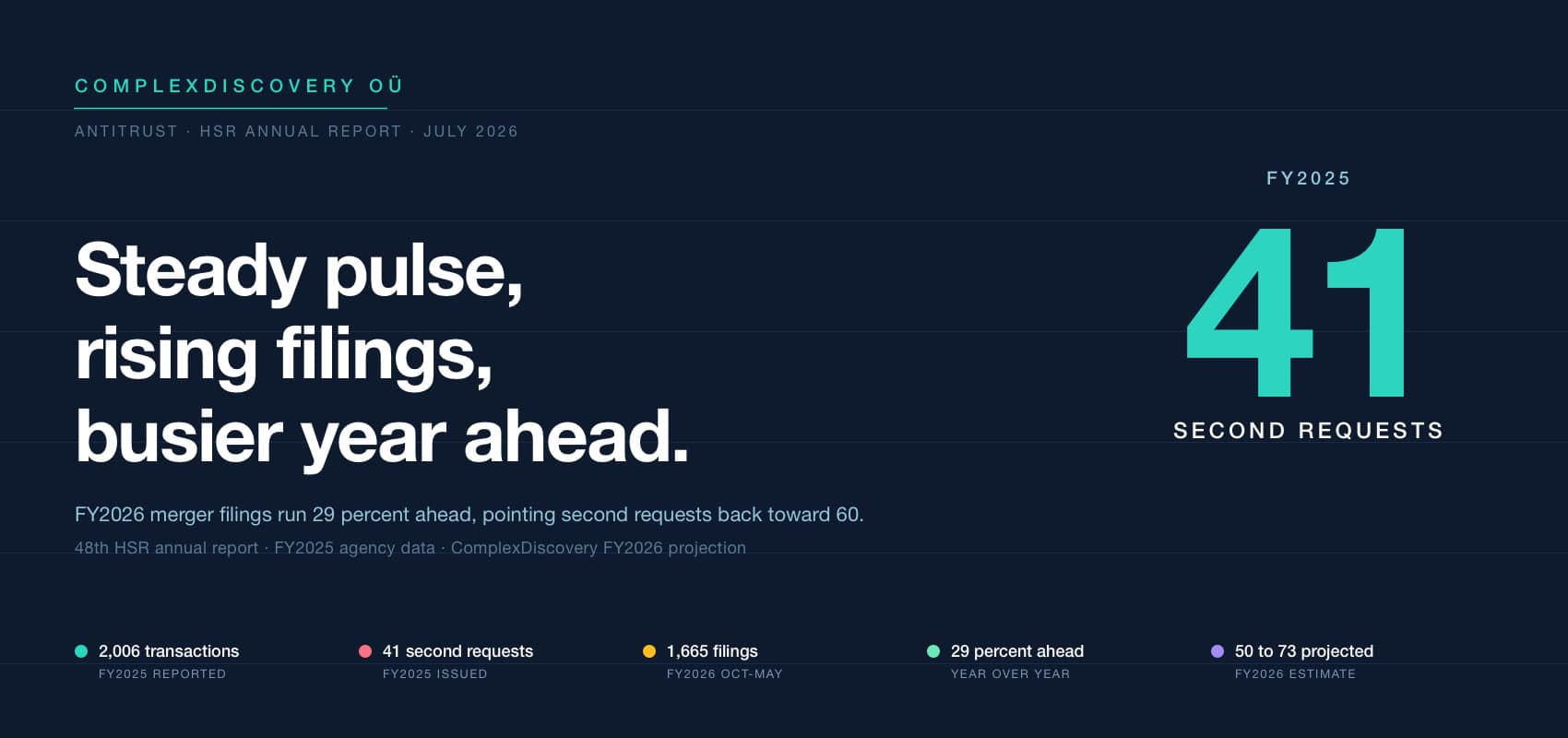
Federal antitrust regulators issued 41 second requests in fiscal year 2025, a 2.1 percent rate that lands squarely inside the narrow band the merger review process has occupied for a decade. The count matters less than the cadence. For the litigation support providers who staff these document-intensive investigations, the annual second request tally is one of the most important demand signals in the antitrust eDiscovery economy, and fiscal year 2026 filing data suggests the signal is strengthening.
The Federal Trade Commission and the Department of Justice Antitrust Division released their 48th annual Hart-Scott-Rodino report July 2, covering the fiscal year that ended Sept. 30, 2025. Companies notified the agencies of 2,006 transactions under the HSR Act during the year. Of the 1,944 adjusted transactions in which a second request could have been issued, 618, or 31.8 percent, were valued above $1 billion; the FTC issued 20 second requests and the Antitrust Division issued 21. Transaction counts remained generally in line with the past decade, the agencies said in the report.
A narrow band across a volatile decade
The decade of data in the report’s Appendix A tells a story of stability inside apparent volatility. Reported transactions swung from a pandemic low of 1,637 in fiscal year 2020 to a record 3,520 in fiscal year 2021, then settled back to about 2,000 per year from fiscal year 2023 forward. Second request counts moved far less. Across fiscal years 2016 through 2025, the agencies issued between 37 and 66 second requests annually, averaging about 51 per year. The rate oscillated between 1.6 percent and 3.0 percent of adjusted transactions, with a 10-year mean near 2.5 percent.
That range is the pulse rate. Deal volume can double, as it did in fiscal year 2021, without doubling second request output. The fiscal year 2021 data point is instructive: transactions surged 115 percent over the prior year while the issuance rate fell to 1.9 percent, its second-lowest level of the decade, suggesting that agency capacity, enforcement priorities, and matter complexity may constrain second request output even when deal volume rises sharply. The fiscal year 2025 rate of 2.1 percent was a step down from 3.0 percent in fiscal year 2024.
Enforcement intensity tells a parallel story. The agencies took 18 merger enforcement actions in fiscal year 2025, according to the FTC’s announcement of the report. An analysis by the American Action Forum, a policy group that favors lighter regulation, calculated that figure at 0.9 percent of adjusted transactions, the lowest share since 2005.
What one second request means for a provider
Each of those 41 investigations translated into one of the largest discrete eDiscovery engagements available in the legal services market. A second request obligates both merging parties to produce documents and data covering products, markets, and competitive effects, and the parties cannot close until they substantially comply. Compliance typically takes two to four months, can cost millions of dollars, and can extend deal timelines by 10 months or longer, according to guidance published by Thomson Reuters.
Document volumes at this scale dwarf routine litigation. One global provider that markets second request services and reports over 100 completed merger deals has described, as an analogous merger-control example, a recent United Kingdom investigation involving Vodafone and Three that required collecting, reviewing, and producing millions of documents from both companies. Review economics are unforgiving at those volumes. The Winter 2026 eDiscovery Pricing Survey from ComplexDiscovery OÜ and EDRM found human review rates concentrated in the 50 cents to $1 per document range, with generative AI-assisted review most frequently reported at 26 to 50 cents per document and meaningful clustering down to 11 cents. On a review of several million documents, the spread between those price points is measured in seven figures, which explains why second requests have become the proving ground for AI-assisted review at scale.
The scope of what must be reviewed keeps widening. Second requests now routinely reach collaboration platforms, chat applications, and other emerging data sources alongside email and shared drives, a shift that rewards merging parties with disciplined information governance programs and punishes those without defensible data maps when the clock starts.
Provider economics of a 40-to-65 pulse
For litigation support providers, the historical pulse creates a market that is simultaneously small in count and enormous in revenue concentration. Forty to 65 engagements per year, split across two agencies and dozens of merging parties, means a specialized provider that captures even five or six second requests in a fiscal year has anchored a material share of its annual revenue on antitrust work. A concentrated field of specialized providers markets dedicated second request practices, and the compressed timelines reward firms that maintain standing infrastructure: pre-negotiated review platforms, tested AI workflows, and surge review capacity that can scale to hundreds of reviewers within days.
The lumpiness cuts both ways. A fiscal year like 2023, when the agencies issued 37 second requests, the lowest count of the decade, tightens competition for every engagement. A rebound year like fiscal year 2024, with 59, absorbs available capacity quickly. Providers that treat the annual HSR report as a planning document rather than a news item can calibrate hiring, platform licensing, and partner relationships against the pulse instead of against anecdote.
Fiscal year 2026 filings point higher
The forward indicator now flashing is transaction volume. Preliminary monthly data from the FTC’s Premerger Notification Program shows 1,665 transactions reported in the first eight months of fiscal year 2026: 215 in October 2025, 227 in November, 232 in December, 180 in January 2026, 188 in February, 203 in March, 185 in April, and 235 in May. That pace runs 29 percent ahead of the 1,292 transactions reported in the same eight months of fiscal year 2025, according to final figures in the annual report. Two cautions belong next to that comparison. First, fiscal year 2025’s spring months may have been depressed in part as filers adjusted to the expanded HSR form that took effect Feb. 10, 2025, so some of the year-over-year gap likely reflects a weak baseline rather than pure acceleration. Second, monthly figures are preliminary until finalized in the annual report, and they tend to revise downward: the FTC posted 1,362 preliminary transactions for the same fiscal year 2025 months that the annual report later finalized at 1,292, a 5.1 percent reduction. Measured preliminary to preliminary, the fiscal year 2026 pace runs 22 percent ahead.
October through May has historically carried about two-thirds of full-year volume. In the seven years of the past decade without pandemic or merger-wave distortions, those eight months contributed between 62.4 percent and 68.3 percent of annual transactions. Applying that range to the fiscal year 2026 data yields a full-year projection of roughly 2,440 to 2,670 reported transactions, with a central planning estimate near 2,530, which would be the highest total since fiscal year 2022. After adjusting for transactions in which a second request could not be issued, historically about 96.7 percent of the reported total, fiscal year 2026 would produce roughly 2,450 adjusted transactions. If fiscal year 2026’s preliminary counts revise downward at the same 5.1 percent rate fiscal year 2025’s did, the projection shifts to roughly 2,310 to 2,530 reported transactions, with a central planning estimate near 2,400 and about 2,320 adjusted. Either basis would make fiscal year 2026 the busiest filing year since fiscal year 2022, if the projection holds.
The second request arithmetic follows directly. At fiscal year 2025’s 2.1 percent rate, the as-posted volume implies about 51 second requests. At the decade average of about 2.5 percent, roughly 60. At the 3.0 percent rate recorded in fiscal years 2016, 2019, 2020, and 2024, about 73. On the revision-adjusted basis, those scenarios run about 49, the high 50s, and 70. Any outcome in that range would exceed fiscal year 2025’s count of 41, and the upper scenarios would surpass the decade high of 66 set during the fiscal year 2021 merger wave. This projection is a ComplexDiscovery estimate built on preliminary agency data and historical ratios, not an agency forecast, and a continuation of the current administration’s lighter enforcement posture would argue for the lower end of the range.
The form fight complicates the forecast
One wildcard sits behind the filing surge. On Feb. 12, 2026, a federal district court in the Eastern District of Texas vacated the expanded HSR premerger notification form that had taken effect in February 2025, ruling the changes arbitrary and capricious under the Administrative Procedure Act. After the Fifth Circuit denied the FTC’s motion for a stay on March 19, the agencies returned to accepting the pre-2025 form, and client alerts from law firms including Kirkland & Ellis, Dechert, and White & Case advised merging parties that filing burdens had dropped substantially. A lighter filing burden lowers the cost of notification and may be one factor contributing to the fiscal year 2026 volume increase. The agencies opened a public comment period on the future of the premerger form March 25.
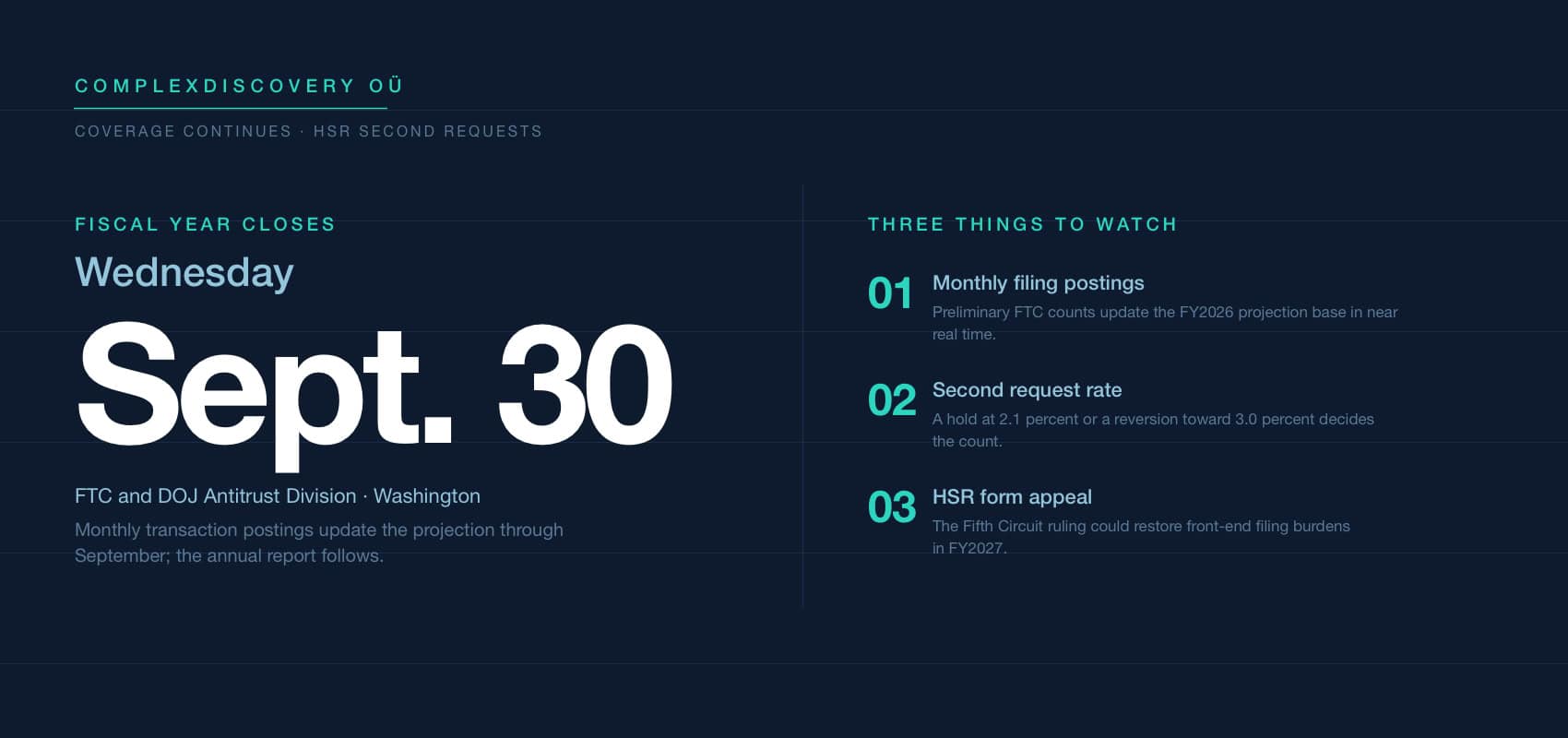
For providers, the practical takeaways sit at both ends of the process. Lighter initial filings mean less front-end document work per notification, shifting the revenue weight of merger review even further toward the second request phase. Rising notification volume expands the base to which the pulse rate applies. Providers should track the FTC’s monthly transaction postings, which update the base in near real time, and watch the comment period’s outcome, since a rebuilt form could restore front-end burdens in fiscal year 2027.
If the fiscal year 2026 projection holds and second requests climb back toward 60 or higher, will the litigation support market’s surge capacity, thinned by two quieter years, be ready when the next wave of clock-stopping demands arrives?





News sources
- Hart-Scott-Rodino Annual Report for Fiscal Year 2025 (Federal Trade Commission)
- FTC and DOJ Issue Fiscal Year 2025 Hart-Scott-Rodino Annual Report (Federal Trade Commission)
- DOJ and FTC Issue Fiscal Year 2025 Hart-Scott-Rodino Annual Report (U.S. Department of Justice)
- Premerger Notification Program: HSR Transactions by Month (Federal Trade Commission)
- District Court Vacates New HSR Rules, Fifth Circuit Denies Motion to Stay Order Pending Appeal (Kirkland & Ellis)
- Breaking: Fifth Circuit Denies FTC Stay; Pre-2025 HSR Rules Reinstated (Dechert)
- The Pricing Pulse: Document Review Insights from the Winter 2026 eDiscovery Pricing Survey (ComplexDiscovery)
- What You Should Know Before Filing the Hart-Scott-Rodino Act (Thomson Reuters)
- HSR Report Showed Early Terminations Are (Almost) Back (American Action Forum)
Assisted by GAI and LLM Technologies
Additional Reading
- HSR Act Reporting: A ComplexDiscovery Chronology
- FTC Annual Competition Reports (Hart-Scott-Rodino Act Reports)
Source: ComplexDiscovery OÜ

ComplexDiscovery’s mission is to enable clarity for complex decisions by providing independent, data‑driven reporting, research, and commentary that make digital risk, legal technology, and regulatory change more legible for practitioners, policymakers, and business leaders.