
Editor’s Note: A pristine plan no longer proves that anyone did the planning. Large language models now produce strategy decks, annual revenue and sales plans, marketing launch and engagement plans, migration roadmaps, incident response playbooks and discovery project plans on demand, and the polish of those documents is no longer reliable evidence of the competence behind them. This analysis connects a 2010 warning from H.R. McMaster about the illusion of understanding that slides create, and Dwight D. Eisenhower’s 1957 distinction between worthless plans and indispensable planning, to research published between 2025 and 2026 on workslop, developer productivity and stalled enterprise AI pilots.
For cybersecurity, information governance and eDiscovery professionals, the stakes are concrete: an incident response playbook is tested only during a breach, a retention schedule only under a litigation hold, and a discovery project plan only when collection scope expands. Each is now trivially easy to generate and quietly expensive to trust, and the same is true of the sales plan whose coverage ratios no one can defend, and of the launch plan generated outside the marketing function yet circulated as the organizational plan.
Watch for approval workflows that begin evaluating planners rather than plans, and for procurement teams that apply the same scrutiny to AI-polished vendor proposals. The organizations that adapt first will be the ones asking authors what they can defend without the document open.
Content Assessment: The great prompter has a plan for everything and an answer for nothing
Information - 94%
Insight - 95%
Relevance - 91%
Objectivity - 90%
Authority - 91%
92%
Excellent
A short percentage-based assessment of the qualitative benefit expressed as a percentage of positive reception of the recent article from ComplexDiscovery OÜ titled, "The great prompter has a plan for everything and an answer for nothing."
News Analysis – Artificial Intelligence Beat
The great prompter has a plan for everything and an answer for nothing
ComplexDiscovery OÜ Staff
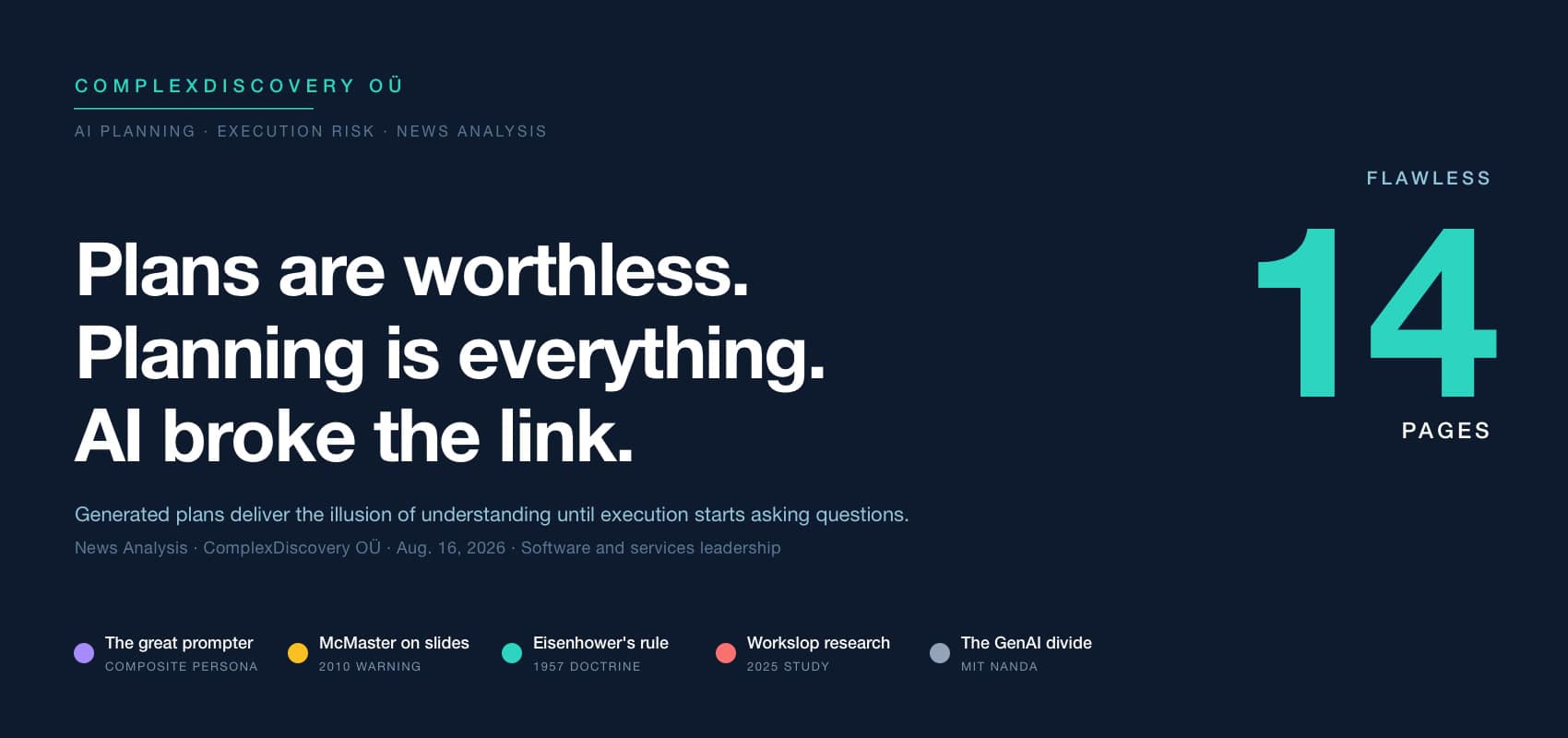
The plan arrived on time, ran 14 pages and read beautifully. Nobody in the room could explain it, least of all the person who wrote it, because no person wrote it.
That scene, or one like it, now plays out routinely inside technology-enabled software and service businesses, where large language models have made pristine planning documents available to anyone who can type a request. The strategy deck, the annual revenue plan, the migration roadmap, the incident response playbook and the discovery project plan can each be generated in minutes, fully formatted, confident in tone and untouched by the expertise the work will eventually demand. The document is real. The understanding behind it may not be.
Call the person who produces these artifacts the great prompter. He is a composite, not a colleague, assembled from patterns that researchers and managers have been describing since generative artificial intelligence entered the workplace in force. The great prompter delivers a polished plan for every initiative and can defend none of them. Asked why phase two precedes phase three, he re-reads his own document, searching it for the reasoning the way a stranger would. Asked what happens if the vendor integration slips, he offers to generate an addendum. The plan was never a record of his thinking. It was a substitute for it, and the substitution stays invisible until execution begins.
Revenue planning offers a particularly clear illustration. A generated annual sales plan arrives with everything a board expects: segmented quotas, territory carves, a 3-to-1 pipeline coverage ratio, ramp schedules for new hires and a quarter-by-quarter bridge from bookings to revenue. Ask the person who prompted it why coverage sits at 3-to-1 rather than 4-to-1 for a segment with nine-month sales cycles, or which churn assumption lives under the net revenue retention line, or how the ramp math moves if hiring slips a quarter, and the answers are not in the room. A veteran sales leader builds those numbers from scar tissue: deals lost to a discounting spiral, territories that looked balanced on paper and starved half the team, a forecast that collapsed because one enterprise logo carried 30 percent of the number. The great prompter has the spreadsheet without the scars, and a board that approves the plan is underwriting confidence that no one in the building holds.
Marketing suffers a second-order version of the problem. Launch plans and engagement plans are now generated not only by inexperienced marketers but by people outside the function entirely: a founder, a sales director or a product manager prompts a full product launch plan, tiered channel mix, influencer outreach, a 12-week engagement calendar with posting cadences and KPI targets, and circulates it as the organizational plan. The author has never run a launch, does not manage the function and could not explain why the calendar front-loads paid spend or what an engagement rate should be for the segment. But the document’s polish confers a borrowed authority, and it travels farther and faster than the expertise it bypassed. The marketing owner then faces a choice the format has rigged: adopt a plan built on no experience, or spend scarce credibility rebutting 14 pages of confident structure with the messier truths of budgets, sequencing and audience behavior. Generation without expertise was always cheap talk. Generation without standing turns cheap talk into an organizational document.
The slide deck warning that predicted this
The military saw this failure mode coming 16 years ago, in an earlier generation of pristine artifacts. In April 2010, Brig. Gen. H.R. McMaster, who had banned PowerPoint presentations while leading the effort to secure the northern Iraqi city of Tal Afar in 2005 and who would later serve as U.S. national security adviser, used remarks at a military conference in North Carolina to liken the software itself to a threat from within the force. The danger, McMaster said in a telephone interview with The New York Times, was that slides create “the illusion of understanding and the illusion of control,” and he added that not every problem can be reduced to a list of talking points. The rigid list of talking points was the format’s worst offense in his view, the Times reported, because it flattens the ways political, economic and ethnic forces act on one another. Gen. James Mattis, then the Joint Forces commander, told the same conference that the format made its users stupid.
McMaster’s complaint was never really about slides. It was about what a polished artifact does to the people who receive it: the packaging certifies that thinking occurred, whether or not it did. A briefing that compresses a war into talking points lets a room full of decision-makers feel informed while the interconnections that will decide the outcome go unexamined. Commanders quoted in that 2010 reporting worried that the format crowded out debate and careful judgment, and that it spared the briefer the harder work of building a written argument that could withstand questioning.
Every element of that critique transfers to machine-generated planning documents, with one aggravating difference. The PowerPoint briefer at least had to assemble the talking points, an act that forced some minimal contact with the material. The great prompter skips even that. A language model requires no task expertise to produce a plan that looks like the work of an expert, which means the artifact’s polish is no longer reliable evidence of the competence behind it. The illusion of understanding and the illusion of control have been decoupled from the labor that once produced at least a little of each.
What Eisenhower knew about worthless plans
Dwight D. Eisenhower gave the distinction its lasting form on Nov. 14, 1957, in remarks to the National Defense Executive Reserve Conference in Washington. “Plans are worthless, but planning is everything,” he said, describing it as an old Army saying. The former Supreme Allied Commander went further: because an emergency is by definition unexpected, the first thing to do when one arrives is to take the plans off the top shelf and, in his words, “throw them out the window.” But those who have not been planning, he said, cannot begin the work intelligently.
Eisenhower’s formulation explains precisely why the great prompter fails. The value of a plan was never the document. It was the planning: the hours spent steeped in the problem, mapping dependencies, arguing over sequence, discovering which assumptions were load-bearing. That work builds the judgment a team draws on when reality departs from the script, which it always does. A generated plan delivers the worthless half of Eisenhower’s equation while skipping the everything. When the emergency comes and the document goes out the window, the person who prompted it has nothing left, because the document was the only thing he ever had.
Software and services work supplies the emergencies on schedule. A migration hits an undocumented dependency. A key engineer resigns mid-sprint. The quarter’s anchor deal slips, and nobody can rework the coverage math because nobody built it. A retention schedule collides with a litigation hold, or a client matter expands the collection scope by an order of magnitude. Teams that did the planning absorb these shocks by reasoning from understanding. Teams holding a generated artifact discover that the plan cannot answer questions it was never the product of anyone asking.
Polished output, measurable drag
The costs are no longer hypothetical. Research published in Harvard Business Review in September 2025 by BetterUp Labs, the research arm of coaching company BetterUp, and Stanford University’s Social Media Lab gave the phenomenon a name, workslop, defined as AI-generated content that “masquerades as good work” without the substance to move a task forward. The six-author team included BetterUp chief scientist Kate Niederhoffer and Stanford communication professor Jeffrey Hancock. In the group’s survey of 1,150 full-time U.S. desk workers, roughly 4 in 10 reported receiving such content in the prior month, and recipients estimated spending nearly two hours dealing with each instance. Using self-reported salaries, the team put the cost at about $186 per employee each month, a figure the researchers pair with an estimate of over $9 million a year in lost productivity across a 10,000-person organization, a pairing that squares with the cost falling on the roughly 4 in 10 workers who report receiving workslop rather than on every employee. Recipients paid a second price in trust: 42 percent viewed the sender as less trustworthy afterward, about half rated the sender as less creative, capable or reliable, and a third said they were less inclined to work with that person again.
The illusion runs deep enough to fool even the producers. A randomized controlled trial published by the research nonprofit METR in July 2025 assigned 16 experienced open-source developers 246 real tasks in codebases they knew well. When the developers were allowed to use early-2025 AI coding tools, tasks took 19 percent longer on average. The developers had predicted the tools would make them 24 percent faster, and after the slowdown they still believed they had been about 20 percent faster. The study’s scope was narrow, covering experienced contributors in mature codebases, and METR reported in early 2026 that follow-up data showed some evidence of speedup while cautioning that selection effects made its estimates unreliable. The durable finding is the perception gap itself: confident self-assessments of AI-assisted productivity can be measurably, directionally wrong.
Organizational results follow the same pattern. A preliminary report from MIT’s Project NANDA, published in July 2025 and not peer-reviewed, drew on structured interviews with representatives of 52 organizations, survey responses from 153 senior leaders and a systematic review of over 300 publicly disclosed AI initiatives. It found about 95 percent of organizations getting zero return on generative AI despite an estimated $30 billion to $40 billion in enterprise investment, while just 5 percent of integrated AI pilots were extracting meaningful value. The report attributes the divide to a learning gap in tools and organizations rather than to model quality, and its lead author, Aditya Challapally, told Fortune that the rare successes pick one pain point and execute well. The tools generate; the organizations fail to translate. That is the great prompter’s failure, run at enterprise scale.
Why execution exposes the gap
A generated plan fails at a specific and predictable moment: the first time someone with executional responsibility asks it a question the document does not answer. Interpretation is where expertise re-enters the process. Translating a milestone list into staffing decisions, sequencing tradeoffs and risk responses requires exactly the domain fluency the prompt never demanded. The gap between artifact and ability stays hidden through the approval meeting, the kickoff and often the first status review, because those rituals evaluate documents. It surfaces when the work does.
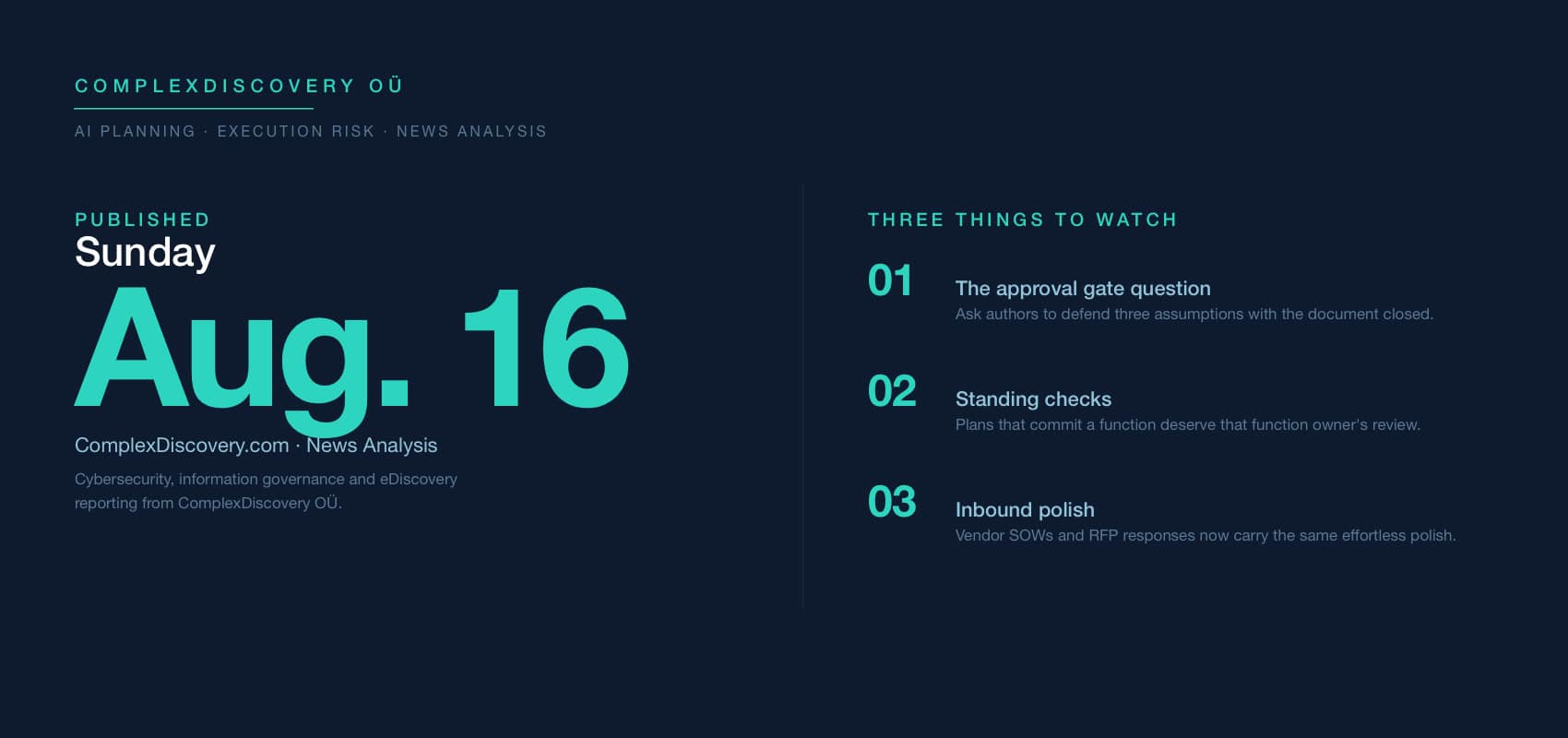
Leaders in software and services businesses can close the gap without banning the tools, and the fixes cost less than the failures. Evaluate planners, not plans: before approving any planning document, ask its author to defend the three riskiest assumptions without the document open, since an author who did the planning can and an author who prompted it cannot. Require the reasoning as a deliverable alongside the plan, in the author’s own words, because a paragraph of genuine rationale is harder to fake than 14 pages of structure. Check standing as well as substance: a planning document that assigns work to a function its author does not manage deserves that function owner’s review before it earns the word organizational. Stress-test in the room by changing one variable, a slipped date, a lost engineer, a doubled scope, a missed quarter, and watching whether the team reasons or regenerates. Applied to a sales plan, the same test asks the author for the coverage ratio, the ramp assumptions and the concentration risk in his or her own words, with the spreadsheet closed. And reposition the model as a sparring partner rather than a ghostwriter: teams that draft their own skeleton plan and use the tool to attack it keep the planning while still capturing the drafting speed. The same scrutiny belongs on inbound documents, because vendor proposals, statements of work and RFP responses can now be generated with the same effortless polish, and buyers of software and services should probe the people behind them just as hard.
Restoring the link between plan and planner
None of this is an argument against the tools. Drafting speed is real, and the MIT researchers’ point cuts both ways: if failure traces to a learning gap in organizations rather than to model quality, then the remedy lies in how organizations assign, review and own the work, which is within any leadership team’s control. The Stanford and BetterUp researchers reached a similar conclusion in later work, arguing that workslop flows less from lazy individuals than from management pressure to produce with AI absent clear norms for how.
The discipline that matters is restoring the link between authorship and understanding. Eisenhower’s Army aphorism assumed the link because in 1957 no other arrangement was possible: the only way to possess a plan was to have planned. Generative AI severed that connection, and the twin illusions McMaster warned about now come standard with every generated document, at near-zero marginal cost across the departments of technology-enabled businesses. The organizations that thrive will be the ones that treat a pristine plan not as evidence of readiness but as an open question about it.
When the next beautifully formatted plan lands in your approval queue, what will you ask its author to explain with the document closed?
News sources
- We Have Met the Enemy and He Is PowerPoint (The New York Times)
- Remarks at the National Defense Executive Reserve Conference, Nov. 14, 1957 (The American Presidency Project)
- AI-Generated “Workslop” Is Destroying Productivity (Harvard Business Review)
- Why People Create AI “Workslop” and How to Stop It (Harvard Business Review)
- Harvard Business Review warns AI workslop is rotting companies from the inside (The Next Web)
- A randomized trial by METR found experienced developers completed real coding tasks 19 percent slower with AI tools (ScienceBlog)
- MIT report: 95 percent of generative AI pilots at companies are failing (Fortune)
- Workslop: The Hidden Cost of AI-Generated Busywork (BetterUp Labs)
- Beware co-workers who produce AI-generated workslop (TechCrunch)

Assisted by GAI and LLM Technologies
Additional reading
- DoorDash AI inquiry turns model selection into a governance test
- Ninth Circuit vacates Amazon injunction; AI agent logs emerge as eDiscovery issue
- Federal magistrate judge treats LinkedIn’s Relativity aiR workflow as TAR
- One benchmark, three directions: 2026 legal rates rise, flatten and fall at once
- Confidence cools, commitment holds: full results from the 1H 2026 eDiscovery Business Confidence Survey
- Complete look: ComplexDiscovery OÜ’s 2025 to 2030 eDiscovery market size mashup
- The workstream of eDiscovery: Considering processes and tasks
- Andrew Haslam’s eDisclosure Systems Buyers Guide at 14: What the 1H 2026 update reveals
- A Complete Analysis of the Winter 2026 eDiscovery Pricing Survey
- The M&A Risk of Confusing Market Velocity with Marketing Capability
Source: ComplexDiscovery OÜ

ComplexDiscovery’s mission is to enable clarity for complex decisions by providing independent, data‑driven reporting, research, and commentary that make digital risk, legal technology, and regulatory change more understandable for practitioners, policymakers, and business leaders.