

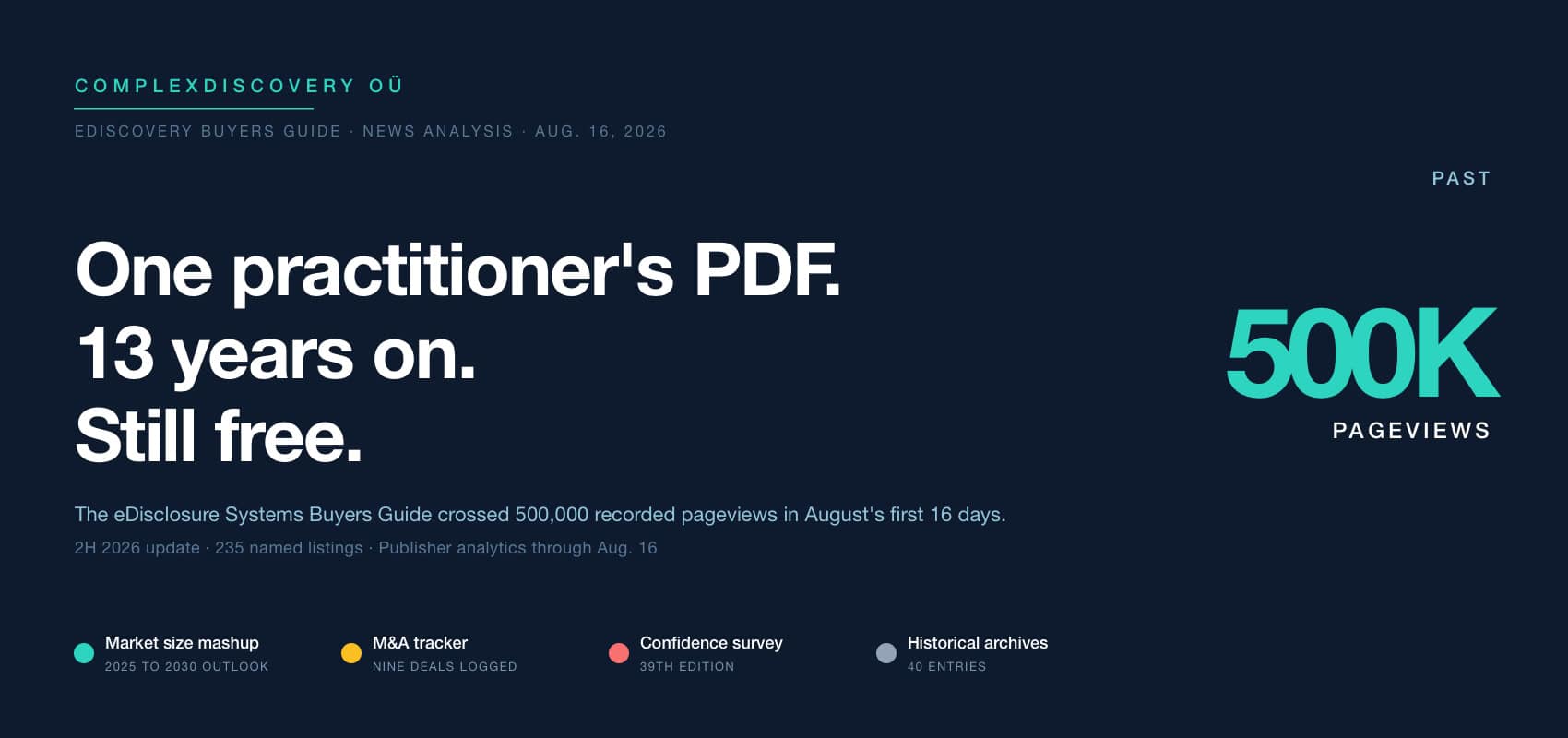
Editor’s Note: Andrew Haslam’s eDisclosure Systems Buyers Guide crossed its 500,000th recorded pageview in the first 16 days of August, by the publisher’s own unaudited analytics, and the 2H 2026 update captures the reference at that threshold: a catalog of 235 named listings, three new market analyses since April, and pageview volume running at double its January-through-July 2025 pace.
For cybersecurity, data privacy, regulatory compliance, and eDiscovery professionals, the update layer matters as much as the milestone. The 2025 to 2030 market mashup gives budget owners one citable mid-range number, the July M&A tracker identifies suppliers connected to recently announced transactions, and the 39th confidence survey pairs cooler respondent sentiment with benchmarks on AI deployment and AI-control documentation among its 49 respondents.
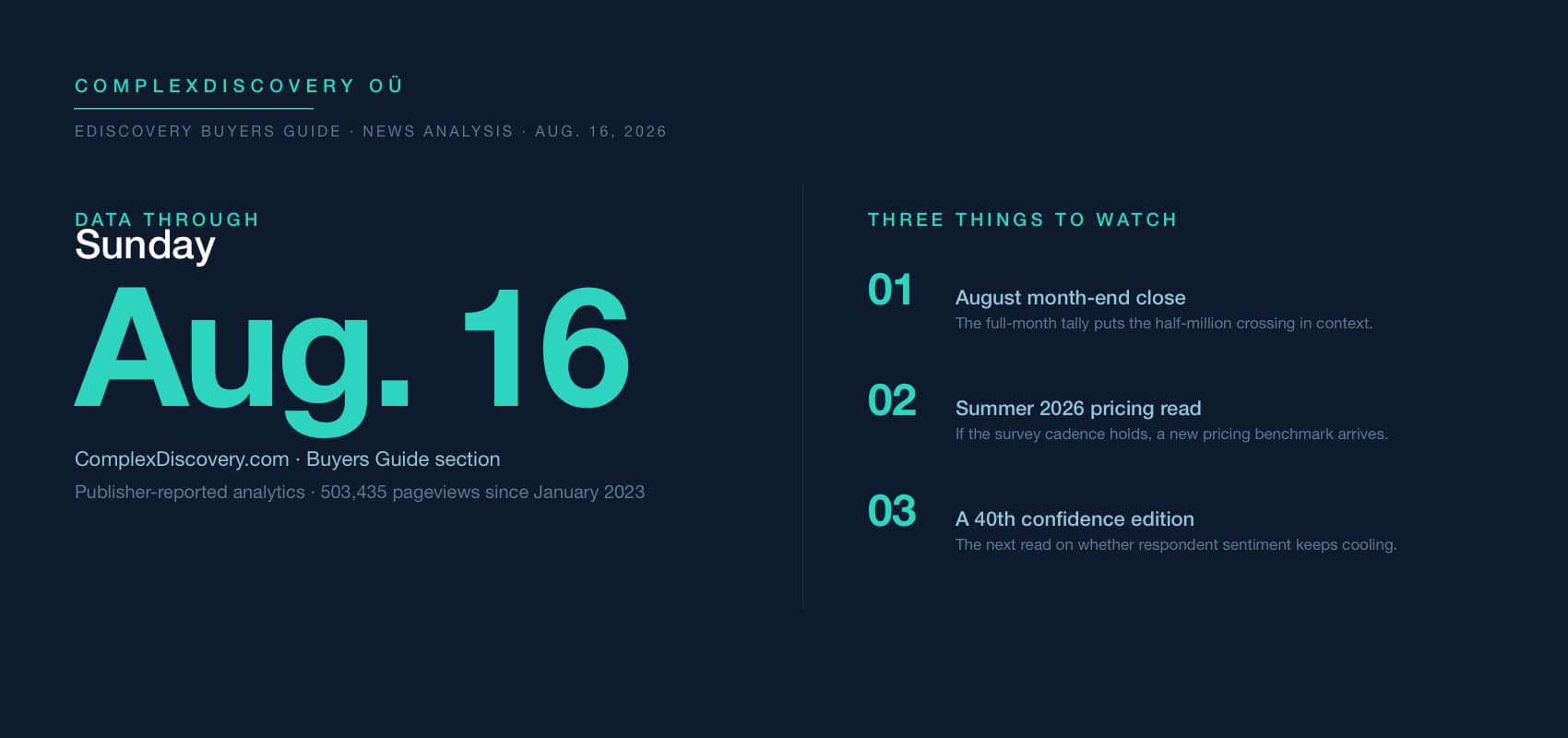
Watch three things next: the August month-end close that sets the milestone’s full context, a Summer 2026 pricing read if the survey cadence holds, and whether a 40th confidence edition extends the cooling seen among respondents. The guide began as one practitioner’s free PDF in 2013. The second half of 2026 finds it operating as market infrastructure.
Content Assessment: Half a million answers: the 2H 2026 update of Andrew Haslam's eDisclosure Systems Buyers Guide
Information - 94%
Insight - 94%
Relevance - 93%
Objectivity - 92%
Authority - 94%
93%
Excellent
A short percentage-based assessment of the qualitative benefit expressed as a percentage of positive reception of the recent article from ComplexDiscovery OÜ titled, "Half a million answers: the 2H 2026 update of Andrew Haslam's eDisclosure Systems Buyers Guide."
News Analysis – eDiscovery Beat
Half a million answers: the 2H 2026 update of Andrew Haslam’s eDisclosure Systems Buyers Guide
ComplexDiscovery Staff
Sometime in the first 16 days of August, Andrew Haslam’s eDisclosure Systems Buyers Guide quietly logged its 500,000th recorded pageview.
No banner marked the moment, and nothing on the page acknowledged it. The milestone passed the way reference traffic always does: one unremarked pageview at a time.
The arithmetic is short, and so is the disclosure that belongs beside it: ComplexDiscovery OÜ publishes the guide, publishes this analysis, and supplied the pageview figures, which no outside service audits. Those figures count 494,155 pageviews from the series’ start in January 2023 through July 31, and 9,280 more across Aug. 1 through 16, for a running total of 503,435. The 500,000th pageview therefore fell somewhere inside August’s first 16 days.
The 2H 2026 update arrives with that milestone crossed and a reference that kept building through the summer. Since the April update, the guide has added three market dynamics analyses while its displayed category totals rose from 164 to 168 under suppliers and from 68 to 69 under software. It has also posted the highest January-through-July total in that series: 160,340 pageviews, double the 79,840 recorded across the same seven months of 2025.
From personal project to standing market reference
Andrew Haslam compiled the first eDisclosure Systems Buyers Guide in 2013, a PDF assembled on personal time and released to the community without charge. A practitioner first and a publisher second, Haslam joined Squire Patton Boggs as an eDisclosure project manager in its London office in 2016, and he maintained the guide across a decade of annual editions, cataloging suppliers and software into what peers came to treat as a standing public reference. The editions grew into serious volumes. Chris Dale of the eDisclosure Information Project put the 2021 edition at 496 pages and described it as a reference built for finding the section that matters rather than reading cover to cover.
The 2022 edition was Haslam’s last as author. Doug Austin of eDiscovery Today reported at the time that the 450-page volume would be the final version in its existing form, with Haslam stepping away to spend more time with his wife and grandchildren. The guide’s stewardship passed to ComplexDiscovery OÜ in 2022, and in March 2023 the publisher announced the guide was expanding into a complete online knowledge base, replacing the annual PDF with a continuously updated reference. That announcement put the combined catalog of the day at 168 supplier and software offerings.
The April 2026 update called that transition generational rather than a retirement: the market had grown beyond any single author’s capacity to maintain, so the format changed so that the mission would not. The online edition is published today by ComplexDiscovery OÜ in collaboration with EDRM, with listings curated by Holley Robinson, senior marketing operations manager at ComplexDiscovery OÜ, supported by Mary Mack and the EDRM community. Mack, EDRM’s chief executive and chief legal technologist, described the guide in a 2024 release announcing
Three market dynamics additions since April
The second half’s new editorial weight landed on the market dynamics side of the guide, where three analyses joined the collection between late June and late July.
The June 26 entry, a complete look at ComplexDiscovery OÜ’s 2025 to 2030 eDiscovery market size mashup, reconciles public analyst estimates, vendor disclosures, and industry reference work into a mid-range view of the market: an estimated $19.61 billion worldwide in 2025, projected to reach $28.08 billion by 2030 at a 7.44 percent compound annual growth rate, with software growing at 10.41 percent and services at 5.75 percent. The same analysis, with every figure drawn from the publisher’s aggregation model, projects global data volume multiplying about 4.5 times over the period while the worldwide eDiscovery market grows about 1.4 times, a divergence budget owners can cite when a vendor’s pricing model assumes the two lines move together. For teams drafting 2027 budget memos, the mashup offers what scattered analyst decks do not: one citable mid-range number.
The July 14 update to the guide’s mergers, acquisitions, and investments tracker logged nine publicly announced transactions from Jan. 15 through July 9, 2026, and named the two themes that dominate its 2026 ledger: artificial intelligence capability and legal talent. The tracker has followed publicly announced deal events since November 2001, over 600 to date, under a broad market definition its own update calls not exhaustive. The practical read for buyers is simple. A vendor shortlist assembled in March needs rechecking against July’s deal sheet, because a supplier connected to a recently announced transaction may present integration, support, contract, and data-portability questions it did not present a quarter earlier.
The July 20 addition brings the 39th edition of the eDiscovery Business Confidence Survey, conducted by ComplexDiscovery OÜ in collaboration with EDRM, into the guide. Among its 49 respondents, 38.78 percent rated current conditions good, down from 59.38 percent among the 64 respondents of the prior edition, the largest half-to-half decline across the four editions the analysis reviewed. The survey describes itself as a targeted, nonprobability sample not designed to represent the entire industry, and it notes that changes between editions may reflect sample composition as well as sentiment. The same survey reported generative AI deployment at 69.39 percent of respondent organizations and AI-control documentation at 57.14 percent, figures worth benchmarking against a reader’s own governance posture before the next audit or client questionnaire asks first.
Technology area coverage holds at 16 entries, running from records information management and email archiving through technology-assisted review, led by the four analyses the April update introduced, including the Total Success Predictor Rating framework and its companion vendor-viability scoring tool. If the guide’s survey cadence holds, the second half brings a Summer 2026 pricing read and a 40th confidence edition.
A catalog of 235 named supplier and software listings
The listings remain the guide’s operational core. As of Aug. 16, the guide displayed category totals of 168 under suppliers and 69 under software, up from the 164 and 68 the April update reported on the same basis. Each total includes one administrative vendor-inclusion-request entry, leaving 167 named supplier entries and 68 named software entries, 235 in all.
The roster runs from global consultancies and forensic collection specialists to information governance platforms and review software. A security team pricing an incident-response collection, a records manager comparing email archiving approaches, and a litigation support director scoring review platforms are all working inside the guide’s coverage, which spans the cybersecurity, information governance, and eDiscovery disciplines. Curation continued through the summer, as evidenced by rising tallies, and the guide’s page records show listing entries for HaystackID, Venio Systems, and Digital DNA Technologies with June-to-early-August last-modified dates.
The guide’s own updates describe how experienced users work the listings: as starting coordinates rather than verdicts, read against public reporting and peer reference checks. Where those views agree, a shortlist firms up quickly. Where they diverge, the divergence itself is the finding.
Pageview growth that doubled the prior year’s pace
The pageview numbers give the 2H 2026 update its clearest storyline. The guide drew 89,930 pageviews across April through July, up 81.7 percent from the 49,500 recorded in the same four months of 2025. The trailing 12 months produced 262,100 pageviews, compared with 117,960 for the preceding 12 months, an increase of 122.2 percent. Every month since September 2025 has finished above 19,000, an 11-month floor without precedent in the series.
The annual arc runs in four acts. The series logged 81,377 pageviews in 2023, a first year lifted by a November surge to 20,777 that the published record leaves unexplained. It consolidated at 70,838 in 2024, then climbed to 181,600 in 2025. The first seven months of 2026 have already produced 160,340, or 2.26 times the full 2024 total, with October 2025’s 26,660 still the single-month high in the series and January 2026’s 26,370 close behind.
These figures are publisher-reported analytics from ComplexDiscovery OÜ, current through July 31, 2026, for the monthly series and through Aug. 16 for the August partial, and they extend the milestones earlier updates disclosed, including the April update’s report of over 321,957 pageviews accumulated since the start of 2024 and the August 2025 update’s report of a then-record 16,250-pageview June.
Record, snapshot, and precursor in one reference
The April update framed the guide as part current roadmap, part historical record. The months since have sharpened a third function: precursor.
As record, the guide carries a 40-entry historical archives section preserving the reference’s earlier eras, and the archive rewards comparative reading. A supplier that appeared in an early edition and appears again today has usually passed through a rename, a merger, or a repositioning along the way, and the listings quietly document the path. As a snapshot, the current catalog and the 2026 surveys offer separate present-day views of the listings, reported pricing, and participating respondents’ sentiment, refreshed continuously rather than at an annual print cycle. As a precursor, the 2025 to 2030 mashup projects where spending goes, the confidence series shows its respondents cooling, and the M&A tracker’s twin themes show which capabilities and teams appear in its announced 2026 deal mix.
For a reader opening the guide for the first time this half, the working path is short: read the 1H 2026 confidence results for sentiment, run an active vendor list against the July M&A tracker, and pull the mashup’s mid-range number into the next budget memo. The guide is open access, housed in the Buyers Guide section of ComplexDiscovery.com, and priced today the way Haslam priced the first edition: free.
That triple duty is the practical meaning of Haslam’s legacy. The gift was never the PDF. It was the standing expectation that somebody would keep the market legible for the people working inside it, and the 2H 2026 update shows the expectation compounding: more listings than the catalog carried in April, pageview volume at twice its year-earlier pace, and a research layer that now projects to 2030.
The 500,000th pageview looked like all the others in the log: a page served at no charge, the way the guide has worked since 2013. The crossing came in the 44th calendar month of the publisher’s analytics series. The total accumulated one recorded pageview at a time. What should the guide be when the log reads one million?
eDisclosure Buyers Guide Updates
- Andrew Haslam’s eDisclosure Systems Buyers Guide (ComplexDiscovery)
- Complete look: ComplexDiscovery OÜ’s 2025 to 2030 eDiscovery market size mashup (ComplexDiscovery)
- A strategy needs one dominant center of gravity (ComplexDiscovery)
- eDiscovery M&A tracker update: nine deals and two themes (ComplexDiscovery)
- Confidence cools, commitment holds: full results from the 1H 2026 eDiscovery Business Confidence Survey (ComplexDiscovery)
- Andrew Haslam’s eDisclosure Systems Buyers Guide at 14: What the 1H 2026 update reveals
- March 2023 Update: Andrew Haslam’s eDisclosure Systems Buyers Guide Online Knowledge Base (ComplexDiscovery)
- An In-Depth Look at the 2022 eDisclosure Systems Buyers Guide (eDiscovery Today)
- Andrew Haslam’s eDisclosure Systems Buyers Guide 2021 (eDisclosure Information Project)
- ComplexDiscovery OÜ and EDRM Release Enhanced 3Q 2024 Edition of Andrew Haslam’s eDisclosure Buyers Guide (EIN Presswire)

Assisted by GAI and LLM Technologies
Source: ComplexDiscovery OÜ

ComplexDiscovery’s mission is to enable clarity for complex decisions by providing independent, data‑driven reporting, research, and commentary that make digital risk, legal technology, and regulatory change more legible for practitioners, policymakers, and business leaders.