
Editor’s Note: A federal magistrate judge has given litigators their first close look at how a court handles generative artificial intelligence making final responsiveness calls, and the answer required no new law. In Schulte v. LinkedIn Corp., the court denied three plaintiff demands aimed at LinkedIn’s Relativity aiR workflow and treated the tool as a form of technology-assisted review under the case’s existing ESI order. The order is nonprecedential and tied to its record, which is exactly why the commentary matters: retired Magistrate Judge Andrew Peck, whose Da Silva Moore opinion opened the TAR era, describes it with DLA Piper colleague Reema Holz as the first federal decision to accept generative AI in that role.
Compliance, security and information governance teams should note what mattered: custodial volume materially influenced the proportionality decision, disclosure obligations began and ended with the protocol, and validation metrics were not compelled absent a specific deficiency. Watch the search-string conference the order required, the diverging AI confidentiality rulings, and the protocol language crossing your desk this quarter.
The rules held. The expectations moved.
Content Assessment: Federal magistrate judge treats LinkedIn's Relativity aiR workflow as TAR
Information - 93%
Insight - 92%
Relevance - 94%
Objectivity - 94%
Authority - 93%
93%
Excellent
A short percentage-based assessment of the qualitative benefit expressed as a percentage of positive reception of the recent article from ComplexDiscovery OÜ titled, "Federal magistrate judge treats LinkedIn's Relativity aiR workflow as TAR."
Industry News – Artificial Intelligence Beat
Federal magistrate judge treats LinkedIn’s Relativity aiR workflow as TAR
ComplexDiscovery OÜ Staff
A federal magistrate judge has looked at LinkedIn’s plan to let a generative artificial intelligence tool make final responsiveness calls and found nothing that required new rules.
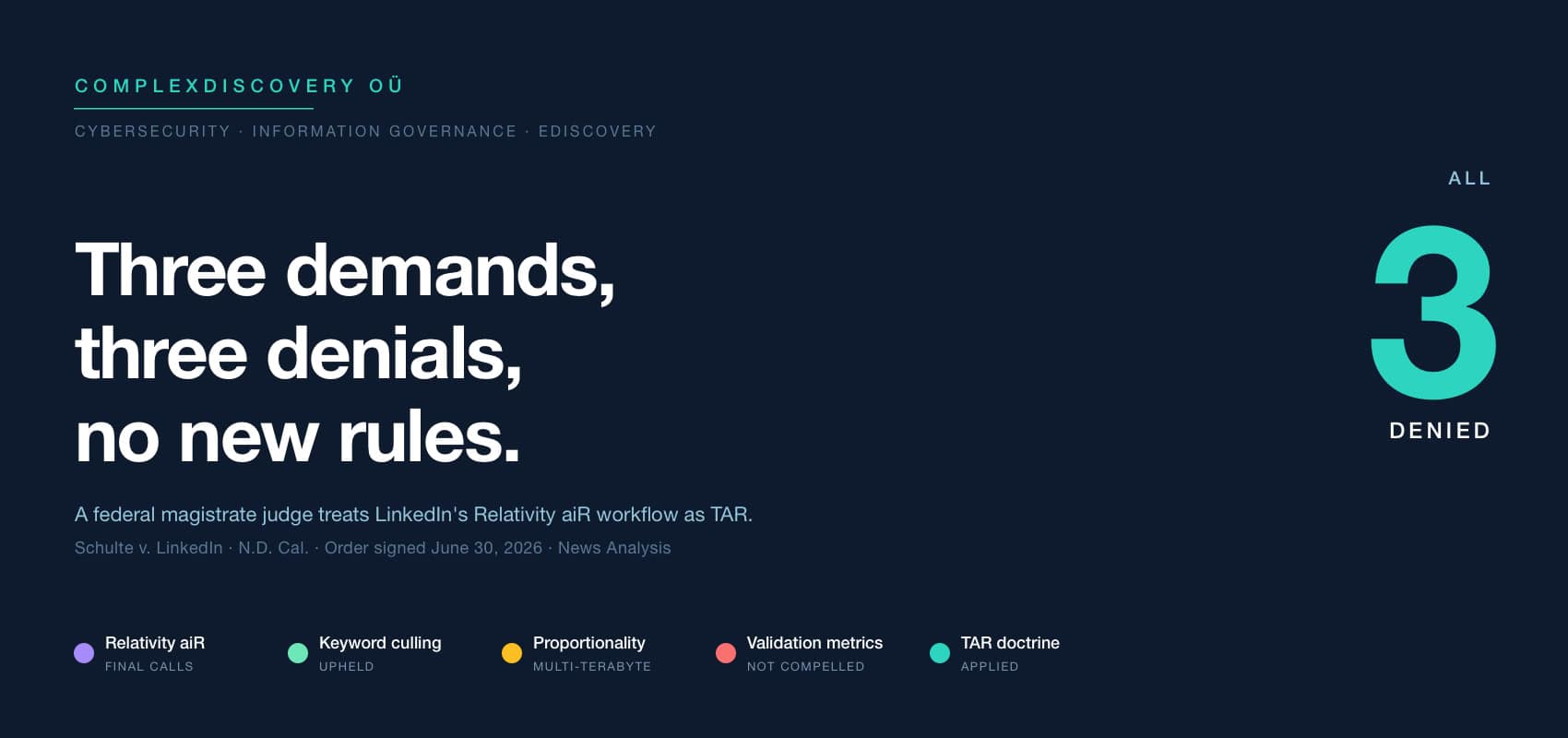
In a 12-page order in Schulte v. LinkedIn Corp., U.S. Magistrate Judge Laurel Beeler of the Northern District of California denied all three plaintiff demands aimed at the Relativity aiR workflow, treating the tool as a form of technology-assisted review, or TAR, under the discovery protocol the parties already had.
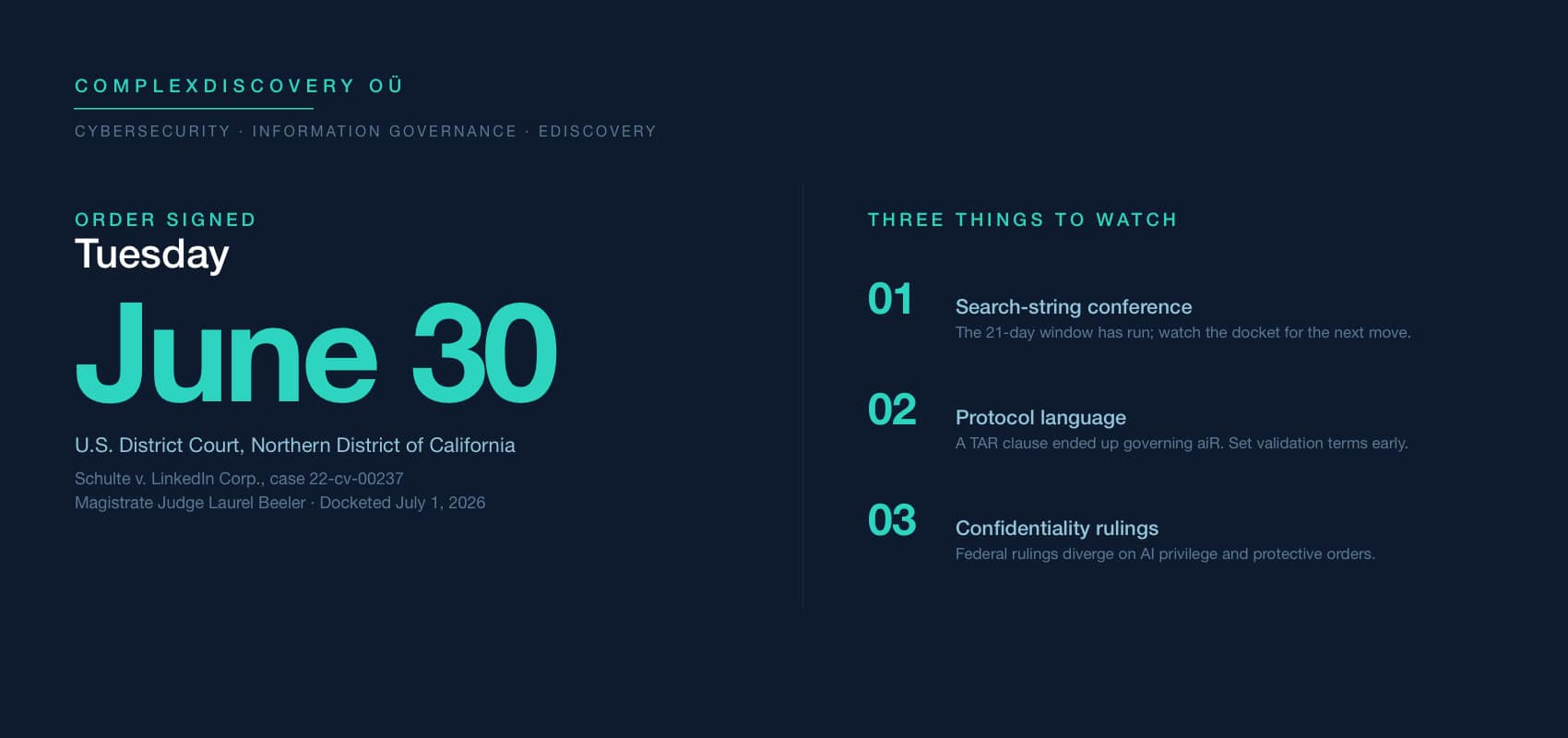
Beeler signed the order June 30, 2026, and it entered the docket the next day. It creates no precedent that binds another court, and it resolves one protocol fight on one record rather than blessing generative AI review at large. What it does is meet a closely watched test with the machinery that already exists: reasonableness, proportionality and the disfavored status of discovery on discovery.
The commentary treated that restraint as the news. Retired U.S. Magistrate Judge Andrew Peck, who wrote the 2012 opinion in Da Silva Moore v. Publicis Groupe that first approved technology-assisted review, and his DLA Piper colleague Reema Holz describe Schulte as the first federal decision to accept generative AI making the final responsiveness call in discovery. At least eight law firms and eDiscovery providers published analyses within a month of the order.
The underlying case is an antitrust class action, not a technology dispute. Todd Crowder, Kevin Schulte and Garrick Vance sued LinkedIn in January 2022, alleging the company monopolized the professional social networking market and overcharged Premium subscribers. The operative complaint, as the discovery order summarizes it, alleges LinkedIn offered potential rivals access to its private user data through application programming interfaces unavailable to others, on the condition that they not compete with LinkedIn, and tied its user data to parent company Microsoft’s Azure cloud product. U.S. District Judge Haywood S. Gilliam Jr. dismissed an earlier version of the complaint with leave to amend in 2023, then allowed the amended complaint to proceed in March 2024. A proposed class settlement failed to win preliminary approval in 2025, Reuters reported, returning the parties to litigation and to the custodial document discovery that produced this dispute in case number 22-cv-00237. Court records opened the matter as Crowder v. LinkedIn Corporation; the discovery order and the commentary around it carry Schulte’s name. The order itself resolved three discovery letter briefs at once, and the two that drew no commentary, a denied request to add an in-house attorney as a custodian and a denied demand for text message production, are a reminder that the aiR fight was one dispute among several.
Two disclosures in May
On May 15, 2026, LinkedIn gave plaintiffs its 25 search strings and disclosed, under the protocol’s TAR provision, that it would use Relativity aiR to help filter out non-responsive documents. After plaintiffs requested more information on May 23, LinkedIn disclosed that no seed or training set had been used, that aiR would make the final responsiveness calls and that humans would review samples drawn from each responsiveness category as quality control, the order recounts. The target review population contained 204,444 documents.
Relativity’s own documentation describes aiR for Review as a large language model application built on Azure OpenAI. Unlike classic predictive coding, aiR does not learn from a seed or training set; it analyzes extracted document text against natural-language prompt criteria, which Relativity recommends testing against human-reviewed samples. For each document, the tool returns a recommendation, citations to the underlying text and a rationale for the call.
The operative order on electronically stored information, or ESI, required parties to disclose whether they intended to use TAR to filter out non-responsive documents. Beeler found LinkedIn’s disclosures satisfied that provision and went beyond it, a fit law firm WilmerHale captured in the title of its client alert: “Old Rules, New Tools.”
Three demands, three denials
Within the aiR letter brief, plaintiffs asked the court to bar the search-string culling, to order aiR run across the complete files of all 19 custodians, and to compel disclosure of validation metrics, including elusion estimates, error rates and the number of human reviewers involved. Beeler denied each request.
On culling, the court held that using search terms to narrow a population before machine review satisfies the reasonableness and proportionality standards of Rules 26(b) and 34(b)(2), citing TAR-era decisions that approved the same sequence: In re Biomet from 2013 and Livingston v. City of Chicago from 2020. Plaintiffs had argued the strings would artificially shrink the reviewable population, but the court required evidence that specific strings were deficient rather than a general objection to culling. The order directed the parties to meet and confer on the search strings within 21 days.
On scope, the court found that forcing aiR across the full custodial files would be disproportionate. Two custodians’ files alone held about 800 gigabytes, and the complete set for all 19 custodians would run to multiple terabytes without the strings, volumes that carry processing, hosting and human review costs whatever tool reads the documents. Data volume, burden and total review cost remained material to the proportionality analysis even with generative AI at the center of the fight.
The ruling landed on a question the industry had queued up in advance. Complete Discovery Source had spent the spring asking, in a February leadership forum and an April webinar, whether generative AI’s falling review costs should rework the proportionality calculus. William Wallace Belt Jr. of the eDiscovery services provider read the order as the answer: on this record, cheaper machine review bought no one a bigger population. The order itself is narrower than the slogan, weighing Rule 26(b)(1)’s factors on these volumes and this showing rather than holding that falling AI costs can never move the analysis.
On validation, the court held that the ESI order required disclosure of TAR use and nothing further. Demands for elusion estimates and reviewer counts amounted to discovery on discovery, disfavored absent a specific production deficiency, and the order cited Taylor v. Google, a 2024 Northern District of California decision, for the doctrine. Plaintiffs pointed to the size of the target population; the court held the number alone did not warrant the inquiry.
The denial leaves an asymmetry in place. Elusion, the rate at which responsive documents slip through a review marked non-responsive, can only be measured with data the producing party holds. Under this order, a requesting party who wants those numbers must first show a specific gap in the production itself.
Old lineage, workaday authorities
In the aiR dispute, Beeler relied on the unglamorous authorities: In re Biomet and Livingston v. City of Chicago for culling ahead of machine review, and Taylor v. Google for the bar on discovery about discovery. The Sedona Principles surface later in the order, in the separate text-message dispute. The TAR trilogy Peck wrote from 2012 to 2016, Da Silva Moore, Rio Tinto v. Vale and Hyles v. City of New York, appears nowhere in it.
Commentators supplied that lineage themselves, and Peck is among them. Writing with Holz, he frames Schulte as extending Da Silva Moore’s principles rather than departing from them. The trilogy’s work, making computer-assisted review judicially acceptable, then routine, then a methodology choice that belongs to the responding party, is done; Beeler did not need to cite it for its assumptions to hold.
The pattern has an English cousin with narrower edges. In December 2025, the U.K. Competition Appeal Tribunal in Gormsen v. Meta Platforms declined to prescribe or forbid AI-assisted review, calling the technology neither experimental nor generally inappropriate where it supplements and assists human review under rigorous checks, while questioning whether large language model tools would scale to that case’s complexity, according to the law firm Burges Salmon. That is acceptance of AI as a helper under human review, a step short of the final-call workflow Schulte let stand.
The settled feeling extends only as far as responsiveness review. Law firms Akin and Sidley Austin have tracked diverging federal rulings this year on generative AI in privilege, work product and protective order disputes, including decisions restricting confidential material in publicly accessible AI tools. Responsiveness review now has a federal data point; the confidentiality questions around AI tools still do not.
The argument nobody made
The most consequential feature of the dispute may be what plaintiffs never challenged. None of the three requests contested LinkedIn’s plan to let aiR make the final responsiveness calls across the 204,444-document target review population, with responsiveness quality control conducted through human review of samples from each responsiveness category. Belt wrote that the sampling operated as a check on the machine’s determinations rather than a layer under a full human review.
Machine-made final calls are not themselves new. Predictive coding and continuous active learning have excluded unreviewed documents from production sets on the strength of model predictions and validation since the workflows Da Silva Moore approved. What is new is the decision-maker: a prompt-driven large language model, working without a training set, whose final calls no party asked the court to second-guess. That is the sense in which Peck and Holz describe the decision as a first. The order does not describe the privilege and confidentiality review that follows responsiveness, and nothing in Schulte suggests those layers disappear.
The shift still lands on certification. Rule 26(g) has never required counsel to read every document in a review population; it requires a signature certifying that a reasonable inquiry supports the response. When no human reviews most of the target population for responsiveness, the content of that reasonable inquiry moves into prompt design, sampling discipline and validation records. Counsel who cannot explain those choices will find the certification harder to defend than the workflow.
Putting the order to work
The ESI order in Schulte was drafted around TAR disclosure, and it ended up governing a generative AI workflow. Teams negotiating protocols today should write for that outcome deliberately, deciding at the start what validation exchange, if any, the parties owe each other, because analysis from Servient, an eDiscovery software provider, says parties who settle AI terms up front retain control over metric confidentiality while those who leave protocols silent invite open-ended fights.
Responding parties should read the chronology closely. LinkedIn’s May 15 disclosure was not volunteered; the protocol required it. The additional details the court recounted, the absence of a training set, the final-call design and the sampling plan, surfaced after plaintiffs asked for more on May 23. The lesson is responsiveness as much as generosity: a producing party that answers methodology questions promptly may build a record relevant to a later compulsion motion. James Park of DISCO, an eDiscovery technology provider that markets its own generative AI review tool, drew a kindred lesson from the order, and the DLA Piper analysis lists early methodology disclosure among its central takeaways. Preserving elusion tests, recall estimates and sampling records can support defensibility, although the burden depends on the review, and no rule in Schulte compels sharing them.
The order also hands assignments to the professions upstream of the protocol. Information governance teams control the volumes that materially affect proportionality disputes, and retention practices that defensibly reduce unnecessary custodial data shrink the next dispute before it starts. Security teams inherit a diligence question of their own: aiR runs extracted document text through a hosted large language model, so where that text travels, how long it persists and under what controls belong on the vendor review checklist. Relativity’s documentation states that Azure OpenAI retains no document data and that submissions are not used to train models for Relativity, Microsoft or any third party; diligence means testing those representations against the contract rather than taking either the fear or the assurance on faith.
Requesting parties inherit the harder assignment. Beeler placed the burden of identifying a specific production gap on the party seeking discovery about the review, so objections built on population size or general distrust of the technology will not open the door. Benchmarking a production against other sources, tracking missing custodians and documenting absent threads are now the price of admission to a validation fight.
As of early August 2026, the 21-day window for the search-string conference has run, and no further order on the strings has surfaced in the commentary. The ruling binds no one beyond the parties, and a different record, one with a documented production gap, could put elusion estimates in front of this court or another one. But the decision Peck and Holz call the first of its kind is on the books, scoped to its facts and pointing one way: the tools changed, and the rules held.
Which sharpens the question for every protocol negotiation this year: if an ESI order requires disclosure only of TAR use, and no specific deficiency has been shown, how much validation exchange should the parties write in at the start, and how much would you?
News sources
- Discovery Order, Crowder v. LinkedIn Corporation, ECF 203 (N.D. Cal., filed July 1, 2026) (Justia)
- Court Greenlights Generative AI for Document Review (DLA Piper)
- Old Rules, New Tools: N.D. Cal. Applies Traditional TAR Principles to Generative AI Discovery (WilmerHale)
- Court Declines to Give Generative AI Review Special Scrutiny, Treats It as TAR (Arnold & Porter eData Edge)
- Reality Check: We Asked About AI and Proportionality. A Court Just Answered. (Complete Discovery Source)
- A Court Backs Keyword Culling Before GenAI Review and Turns Away an AI Audit (Servient)
- “Search, Forward” with AI: Court Approves AI-Assisted Review Workflow for eDiscovery (HaystackID)
- AI-Assisted Disclosure: What Schulte v LinkedIn Tells Us About the Next Evolution of TAR (Burges Salmon)
- Schulte v. LinkedIn: Courts Treat GenAI Review as TAR (DISCO)
- aiR for Review Documentation (Relativity)
- Federal Courts Issue Diverging Rulings on the Use of Generative AI in the Context of Privilege, Work Product, and Protective Orders (Akin)
- Generative AI in Discovery: Protective Orders as an Emerging Point of Dispute (Sidley Data Matters)
- US Judge Rejects LinkedIn Antitrust Settlement, Citing ‘Serious Problems’ (Reuters via TradingView)
- LinkedIn Monopoly Class Action Escapes Dismissal (Top Class Actions)
- Crowder v. LinkedIn Corporation Docket 22-cv-00237 (CourtListener)

Assisted by GAI and LLM Technologies
Additional reading
- One benchmark, three directions: 2026 legal rates rise, flatten and fall at once
- Confidence cools, commitment holds: full results from the 1H 2026 eDiscovery Business Confidence Survey
- Complete look: ComplexDiscovery OÜ’s 2025 to 2030 eDiscovery market size mashup
- The workstream of eDiscovery: Considering processes and tasks
- Andrew Haslam’s eDisclosure Systems Buyers Guide at 14: What the 1H 2026 update reveals
- A Complete Analysis of the Winter 2026 eDiscovery Pricing Survey
- The M&A Risk of Confusing Market Velocity with Marketing Capability
Source: ComplexDiscovery OÜ

ComplexDiscovery’s mission is to enable clarity for complex decisions by providing independent, data‑driven reporting, research, and commentary that make digital risk, legal technology, and regulatory change more understandable for practitioners, policymakers, and business leaders.