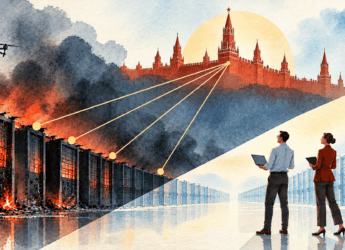

Editor’s Note: Three claims about one morning near Omsk reached the public record on Aug. 2, and the Institute for the Study of War relayed all three without reconciling them. Elsewhere in the same assessment ISW cited geolocated footage. For Omsk it did not, and that one distinction carried the whole claim.
Cybersecurity, information governance and eDiscovery professionals should read this as a case study rather than as war coverage. The failure modes are ones they already audit for: severity language drifting from the underlying artifacts, escalation paths that reward the expected answer, synthetic media offered as proof of events that did not happen, and platform-hosted evidence facing a government block with no preservation plan behind it.
Four things to watch. Whether Russia moves from charging Telegram’s founder to blocking the platform, which would put a deadline under anyone collecting from it. Whether Russia’s claimed advances keep diverging from measured ones, given that ISW puts even Moscow’s own claimed rate at about footpace. Whether AI-generated battlefield footage keeps being caught by visual analysis rather than detection tooling. And whether official and unofficial Russian accounts of the same incident keep diverging as they did here.
Content Assessment: Three accounts from one wartime morning in Russia
Information - 93%
Insight - 91%
Relevance - 90%
Objectivity - 90%
Authority - 92%
91%
Excellent
A short percentage-based assessment of the qualitative benefit expressed as a percentage of positive reception of the recent article from ComplexDiscovery OÜ titled, "Three accounts from one wartime morning in Russia."
Industry News – Geopolitics Beat
Three accounts from one wartime morning in Russia
ComplexDiscovery Staff
Footage published Aug. 2 reportedly showed smoke rising from the Omsk Oil Refinery. The regional governor said falling drone debris had caused a fire in a field near Omsk City.
A Russian milblogger said Ukrainian drones did not reach the refinery at all. Three claims from one morning, and the Institute for the Study of War relayed all three without reconciling them.
How ISW handled them is the story. Among the sites for which its Aug. 2 assessment cited geolocated footage were a fire near the Saratov Oil Refinery, smoke at the Bashneft refinery in Ufa, a fire near the Engels-2 strategic bomber base, and smoke at a Wildberries warehouse in Samara Oblast. For Omsk, the same document said only that footage reportedly showed smoke rising from the refinery. One qualifier separates footage ISW described as geolocated from footage it only relayed, and it carries the entire evidentiary weight of the claim. Look again at the three claims and the line gets finer still. They are not even about quite the same thing. A field near Omsk City is not the refinery, and smoke is not a strike.

Where a euphemism becomes the record
Omsk Oblast Governor Vitaly Khotsenko said drone debris caused a fire in a field near Omsk City. Radiy Khabirov, who heads the republic of Bashkortostan, said air defenses had turned back a major drone attack and downed a single drone above an industrial area of Ufa, and that a fire started afterward. Note the grammar in both. Something fell, something burned, and nobody struck anything.
Khabirov had said much the same thing the day before. On Aug. 1, after Ukraine’s security service reported striking three Bashneft refineries in Ufa, he said forces had repelled a drone strike but that a downed drone hit the city’s industrial zone. Same official, same construction, two consecutive days, two separate strike reports. ISW characterizes such claims from Russian officials as repeated, and wire copy out of Russia has carried the construction for months. A phrasing that survives that kind of repetition is not a description. It is a policy.
The complaint about it now comes from inside. On Aug. 2, a Kremlin-affiliated military blogger, or milblogger, faulted the authorities for refusing to describe the country’s situation candidly in public. His specific objection was to the vocabulary. Officials keep attributing damage to wreckage falling from intercepted drones and missiles, he said, rather than saying that Ukrainian strikes had succeeded. He added that Ukraine’s long-range strikes had not decreased for a second month running, and that a high interception rate was no guarantee of safety for infrastructure behind the lines.
What makes the euphemism effective is that debris is real. Ukraine’s own air force logged debris falls at three locations on the night of Aug. 1 to 2, when Russia launched 133 drones and loitering munitions, a mix ISW itemized as Shahed, Gerbera and Italmas strike drones, Banderol loitering munitions and Parodiya decoys. Ukrainian forces downed 109, and 24 struck 19 locations. Falling wreckage is a real category of harm, which is precisely what makes the phrase serviceable. The defect is not the word. It is using an accurate category to absorb a different event, which is harder to detect than a fabrication and considerably harder to correct later.
Records professionals should recognize the mechanism, because it does not require a war. A euphemism repeated across enough reports stops being a word choice and becomes the data. Incident reports that say “service degradation” when they mean “intrusion” produce trend analysis measuring vocabulary rather than risk. Security teams have a familiar version: severity shaved by one grade at each escalation, “no evidence of exfiltration” standing in for “we did not have the telemetry to look,” and a quarterly summary that reaches the board describing a well-managed quarter, assembled in perfect good faith from documents each defensible on its own. The corrective is unglamorous and specific. Audit the language of your incident record against the underlying artifacts on a sample basis, and treat a downgrade between tiers as an event needing its own justification rather than a routine act of summarization.
A reporting chain optimized for the answer above it
The deeper finding landed on July 31. Restating it in the Aug. 2 assessment, ISW wrote that Russia’s Northern Grouping of Forces and high military command “are likely lying to the Kremlin about the extent of Russian gains in northern Ukraine in order to further the narrative that Russian forces are actively advancing across the entire theater.” The section of front at issue has barely moved in nearly two years. Battlefield evidence does not back the claimed gains in northern Sumy and Kharkiv oblasts, ISW assessed, and Ukrainian troops have been counterattacking in some of the places Russia says it captured.
ISW assessed that the Kremlin then uses those inflated internal claims outward, as part of an effort to persuade Ukraine’s partners that the war is lost and their support is wasted. Russian Defense Minister Andrey Belousov described the capture of Mohrytsya, a village with a reported prewar population of about 850, as a strategic success.
The next day’s assessment put numbers to the gap. Russian forces advanced in 37.85 square kilometers of Ukraine in July 2026, an area ISW notes is smaller than Manhattan, for an average of 1.22 square kilometers a day. Counting infiltrations as well, the figure reaches about 121.56. ISW’s own year-over-year comparison is the starker one: even that combined figure is a fraction of the 455.74 square kilometers Russian forces seized in July 2025. The Ukrainian General Staff put Russian losses for July at 42,860, a monthly high for the war, which works out to 1,132 casualties for every square kilometer seized. Every derived figure in that assessment reconciles against its own base values when you run the arithmetic, which is worth saying plainly about a source this article leans on heavily.
Against that record, the Russian Defense Ministry and the Kremlin newswire TASS spent July 31 making what ISW called exaggerated claims about how many settlements had been taken in the month. Counting every advance, every infiltration and every assertion together, ISW put the rate at 18.49 square kilometers a day, and then did the thing the whole article is about. It stated what the claim would have to mean. “But even the Kremlin’s most extensive claims do not have Russian forces advancing faster than footpace, a rate of advance far slower than the Kremlin would need to collapse Ukrainian lines and rapidly seize the areas Moscow reportedly aims to capture by the end of 2026,” the Aug. 1 assessment says. The exaggeration is not manufacturing a breakthrough. It is manufacturing a slightly faster walk. ISW also assessed that the effort likely aims in part to persuade Russians that the casualties, the economic strain, the Ukrainian strikes inside Russia and the censorship have been worth it.
What makes this instructive rather than merely damning is who joined the challenge. Ukrainian formations disputed the Russian claims, as you would expect. Kremlin-aligned military bloggers did too, refuting their own side’s account in public. ISW documented the same phenomenon in January 2026 around Kupyansk, where pro-war bloggers complained about what they called beautiful reports, meaning polished claims of progress sent upward that ground conditions did not support. The consequences they described were operational: countermeasures based on a false picture, coordination failures, and casualties in the hundreds.
That is the part worth carrying into a compliance review. A reporting chain that rewards the answer leadership wants will supply that answer, and the damage does not arrive as an obvious lie. It arrives as resource allocation built on a map that no longer matches the ground.
Proof manufactured to order
The fabrication has moved past wording. On July 27, Russian sources circulated video purporting to show a Russian servicemember raising a flag at Bilyi Kolodyaz in Kharkiv Oblast, offered as confirmation the settlement had been taken. ISW assessed the footage was likely generated or altered using artificial intelligence.
The open-source research project GeoConfirmed said it identified the manipulation, and the Ukrainian mapping project DeepState reported the settlement remained under Ukrainian control. The indicators analysts described were mundane rather than exotic. The soldier vanished partway through the clip, and one researcher put his apparent width at roughly three meters before he disappeared. In a second video attributed to Khrystoforivka, analysts flagged a soldier without a helmet, a flag unfurling in the absence of wind, and a figure whose head disappeared before the rest of him did.
This is not new, and that is the point. ISW reported in May 2026 that Russian sources were increasingly distributing AI-generated flag-raising videos as offensive progress slowed, and in June assessed that flag-raising footage from Kostyantynivka and the nearby village of Dovha Balka may have been AI-generated.
Russia is working the same broad class of technology in the opposite direction at the same time, though the evidence for it is thinner and should be read that way. ISW reported on July 29 that a Ukrainian commander said Russian forces were attempting to equip Molniya fixed-wing first-person view drones with machine vision and AI-enabled targeting. On Aug. 2 it relayed an assessment by the Ukrainian defense outlet Militarnyi, drawn from recently published photographs, that Russia’s jet-powered Geran-4 drones had been reworked to house an optoelectronic guidance system, alongside a fixed camera that open-source analysts identified as a Chinese 180-degree wide-angle unit. Neither is a confirmed fielded capability. One reported line of Russian effort seeks to equip machines to identify targets from real imagery. Another circulates imagery made to be believed rather than verified. Both are running at once. That is roughly where authentication sits in ordinary commercial matters now too.
Evidence on a clock, cargo on a manifest
On July 29, Russia’s Federal Security Service charged Telegram founder Pavel Durov with aiding terrorism under Article 205.1 of the Russian Criminal Code, an offense carrying a possible life sentence, and placed him on an international wanted list. The FSB said Telegram had failed to remove channels that it said Ukrainian intelligence services used to organize sabotage, killings and fraud inside Russia. Telegram declined to comment at the time. Durov has previously called comparable allegations a pretext for suppressing privacy and speech.
ISW assessed that the Kremlin is continuing to set conditions to block Telegram and to close off the open internet in Russia, and that the move may also support efforts to manage public backlash should compulsory mobilization follow. Those qualifiers are ISW’s, and they belong in any restatement of the claim.
Follow the sequence. The military reporting chain produced claims its own supporters could not accept. Those supporters said so on Telegram. The state is now positioning to remove Telegram. Whether or not suppressing that dissent is a motive, a block would have that effect, and it would arrive as a preservation problem with a deadline. Content on a platform a government is setting conditions to block is evidence on a clock. Anyone whose matters touch this record should be collecting it now, with provenance captured at collection rather than reconstructed later.
Classification does comparable work in physical logistics. Samara Oblast’s governor and the Wildberries press office both confirmed that Ukrainian forces hit one of the company’s warehouses on Aug. 2. Wildberries is a major Russian online marketplace, which ISW calls the country’s closest equivalent to Amazon, and by ISW’s count the strike was the 17th against its facilities since July 18. Separately, ISW relayed a claim from Ukrainian officials on July 30 that Wildberries logistics centers supply the Russian military with drone components and navigation equipment. Nothing in the reporting establishes that the warehouse hit in Samara Oblast held any such goods, and nothing here should be read to suggest it did. But whether a given warehouse is retail infrastructure or military logistics is a records question before it becomes a targeting question, and the answer lives in shipping documentation. Compliance teams running dual-use screening against commercial logistics data are working that same problem with lower stakes and better lawyers.
When the vacuum fills itself
The pattern repeated on Aug. 1 in central Moscow, where an improvised explosive device detonated at Balzi Rossi, an Italian restaurant on the ground floor of a Stalin-era tower. Russia’s National Antiterrorism Committee put the toll at three: the woman who brought the device in, wrapped as a present, a security guard, and a diner. Twenty-one people were hurt. No identities were released, and no responsible party was named.
Baza, a Russian outlet with ties to Russian law enforcement, then reported that two of the wounded had died, which put the count at five. That higher figure came from Russian media and law-enforcement-linked Telegram channels rather than from an official announcement, and Russian reporting later settled there, according to Kyiv Post and Ukrainska Pravda. The unofficial figure arrived first and held. The business daily Kommersant reported that security at the party was heavy, and that Federal Protective Service officers were there off duty. Insider Russian sources said the intended target may have been Russian Aerospace Forces Commander Col. Gen. Alexander Chayko, reportedly marking his 55th birthday. His condition went unstated for two days while those sources speculated. The Moscow Times reported on Aug. 3 that he was alive and unharmed.
Then the vacuum filled from an unexpected direction. On Aug. 3, the day this article published and a day after the assessment it draws on, the Russian Embassy in Rome blamed the bombing on what it called Kyiv terrorists, saying the attack was meant to frighten Italians working in Russia. It offered no evidence, and Ukrainian authorities had not commented. The embassy also gave a casualty count of five killed and 19 injured, a figure that does not match the 21 wounded Russia’s own National Antiterrorism Committee had reported two days earlier.
Watch what just happened to the record. For two days the official account was accurate as far as it went and silent past that point, and unofficial channels filled the silence with a death toll that later held. On the third day a diplomatic mission filled the remaining gap with an attribution and a revised injury count, neither evidenced, neither from the investigators. Incomplete records do not stay incomplete. They get completed by whoever is willing to fill them, and the filler sets the terms.
What a defensible record actually looks like
Set the Russian reporting chain beside ISW’s and the contrast is procedural rather than ideological. Every assessment carries the same published methodology statement: “ISW does not receive any classified material from any source, uses only publicly available information, and draws extensively on Russian, Ukrainian, and Western reporting and social media as well as commercially available satellite imagery and other geospatial data as the basis for these reports.”
ISW provides endnote references for the sources used in each assessment. Uncertainty is signaled through estimative language, words like likely, possibly, claimed and confirmed, so a reader can tell an observation from an inference. ISW publishes no formal confidence scale; the discipline is in the vocabulary. And each assessment states plainly what it does not cover, disclosing that ISW does not report in detail on Russian war crimes, giving its reason, and condemning those violations even while declining to document them. Publishing the boundaries of your own coverage costs almost nothing, and it is worth adopting in any reporting that someone will rely on later.
None of this is exotic. It is the same discipline behind the Berkeley Protocol on Digital Open Source Investigations, which the Human Rights Center at the University of California, Berkeley, School of Law and the Office of the United Nations High Commissioner for Human Rights launched in English in December 2020 and issued as a United Nations publication in 2022. It sets out how investigators should collect, assess and preserve digital open source material in cases involving international criminal, human rights and humanitarian law. It is guidance rather than law. Its value is that it made the expectations explicit, which is exactly what an organization cannot do after the fact.
Applying the same test to these sources
Fair use of that standard requires turning it on this article. ISW is not a neutral instrument; it is a Washington-based research institution with a declared position on the war, and its assessments are arguments as well as records. The milbloggers whose dissent carries much of the argument above are not auditors either. They are a pro-war constituency who want the war prosecuted harder, which gives them a motive to publicize failure that has nothing to do with candor. Ukrainian strike claims here come from Ukrainian commanders, and DeepState is a Ukrainian project. Each source is useful. None is disinterested.
Retrieval provenance matters as much. This article draws on five consecutive daily assessments, July 29 through Aug. 2. The Aug. 1 and Aug. 2 were read as raw text. The July 29, 30 and 31 assessments came through a tool that summarizes pages rather than returning them, so their wording is a paraphrase of a paraphrase. That is why nothing from those three days appears here inside quotation marks, and why all three quoted passages come from the two documents read in full. A prepublication review against the primary assessments found that same layer had stripped qualifiers from several technical claims; they were restored before publication. Figures and assessments here are current as of ISW’s Aug. 2, 2026 assessment, except for the Aug. 3 developments in Moscow, which are dated in the text. A reader is entitled to know which claims rest on which footing, and the distinction is invisible unless someone writes it down.
Which brings the question back to Omsk. Somewhere a file now records that a fire started in a field, and that record will outlive everyone’s memory of the morning. Every organization has an Omsk: an incident where the official file says one thing, the people closest to it say another, and no one reconciles the two. So the question to carry into your next audit is not whether your reports are accurate. It is whether anyone in your reporting chain is rewarded for saying so when they are not.

News sources
- Russian Offensive Campaign Assessment, August 2, 2026 (Institute for the Study of War)
- Russian Offensive Campaign Assessment, August 1, 2026 (Critical Threats Project, ISW and AEI)
- Russian Offensive Campaign Assessment, July 31, 2026 (Critical Threats Project, ISW and AEI)
- Russian Offensive Campaign Assessment, July 30, 2026 (Critical Threats Project, ISW and AEI)
- Russian Offensive Campaign Assessment, July 29, 2026 (Critical Threats Project, ISW and AEI)
- Russia charges Telegram founder Pavel Durov with aiding terrorism (JURIST)
- OSINT analysts say Russian military used AI to fake territorial gains in Ukraine (The Insider)
- Blast at Moscow Restaurant Kills 5 Amid General’s Party (Kyiv Post)
- Russia Turns to AI Videos to Fake Battlefield Success Near Kostiantynivka, ISW Says (UNITED24 Media, restating ISW)
- Berkeley Protocol on Digital Open Source Investigations (UN Office of the High Commissioner for Human Rights)
- Berkeley Protocol gives guidance on using public digital info to fight human rights abuses (OHCHR, December 2020 launch notice)
- What We Know About the Deadly Moscow Restaurant Attack (The Moscow Times, Aug. 3, 2026)
- Russian Embassy in Rome blames Ukraine for deadly Italian restaurant bombing in Moscow (The Associated Press via ABC News, Aug. 3, 2026)
- Kremlin charges Telegram CEO and prepares for possible ban ahead of mobilization (Mezha, restating ISW)

Assisted by GAI and LLM Technologies
Additional reading
- When an air defense engagement becomes a criminal case file
- The week the war reached Russia’s e-commerce supply chain
- The three silent hours: How Russia’s cyber war targets Ukraine’s newsrooms
- Confirmed versus claimed: reading the gap in Russia’s June offensive
- When the flag may be fake: Ukraine’s June war and the new burden of proof
- When the drone war reaches the reactor fence: Ukraine and the cyber-physical front
- When the refineries burn: Ukraine’s strikes turn Russia’s energy backbone into a cautionary tale
- The night Ukrainian drones exposed gaps in Moscow’s defenses and state TV gave it 60 seconds
- From warning to funding: Russia’s expanding media machine and the risk signals ahead
- Invisible by design: NATO’s 2026 cognitive warfare paper and the crisis of discovery
- When Your Legal Tech Vendor Gets Breached: DocketWise Incident Exposes 116,666 Immigration Records and a Profession’s Blind Spot
- The DOJ’s Cyber FCA Playbook Is Working as Enforcement Triples and Shows No Signs of Slowing
- FTC’s OkCupid Action Reframes AI Training Data as a Consumer Protection Issue
- White House AI Framework Signals New Compliance Stakes for Legal, Cybersecurity, and eDiscovery
- The Gatekeeper’s Key: How the Conformity Assessment Unlocks the EU AI Market
Source: ComplexDiscovery OÜ

ComplexDiscovery’s mission is to enable clarity for complex decisions by providing independent, data‑driven reporting, research, and commentary that make digital risk, legal technology, and regulatory change more legible for practitioners, policymakers, and business leaders.