
Editor’s Note: A federal magistrate in Colorado spent part of March writing contract terms into a protective order, and a seed-stage discovery vendor has since made that order the centerpiece of its marketing. The appeal is easy to see. Morgan v. V2X, Inc. bars confidential material from any AI platform unless the provider is contractually barred from training on inputs and from passing them onward except as essential to delivering the service, and Discernis Discovery describes an architecture that speaks to those concerns.
What this piece adds is the distance between them. Morgan asks for contractual prohibitions, a contractual deletion right, and retained written documentation. Discernis publishes architecture, deployment descriptions, and a 30-day removal window. Those are different kinds of claim, and the public pages do not show the customer contract. The company also publishes three statements of throughput and three ways of stating performance, a reminder that vendor numbers need a denominator.
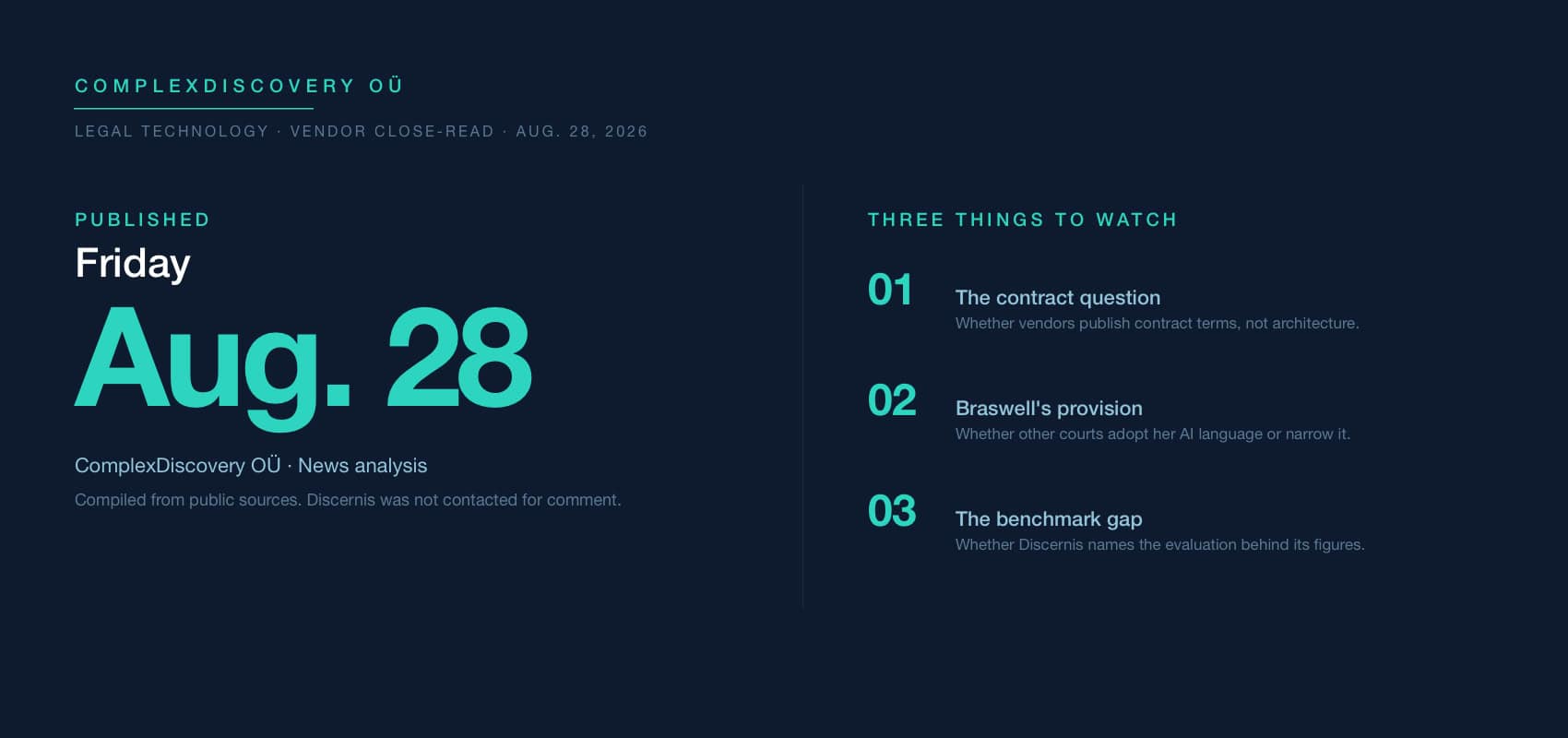
Practitioners in cybersecurity, data privacy, regulatory compliance and eDiscovery share one interest here, because a court order that specifies what a vendor’s contract must prohibit turns procurement language into a discovery obligation. Watch whether other courts adopt Braswell’s provision, and whether vendors start publishing contract terms rather than architecture.
Content Assessment: Discernis bets its architecture answers a Colorado judge
Information - 93%
Insight - 94%
Relevance - 92%
Objectivity - 92%
Authority - 93%
93%
Excellent
A short percentage-based assessment of the qualitative benefit expressed as a percentage of positive reception of the recent article from ComplexDiscovery OÜ titled, "Discernis bets its architecture answers a Colorado judge."
News Analysis – eDiscovery Beat
Discernis bets its architecture answers a Colorado judge
ComplexDiscovery OÜ Staff
Discernis Discovery asks a litigator to paste guiding questions from a review protocol into a box, then reads every document in the collection and ranks what answers them. The measures that bear on whether that result holds up are not the ones on the home page. They sit in the FAQ.
Discernis, a New York company, announced a $2.5 million seed round on Aug. 25. The company named Newfund Capital as lead investor, with participation from Triple Impact Capital, Remarkable Ventures and C2 Ventures, and said the software is in use at Am Law firms on active matters. The SaaS News and Law.com’s Legaltech News carried the round. The money matters less to practitioners than the design premise behind it, and that premise is stated plainly enough to test.
How the product handles a review protocol
The company sells two products, and Discernis Discovery is the one aimed at first-pass review. A reviewer enters or pastes the guiding questions already written into the review protocol, and the software assesses every document for responsiveness and prioritizes what it finds. Output travels back out as load files, .dat files or a CSV listing responsive documents with their scores and the model’s explanations.
The claim that should interest a security reviewer sits in the FAQ rather than the product page. “Discernis builds and hosts our own AI models,” the company says, a claim that, if it holds, keeps client data away from any third-party model provider. Deployment runs cloud, hybrid, on-premises or air-gapped, with the company stating full functionality in each. Pricing runs per matter, which it says eliminates per-gigabyte charges, per-user charges, and storage fees. Read together, those answer a vendor risk questionnaire as much as a feature list, which is the tell that this company expects to be evaluated by security and procurement teams rather than by litigation support alone.
None of it is unique in isolation. Relativity offers aiR for Review, Everlaw offers its Everlaw AI Product Suite, and DISCO offers Cecilia Auto Review, and the Discernis home page positions against that field with a comparison table setting AI-native architecture beside what it calls decades-old infrastructure with “AI retrofitted as an afterthought.” That table is the vendor’s characterization of its competitors rather than an independent assessment, and the incumbents would describe their own architecture differently. A $2.5 million seed round is also an early position from which to press the argument against companies with a decade of installed base.
Throughput is disclosed in specific numbers, and the company publishes three separate statements of it. The FAQ, as of Aug. 26, puts default review at 25,000 documents per hour, scaling automatically to 100,000. The funding announcement a day earlier put the rate above 50,000, which is a lower bound rather than a third tier. The simple rate arithmetic is compatible with the home page’s promise of millions of documents in days, although it establishes nothing about total elapsed matter time. A 5 million document collection needs about 200 processing hours at the default rate, fewer than 100 at the announcement’s stated lower bound and about 50 at the scaled ceiling, a spread of roughly two to eight days before ingestion, setup or export is counted.
That spread is worth holding against the example the company’s own chief executive offers. “We need these documents reviewed by tomorrow, and there are fifteen million of them. Can you do that?” Kwiatkowski said in the announcement, describing how clients arrive. “The short answer is yes.” Fifteen million documents at the FAQ’s scaled ceiling is about 150 processing hours, a little over six days. The company says throughput scales with additional hardware and that faster performance is available through custom deployment, so the answer may well hold. The published rates are what do not reach it.
Three performance claims and what each measures
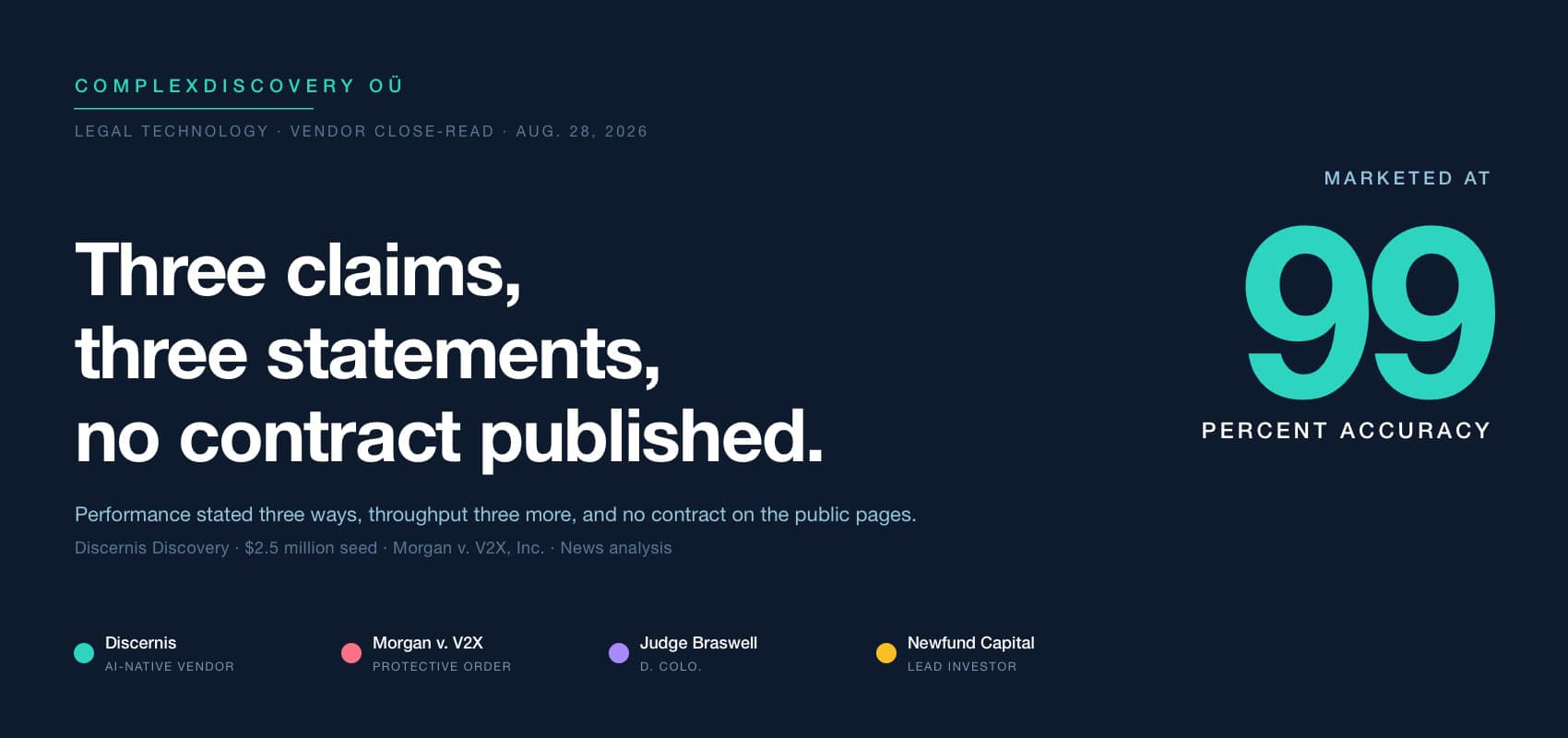
Discernis publishes performance three different ways, and the differences carry more weight than any single figure. The home page leads with roughly 99 percent accuracy. The About page states 99 percent accuracy alongside 90 percent faster processing and 70 percent cost reduction. The FAQ, several clicks deeper, says the system consistently scores over 95 percent recall and over 90 percent precision.
Those measure three different things. Recall is the share of responsive documents the system finds. Precision is the share of what it flags that turns out to be responsive. Accuracy, in its standard binary-classification sense, counts every correct call, responsive and non-responsive alike, which in a collection where responsive material is a small minority means the score is dominated by documents the system correctly ignored.
Run the FAQ’s floor values through that arithmetic, and the headline figure stops looking generous. If accuracy carries its standard meaning, and if all three figures describe the same evaluation population and the same threshold, then 95 percent recall and 90 percent precision yield about 99.2 percent accuracy on a collection that is 5 percent responsive, and about 98.4 percent on one that is 10 percent responsive. Those are assumptions, not findings. Discernis does not define accuracy, does not say whether the three figures come from a single benchmark, and does not publish the collection, threshold, or labeling exercise behind any of them. The arithmetic shows the numbers can coexist. It does not show they have been reconciled, and only the company can close that gap.
The practical point survives the caveat. A lone accuracy figure is the least informative of the three, because at low prevalence it is carried by the documents the system was never going to flag. Recall is often central when parties test whether a review was complete, but defensibility rests on method, validation, documentation and the results on the matter at hand rather than on any one number. The measures that support that conversation are in the FAQ, not on the home page.
Cost claims also move depending on which page a reader lands on. The home and About pages both claim 70 percent lower cost. The page written for law firms claims 40 to 50 percent. Neither identifies its comparator, its workflow, or its customer population, so the two cannot be reconciled from the public material, and subtracting one from the other would imply a shared baseline the site never establishes.
Why a Colorado protective order matters here
The company’s featured resource is not a product sheet. It is a whitepaper on Morgan v. V2X, Inc., and the choice tells you where Discernis thinks its advantage lies.
On March 30, Magistrate Judge Maritza Dominguez Braswell granted in part and denied in part a defense motion to amend the protective order in an employment discrimination case in the District of Colorado. She ordered the plaintiff, who was representing himself, to disclose within 10 days the name of any AI platform he had used on material designated confidential, and she directed that an amended protective order carry a new AI-specific provision.
Braswell rejected both sides’ proposed language and wrote her own. The provision bars any party or authorized recipient from putting confidential information into “any modern artificial intelligence platform, including any generative, analytical, or large language model-based tool,” unless the AI provider is contractually prohibited from two things: “storing or using inputs to train or improve its model,” and disclosing inputs to any third party “except where such disclosure is essential to facilitating delivery of the service.” Where that disclosure is essential, any such third party “shall be bound by obligations no less protective than those required by this Order.” The provider must also contractually give the party the ability to remove or delete all confidential information on request, and the party must retain written documentation of those protections.
The order is candid about the cost of its own rule. The provision will “bar the parties from using most, if not all, mainstream low-to-no-cost AI to process Confidential Information,” Braswell wrote, and she acknowledged that the restriction “disadvantages pro se litigants,” because qualifying enterprise accounts may be reachable only through organizational procurement or at prices a self-represented party cannot bear. Read the summaries instead of the order and the checklist shifts. Amy Swaner’s account lists a third prohibition, on retaining inputs beyond what is necessary, where the order’s own text sets out two numbered prohibitions, a downstream-provider safeguard, a deletion right and a documentation duty.
What the architecture does not settle
Read that provision against what Discernis publishes and the appeal is obvious, but the fit is not established. Morgan’s conditions are contractual. The provider must be contractually prohibited, must contractually afford a deletion right, and the party must retain written documentation of those terms. What Discernis publishes is architectural and operational: models it builds and hosts, deployment choices, a 30-day removal window following a user deletion. None of that is the customer contract, and the public pages do not show one.
The second prohibition is harder to answer from outside. The funding announcement offers what it calls “a sovereign AI approach,” under which “the system deploys on-premises or in the customer’s own secure cloud environment, and all inference runs within it, with no third-party or commercial AI API called at any point.” The FAQ adds that data is hosted by default in a US-based Azure cloud, with other regions or providers available on request, but it does not say who controls that environment. The two descriptions may well be compatible. Either way, Microsoft is an infrastructure provider, so what the order actually poses is whether that role is essential to facilitating delivery of the service, which the order permits, and whether the applicable contracts bind it no less protectively than the order requires. Those are terms not disclosed in the public materials reviewed. A vendor whose featured whitepaper is a court decision is arguing that the decision is its specification. Whether its contracts meet that specification is a separate question, and it is the one a buyer has to ask.
Where the reading of Morgan gets contested
The reach of the decision is contested as well, and the dissent comes from inside the eDiscovery commentariat. Swaner, an attorney who writes the AI For Lawyers newsletter, argued in April that the decision is “narrower than it is being read to be” and that what Braswell resolved was “a data governance question, not a privilege question.” She named two legal technology vendors, Everlaw and Clio, as having overstated its reach, calling their framings “overstatements about both the holding and its reach.” Clio’s post carried the headline “Courts Are Starting to Pick AI Tool Winners.” Braswell did not require every lawyer to adopt only tools meeting that standard, Swaner wrote, and did not rule that consumer AI is inherently incompatible with confidentiality obligations. Discernis, for its part, bills its whitepaper as an examination of a decision “addressing the discoverability and privilege status of generative AI data,” which is broader than what the order decided.
Kelly Twigger, chief executive of the litigation research platform Minerva26 and principal at the eDiscovery firm ESI Attorneys, called Morgan “the most consequential AI-in-litigation decision we have seen yet” while flagging two problems the opinion leaves open. Uploaded data becomes vector embeddings rather than retrievable files, so whether a contractual deletion right can discharge what a court has ordered remains unsettled. And the provision’s language reaches any modern artificial intelligence platform, which, taken strictly, would capture Westlaw, Relativity and Microsoft 365 Copilot. Twigger’s practical counsel was blunt. “Your prompts are your most protected materials,” she wrote. Both commentators have a stake worth naming: Twigger sells a litigation research platform, and Swaner publishes a subscription newsletter on AI and law.
The case itself has moved on. Discovery was stayed in May pending settlement proceedings, and the court appointed limited pro bono counsel for the plaintiff, who had litigated the AI dispute without a lawyer. That posture reflects the docket as last updated Aug. 7. The AI provision stands, but a decision generating this much vendor marketing is still riding on a magistrate’s discovery order in a single district.
The concessions buried in the FAQ
Two FAQ answers deserve more attention than the performance figures. Asked what security certifications or compliance standards the platform adheres to, the company says it is compliant with HIPAA and is “currently working to finalize compliance with ISO 27001 and SOC 2.” Its trust center puts the same three in a table, marking HIPAA compliant and both others in progress. The two unfinished items are different instruments. ISO/IEC 27001 is a standard against which an information security management system can be certified, while SOC 2 is an examination performed by a CPA firm that produces an assurance report. For corporate legal departments and the security teams that vet their vendors, a SOC 2 examination still in progress is a procurement conversation rather than a footnote, and the trust center’s policy documents sit behind an access request. Data residency is the other answer a cross-border matter will need in writing.
Retention gets a similarly specific answer. The company says it keeps no data for training and removes data from all systems within 30 days of a user deletion, which is a commitment an information governance team can map against a retention schedule and a legal hold. It is also a window, not an instant, and a hold that lands on day 20 meets a different system state than one that lands on day 40.
The second answer is narrower than it first appears, and the scope is the point. Asked whether an audit log tracks who extracted or edited what data and when, the FAQ says no, explaining that “data is only processed by the system and is not editable by users.” That answers a question about extraction and editing. It leaves open whether reviewer validation and tag changes generate a history of their own, which the site does not describe either way. Set it beside the answer three questions earlier, where the company says reviewers can override or manually correct what the AI suggests, and a buyer has something specific to ask. Tag validation runs through a QC workflow the company says is built in, and a side pane supports human validation. What no page describes is a record of who validated what and when, which may become relevant to a declaration or a validation record if the protocol is challenged.
Questions worth putting to any AI-native vendor
None of this is disqualifying, and some of it counts in the company’s favor. Discernis publishes throughput figures, recall and precision, infrastructure requirements and security and compliance status in an open FAQ and a public trust center, where a buyer can read them without signing anything first. The company says its founder, Robert Kwiatkowski, holds a computer science doctorate from Columbia University and worked as an applied scientist at Amazon Web Services. Its profile page says he led post-training for AWS’s first commercial large language models; its funding announcement says he built Amazon’s first reinforcement learning from human feedback training pipeline. Neither account is independently confirmed. Discernis frames his value as helping legal teams assess vendor AI claims, which invites exactly the reading applied here.
The buyer’s move is to convert marketing measures into contract terms. Ask for recall and precision on a matter resembling yours, with the responsive prevalence, threshold and labeling method stated, rather than an accuracy figure. Ask whether the throughput rate quoted is the default tier or the scaled one, and what the elapsed time looks like once ingestion and export are counted. Ask which cost baseline each published percentage was measured against. Ask what the QC workflow writes down and whether that record survives export. Ask where the SOC 2 report stands and what the target date is. And ask for the contract language itself, because a Morgan-style order is satisfied by contractual prohibitions and retained documentation, not by an architecture diagram.
The deeper question is what happens as courts keep writing procurement requirements into discovery orders. If a protective order can specify what a vendor’s contract must prohibit, has the bench begun regulating the legal technology market by another name, and are buyers ready to negotiate that way?
Update, Aug. 28, 2026: After publication, a Discernis representative said in an email that a few numbers in the company’s materials might need updating, and gave these as its current throughput figures: “Reviews up to 50,000 documents per hour by default, scaling to 100,000+ per hour with additional compute. Custom deployments can exceed 1,000,000+ documents per hour in production matters.” The Discernis FAQ, rechecked Aug. 28, still states 25,000 documents per hour by default, scaling automatically to 100,000. ComplexDiscovery will note any revision to the published figures.
News sources
- Discernis raises $2.5M for AI that finds key evidence buried across millions of documents (Discernis)
- Discernis Discovery (Discernis)
- FAQ (Discernis)
- Robert Kwiatkowski, Founder and CEO (Discernis)
- Order on Motion to Amend Protective Order, ECF No. 65, Morgan v. V2X, Inc. (CourtListener)
- Morgan v. V2X, Inc., No. 1:25-cv-01991 docket (CourtListener)
- AI on Trial: Morgan v. V2X Draws New Lines on Work Product Protection and Confidentiality (Baker Botts)
- AI, Work Product, and the Protective Order Problem: What Morgan v. V2X, Inc. Means for Every Litigator (ACEDS)
- Morgan v. V2X Decided a Discovery Dispute. Commentary Turned It Into Something Bigger. (AI For Lawyers)
- Discernis Raises $2.5M Seed (The SaaS News)
- E-Discovery AI Startup Discernis Announces $2.5M Seed Round (Law.com)
- Artificial Intelligence for e-Discovery and Legal Intelligence (Relativity)
- Everlaw AI Product Suite (Everlaw)
- Cecilia AI: Legal AI Tools (DISCO)
- ISO/IEC 27001:2022, information security management systems, requirements (ISO)
- System and Organization Controls (SOC) suite of services (AICPA)

Assisted by GAI and LLM Technologies
Additional reading
- Complete look: ComplexDiscovery OÜ’s 2025 to 2030 eDiscovery market size mashup
- The workstream of eDiscovery: Considering processes and tasks
- Complete Look: ComplexDiscovery’s 2024-2029 eDiscovery Market Size Mashup
- Andrew Haslam’s eDisclosure Systems Buyers Guide at 14: What the 1H 2026 update reveals
- A Complete Analysis of the Winter 2026 eDiscovery Pricing Survey
- The M&A Risk of Confusing Market Velocity with Marketing Capability
- Confidence Meets Complexity: Full Results from the 2H 2025 eDiscovery Business Confidence Survey
- Making the Subjective Objective: A Scoring Framework for Evaluating eDiscovery Vendor Viability in 2026
- eDiscovery Vendor Viability Scoring Tool: Making the Subjective Objective
- Beyond Public Cloud: The Enduring Case for Deployment Flexibility in eDiscovery
Source: ComplexDiscovery OÜ

ComplexDiscovery’s mission is to enable clarity for complex decisions by providing independent, data‑driven reporting, research, and commentary that make digital risk, legal technology, and regulatory change more legible for practitioners, policymakers, and business leaders.