
Editor’s Note: Washington’s Oct. 9 designation of the International Criminal Court extended U.S. sanctions from individuals and organizations around the court to the institution itself, and the four general licenses issued with it largely shape what may keep running. The license for maintenance and wind-down, including salaries, rent and payment for routine services, ends April 7, 2027, unless it is adjusted, as the State Department says it can be. The license for enterprise software, including cybersecurity solutions and cloud services supporting the listed software, states no end date.
For eDiscovery, information governance and cybersecurity providers, that structure turns a policy dispute into a classification exercise. A hosted review platform is not among the named software categories, and managed review, forensic collection and incident response go unnamed. Read on its text, the program’s U.S. person definition also reaches foreign subsidiaries of U.S. companies, which could leave European affiliates in a legal conflict if the EU extends its blocking statute to these sanctions.
Professionals should inventory engagements against the license text now and watch for OFAC guidance, any adjustment to the 180-day license and the European Commission’s next step.
Content Assessment: OFAC's ICC General License 14 has no stated expiration date, but does it reach eDiscovery services?
Information - 93%
Insight - 92%
Relevance - 92%
Objectivity - 93%
Authority - 91%
92%
Excellent
A short percentage-based assessment of the qualitative benefit expressed as a percentage of positive reception of the recent article from ComplexDiscovery OÜ titled, "OFAC's ICC General License 14 has no stated expiration date, but does it reach eDiscovery services?"
News Analysis – eDiscovery Beat
OFAC’s ICC General License 14 has no stated expiration date, but does it reach eDiscovery services?
ComplexDiscovery OÜ Staff
The United States sanctioned the International Criminal Court (ICC) itself on Oct. 9. The license covering the court’s salaries and rent expires April 7, 2027, but the one covering its enterprise software, including cybersecurity solutions and cloud services that support listed software functions, states no end date.
That split lands hardest on vendors whose work does not fit neatly on either side of it, and litigation support is one of them.
The State Department designated the court under section 1(a)(ii)(A) of Executive Order 14203, and the Treasury Department’s Office of Foreign Assets Control (OFAC) added it to the Specially Designated Nationals and Blocked Persons List (SDN List) the same day. The entry lists the court at Oude Waalsdorperweg 10 in The Hague, with a July 1, 2002, establishment date and a Dutch value-added tax number.
Until now the program reached people and organizations around the court rather than the institution. The State Department’s fact sheet put the number of persons sanctioned under the order at 17 before the Oct. 9 action. They include ICC President Tomoko Akane and senior trial lawyer Abdoulaye Seye, both designated Aug. 18, and three Palestinian human rights organizations designated in September 2025.
Who the designation reaches
According to the State Department, the action blocked all property and interests in property of the court that are in the United States or in the possession or control of U.S. persons. It also prohibits U.S. persons from providing funds, goods or services to or for the court’s benefit unless an exemption or an OFAC license authorizes the transaction.
The prohibition’s reach turns on how the program defines a U.S. person, and that definition is broader than in several other OFAC programs. Executive Order 14203 and OFAC’s implementing regulations at 31 CFR part 528 include any entity organized under U.S. law, “including a foreign branch, subsidiary, or employee of such entity.” OFAC’s Russia-, Ukraine- and Venezuela-related regulations use a narrower parenthetical that names foreign branches only. Read on its text, which OFAC has not addressed in guidance, the ICC definition makes a European-incorporated subsidiary of a U.S. software or services company a U.S. person in its own right.
Two licenses, two clocks
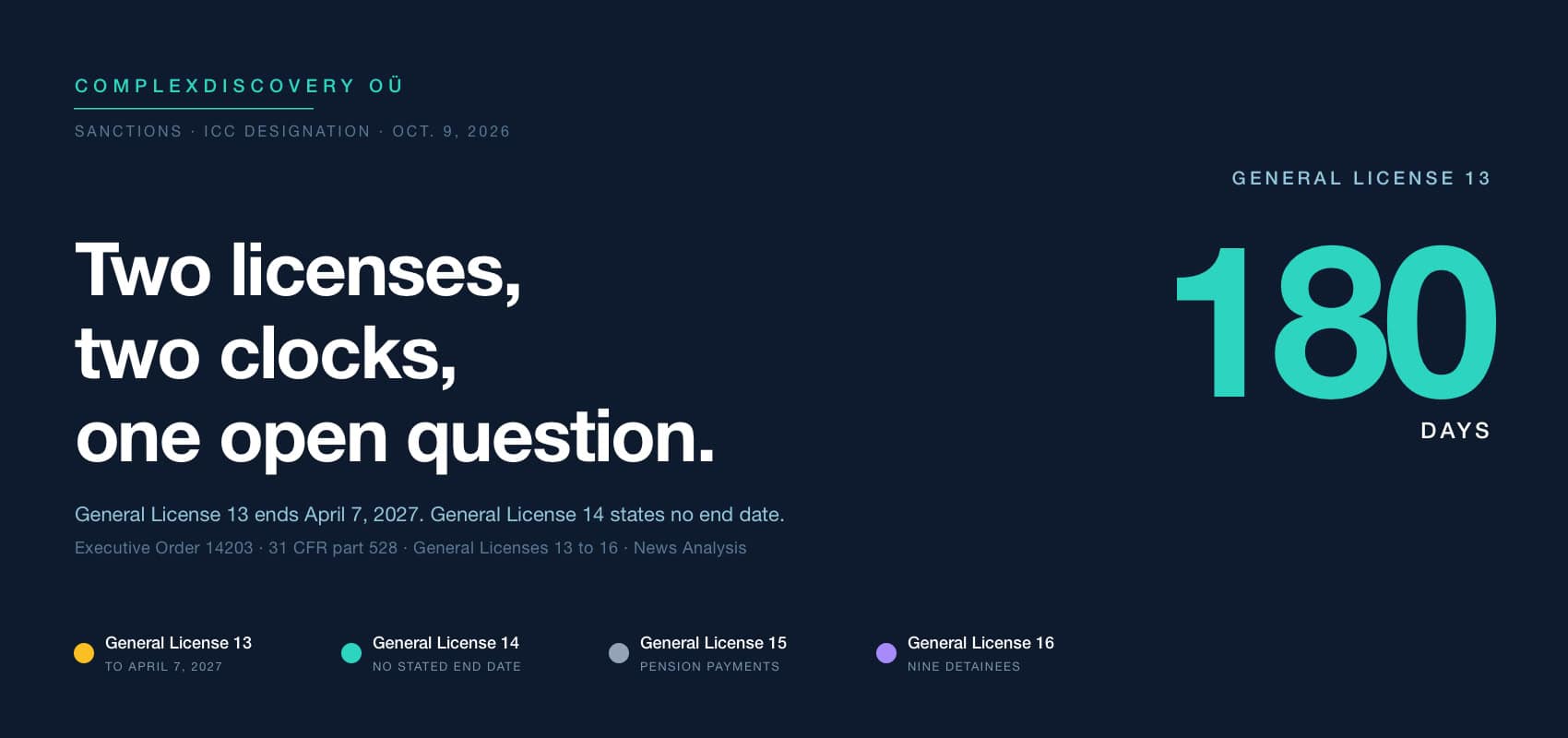
Four general licenses OFAC issued the same day narrow that prohibition, and the first two run on very different calendars. General License 13 authorizes transactions ordinarily incident and necessary to “the maintenance or wind down of operations, contracts, or other agreements” involving the court through 12:01 a.m. EDT on April 7, 2027, which is 180 days after the designation. Its note gives examples: States Parties’ payments to the court; salaries, health insurance and medical services for employees, grantees and contractors; rent, utilities, taxes and insurance; “payment for routine services,” such as subscription-based or standard commercial services; and payments on invoices for transactions authorized by the license or incurred before Oct. 9.
Those examples stop short of the officials designated individually. Paragraph (c) of General License 13 excludes transactions involving any other person blocked under the ICC regulations unless separately authorized. General License 12, the wind-down license OFAC issued for Akane and Seye in August, ran only until Sept. 17.
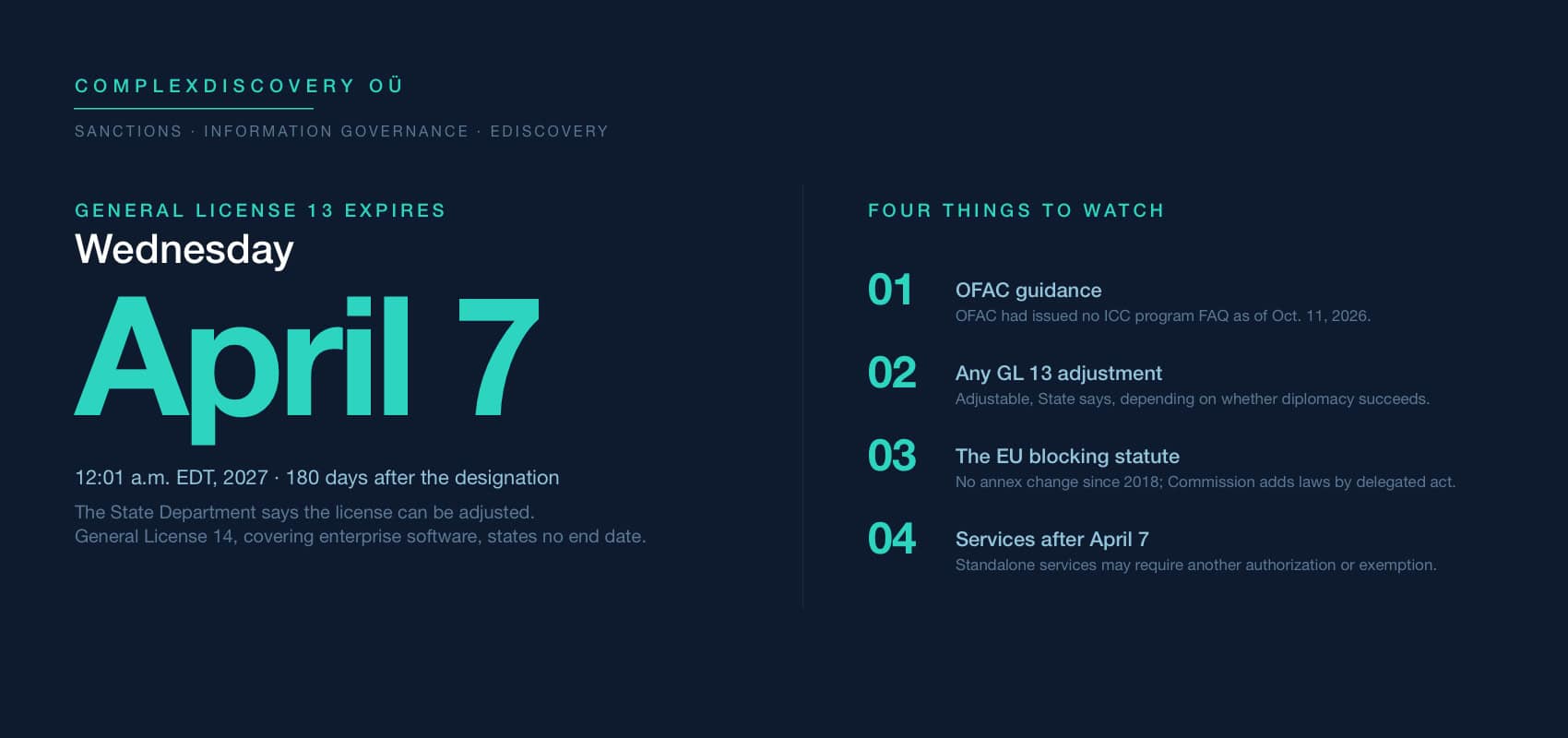
The State Department said the 180-day license is meant to give States Parties time to demonstrate “meaningful progress on diplomatic and legal resolutions” of U.S. concerns about the court. It added that the license can be adjusted depending on whether those efforts succeed.
General License 14 carries no such date. It authorizes transactions ordinarily incident and necessary to the receipt or transmission of telecommunications, the supply of internet-based communication services, and the “provision, acquisition, development, implementation, operation, maintenance, or repair of enterprise software” involving the court. A missing expiration date is not a promise of permanence, because OFAC’s regulations reserve its right to exclude any person or transaction from a license or restrict how a license applies. General License 15 covers pension payments, which must go into blocked interest-bearing accounts in the United States when the recipient is a blocked person. General License 16 covers the continued detention of nine named detainees, among them former Philippine President Rodrigo Duterte. Neither of those two licenses states an expiration.
That structure is easy to flatten into a single six-month deadline, and both coverage and official statements leaned that way. Euronews wrote that the sanctions “give US companies and individuals six months to end their business dealings with the court,” and a JusticeInfo caption over an AFP report described a six-month timeline to wind down business. In an Oct. 9 statement, the European Commission cited “a six-month delay before the measures are applicable,” and the Dutch government said the sanctions “will not take effect immediately.” According to the State Department, the designation’s blocking took effect with the Oct. 9 action. The six-month window belongs to General License 13, not to the technology license, whose text sets no end date.
Reading the enterprise software list
Because the technology license has the longer horizon, its wording is where vendor planning starts. Note 1 to paragraph (c) of General License 14 is the passage practitioners will parse line by line. It says the term “enterprise software” includes software for “enterprise management; enterprise resource planning; financial management; human resources and payroll; customer, donor, or stakeholder relationship management; supply chain and procurement management; facilities and maintenance management; project and grant management; cybersecurity solutions; data storage, backup, and recovery software; as well as cloud-based services, including Software-as-a-Service, in support of the foregoing.”
Two features of that note matter for planning. The list opens with “includes,” which on its face does not read as a closed list. Cloud services appear only “in support of the foregoing,” so the authorization follows what the software does rather than how it is delivered. Outside the note, paragraph (b) separately authorizes internet communication services such as email, collaboration platforms, video conferencing, user authentication, web hosting and domain registration.
Two limits sit beside that grant. Paragraph (e) excludes transactions involving any other person blocked under the regulations unless separately authorized, the same carve-out General License 13 contains, so dealings with the officials designated earlier fall outside both licenses. Note 2 says nothing in the license relieves anyone of export, reexport or in-country transfer licensing requirements administered by the Commerce Department’s Bureau of Industry and Security, so a licensed software deployment still needs its own export controls analysis.
Where litigation support lands
Those limits matter to eDiscovery providers because the court’s Office of the Prosecutor runs an eDiscovery operation of its own. In a January 2023 interview published by Relativity, David Hasman said he led the prosecutor’s e-discovery and data analysis team. He described its work as handling evidence after collection, making it searchable and usable, and preparing it for disclosure.
One platform supporting that work, the cloud review service RelativityOne, sits under a contract with a documented end date. The court’s external auditor, the Board of Audit and Inspection of the Republic of Korea, addressed it in a report published with the court’s 2023 financial statements in July 2024. The report said the prosecutor’s office had entered into a five-year contract “for the use of RelativityOne software,” with a stated term of July 1, 2022, through June 30, 2027, and a fee of about $2.5 million. That term extends 84 days past General License 13’s expiration, which makes the reach of General License 14 material to the contract’s final months. The report predates the designation, so it cannot show whether the contract has been affected since.
A hosted review platform is not one of the categories Note 1 names. Whether it falls under the list’s open-ended “includes,” or under data storage and cloud services in support of a listed category, is a question the license text does not answer. OFAC had published no frequently asked question on the ICC program as of Oct. 11, based on a search of its program page and its full FAQ listing.
Services sit further from the text, since managed document review, forensic collection, consulting and expert work are labor rather than software and none is named. General License 14 reaches transactions ordinarily incident and necessary to providing, acquiring, developing, implementing, operating, maintaining or repairing enterprise software. That plausibly covers implementation and support tied to a licensed platform, but the license does not expressly address standalone services. Security teams face the same question, because Note 1 names “cybersecurity solutions” while incident response retainers and managed detection go unnamed, and how they are treated will turn on the facts of each offering. Until April 7, General License 13 authorizes transactions ordinarily incident and necessary to maintaining or winding down contracts, with payment for routine services among its examples. After that date, absent an adjustment, a services engagement that is not incident to enterprise software may require another authorization or exemption.
OFAC’s standing general license for legal services, 31 CFR 528.506, does not close that gap for litigation support in proceedings before the court itself. It authorizes legal advice on the requirements of U.S. law, representation in proceedings before U.S. courts and agencies, representation concerning the sanctions, and legal services where U.S. law requires counsel at public expense. Related services such as private investigators and expert witnesses are covered only when they are ordinarily incident to those authorized legal services. Other legal services to a blocked person require a specific license, and payment for authorized services must itself be authorized, for example under 31 CFR 528.507 for fees from funds originating outside the United States.
The European squeeze
That classification question is being asked inside a host state that has promised to keep the court running. The Netherlands called the measures “a new and unwelcome escalation” in an Oct. 9 statement from Foreign Minister Tom Berendsen. The statement said “service providers can continue their work for the ICC” and described a six-month period that “creates scope for dialogue,” promising “a serious assessment of the options available, in partnership with other State Parties.” It did not name the EU blocking statute, Council Regulation (EC) No 2271/96.
Berendsen had named it 16 days earlier. In a Sept. 23 interview with the Dutch daily de Volkskrant, he said the Netherlands had requested that the Commission get the blocking statute ready for use and called it a last resort, according to Anadolu Agency’s account of the interview. The statute bars the persons it covers, including any legal person incorporated in the EU, from complying with the foreign laws listed in its annex, though the Commission can authorize compliance where refusing would seriously damage the applicant’s interests. The Commission adds laws to that annex by delegated act, and the EUR-Lex amendment record shows no change to the annex since 2018.
Lize de Kruijf, an assistant director in the Atlantic Council’s GeoEconomics Center, wrote on Oct. 9 that listing the ICC measures in the statute would bar EU persons from complying with them. She cautioned that banks could still be cut off from the U.S. financial system, and that the statute pays nothing to a company whose compliance with it costs U.S. business. The Commission’s statement said the EU stands ready to take necessary measures so the court can keep working “and to protect the interests of EU operators within the Single Market.” An Oct. 10 statement on behalf of the EU rejected threats or attacks aimed at people and companies working with the court, naming service providers among them.
Some of those EU operators are also U.S. persons, and that overlap is what turns the standoff into a compliance problem for vendors. On the regulation’s text, a European subsidiary of a U.S. cloud or eDiscovery provider is a U.S. person under the ICC regulations, and it would also be bound by the blocking statute if the EU added these sanctions to the annex. Non-U.S. vendors carry a separate exposure: the executive order lets the Secretary of State designate any foreign person found to have provided technological support or services to a blocked person, and the general licenses speak only to transactions the regulations prohibit.
The court has been reducing one dependency already. It confirmed in October 2025 that it was replacing Microsoft Office with openDesk, an open-source suite built for German public administration, for its internal work, Computing reported. Mark Klamberg, a nonresident senior fellow with the Atlantic Council’s Strategic Litigation Project, cited that decision on Oct. 9 among the precautions the court had already taken, amid concerns about dependence on U.S. technology.
Reaction divides along familiar lines
Outside government, Philippe Bolopion, executive director of Human Rights Watch, said governments should act “to protect the ICC, its staff, and all those who cooperate with it, starting with the European Union using its laws to mitigate the sanctions’ impact in the region.” Human Rights Watch is among four organizations that filed suit in U.S. federal court on Aug. 11 seeking to overturn the sanctions.
The sanctions have defenders as well. Matthew Kroenig, a senior fellow at the Atlantic Council’s Scowcroft Center and a former U.S. defense and intelligence official, wrote that the court “has wrongly pursued powerful democracies” and argued that international bodies depend on the support of strong states to endure. Secretary of State Marco Rubio said in a video message that Washington would ban transactions with the court and cut off its resources, according to AFP and The Hill.
The court answered the same day. In a written statement, it called the sanctions an attack on the rule of law, and Akane said the court would keep carrying out its mandate independently and impartially, according to Euronews and Anadolu Agency.
Steps for vendors and firms before April
Whichever way the diplomacy breaks, the practical work for vendors starts with an engagement inventory. Sort every contract touching the court into enterprise software under General License 14, maintenance or wind-down under General License 13, or neither, recognizing that one contract can hold all three. Take the third pile to sanctions counsel now rather than in March. Payments routed through the U.S. financial system should reference the license that authorizes them, as 31 CFR 528.502(f) advises.
Screening teams should confirm that the court’s SDN entry is loaded into restricted-party tools and that the officials designated separately still match, since neither license reaches dealings with them. Product teams should document how a hosted platform maps to the Note 1 categories, and export compliance should run the Bureau of Industry and Security analysis that Note 2 preserves. Information governance teams should read exit clauses with the same calendar in mind. Data return, migration and certified deletion for an engagement that will not continue past April 7 may qualify as wind-down work under General License 13, and work on data held in covered storage or backup software may also fall within General License 14’s operation and maintenance terms, though neither license names these tasks.
European subsidiaries of U.S. parents should plan for the case in which the blocking statute applies and their U.S. person status, as the regulation’s text defines it, does not change. The April 7 date is a planning anchor, not a promise, since the State Department has said the license can be adjusted.
If a platform holding the court’s evidence may qualify under a license with no stated end date while the standalone services around it are covered, at most, until April 7, which side of that line does your next engagement fall on?
News sources
- Settlement Agreement between the U.S. Department of the Treasury’s Office of Foreign Assets Control and Pegasus Worldwide Logistics; International Criminal Court Designation and General Licenses; Burma-related Designation Removal (Office of Foreign Assets Control)
- International Criminal Court-related General License 13 (Office of Foreign Assets Control)
- International Criminal Court-related General License 14 (Office of Foreign Assets Control)
- International Criminal Court-related General License 15 (Office of Foreign Assets Control)
- International Criminal Court-related General License 16 (Office of Foreign Assets Control)
- Imposing Sanctions on the International Criminal Court (U.S. Department of State)
- International Criminal Court-Related Sanctions (Office of Foreign Assets Control)
- International Criminal Court-related Designations; Venezuela-related Designation; Issuance of International Criminal Court-related General License (Office of Foreign Assets Control)
- International Criminal Court-related General License 12 (Office of Foreign Assets Control)
- Advancing the United States’ Campaign to Address the Threat Posed by the International Criminal Court (U.S. Department of State)
- International Criminal Court-related Designations; Counter Narcotics and Counter Terrorism Designation Updates; Issuance of International Criminal Court-related General License (Office of Foreign Assets Control)
- 31 CFR Part 528: International Criminal Court-Related Sanctions Regulations (Electronic Code of Federal Regulations)
- Consolidated TEXT: 31996R2271: EN: 07.08.2018 (EUR-Lex)
- Statement by Minister of Foreign Affairs Tom Berendsen on the announced sanctions against the ICC (Government of the Netherlands)
- Statement on the International Criminal Court following announcement of US sanctions (European Commission)
- Financial statements of the International Criminal Court for the year ended 31 December 2023 (International Criminal Court Assembly of States Parties)
- International Criminal Court: Statement by the High Representative on behalf of the EU following the announcement of US sanctions (Council of the European Union)
- Threats against ICC ‘not acceptable,’ EU says after US announces sanctions (Euronews)
- The US hits the ICC with sweeping sanctions (AFP via JusticeInfo)
- International Criminal Court ‘firmly rejects’ new US sanctions (The Hill via Yahoo News)
- ICC strongly rejects US sanctions against court, says it will continue work ‘with independence, impartiality’ (Anadolu Agency, Oct. 9, 2026)
- Netherlands asks EU to prepare ‘blocking statute’ to protect ICC from further US sanctions (Anadolu Agency)
- How sanctions can weaponize US tech against the ICC (JusticeInfo)
- International Criminal Court drops Microsoft for open source (Computing)
- The US just sanctioned the International Criminal Court. What’s next? (Atlantic Council)
- US Sanctions International Criminal Court (Human Rights Watch)
- How AI Visionary David Hasman Helps the International Criminal Court Set Justice in Motion (Relativity)

Assisted by GAI and LLM Technologies
Additional reading
- Cooley and Google Cloud are building a court-filing redaction agent without a published error rate
- Relativity’s 2028 Server exception meets a Riyadh deployment outside its cloud region table
- ENISA Threat Landscape 2026 finds DDoS leads incident counts while ransomware stays most impactful in the short term
- Cyber Resilience Act reporting starts Sept. 11 on an unfinished platform
- Europe’s draft cloud rule would put vendor ownership in the audit file
- The eight-hour clock starts today: EU e-evidence orders now land on covered U.S. providers’ EU addressees
- California’s AI Transparency Act arrives alongside Europe’s Article 50
- Federal magistrate judge treats LinkedIn’s Relativity aiR workflow as TAR
- One benchmark, three directions: 2026 legal rates rise, flatten and fall at once
- Confidence cools, commitment holds: full results from the 1H 2026 eDiscovery Business Confidence Survey
- Complete look: ComplexDiscovery OÜ’s 2025 to 2030 eDiscovery market size mashup
- The workstream of eDiscovery: Considering processes and tasks
Source: ComplexDiscovery OÜ

ComplexDiscovery’s mission is to enable clarity for complex decisions by providing independent, data‑driven reporting, research, and commentary that make digital risk, legal technology, and regulatory change more understandable for practitioners, policymakers, and business leaders.