
Editor’s Note: U.S. pressure on Kyiv took concrete form in the second week of October. Treasury’s General License 135 relaxed specified sanctions on Russian diesel transactions, including imports, though its fit with a 2022 import ban remains unresolved, and European officials told CNN the administration threatened to suspend intelligence sharing and weapons purchases over Ukraine’s refinery strikes. A speed cap then hit Starshield, the satellite service Ukrainian drone units use; officials told Reuters the order came from inside the White House, though a senior U.S. official said the president never requested it. Institute for the Study of War assessments for Oct. 13 through 16 show the Kremlin rejecting a ceasefire and inflating battlefield gains as that pressure built.
For cybersecurity, data privacy, regulatory compliance and eDiscovery professionals, the week is a working lesson in dependency. General License 135 carries express limits and an unsettled statutory backdrop, and transactions under it fall within OFAC’s 10-year recordkeeping rule. The Starshield episode shows how control of a service can sit with someone other than the user who relies on it.
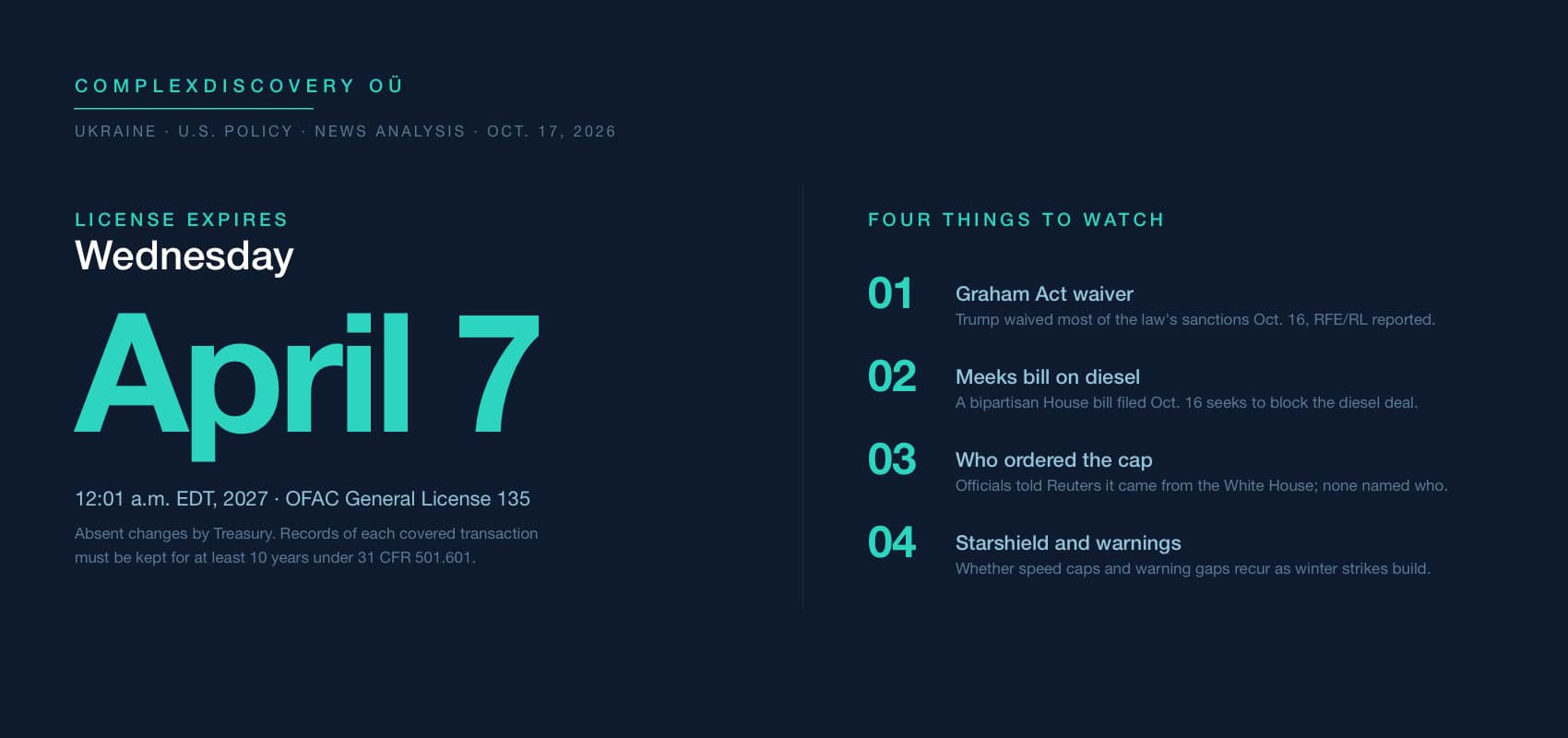
Watch the Oct. 16 waiver of Graham Act sanctions, the House bill to block the diesel deal and whether missile-warning gaps recur as winter strikes build.
Content Assessment: Diesel license, Starshield cap and intelligence warnings strain US support for Ukraine
Information - 94%
Insight - 94%
Relevance - 91%
Objectivity - 90%
Authority - 94%
93%
Excellent
A short percentage-based assessment of the qualitative benefit expressed as a percentage of positive reception of the recent article from ComplexDiscovery OÜ titled, "Diesel license, Starshield cap and intelligence warnings strain US support for Ukraine."
News Analysis – Geopolitics Beat
Diesel license, Starshield cap and intelligence warnings strain US support for Ukraine
ComplexDiscovery Staff
The Trump administration pressed Ukraine this month to stop striking Russian refineries, and European officials told CNN it threatened to suspend intelligence sharing and weapons purchases if Kyiv refused.
Then a speed cap hit Starshield, the military satellite service Ukrainian drone crews rely on. U.S. and Western officials told Reuters the order came from inside the White House, though none named who gave it, and a senior U.S. official said the president never requested it. Daily assessments for Oct. 13 through 16 from the Institute for the Study of War (ISW) describe a Kremlin working that friction to its advantage, rejecting a ceasefire, refusing territorial concessions and inflating its battlefield gains.
The threads meet in one place. Much of what Ukraine depends on, from satellite links to interceptor stocks to missile warnings, is controlled in the United States, by the government or by U.S. companies. For professionals who manage sanctions exposure, vendor dependency and records that regulators may examine years from now, the week is a live case study in how quickly those controls can move, and the first of them moved on Oct. 9.
A diesel license with limits written in
That Friday, President Donald Trump wrote that Russian President Vladimir Putin had agreed by phone to “immediately supply” over 300,000 tons of diesel to world markets and to follow with 500,000 tons in November, CNN reported. Citing U.S. Energy Information Administration data, CNN said the two tranches together equal roughly 36 hours of U.S. diesel demand.
The Treasury Department’s Office of Foreign Assets Control (OFAC) issued Russia-related General License 135 the same day. The license authorizes transactions tied to the sale, delivery, offloading and importation of Russian-origin diesel that two Russia sanctions programs would otherwise prohibit, according to a post on the Sanctions Notes blog of the law firm Herbert Smith Freehills Kramer. It expires at 12:01 a.m. EDT April 7, 2027. It carries an express limit: no debits to accounts held at U.S. financial institutions by Russia’s central bank, its National Wealth Fund or its Finance Ministry. It also does not reach prohibitions under any other OFAC program, the firm said.
Nor does the license settle every legal question. The firm noted that it does not expressly address the 2022 Ending Importation of Russian Oil Act. That statute bars U.S. imports of Russian products in Chapter 27 of the Harmonized Tariff Schedule, the chapter covering mineral fuels and oils, and sets its own process for lifting the ban. Four Republican and three Democratic senators said Oct. 11 that permitting the imports runs counter to the 2022 law, according to the post.
Washington’s reasons reached beyond the pump. A U.S. official told CNN that Kyiv’s refusal to stop hitting refineries helped push Trump toward the agreement. The same official said U.S. envoy Steve Witkoff and Jared Kushner, Trump’s son-in-law, told Ukrainian officials in Miami that Trump wanted the attacks to stop. The U.S. delegation also said the White House hoped the deal would make Moscow more flexible in peace talks, a person familiar with the meeting told Reuters. Gregory Brew, an analyst at Eurasia Group, read the bargain from Moscow’s side. “I also have a strong suspicion Putin expects Ukraine to cease its attacks on refineries in exchange for doing Trump the favor,” Brew said in an email cited by CNN.
Energy analysts doubted the volume would move prices much. Dan Pickering, founder and chief investment officer of Pickering Energy Partners, called the deal “helpful but not a needle mover for global diesel markets.” Richard Nephew, a former principal deputy coordinator for sanctions policy at the State Department, warned in comments reported by CNN that the signal from the deal, and the harm to sanctions enforcement as a whole, are serious.
Moscow then undercut the White House argument, reported by NBC News, that Ukraine’s strikes drive global diesel prices. Deputy Prime Minister Alexander Novak and Deputy Foreign Minister Georgy Borisenko both tied the shortages on Oct. 12 to the conflict around Iran and the Strait of Hormuz, ISW reported. Kremlin spokesman Dmitry Peskov denied any direct link between the agreement and Russia’s stance on Ukraine. ISW assessed that Moscow offers Washington economic incentives it calls unrelated to the war in order to win concessions on the war, and that Russia would benefit disproportionately if the United States forced Kyiv to stop hitting refineries.
For compliance teams, the question is narrower and more durable. A general license covers only what it says, so a counterparty blocked under a second authority, such as an Iran-related program, still needs its own analysis, the Herbert Smith Freehills Kramer post said. OFAC’s recordkeeping rule, 31 CFR 501.601, requires a full record of each transaction subject to sanctions regulations, including those made under license, for at least 10 years, according to a 2025 Greenberg Traurig alert. The rule mandates the transaction records. Where a license’s legal footing is publicly contested, it is also prudent to keep the analysis showing how a company decided to rely on it, because that is the file counsel will want if questions arrive in the 2030s.
Fuel, though, was only the opening lever.
Warnings over intelligence and weapons purchases
Within two days of the license, the State Department and the Pentagon sent warnings to Ukrainian and European officials over the Oct. 10 to 11 weekend, two European officials told CNN. The message, as those officials described it, was that Washington might stop sharing intelligence and halt European purchases of U.S. arms for Ukraine unless Kyiv ended its long-range attacks on Russian energy targets. Those purchases run through the Prioritized Ukraine Requirements List (PURL). A U.S. official told CNN that negotiators described Washington to the Ukrainians as a strong partner supplying munitions and intelligence, and said Kyiv should avoid moves that hurt U.S. consumers.
Trump has since insisted the United States did not stop sharing intelligence, CNN and NBC News reported, and a NATO official told CNN on Oct. 12 that PURL supplies were still flowing. The administration has pulled this lever before. It suspended intelligence sharing in March 2025 after a contentious Oval Office meeting and restored it after Ukraine accepted a proposed U.S. ceasefire.
What happened over the nights that followed is harder to read. Ukraine’s Air Force said it received no information about Russian ballistic missile launches before the Oct. 12 to 13 strikes on Kyiv and detected the missiles only by radar, ISW reported. Air Force spokesman Col. Yuriy Ihnat told a national telethon that information the United States and other NATO countries share with Ukraine over satellite communications sometimes fails to arrive, and that this was not the first such case, Ukrainska Pravda reported. If technical problems were to blame, he said, specialists would work them out with partners. After the following night’s attack, which Ukrainian officials said struck all three combined heat and power plants in Kyiv, Ihnat said Ukraine got no warning of the first wave but partners warned of the three that followed, according to ISW.
Those accounts do not show that the United States withheld anything, and Ihnat raised technical problems only as a possibility for specialists to establish. They do show how heavily Ukraine’s ballistic missile warning leans on a pipeline it does not control.
Interceptors are the other half of the problem. Ukraine’s stock of interceptors for the U.S.-made Patriot system is exhausted, a source familiar with the situation told CNN on Oct. 15, and CNN reported that a PURL suspension would threaten future interceptor shipments. ISW assessed that Russia will “very likely” keep pairing ballistic missiles with jet-powered drones in its winter strike packages. Ukraine’s answer to those drones runs through another U.S. system.
A speed cap on a military satellite network
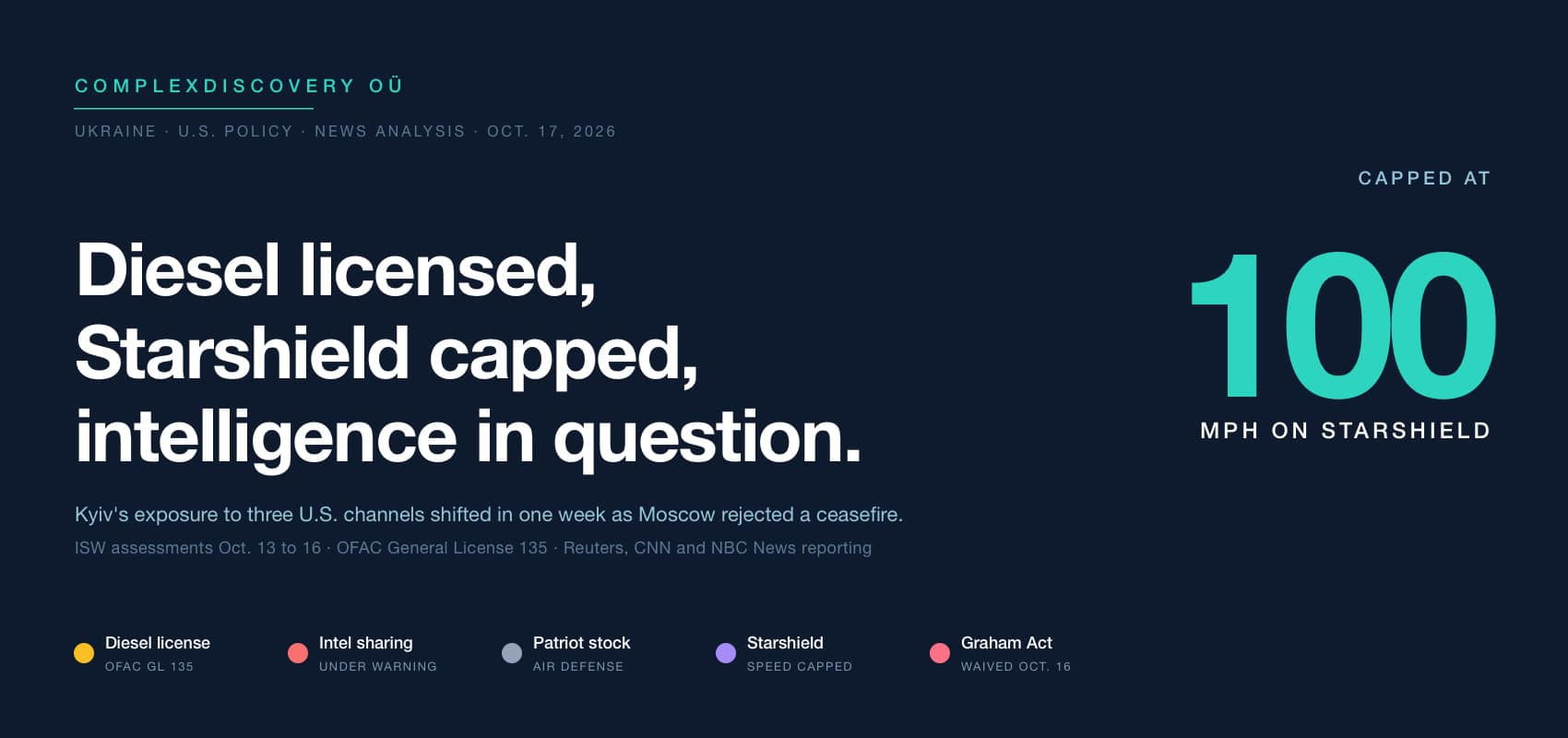
That system is Starshield, the government-use version of SpaceX’s Starlink network. Ukrainian officials reported Oct. 14 that SpaceX had limited in-motion connectivity for Starshield terminals in Ukraine to 100 mph, or about 160 kilometers per hour, ISW reported. SpaceX Chief Executive Elon Musk, whose company built and operates the service, said on X that the U.S. government owns and controls Starshield. Decisions on its speed and usage limits therefore rest with the U.S. military or the president, Musk said, according to ISW, CNN and Reuters.
Reuters then reported Oct. 15 that the order came from inside the White House, citing two U.S. officials and a Western official briefed on the matter. Those officials said Defense Department leaders received a message that the service needed to be slowed, but they did not say who at the White House gave it. A senior Ukrainian official told Reuters that Kyiv had been told the decision was the White House’s. A senior U.S. official told NBC News that “no such request was ever made by the president,” a denial Reuters and CNN also reported, and the White House did not answer Reuters’ questions about whether other officials made the request. Reuters’ reporting points to the White House as an institution while leaving the decision-maker unnamed.
ISW assessed that the cap landed on two capabilities at once. One is the interceptor drones that Ukraine uses against Russia’s jet-powered Geran drones, which ISW, citing presidential adviser Serhiy Beskrestnov, describes as Ukraine’s most effective counter to them. The other is the intermediate-range strike drones, including U.S.-made Hornet drones whose top speed exceeds the cap, that hit Russian logistics behind the front. ISW said data from Ukraine’s Unmanned Systems Forces showed strikes on Russian logistics vehicles fell markedly Oct. 14, “very likely” because of the restrictions.
The cap could not touch Ukraine’s long-range campaign inside Russia, ISW said, because SpaceX already limits Ukraine’s access to both services to Ukrainian territory. That geofence is its own reminder that a provider can decide where a customer’s service works, not only how fast.
How much service came back is still contested. ISW, citing Ukrainian Defense Ministry sources, said units reported unrestricted access resumed Oct. 15. A person in the same ministry told Reuters that day that terminals worked in motion only up to 100 mph, and CNN reported service was partly restored. Asked in Brussels on Oct. 16, Ukrainian President Volodymyr Zelenskyy said the speed had not fully returned. “Has the speed been fully restored to what it was? No. Is the speed returning? Yes,” he told reporters, NBC News reported.
Security and information governance teams will recognize the audit question underneath. A contract states who owns a service, but it does not always state who can change its parameters overnight. The practical step is an inventory of systems where a vendor or a government can throttle, geofence or reprioritize service, paired with a written account of what happens to operations when it does.
Moscow, watching the strain between Washington and Kyiv, moved to exploit it.
Ceasefire talk and the Kremlin’s refusals
Its opening was Trump’s Oct. 11 announcement that Russia and Ukraine had agreed to what he called an “energy ceasefire,” news that a source close to Zelenskyy told CNN came as a surprise. ISW cited numerous reports that Ukraine held off striking Russian energy sites from Oct. 11 to 14 while Russian strikes on Ukraine’s grid continued.
Moscow’s answer came quickly. Russian Foreign Minister Sergei Lavrov said Oct. 15 that there would be no ceasefire, ISW reported, and Peskov claimed Ukraine had not observed the moratorium and that Zelenskyy’s unwillingness to negotiate was thwarting U.S. peace efforts. ISW called that claim false and said it aimed to cast Kyiv as the obstacle. Kyiv said Oct. 15 it would stop observing Trump’s proposed energy ceasefire, and Trump called the renewed refinery strikes a “disgrace” in a Newsmax interview, NBC News reported.
Putin closed another door Oct. 16. He visited a military command post and said the buffer Russia calls a security zone in northern Ukraine would not be a subject of negotiations, according to ISW. The think tank assessed that the Kremlin refuses any diplomatic or territorial concession to end the war. The same visit produced figures that ISW says are designed to persuade Kyiv’s backers that Ukraine should give in.
Battlefield claims aimed at Western capitals
Those figures do not match the front, ISW said. Putin claimed Russian forces had seized about 6,500 square kilometers and 310 settlements since the start of 2026, and Gen. Valery Gerasimov, chief of the General Staff, claimed over 1,800 square kilometers since Sept. 1. ISW assessed a net Russian loss of 122 square kilometers since Sept. 1. Putin said Ukraine holds 2,748 square kilometers of Donetsk Oblast, just over 10 percent; ISW put Ukrainian control at 5,530 square kilometers, or 20.4 percent.
ISW, which says it relies only on publicly available information, described the claims as cognitive warfare, meant to push Kyiv and the governments backing it toward Russia’s terms. Those terms include the fortified cities of Donetsk Oblast’s Fortress Belt, which ISW said Russian forces have been unable to capture. Ukraine’s counteroffensive north of Lyman, which Brig. Gen. Andrii Biletskyi said has retaken 277 square kilometers and 16 settlements, relied on months of the intermediate-range strikes the Starshield cap put at risk.
Whether that campaign and the support behind it hold through winter depends partly on choices still being made in Washington, and the next one landed before the week ended.
What practitioners should watch next
Late Oct. 16, Trump signed an executive order waiving most of the sanctions, tariffs and restrictions in the Lindsey O. Graham Sanctioning Russia and Iran Act of 2026, RFE/RL reported. The waiver came two days before those measures were due to take effect. NBC News and RFE/RL both reported that the order calls the waiver in the national interest. The Graham law keeps intact Treasury’s power to issue new general licenses, the Herbert Smith Freehills Kramer post noted, a point that matters to anyone relying on General License 135.
Congress is pushing back on the diesel deal itself. Rep. Gregory Meeks, D-N.Y., the ranking Democrat on the House Foreign Affairs Committee, filed a bipartisan bill Oct. 16 to block the deal, RFE/RL reported, and Rep. Brian Fitzpatrick, R-Pa., had earlier announced plans for a bill to block Russian oil purchases. Absent changes, General License 135 expires at 12:01 a.m. EDT April 7, 2027.
Counsel for companies with Russian exposure should also track a Putin decree dated Oct. 15, which Ontex disclosed Oct. 16. It put the Russian units of five foreign companies, among them France’s Tarkett and Belgium’s Ontex, under “temporary management,” a step ISW assessed may aim to pressure Europe into unfreezing Russian assets.
The coming weeks will show whether the Starshield limits and missile-warning gaps recur as Russia’s winter strike campaign builds, and ISW’s daily assessments offer one running record to track them. Kyiv’s exposure now runs through a U.S. fuel license, a U.S.-built satellite network and U.S. intelligence feeds, and each changed or came under threat within a single week. If a partner’s support can shift that fast, how many organizations have mapped which of their own critical services sit on someone else’s switch?
News sources
- Russian Offensive Campaign Assessment, October 13, 2026 (Institute for the Study of War)
- Russian Offensive Campaign Assessment, October 14, 2026 (Institute for the Study of War)
- Russian Offensive Campaign Assessment, October 15, 2026 (Institute for the Study of War)
- Russian Offensive Campaign Assessment, October 16, 2026 (Institute for the Study of War)
- Issuance of Russia-related General License (U.S. Department of the Treasury, Office of Foreign Assets Control)
- Update on Ontex Russia (Ontex)
- Trump says Ukraine should get a new leader as he spars with Zelensky over US-Russia diesel deal (CNN)
- US threatens to suspend intel sharing, weapons purchases if Ukraine continues Russia energy strikes, sources say (CNN)
- Exclusive: Ukraine runs out of Patriot interceptor missiles as Zelensky and Trump clash over war (CNN)
- Order To Limit Starshield For Ukraine Came From Inside White House, Sources Say (Reuters via HuffPost)
- Trump: Ukraine resuming strikes on Russian oil sites is a ‘disgrace’ (NBC News)
- Zelenskyy says Trump is ‘rewarding Putin’ as he waives new Russia sanctions passed by Congress (NBC News)
- Trump Waives Graham Act Sanctions On Russia Before They Take Effect (Radio Free Europe/Radio Liberty)
- В Воздушных силах объяснили, почему в Киеве тревога прозвучала после взрывов (Ukrainska Pravda)
- US has warned Ukraine data sharing will cease in event of new strikes on Russia: The Washington Post (The Washington Post via Ukrainska Pravda)
- OFAC issues General License 135 authorizing transactions involving Russian-origin diesel fuel (Herbert Smith Freehills Kramer)
- US Treasury Extends Recordkeeping Requirement for Economic Sanctions Compliance to 10 Years (Greenberg Traurig)

Assisted by GAI and LLM Technologies
Additional reading
- Drones hit two Yandex data centers, and a Kremlin decree sets terms for state management
- A cell tower near Lyman and Russia’s fight over its own war record
- How a general’s walk across a bridge tested Putin’s claim to Svyatohirsk
- Germany names Russia for the Leipzig drone, and keeps most of its evidence out of view
- Estonia scrambled jets over a drone no official has identified
- Russia leans on drones and dissent-proofing as fuel crisis bites
- Senate passes Graham sanctions act, shifting Russia pressure from policy to statute
Source: ComplexDiscovery OÜ

ComplexDiscovery’s mission is to enable clarity for complex decisions by providing independent, data‑driven reporting, research, and commentary that make digital risk, legal technology, and regulatory change more legible for practitioners, policymakers, and business leaders.