

Editor’s Note: Since Aug. 2, 2026, Article 50(4) of the European Union’s Artificial Intelligence Act has required organizations that use AI to generate or manipulate text published to inform the public on matters of public interest to disclose that the text is AI-generated or manipulated, unless the text has undergone human review or editorial control and a person or company holds editorial responsibility for it.
Nonbinding guidelines the European Commission published July 20 say that review must be substantive, with fact-checking at minimum, and that automated review, review of AI output by another AI system with only a superficial human check, or a cursory sign-off does not qualify. The test arrives as AI-native outlets publish with agents doing much of the work, among them Italy’s Redazione Zero, which labels its agent-written stories as produced without human review. Errors earlier in 2026 at Ars Technica, The New York Times and Danish newspaper Berlingske, all before the rule applied, traced to AI output that was not adequately verified.
For cybersecurity, information governance and eDiscovery professionals, review may become something an organization has to show, though the Commission’s voluntary Code of Practice does not require documenting each review. Watch for first information requests and complaints.
Disclosure: ComplexDiscovery OÜ is registered in Estonia, an EU member state. This article was produced with an AI-assisted editorial pipeline, including AI-assisted research, drafting and fact-checking, and was reviewed and approved by the editor before publication.
Content Assessment: An AI agent can write the story, but EU law asks whether a human reviewed it
Information - 94%
Insight - 93%
Relevance - 92%
Objectivity - 92%
Authority - 93%
93%
Excellent
A short percentage-based assessment of the qualitative benefit expressed as a percentage of positive reception of the recent article from ComplexDiscovery OÜ titled, "An AI agent can write the story, but EU law asks whether a human reviewed it."
[/exclude_from_rss]
Industry News – Artificial Intelligence Beat
An AI agent can write the story, but EU law asks whether a human reviewed it
ComplexDiscovery Staff
The homepage of Redazione Zero, an Italian news site whose stories are selected and written by AI agents, opens with a banner stating that its content is generated by artificial intelligence without human review. “The decisions are taken by the system; the consequences are borne by me,” its publisher, software developer Emilio Salmeri, told the Reuters Institute.
That arrangement, a person answering for copy no person reviewed, is one European Union law has treated differently since Aug. 2. Under Article 50(4) of the EU Artificial Intelligence Act, holding editorial responsibility for AI-generated news text does not by itself exempt it from labeling. The text must also have undergone human review or editorial control, which nonbinding Commission guidelines published July 20 say must be substantive rather than a cursory sign-off.
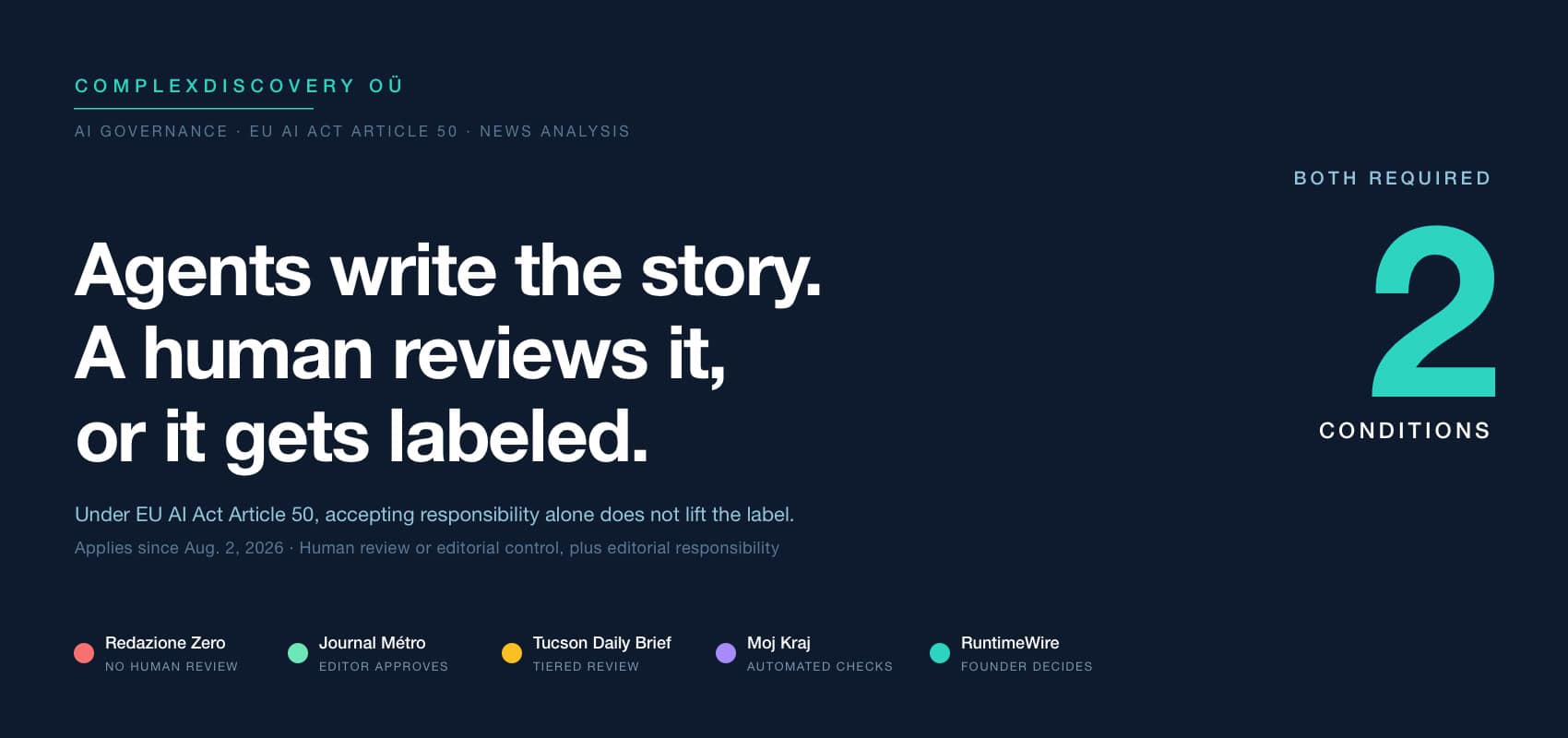
Where the AI-native newsrooms put the human
Redazione Zero sits at one end of a range the Reuters Institute documented in an Oct. 16 article by Gretel Kahn on what it called AI-native newsrooms. The article cited Jindex.ai, a database built by Ukrainian journalist Katya Gorchinskaya, as recording about 30 such outlets worldwide. At Redazione Zero, two agents built on Anthropic and OpenAI models gather the news each morning, and a second set of AI verifiers checks drafts and can stop them from running. An AI editor then closes the day with an editorial explaining the choices. Salmeri writes the rules; he does not choose stories, review them or sign off on them before they run.
The other four outlets combine human involvement and automated checks in different ways. At Journal Métro in Montreal, Editor-in-Chief Olivier Robichaud verifies facts, adds context and approves AI-generated drafts before publication. Nicholas De Leon of the Tucson Daily Brief sends routine aggregation straight to the site and holds higher-stakes coverage for manual review. Croatia’s Moj Kraj relies on automated scoring thresholds, publishing 20 to 30 of the roughly 100 drafts its system writes each day. Ryan Merket, founder and editor-in-chief of RuntimeWire, decides what is newsworthy and uses his own byline on every story because, he told Kahn, he answers for all of them.
Those operations are small, but interest in the tools behind them is not confined to startups. In the Reuters Institute’s January trends report, 75 percent of 280 digital news leaders from 51 countries and territories said they expected “agentic tools” to have a large or very large impact “on the news industry in the near future.” The institute cautioned that the respondents were a strategic group chosen for their senior roles, not a representative sample.
What Article 50 requires of public-interest text
Every one of those models answers a question that EU law now frames precisely. The second subparagraph of Article 50(4) requires deployers of an AI system that generates or manipulates text published to inform the public on matters of public interest to disclose that the text was artificially generated or manipulated. The duty falls away when the use is authorized by law to detect, prevent, investigate or prosecute criminal offenses. It also falls away where the AI-generated content “has undergone a process of human review or editorial control and where a natural or legal person holds editorial responsibility for the publication of the content.”
The two requirements in that second exception are cumulative, and the Commission’s guidelines treat them that way. The guidelines are nonbinding; they state that only the Court of Justice of the European Union can give an authoritative interpretation of the AI Act. Within those limits, they define human review as deliberate examination of the content’s substance by people with relevant knowledge and professional judgment, and they set fact-checking the content’s accuracy as a minimum. Editorial control, in the guidelines’ account, means an editorial entity, such as an editor-in-chief, that in practice has the power to approve, change or turn down the substance of a text for substantive reasons.
What does not count is spelled out. Spell-checks, an editorial policy that exists only on paper, automated review and a cursory sign-off with no substantive engagement all fall short. One of the guidelines’ examples of text that fails is close to a description of an agentic pipeline: AI-generated articles “reviewed and edited by another AI system,” where a human editor performs only “a mere superficial, grammatical check before publication.” Any substantive AI change made after editorial sign-off voids the exception for the resulting content.
The second condition is that a natural or legal person holds editorial responsibility for publication. The guidelines read that as ultimate legal responsibility, and they recommend that the identity and contact details of that person, entity or function be made publicly available. News organizations that qualify as media service providers can lean on the editorial procedures they already run. Fines for breaching Article 50 obligations can reach 15 million euros or, if the offender is an undertaking, 3 percent “of its total worldwide annual turnover for the preceding financial year, whichever is higher,” under Article 99(4) of the act. For small and medium-sized enterprises, including startups, and for small mid-cap companies, the lower of the two figures is the ceiling.
Several 2026 errors broke at the handoff
Several of the year’s best-documented newsroom AI failures broke at the step the guidelines make central: a person checking what a tool produced. Ars Technica Editor-in-Chief Ken Fisher retracted a February story that contained “fabricated quotations generated by an AI tool and attributed to a source who did not say them,” which he called a serious failure of the publication’s standards. In a statement posted on Bluesky, senior AI reporter Benj Edwards said he had tried an experimental Claude Code-based tool to extract source material from a blog post for his outline. When that tool would not handle the post, he pasted the text into ChatGPT, and he did not verify the resulting quotes against the original. TheWrap reported that Ars fired Edwards; a staff comment posted beneath the editor’s note said Ars does not comment on personnel decisions.
The New York Times corrected a story in May after a remark attributed to Canadian Conservative leader Pierre Poilievre turned out to be an AI summary of his positions, presented as a quotation. The paper’s editors’ note said the reporter should have checked what the AI tool returned. Danish newspaper Berlingske suspended a journalist after an AI summarizing tool produced fabricated quotes and sources, and Editor-in-Chief Tom Jensen said the paper’s rule requiring a journalist to process AI input had not been followed.
All three came before Article 50 applied, so they illustrate a failure point rather than breaches of the act. In each case the AI tool sat upstream, and the failure came at the human check that should have caught its output before readers saw it. Newsroom standards have pointed at that check for years. The Associated Press said in standards published in August 2023 that output from a generative AI tool should be “treated as unvetted source material,” and it placed responsibility for the accuracy and fairness of what AP publishes on its journalists. Ars has since published a reader-facing AI policy, last updated April 22, which says AI tools “must not be used to generate, extract, or summarize material that is then attributed to a named source.” The policy says those standards “have governed our editorial work since AI tooling became available.”
The same checkpoint can also work as a security control, though not a guaranteed one. OpenAI said Oct. 8 that it had banned ChatGPT accounts tied to an Iran-origin influence operation it calls “Bogus Bylines.” The operators used the company’s models to polish long-form articles and the emails pitching them to editors, and almost 100 articles ran under the operation’s seven fake bylines in small and medium online outlets. OpenAI, which was reporting on misuse of its own platform, said the content the operations placed in outlets was not all generated with its models. Daily Kos, one of the outlets involved, said in an Oct. 9 post that three community posts from the operation’s persona “evaded our existing automated safeguards and human moderation,” and that “no technological solution will be foolproof.” Its account also points to a second control: the posts got through because a fabricated identity went unnoticed, which makes checking who a contributor is a separate safeguard from reviewing what they wrote.
A byline does not establish editorial responsibility
Cleveland.com showed a different handoff failing. In September, government reporter Kaitlin Durbin said a story from the site’s AI-assisted Express Desk had run under her byline while she was on her honeymoon, though she had not written or reviewed any of it. The byline was corrected to the Express Desk, which the site says “uses AI tools to assist in producing content, which is reviewed and edited by staff.” Editor Chris Quinn told Futurism the error was a miscommunication between editors.
The case arose in the United States, but it shows two things a byline can blur. A byline credits an author, while editorial responsibility, in the EU guidelines’ account, is ultimate legal responsibility for publication, which can sit with an individual, an editorial board or the company that publishes. The guidelines recommend publishing who holds that responsibility and how to reach them. Merket’s choice at RuntimeWire, putting his own byline on every story, joins the two roles in one person. Redazione Zero’s banner is the kind of disclosure the provision calls for when review is absent.
Proving the review is an evidence question
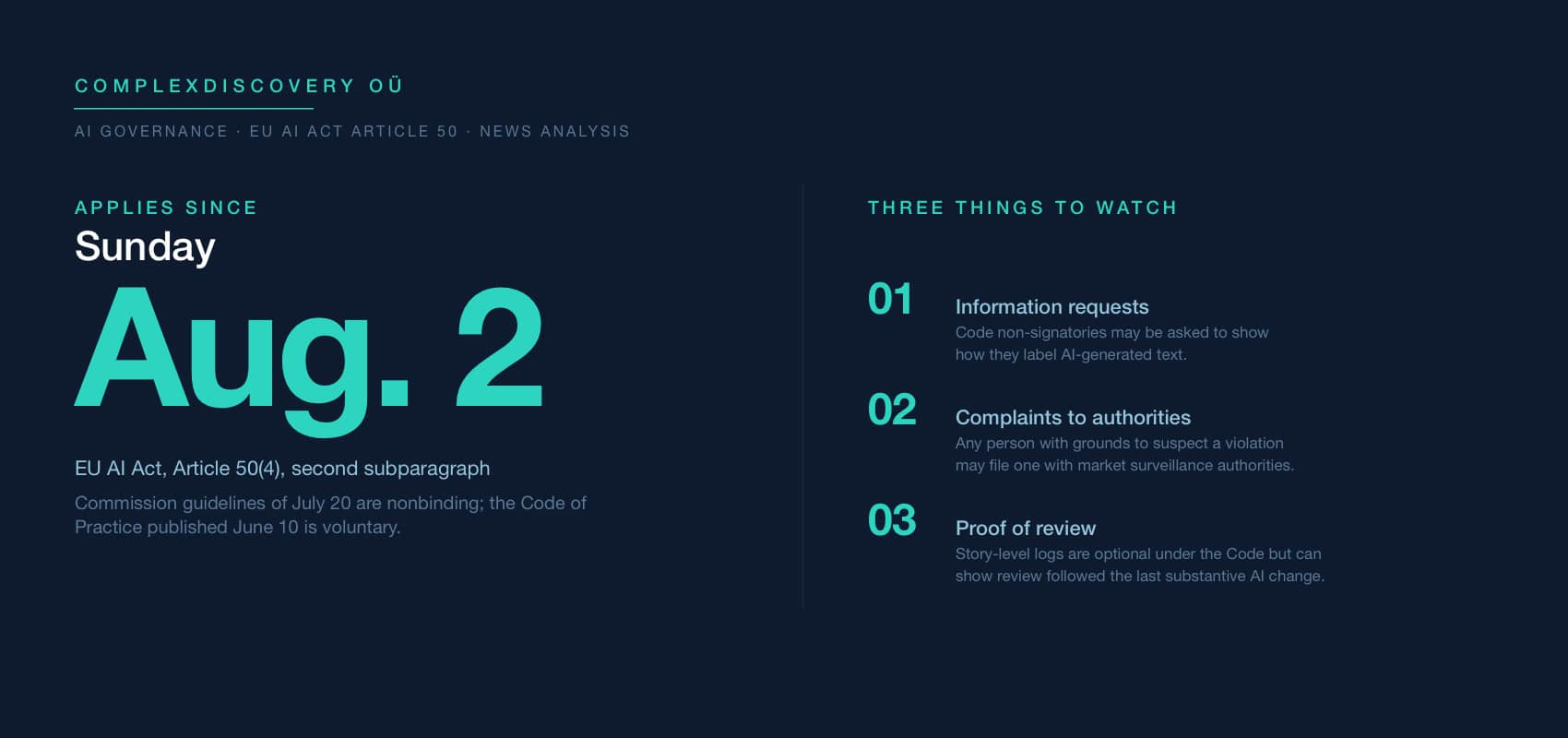
For information governance and eDiscovery teams, the practical consequence is that human review becomes something an organization may need to show. The guidelines say deployers that do not sign the Commission’s voluntary Code of Practice on Transparency of AI-Generated Content, published June 10, are expected to show compliance through other adequate means. Those deployers may also face requests for information about their labeling practices. Enforcement can start with a market surveillance authority itself or with a complaint, and any person with grounds to suspect a violation may file one.
Neither document asks for a file on every story. The guidelines’ text-exception section, paragraphs 133 through 140, does not prescribe what records of the review a publisher must keep. Under the Code’s Commitment 4, signatories other than media service providers already subject to editorial standards and oversight frameworks commit to written policies naming the person with editorial responsibility and describing the organizational measures behind human review. The Code says that commitment “does not entail having to document individual instances of human review or editorial control,” though signatories may record more about the review if they choose.
That leaves story-level records as an optional design choice, and the guidelines’ point about sequence suggests one. A newsroom that wants evidence beyond its policies can retain the agent’s run log, the draft each human saw, the reviewer’s identity and a timestamp for sign-off. It can then compare that timestamp with the last substantive AI modification, because a later substantive AI change voids the exception. Those files are ordinary electronically stored information. A retention schedule should account for them in advance, and a litigation hold should reach them once a claim, such as a defamation suit, is pending or reasonably anticipated. Organizations outside journalism face the same test, since the guidelines’ examples include AI-manipulated investor reports on a listed company’s website and AI-generated public safety warnings.
Machines write, and someone still reads
Salmeri draws a version of the AI Act’s line himself. Corrections and withdrawals, he told the Reuters Institute, are his decision and never the system’s. “The system writes, but it does not rule on its own conduct,” he said. The guidelines apply a similar idea one step earlier: under their reading, an AI system reviewing another AI system’s draft does not count as review either. A newsroom within the act’s reach that wants machines to “carry the mechanical load,” in Merket’s phrase, will have to decide which stories get a human reviewer and which get a label.
That choice lands on legal, compliance and records professionals, whether they advise publishers or any other organization that puts AI-assisted text on public matters in front of readers. When a regulator or a litigant asks who reviewed a story before it ran, will the answer be in the file?
News Sources
- Article 50: Transparency obligations for providers and deployers of certain AI systems (European Commission AI Act Service Desk)
- Article 99: Penalties (European Commission AI Act Service Desk)
- Article 113: Entry into force and application (European Commission AI Act Service Desk)
- Guidelines on the implementation of the transparency obligations for certain AI systems under Article 50 of the AI Act (European Commission)
- Commission publishes Code of Practice on marking and labelling AI-generated content (European Commission)
- Code of Practice on Transparency of AI-Generated Content (European Commission via ALIA)
- Disrupting AI-enabled “false front” operations (OpenAI)
- Editor’s Note: Retraction of article containing fabricated quotations (Ars Technica)
- Ars Technica’s policy on generative AI (Ars Technica)
- Post by @benjedwards.com: Bluesky (Benj Edwards via Bluesky)
- Daily Kos targeted by Iranian propaganda effort (Daily Kos)
- Standards around generative AI (The Associated Press)
- Redazione Zero (Redazione Zero)
- Journalism, media, and technology trends and predictions 2026 (Reuters Institute for the Study of Journalism)
- Inside the rise of AI-native newsrooms run by autonomous agents (Reuters Institute for the Study of Journalism)
- AI in journalism: Live tracker of scandals and mistakes (Press Gazette)
- Ars Technica Pulls Article With AI Fabricated Quotes About AI Generated Article (404 Media)
- Ars Technica Fires Reporter Over AI-Generated Quotes (TheWrap)
- A quote from New York Times Editors’ Note (Simon Willison’s Weblog)
- Journalist Accuses Ohio’s Main Newspaper of Slapping Her Name on an AI “Express Desk” Article Without Her Knowledge, While She Was on Honeymoon (Futurism)
- Yes, August 2 Still Matters: The EU Approved a High-Risk AI Delay, but Most Transparency Obligations Remain (Jones Walker)
- European Commission Publishes Final Code of Practice on Marking and Labelling AI-Generated Content (Jones Day)





Assisted by GAI and LLM Technologies
Additional reading
- An Oxford tutorial for newsroom leaders who must learn faster than the news
- An Oxford tutorial for cybersecurity, governance and eDiscovery
- Estonia aims to be first to give AI agents official digital IDs
- Parliament hits pause on high-risk AI rules and bans nudifier apps
- Europe’s AI labeling rules arrive with a voluntary code and a hard deadline
- AI is becoming an advisor, and it is rewriting how buyers find you
Source: ComplexDiscovery OÜ

ComplexDiscovery’s mission is to enable clarity for complex decisions by providing independent, data‑driven reporting, research, and commentary that make digital risk, legal technology, and regulatory change more legible for practitioners, policymakers, and business leaders.