

Editor’s Note: A three-judge panel of the 5th U.S. Circuit Court of Appeals on Oct. 22, 2026, vacated a preliminary injunction that U.S. District Judge Henry T. Wingate had entered against Mississippi House Bill 1193, a 2025 law restricting diversity, equity and inclusion programs in public schools and colleges, and ordered the case, Jackson Federation of Teachers v. Fitch, reassigned to a different judge. The majority cited fabricated parties, facts, and quotations in Wingate’s July 2025 temporary restraining order, a nonexistent case included in a corrected version of that order, and what it described as misreadings of Supreme Court precedent. Wingate has said a law clerk used the AI tool Perplexity during preparation of an early draft that was mistakenly docketed. The panel did not rule on the constitutionality of the law and imposed no sanctions.
For cybersecurity, information governance, and eDiscovery professionals, the decision illustrates how AI-generated errors can enter even judicial work product, survive subsequent revisions, and remain in the public record after questions are raised. The case also highlights growing concerns about verification, accountability, and disclosure obligations when AI tools are used in legal workflows. Watch how the newly assigned judge handles the remand and whether courts adopt more formal rules governing AI use in judicial chambers.
Content Assessment: 5th Circuit reassigns Mississippi DEI case after judge's orders cite fabricated parties, quotations and a nonexistent case
Information - 93%
Insight - 92%
Relevance - 90%
Objectivity - 90%
Authority - 88%
91%
Excellent
A short percentage-based assessment of the qualitative benefit expressed as a percentage of positive reception of the recent article from ComplexDiscovery OÜ titled, "5th Circuit reassigns Mississippi DEI case after judge's orders cite fabricated parties, quotations and a nonexistent case."
Industry News – Artificial Intelligence Beat
5th Circuit reassigns Mississippi DEI case after judge’s orders cite fabricated parties, quotations and a nonexistent case
ComplexDiscovery Staff
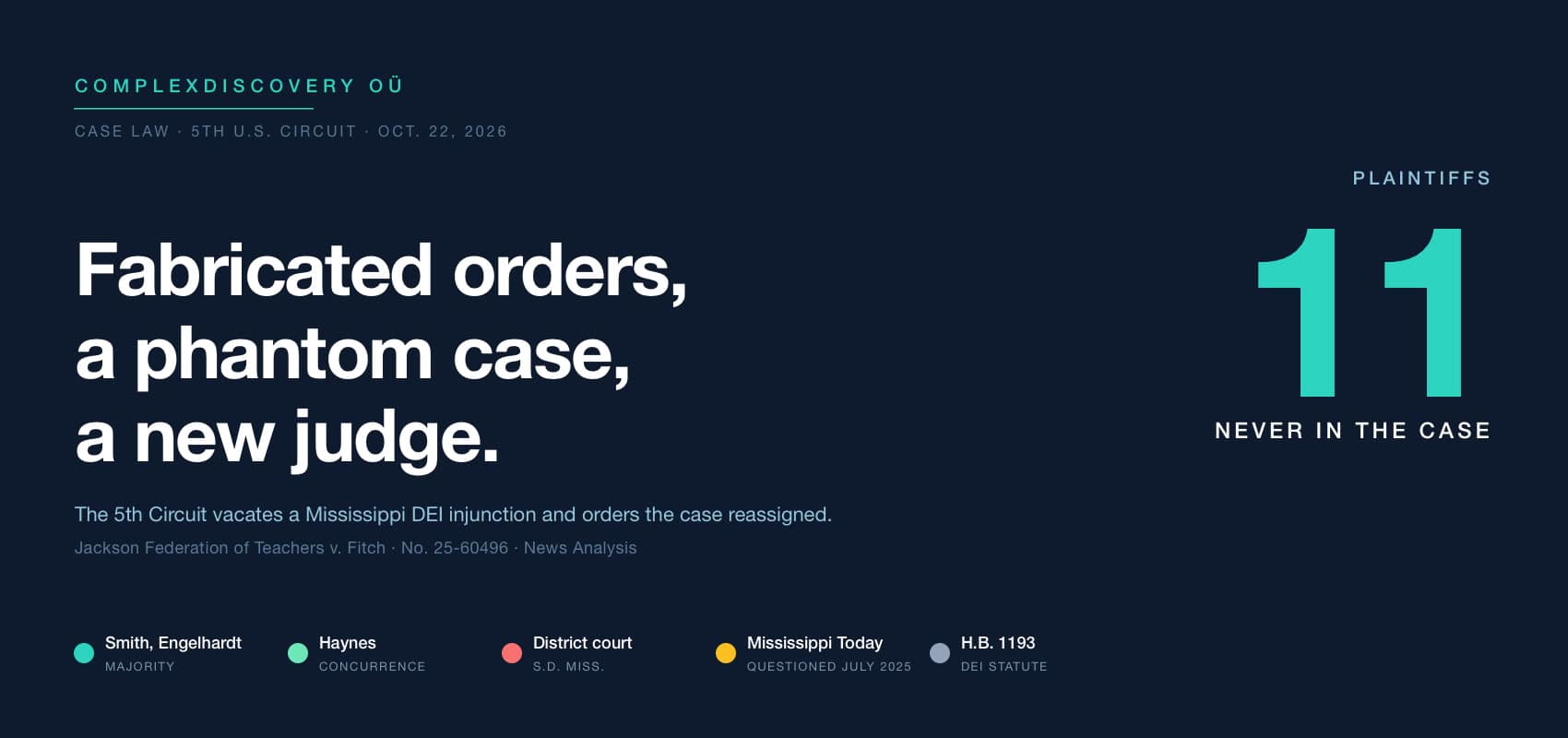
A federal appeals court on Oct. 22 ordered a challenge to Mississippi’s diversity, equity and inclusion law taken from the judge who blocked it, citing “extraordinarily grave errors” that included fabricated parties, facts and quotations in his orders.
Even the corrected version of his first order still cited a 4th Circuit case that does not exist, the appeals court found, a citation Mississippi Today had publicly questioned in July 2025.
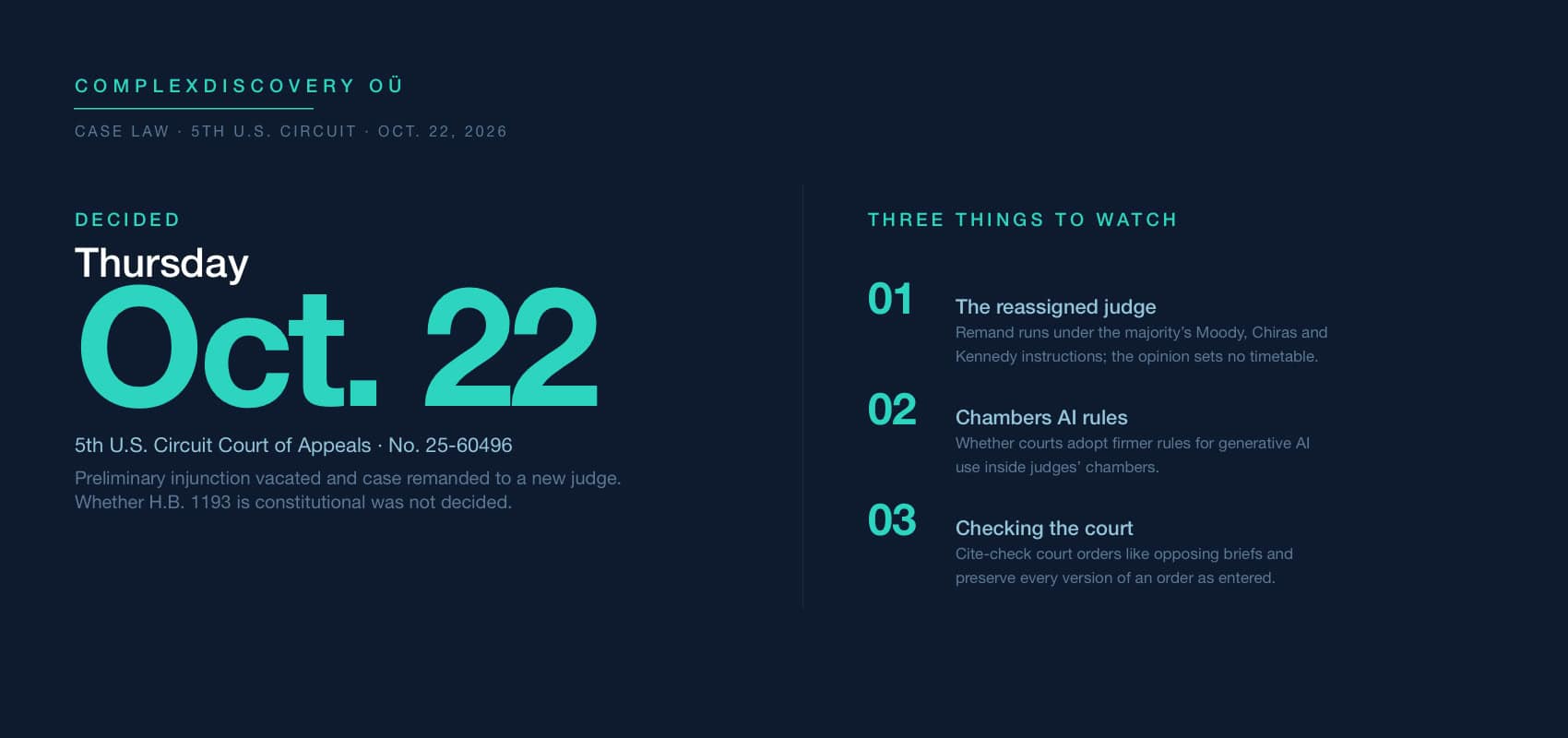
In Jackson Federation of Teachers v. Fitch, No. 25-60496, the 5th U.S. Circuit Court of Appeals vacated the preliminary injunction that U.S. District Judge Henry T. Wingate of the Southern District of Mississippi had entered against House Bill 1193, a 2025 law that, as the opinion describes it, restricts DEI programs, required trainings and course content in Mississippi’s public schools and colleges. The panel directed the chief judge of the Southern District to assign the case to a different district judge “for all further proceedings.” Judge Jerry E. Smith wrote the opinion, which Judge Kurt D. Engelhardt joined, according to Courthouse News Service. Judge Catharina Haynes wrote a three-sentence concurrence joining only the opinion’s final paragraph, the one that vacates the injunction, remands the case and orders reassignment.
The panel did not decide whether the statute is constitutional, leaving that question to the incoming judge under instructions the opinion sets out at length. For how the errors arose, the opinion relies on Wingate’s own explanation: he has said a law clerk used the generative AI tool Perplexity on an early draft of the first order that was docketed by mistake. His chambers and the Mississippi attorney general’s office did not immediately respond to Courthouse News requests for comment.
Lawyers who file fabricated citations can face show-cause orders, monetary penalties and bar referrals. This opinion shows what happens when the fabricated material sits in the court’s own orders: the remedy the 5th Circuit ordered was a new judge, and the opinion imposes no sanction.
Inside the July 2025 restraining order
The record the opinion describes begins with a temporary restraining order Wingate entered on July 20, 2025. According to the opinion, that order named as plaintiffs 11 individuals and organizations that had never been parties to the case and listed as defendants two officials who, the opinion says, were not actually sued in those roles. It also claimed, with no supporting evidence, that the law had already led three postsecondary institutions to cancel DEI programming. And it attributed to H.B. 1193 four phrases, among them “critical race theory” and “institutional bias,” that appear nowhere in the statute’s text, according to the opinion. It cited declarations from four people who, Smith wrote, “do not appear in the record at all and may not even exist.”
The state defendants flagged the errors in a motion to clarify on July 22, 2025. The district court then removed the original order from the docket and replaced it, without explanation, with a corrected version backdated to July 20, the opinion says. When the state asked that the original be restored as a superseded order, the court refused and called the inaccuracies “clerical.” Smith wrote that the court was “grateful” and “lucky” that the defendants had attached a copy of the original as an exhibit to a later motion, because Wingate had removed it from public access.
Sen. Chuck Grassley of Iowa, writing as chairman of the Senate Judiciary Committee, wrote to Wingate on Oct. 6, 2025, about the role, if any, that generative artificial intelligence had played in preparing the order. Wingate answered in an October 2025 letter to the Administrative Office of the U.S. Courts, written for transmission to Grassley. He said the clerk had used Perplexity “strictly as a foundational drafting assistant,” that the draft had skipped his chambers’ standard review before it reached the docket, and that the root cause was “a lapse in human oversight.” He also said he had put in place a new chambers plan covering “all draft opinions, orders, and memorandum decisions.” Under that plan, each draft must undergo “a mandatory, independent review by a second law clerk,” with all cited cases “printed from Westlaw and attached to a final draft.”
A nonexistent case outlives the correction
The corrected order is where the opinion’s account turns from embarrassment into something closer to a structural warning. At oral argument, Smith wrote, it was discovered that the replacement order cited “Cousins v. School Bd. of City of Norfolk, 503 F.2d 422, 426-27 (4th Cir. 1974).” The case does not exist, the opinion says, calling it “an apparent AI hallucination.” The cited volume and page fall inside United States v. Anderson, a 6th Circuit decision, and the pinpoint pages fall within Avis Rent A Car System, Inc. v. United States, a 2nd Circuit decision, according to the opinion. Mississippi Today had questioned the citation in public months before the appeal was argued. Its July 28, 2025, report said the corrected order still cited Cousins and that the outlet’s own search suggested the case either did not exist or was cited incorrectly.
That citation mattered beyond the restraining order. Wingate’s Aug. 18, 2025, preliminary injunction, entered three weeks after that report, “generally incorporates by reference” the restraining order’s analysis, which led Smith to treat the phantom case as “arguably part of the shoddy reasoning” of the injunction as well. The corrected order predates Wingate’s October letter, so the record does not show whether the review steps he described there would have caught it.
The opinion does not say how the corrected order was prepared; for the original, it relies on Wingate’s account. In one of its sharpest passages, it says the district court, “or perhaps, being charitable, its AI agent,” ignored and manipulated governing law, “apparently to satisfy a policy agenda.” Haynes did not join that language.
Why the panel ordered reassignment
All three judges joined the reassignment order itself, though the reasoning behind it belongs to the majority. The opinion calls reassignment on remand an “extraordinary” and “rarely invoked” power, used so sparingly that the circuit has not settled which of its two tests governs. The majority applied both. Under the first, it said Wingate’s choice to strip out the fabricated material, with no account of why the order could survive without it, “may already evince” a “substantial difficulty” in setting aside views built on rejected findings. It added that returning the case to him would lower the judiciary’s standing with the public and that the benefit of a fresh start would outweigh the cost. Under the second test, it concluded that an objective observer might “question the impartiality of the proceedings.”
The fabrications were not the majority’s only ground, and much of the opinion addresses legal error. It faulted Wingate for twice describing the Supreme Court’s facial-challenge framework in Moody v. NetChoice as only “supposedly” required. It also faulted him for treating legal uncertainty as a reason to “pause” a statute, when a preliminary injunction requires, among other things, a finding that the plaintiffs are likely to succeed on the merits. And it rejected his reading of Trump v. CASA as support for “all-or-nothing” relief, which the majority called “almost exactly the opposite” of what that decision says. The majority’s reassignment analysis cites “the AI hallucinations and mistakes of law” together, so readers who frame the ruling as a pure AI holding will overstate it.
Few tools when the bench is the source
Set beside the attorney cases, that remedy looks different in kind. When fabricated authority has reached a court order through a lawyer’s filings, appellate courts have vacated the order and sanctioned the lawyer. The Supreme Court of Georgia did both in Payne v. State in May 2026, vacating a trial court’s order, largely drafted by a prosecutor, that denied a murder defendant a new trial, and suspending the prosecutor from practice before that court for six months. In Shahid v. Esaam in June 2025, the Georgia Court of Appeals vacated a trial court’s order denying a wife’s petition to reopen her divorce case and set aside the decree. The appeals court said that order “purports to have been prepared” by the husband’s attorney. It made no finding about who inserted the fictitious cases, and it imposed the maximum $2,500 frivolous-motion penalty on the attorney over an appellate brief in which 11 of 15 citations were bogus.
Judges whose orders carried fabricated material have faced far less, at least in the cases commentators have reviewed. U.S. District Judge Julien Xavier Neals of New Jersey withdrew a securities opinion in 2025 after it was found to contain fabricated quotations, and he later told Grassley that a law school intern had used ChatGPT. In an Oct. 20, 2026, commentary for Bloomberg Law, Oliver Roberts of WashU Law wrote that the public record showed no evidence of judicial discipline in the judge-error cases he reviewed. Fordham law professor Bruce A. Green called sanctions against Neals and Wingate highly unlikely in an October 2025 Law360 report.
No report of a judicial-conduct complaint against Wingate appeared in the coverage reviewed for this article as of Oct. 23, 2026. The 5th Circuit’s Judicial Conduct Matters index lists closed matters by complaint number, so it cannot show whether a complaint is pending. Federal law also keeps records of judicial-conduct investigations confidential except in limited circumstances. One is disclosure “authorized in writing by the judge who is the subject of the complaint” together with the chief judge of the circuit, the chief justice or a designated Judicial Conference committee chair.
Reassignment fills part of that gap without being discipline, because it attaches to the case rather than to the judge’s standing and carries no disciplinary finding. It does, however, set out a named judge’s errors in a published appellate opinion that the incoming judge, the parties and the bar will read.
Lessons for litigators and records teams
The checking that worked here was done outside the chambers that issued the order. The state’s lawyers read the restraining order closely enough to identify invented plaintiffs within two days. Mississippi Today questioned the surviving phantom case eight days after the original order, and the opinion records its discovery at oral argument. Practitioners should cite-check a court’s orders with the rigor they apply to an opponent’s brief, especially orders drafted quickly on emergency motions, and move promptly to clarify when an order does not match the record.
The episode is also a records problem. The original order disappeared from the public docket, and the court called itself lucky that the defendants had preserved a copy by attaching it to a motion. Wingate told Grassley the clerk’s office would keep the errant order under record retention requirements, but a retained internal copy is not the same as a public docket entry. Information governance and eDiscovery teams that track court filings should capture and preserve every version of an order as entered, because a later replacement may not show what changed.
Two details in Wingate’s letter speak to security and privacy teams. He said the clerk did not input “any sealed, privileged, confidential, or otherwise non-public case information” into Perplexity, a data-handling question organizations routinely ask of public AI tools. He also disclosed that the vendor of his chambers’ cite-checking tool builds AI into that feature, with clerks reviewing its output, a reminder that verification tools can carry the same technology they are meant to check. The controls he described, a second reviewer and printed copies of every cited case, give law firm verification protocols a concrete checklist to borrow.
Remand leaves the statute’s fate open
The case itself now goes to a judge who inherits a detailed road map. The majority read H.B. 1193 as regulating public schools, colleges and their educators but not students. It directed the district court to apply the circuit’s decision in Chiras v. Miller to textbooks, curricula and instruction, and the framework of Kennedy v. Bremerton School District to teachers’ and professors’ personal, noncurricular statements in the classroom. For the vagueness claims, it described a separate and demanding standard drawn from the circuit’s McClelland v. Katy Independent School District decision. On the facial First Amendment challenge, Moody requires the plaintiffs to show that the law’s “unconstitutional applications substantially outweigh its constitutional ones.”
The Mississippi Center for Justice, which represents the plaintiffs with the ACLU of Mississippi, said it had worried that districts might read the law to limit what teachers and students discuss in class. “The court’s interpretation addresses one of those major concerns and affirms that these discussions can continue,” the center said in a statement reported by Courthouse News. Haynes, writing for herself, said it was “very important” on remand to protect teachers’ ability to instruct students against the kinds of discrimination Title VII prohibits. The opinion sets no timetable for the remand.
Wingate told Grassley: “It is my job to ensure the veracity of all cases cited and relied upon in my opinions and orders.” The Cousins citation survived a correction made after the state flagged the original errors, stayed in the order after a newsroom questioned it and rode into the preliminary injunction by reference. If the court is the last line of verification for everyone else’s citations, who is assigned to check the court’s?
News Sources
- Jackson Federation of Teachers v. Fitch, No. 25-60496 (opinion, Oct. 22, 2026) (U.S. Court of Appeals for the Fifth Circuit)
- Wingate to Grassley re Judiciary Use of AI (Office of U.S. Sen. Chuck Grassley)
- SHAHID v. ESAAM (2025) (Court of Appeals of Georgia via FindLaw)
- 28 U.S. Code § 360: Disclosure of information (Legal Information Institute, Cornell Law School)
- Grassley Releases Judges’ Responses Owning Up to AI Use, Calls for Continued Oversight and Regulation (U.S. Senate Committee on the Judiciary)
- Judicial Conduct Matters (U.S. Court of Appeals for the Fifth Circuit)
- AI ruling? Attorneys baffled by federal judge’s order that lists incorrect parties, wrong quotes (Mississippi Today)
- Fifth Circuit slams AI rulings in school diversity policy case (Courthouse News Service)
- Judge Whose Ruling Had AI-Generated Errors Sees Case Reassigned (Bloomberg Law)
- Georgia Supreme Court orders redo in Hannah Payne case over AI citations (Atlanta News First)
- Georgia court throws out earlier ruling that relied on fake cases made up by AI (The Register)
- Fed. Judges Unlikely To Face Discipline For Possible AI Use (Law360)
- Judges Citing Fake AI-Generated Law Have Faced Few Consequences (Bloomberg Law)
- Judicial AI Hallucinations or Errors : 11 Cases and Counting (Natural and Artificial Law)





Assisted by GAI and LLM Technologies
Additional reading
- An AI agent can write the story, but EU law asks whether a human reviewed it
- An Oxford tutorial for newsroom leaders who must learn faster than the news
- An Oxford tutorial for cybersecurity, governance and eDiscovery
- Estonia aims to be first to give AI agents official digital IDs
- Parliament hits pause on high-risk AI rules and bans nudifier apps
- Europe’s AI labeling rules arrive with a voluntary code and a hard deadline
- AI is becoming an advisor, and it is rewriting how buyers find you
Source: ComplexDiscovery OÜ
ComplexDiscovery’s mission is to enable clarity for complex decisions by providing independent, data‑driven reporting, research, and commentary that make digital risk, legal technology, and regulatory change more legible for practitioners, policymakers, and business leaders.