
Editor’s Note: Federal trade fraud enforcement now comes with a published reference. On July 14, the Justice Department and the Department of Homeland Security released “A Resource Guide to Trade Fraud Enforcement” while announcing that their joint task force had surpassed $1 billion in a combined tally of recoveries, penalties, forfeitures and publicly charged losses in under a year. The pairing matters: the government is describing its scorecard and, in the same breath, the conduct it intends to examine next.
For cybersecurity, data privacy, regulatory compliance and eDiscovery professionals, the guide converts customs enforcement into a records discipline. Entry filings, broker communications, origin certificates and adverse-event records can become evidence in False Claims Act, criminal and securities matters, and whistleblower channels put internal documents at the center of future cases.
Watch three fronts next: agency implementation measures due under Executive Order 14411 by late 2026, any further expansion of forced labor priority sectors, and qui tam filings built on supply chain data. Companies that treat trade compliance as an information governance function will meet this moment better than those that treat it as a customs formality.
Content Assessment: DOJ and DHS issue trade fraud guide as task force tally exceeds $1 billion
Information - 94%
Insight - 93%
Relevance - 93%
Objectivity - 92%
Authority - 92%
93%
Excellent
A short percentage-based assessment of the qualitative benefit expressed as a percentage of positive reception of the recent article from ComplexDiscovery OÜ titled, "DOJ and DHS issue trade fraud guide as task force tally exceeds $1 billion."
Industry News – eDiscovery Beat
DOJ and DHS issue trade fraud guide as task force tally exceeds $1 billion
ComplexDiscovery Staff
Federal trade fraud enforcement now comes with a published reference text and a $1 billion scorecard. What that number counts deserves as much attention as its size.
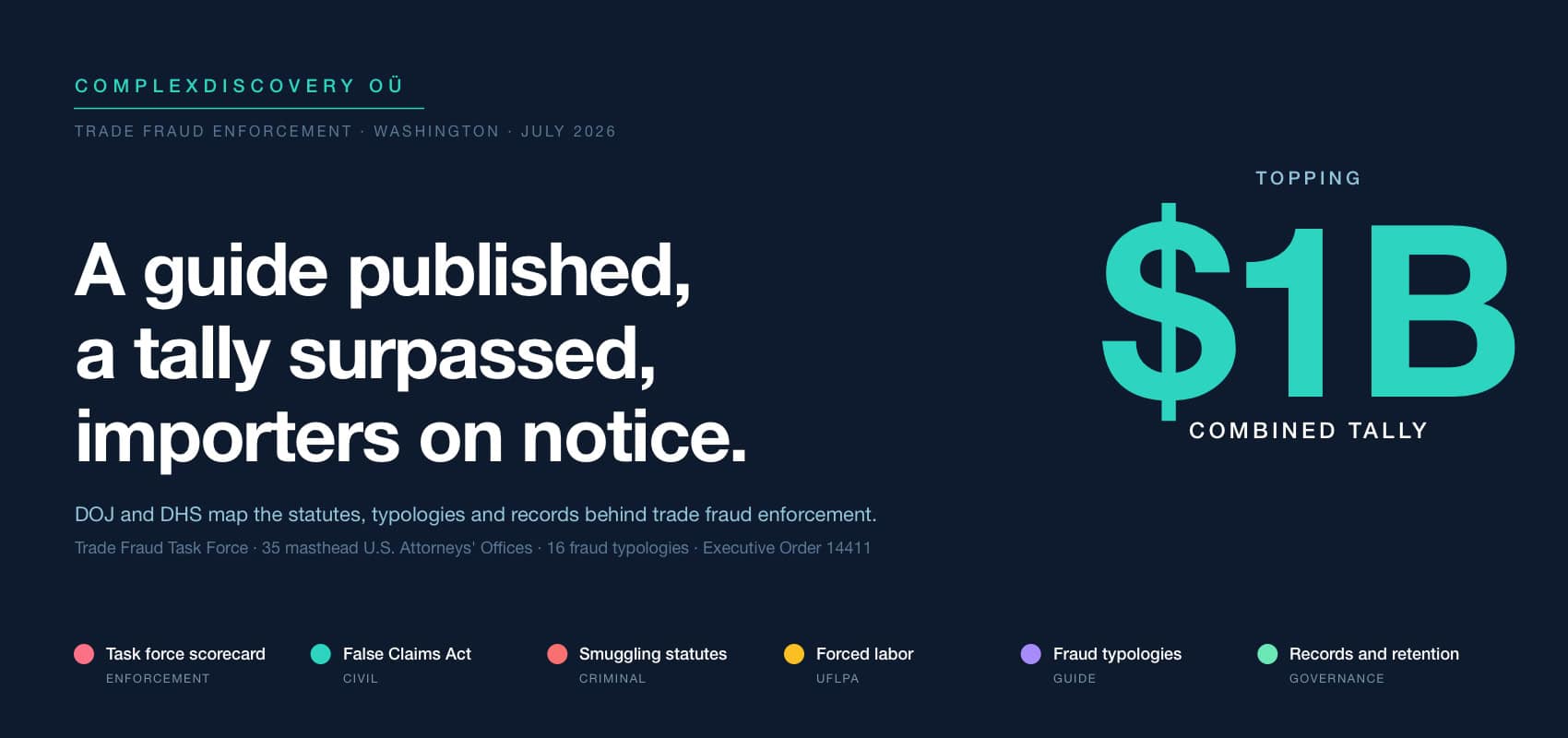
The Justice Department (DOJ) and the Department of Homeland Security (DHS) released “A Resource Guide to Trade Fraud Enforcement” on July 14, the same day officials said the joint Trade Fraud Task Force had surpassed $1 billion in a combined tally of civil and criminal recoveries, penalties, forfeitures and publicly charged losses since its launch in August 2025. The figure is not a cash-recovery total. Roughly half traces to a single settlement in a matter whose related criminal convictions date to 2021, years before the task force existed, and the charged losses in unresolved cases remain allegations.
The 31-page guide, prepared by the task force partnership of DOJ and DHS components including the National Fraud Enforcement Division, Homeland Security Investigations (HSI) and U.S. Customs and Border Protection (CBP), assembles the statutes, agencies and fraud typologies behind federal customs enforcement, illustrated with case examples drawn from two decades of prosecutions and settlements. The guide is informational and nonbinding. By its own terms it creates no enforceable rights or defenses, offers no legal advice and does not limit the enforcement positions of DOJ, DHS or any other agency.
“For too long, fraud actors have viewed customs violations as a mere surcharge or cost of doing business,” Assistant Attorney General Colin McDonald of the National Fraud Enforcement Division said in the announcement. “By utilizing the Department’s full weight, we are making it clear that trade fraud is a serious economic crime.”
What the billion-dollar tally counts
The task force pairs DOJ’s civil and criminal enforcement components with CBP and HSI. Thirty-five U.S. Attorneys’ Offices are listed as task force masthead offices, and DOJ used the July 14 announcement to create the Global Trade & Commerce Enforcement Section within the National Fraud Enforcement Division, a litigating unit dedicated to criminal customs fraud, external revenue evasion and related trade crimes.
The matters behind the tally read like a tour of the import economy. Perfectus Aluminum Inc. and related companies agreed in May 2026 to pay $549.5 million to resolve False Claims Act allegations that they evaded antidumping and countervailing duties on over 2.2 million aluminum extrusions misrepresented to CBP as finished “pallets”; related criminal convictions in that matter came in 2021, before the task force was formed. Ceratizit USA agreed in December 2025 to pay $54.4 million to settle allegations that it transshipped tungsten carbide through a third country and falsely declared origin. In the newest charges, Raj Kohli and Veena Kohli, operators of gold jewelry importer Surya International in South San Francisco, California, and Narain Gulabani, owner and operator of Barkha Wholesale in Naperville, Illinois, face federal charges involving over $933 million in imported gold jewelry and over $51.6 million in allegedly evaded duties. Those charges are allegations, and the defendants are presumed innocent unless proven guilty.
Separate from the task force tally, CBP has assessed $2.1 billion in commercial trade penalties in the current fiscal year as of the July 14 announcement, and 35 parties have been debarred from federal business. U.S. Attorney Andrew Boutros, whose Northern District of Illinois office serves as a lead prosecuting office for the task force, said Chicago’s position as one of the country’s largest inland ports gives his district expansive venue over trade fraud matters.
“When companies commit trade fraud, the prosperity and safety of American workers, families, and communities are put at risk,” DHS Assistant Secretary for Trade and Economic Security Aris Kourkoumelis said in the announcement. McDonald and Kourkoumelis co-signed the guide’s foreword.
Inside the 31-page enforcement guide
The guide walks through the customs entry process, the legal duties of the over 450,000 importers of record and about 14,500 licensed customs brokers registered with CBP, and a layered tariff system in which a single entry can face ordinary duties, Section 301 tariffs, antidumping or countervailing duties and Section 232 measures at once, with Section 201 safeguards available for covered products. Because antidumping and countervailing duties can exceed 100 percent of declared value, the guide identifies them as a frequent target for evasion.
Its enforcement chapter catalogs the tools prosecutors bring to customs cases: CBP’s administrative penalty authority under Section 592 of the Tariff Act, the civil False Claims Act with treble damages and whistleblower provisions, and a suite of Title 18 criminal statutes. Smuggling under Section 545 carries a statutory maximum of 20 years in prison and requires forfeiture of the goods or their value. Trade fraud proceeds can also trigger money laundering charges, and repeated schemes can support counts under the Racketeer Influenced and Corrupt Organizations Act.
The guide puts the government’s theory of the problem in one line: “any imported good that presents a risk to our revenue, our safety, or our values usually begins with a lie.”
Sixteen fraud typologies anchor the guide’s final chapter, from false country of origin declarations and undervaluation to drawback fraud, port shopping, shell company schemes and forged safety certifications. Case examples include Ford Motor Co.’s $365 million settlement in March 2024 over misclassified cargo vans, a $1.6 billion resolution with Toyota subsidiary Hino Motors over falsified engine emissions data, and a honey importation prosecution involving 27 defendants and about $260 million in losses that the guide describes as the largest criminal antidumping and countervailing duty prosecution in American history.
Forced labor takes a prominent place in the guide
A full chapter addresses forced labor, which the guide frames as both a humanitarian obligation and an enforcement priority. Section 307 of the Tariff Act of 1930 bars imports made with forced labor, and CBP can detain goods on reasonable suspicion through withhold release orders. The Uyghur Forced Labor Prevention Act adds a rebuttable presumption that goods connected to the Xinjiang Uyghur Autonomous Region are barred from entry.
The Forced Labor Enforcement Task Force has expanded its list of high-priority sectors from the original four to 12, adding aluminum, polyvinyl chloride, seafood, steel, copper, lithium, caustic soda and jujubes to apparel, cotton, silica-based products and tomatoes. The guide signals that importers should exercise the highest level of scrutiny when their supply chains intersect those sectors, and it warns that criminal exposure under the peonage statutes reaches those who knowingly benefit financially from participation in a venture while knowing, or recklessly disregarding, that the venture used forced labor, from the importer down to the retailer.
Down-chain liability reaches wholesalers and retailers
The guide’s corporate oversight section may be its most consequential passage for general counsel. “The era when a company can claim ignorance of its upstream partners’ activities is over,” the guide says, warning that DOJ will examine whether compliance failures reflect negligence, reckless disregard, willful blindness or intentional criminality.
Federal law reaches past the border transaction. Under the second paragraph of Section 545, anyone who receives, conceals, buys or sells goods known to have been imported contrary to law faces the same 20-year exposure as the importer. The guide cites prosecutions of resellers who never touched a customs form.
The publication also lands within weeks of Executive Order 14411, “Strengthening Customs Enforcement,” signed June 3, 2026. The order directs DHS to tighten importer-of-record vetting, restrict foreign importers from filing informal entries, and revise penalty mitigation standards to establish a minimum floor of not less than 50 percent of the assessed penalty, absent exceptional circumstances that materially impact national security, while eliminating mitigation for repeat offenders. The guide cites the order in describing CBP’s push to enforce liquidated damages claims and impose maximum broker penalties.
What compliance and governance teams should do now
For companies, the guide reads as a catalog of the records investigators ask for. Importers of record cannot contract away responsibility for entry accuracy, even when a licensed broker prepares the filings, so legal teams should verify that broker oversight is documented and that classification decisions and valuation methods survive scrutiny. Supply chain audits should test country of origin claims against substantial transformation standards rather than accepting supplier certificates at face value.
Record retention deserves equal attention. Customs brokers and importers must keep entry records for five years, and those records, including invoices, broker communications and partner agency certifications, can become central evidence in a False Claims Act action, grand jury investigation or related subpoena response. Companies discovering underpayments should weigh voluntary self-disclosure with counsel. In one guide-listed matter, importers that self-disclosed unpaid duties on Chinese plastic resin resolved False Claims Act liability for $6.8 million, with DOJ expressly crediting the timely disclosure, independent internal investigation and remediation.
The whistleblower channel raises the stakes. Knowingly avoiding or decreasing customs duties owed to the government can support a reverse false claim action under the False Claims Act, exposing companies to treble damages, and the statute’s knowledge standard reaches deliberate ignorance and reckless disregard as well as actual knowledge. Qui tam relators can file under seal, and DOJ’s Corporate Whistleblower Program accepts trade fraud referrals, meaning a company’s own logistics staff may be the government’s first witness.
Public companies carry a second layer of exposure. Trade fraud can violate the books-and-records and internal-controls provisions of the federal securities laws, the guide says, along with an issuer’s obligation to provide truthful material information in periodic reports. A duty-evasion scheme that never surfaces in a customs penalty can still surface in a securities enforcement action or a disclosure claim.
Records will decide the next round of cases
Trade fraud enforcement is document enforcement. Every typology in the guide, from double invoicing to falsified certificates of origin, turns on records that companies create, transmit and retain. Information governance programs that can produce accurate entry data quickly, and eDiscovery teams that can reconstruct supply chain correspondence, will shape which companies resolve inquiries as compliance matters and which face treble damages or indictment.
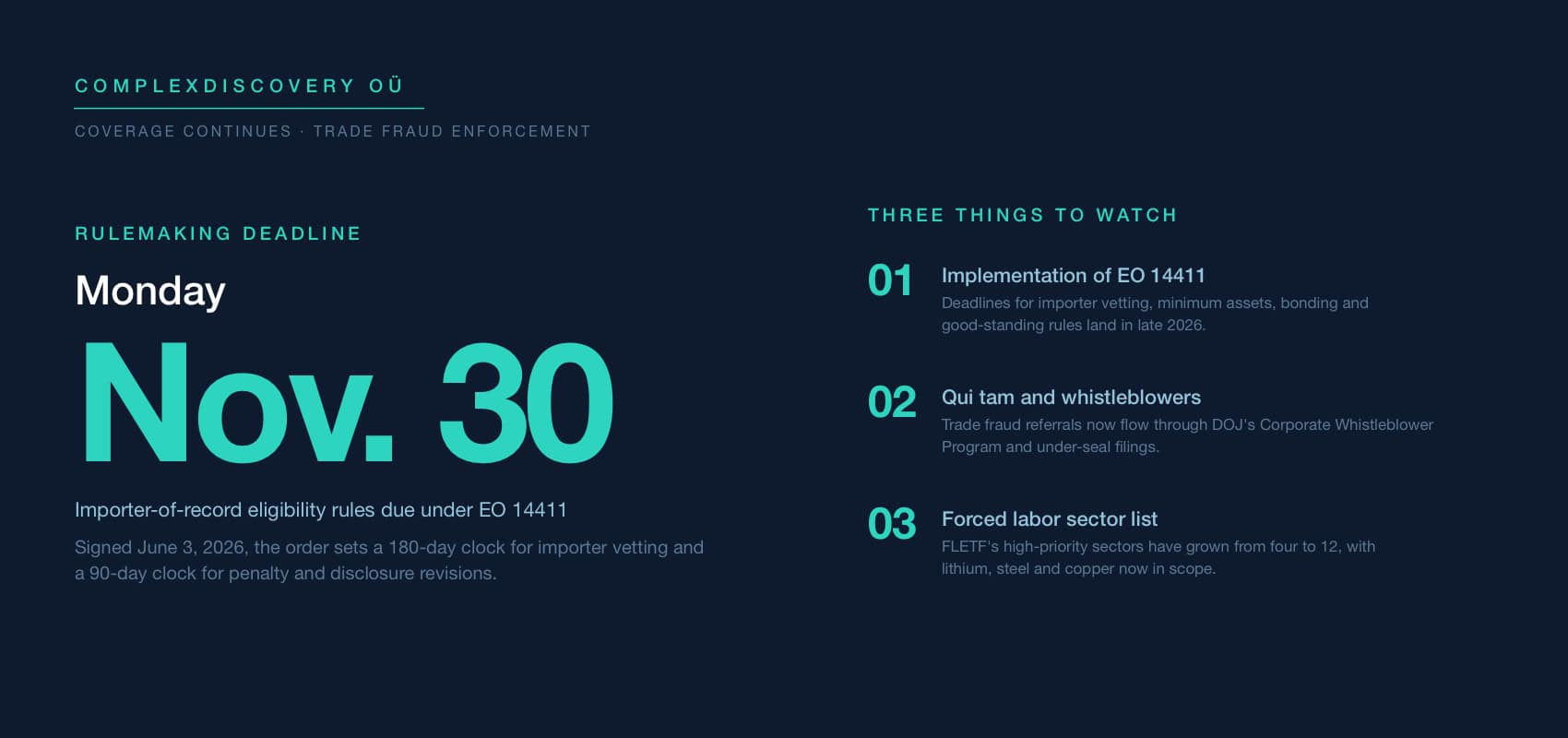
The task force has promised more, and the regulatory calendar backs it up. Executive Order 14411 set a 90-day clock for revised penalty standards and certain disclosure measures and a 180-day clock for new importer-of-record eligibility rules, including minimum domestic assets, bonding levels and good-standing requirements. Those implementation deadlines run from early September through late November 2026, though the directives are instructions to agencies, not yet final rules. Taken together, the guide and the order make the administration’s enforcement priorities explicit and put importers on notice of the conduct agencies intend to examine closely; they do not displace fact-specific statutory and procedural defenses.
When federal investigators can quote your invoices back to you, how confident are you in what your supply chain records actually say?
News sources
- A Resource Guide to Trade Fraud Enforcement (U.S. Department of Justice and U.S. Department of Homeland Security)
- Trade Fraud Task Force Surpasses $1 Billion in Recoveries and Charged Losses in Less Than One Year (U.S. Department of Justice)
- Departments of Justice and Homeland Security Partnering on Cross-Agency Trade Fraud Task Force (U.S. Department of Justice)
- Federal officials tout work of Chicago-based Trade Fraud Task Force (Daily Herald)
- DOJ celebrates $1B trade fraud haul, boosted by tariff evasion case (Chicago Sun-Times)
- Strengthening Customs Enforcement (Executive Order 14411) (Federal Register)
- Perfectus Aluminum Inc. and Related Companies Agree to Pay $549.5M to Settle False Claims Act Allegations (U.S. Department of Justice)
- Forced Labor Enforcement Task Force Release of the 2025 Update to the UFLPA Strategy (Office of the U.S. Trade Representative)

Assisted by GAI and LLM technologies
Additional reading
- UK and EU impose first simultaneous cyber sanctions as Poland attack is attributed to the FSB
- The negotiator was the leak: insider who betrayed ransomware victims gets 70 months
- Why a single Signal recovery key is a preservation problem
- Europe’s critical sectors are maturing, but seven still sit in ENISA’s risk zone
- When the worm targets the assistant: Miasma turns AI coding agents into the trigger
- Glasswing widens: Anthropic puts Mythos inside power, water and hospital operators across more than 15 countries
- Canvas breach moves from disclosure to demand as ShinyHunters sets May 12 deadline
- CISA’s CI Fortify rewrites the disconnection playbook for critical infrastructure
- A 48-month federal benchmark resets the incident-response insider question
- Data collection in occupied territory: A closer read of Cyber Law Toolkit scenario 35
- Cyber Law Toolkit tests surveillance and data collection under occupation
Source: ComplexDiscovery OÜ

ComplexDiscovery’s mission is to enable clarity for complex decisions by providing independent, data‑driven reporting, research, and commentary that make digital risk, legal technology, and regulatory change more legible for practitioners, policymakers, and business leaders.