
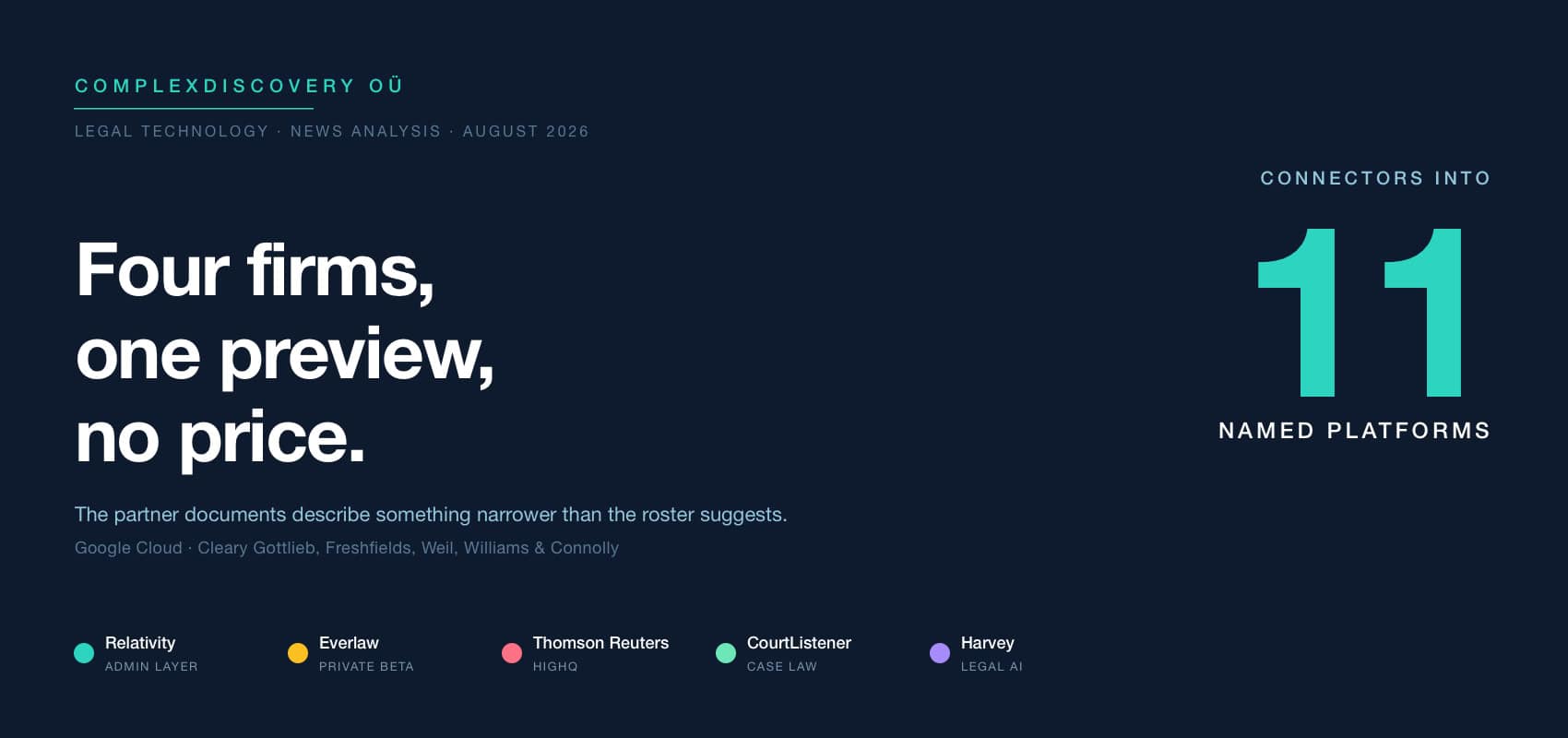
Editor’s Note: Google Cloud entered the legal vertical Aug. 25 with Gemini Enterprise for Legal, announcing a preview during ILTACON week with four Big Law names and connectors into 11 named legal platforms. The roster is broad. The partner documents read differently: Relativity’s connector handles administrative orchestration while substantive analysis stays in Relativity aiR, Everlaw’s sits in private beta, and the Thomson Reuters connection runs to HighQ rather than Westlaw.
For cybersecurity, privacy, compliance and eDiscovery professionals, three findings carry past the announcement. Google described the product’s skills three times and never identically, offering illustrative examples rather than a catalog tagged by availability, which is the document a preview buyer actually needs. Permission inheritance, the launch’s headline security feature, also aggregates reach across document management, contract, evidence, and docket systems, while Google’s launch materials do not provide a connector-by-connector authentication map. And a promoted motion-to-seal workflow puts agentic redaction proposals into court filings, while the materials reviewed here do not say who is professionally responsible when a confirmed proposal is wrong.
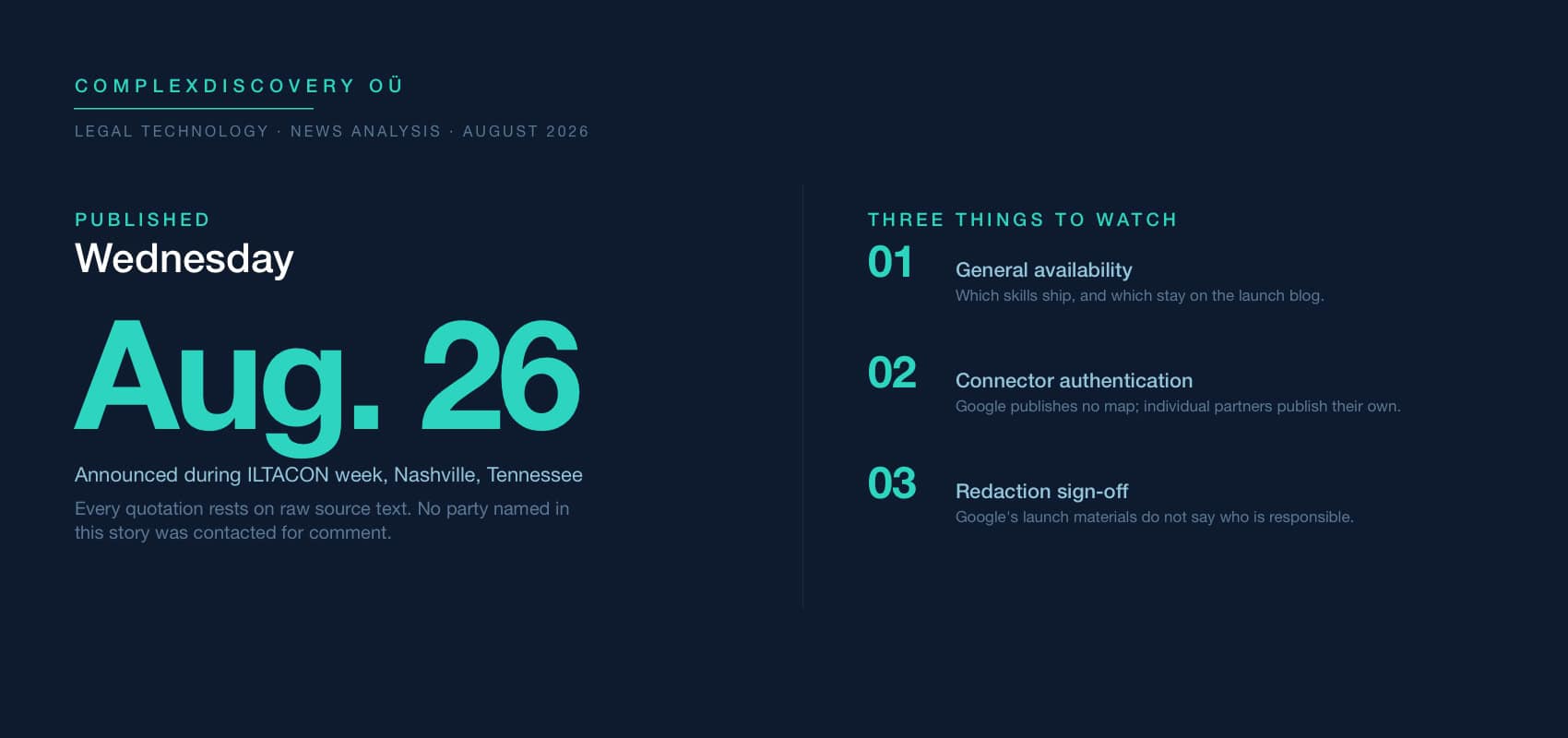
Watch the preview label. General availability will settle which skills ship, what the connectors actually reach, and whether firms answer the sign-off question before a court asks it for them.
Content Assessment: Google's legal AI launch is narrower than its connector roster suggests
Information - 92%
Insight - 93%
Relevance - 92%
Objectivity - 92%
Authority - 90%
92%
Excellent
A short percentage-based assessment of the qualitative benefit expressed as a percentage of positive reception of the recent article from ComplexDiscovery OÜ titled, "Google's legal AI launch is narrower than its connector roster suggests."
News Analysis – eDiscovery Beat
Google’s legal AI launch is narrower than its connector roster suggests
ComplexDiscovery OÜ Staff
Google Cloud launched Gemini Enterprise for Legal in preview Aug. 25, naming legal teams at Cleary Gottlieb, Freshfields, Weil and Williams & Connolly in the announcement. The launch materials provide no general availability date or published price, and do not identify a Google-built eDiscovery review application.
The product has four parts: specialized skills, Model Context Protocol connectors into 11 named legal platforms alongside Microsoft 365 and Google Workspace, a partner network of third-party agents and systems integrators, and the governance layer of the underlying Gemini Enterprise platform. Google’s own FAQ describes it as a plugin rather than a destination, “a legal plugin inside the Gemini Enterprise app, not a separate application your team logs into.” The announcement landed during ILTACON week, the International Legal Technology Association’s annual conference, which runs Aug. 23 through Aug. 27 in Nashville, Tennessee.
“With agentic AI, legal professionals have the ability to research across historical case law, build complex arguments, and automate mundane tasks that can provide enormous value to their clients,” said Thomas Kurian, chief executive of Google Cloud, in the announcement. “However, ensuring every aspect of these agentic workflows is accurate, factual, and grounded in legal authority is of critical importance.”
Legal was not the only vertical. Google announced a financial services version the same day and called the pair the first in a series of packaged industry solutions, with healthcare, life sciences and other professional services named as next. The legal product is one instance of a repeatable pattern, not a bespoke run at law firms.
How little the launch customers said
The law firms in that announcement said little about what they are doing with the product, and the wording repays attention. Google’s press release calls the four launch customers. Its blog, published the same day, describes them as firms Google is “working closely with” to make sure the capabilities address real practice. Those are different designations, and the distance between them is the distance between a deployment and a design partnership.
Cleary Gottlieb Managing Partner Jeff Karpf, quoted in Google’s release, said the firm “is committed to embedding AI into our workflows in strategic and competitive ways.” No firm described a matter it had run through the product. The one named build in the launch materials comes from Google’s blog rather than from the firm itself, a Weil tool called Benchmark for judicial insights, which the blog says was built on Gemini Enterprise. It does not say the tool runs on the new legal plugin. Every one of these statements reached the public through the vendor’s own announcement, which is the ordinary shape of a launch and a reason to read the enthusiasm at a discount.
What Google says the skills are
That discount applies to the product description too, because Google described the skills three times on launch day and never the same way twice. The press release names legal brief drafting, citation verification, contract lifecycle management, regulatory horizon scanning and data subject access request fulfillment. The blog post under Kurian’s byline names contract review and redlining, playbook creation, regulatory horizon scanning, legal research and DSAR fulfillment. The product page’s FAQ names contract lifecycle management, playbook creation, regulatory horizon scanning, DSAR fulfillment and litigation workflows.
None of the three is offered as a finished roster. The press release introduces its five examples with the word “like.” The blog’s list trails off into an unspecified remainder, and the product page’s own skills summary does the same. Read as the illustrative selections they are, two phrases survive all three descriptions: regulatory horizon scanning and DSAR fulfillment. Citation verification appears in the press release alone, which is worth noticing because it targets the hallucinated-citation problem that has drawn judicial sanctions against lawyers.
What Google has not published is a complete catalog tagged by availability, and in a preview that is the document a buyer actually needs. Ask which skills are enabled now and which are planned, because a capability named in a launch blog is not a commitment to ship it. Pricing is unpublished too, and the pitch standing in for it is economic: Google says it sends routine, high-volume work to cheaper and faster models, holds its premium reasoning models back for complex analysis, and escapes the markups charged on rented compute because it owns the whole stack. Buyers should ask which routing decisions they can see and override, because a control that selects the cheaper model is a quality control as much as a cost one.
The two phrases Google repeats everywhere point at regulated, deadline-driven work. That broadens the pitch past the four firms in the announcement toward corporate legal, privacy and compliance teams, without pointing away from law firms, which run the same workflows for clients and inside their own operations. Google’s FAQ says as much, naming both law firms rolling AI out across practice groups and in-house teams facing rising contract and compliance volume.
DSAR fulfillment carries an especially unforgiving failure mode. An agent that compiles personal data across fragmented systems in seconds can over-disclose just as quickly, and a response sweeping in a second data subject’s information can become a separate privacy incident. Teams piloting this should test scope precision before they test speed, because the deadline pressure that makes the agent attractive is the same pressure that will discourage a careful look at what it returned.
The eDiscovery connectors are narrower than the roster suggests
A similar gap between what the roster implies and what the documents say runs through the connectors. Relativity and Everlaw both appear on the list, and both published announcements of their own the same day. Neither describes what a reader of the roster might assume.
Relativity’s integration is an administrative layer. Its release frames the work in operational terms: opening matters, shaping workspaces around the data they will hold, and setting access and workflow rules through natural language, for litigation support staff, legal operations, service providers and developers. Chris Brown, president of Relativity, drew the boundary explicitly, saying the integration lets users orchestrate matters and workflows “inside RelativityOne, their sensitive data never leaving the platform and the substantive analysis staying within Relativity aiR.”
Everlaw’s connector reaches the evidence, but it is not broadly available. Google’s own partner announcement states that Everlaw is in Gemini Enterprise “today in a private beta” and will reach joint customers later. Everlaw’s separate announcement the same day called that stage a private preview rather than a private beta, and said the integration would be available to all joint customers in the coming weeks. One stage, two labels, from the two companies describing the same integration. Max Christoff, chief technology officer at Everlaw, described the scope as search plus document and metadata retrieval, with access “governed in real time by the user’s own permissions.” Everlaw says teams will use that channel to analyze large document volumes and generate early case insights, while Everlaw itself remains the system of record for the evidence and its audit trail.
Read together, those two documents describe an administrative layer over one platform and a governed reach into the evidence in the other. Neither describes Google’s platform as the system of record, and neither describes it running privilege review.
What the connectors share is permission inheritance. Google says permissions travel with the data, so a connector works inside whatever matter-level access the underlying system already grants and an agent retrieves only what the attorney could already open. Its FAQ says legal work falls under the same governance as the rest of a customer’s deployment, “with no second control plane for IT and risk teams to administer.” That is the right design. It also aggregates reach that used to sit apart: work spread across document management, contract, evidence and docket systems now runs through one interface, and no individual platform’s log sees the whole of it. What Google’s launch materials do not provide is a connector-by-connector authentication map. Individual partners have published their own: Thomson Reuters says its HighQ connection is read-only and authenticates users with their existing HighQ credentials. Security teams should assemble that picture connector by connector, establishing which credential is presented and where the session is recorded, rather than assuming a single identity or a single audit trail.
Everlaw’s answer was to partner with everyone
Everlaw spread its bets that week rather than concentrating them. The company disclosed four partnerships and integrations on Aug. 25: Thomson Reuters CoCounsel Legal, Harvey, Google Cloud and Microsoft 365 Copilot. Google’s is the nearest of the four; the other three are expected in the fall. Everlaw calls itself “the evidence layer for legal AI,” a designation its announcement pairs with a promise to power whichever AI tools legal professionals pick.
A platform trusted by 93 of the Am Law 200, by the company’s own count, has little reason to hand any single model vendor an exclusive. Julie Brown, director of practice technology at the law firm Vorys, was quoted in Everlaw’s announcement welcoming the ability to connect platforms directly to the evidence so teams “get oriented to matters faster, surface important facts earlier, and generate insights with confidence in the underlying record.” Her enthusiasm is for optionality, and it appeared in a vendor release.
Where the primary law comes from
Optionality has edges, and the connector list marks one of them. Thomson Reuters appears on it, though not the part of Thomson Reuters a litigator might expect. Google’s press release names only “Thomson Reuters,” and that is how much of the coverage repeated it. The blog is more specific: the connector runs to HighQ, the collaboration and matter management product, filed under primary law, research and public dockets. Westlaw is absent from all three of Google’s descriptions.
Among the named connectors, direct case-law access comes through Free Law Project’s CourtListener, a nonprofit database of federal and state opinions, PACER dockets and oral arguments, alongside Courtroom5 for jurisdiction-aware procedural rules. Both are real sources. Neither is the editorially maintained citator a litigator checks before signing a brief, and any firm relying on the citation verification skill, which Google named only once across three descriptions, should establish which corpus sits behind it before trusting an output.
The question the launch does not answer
Grounding is only half of the reliance problem. The other half turns up in a workflow Google promoted by name, the motion to seal, which the company describes as identifying sensitive terms and personally identifiable information for rapid practitioner confirmation. That is an agent proposing candidate redactions on a filing a court will rely on.
Google’s governance answer is architectural: a control plane enforcing security policies, native audit logging, private data isolation, and outputs held to what the company calls verifiable grounding with traceable citations. Those are concrete controls Google says the platform provides, and they are aimed at governing and documenting whether the system behaves as configured.
They do not address the separate question of who is professionally responsible when a proposed redaction is wrong and a reviewer confirms it anyway. Audit logs record what an agent did. They do not supply the human judgment a court expects behind a filing, and nothing in the launch materials reviewed for this article assigns that duty. Firms adopting the workflow should decide now, in writing, which attorney signs off on an agentic redaction and what a sufficient review of one looks like, because the answer will not arrive in a release note.
A crowded week in Nashville
Google will not be the only vendor putting that question to firms this quarter. It did not land in an empty field. Thomson Reuters announced Thomson, its first proprietary large language model, on Aug. 24, saying it spent $40 million training the model on decades of its own Westlaw, Practical Law, Checkpoint and Reuters content. The model goes first into CoCounsel Legal’s Tabular Analysis, a product the company says stays “multi-model by design,” applying Thomson where it helps most and other vendors’ models elsewhere. LexisNexis unveiled its Legal Intelligence Engine the same day, rebuilding its agentic platform around an orchestration layer. Everlaw made its announcements the next morning, at the conference.
Artificial Lawyer, which covered the launch, wrote that Google now joins OpenAI and Anthropic in having a dedicated legal offering, while saying in the same piece that OpenAI is still rolling its vertical out. Anthropic released Claude for Legal in May. OpenAI hired Ironclad co-founder Jason Boehmig in June to build products for the legal sector. Whether Google is second or third depends entirely on what counts as shipped, and the ranking matters less than the direction.
The same publication counts a wider field than three: Microsoft with a legal agent, Palantir working with Kirkland, and Perplexity taking aim at the same buyers. Counting frontier labs alone flatters the tidiness of the story. Law firms and corporate legal departments are being sold to by everyone at once.
The direction is that the incumbents are not waiting to be disintermediated, though each is defending different ground. Everlaw is protecting its position as the evidentiary system of record, and multiplied its partners rather than choosing among them. Thomson Reuters is protecting authoritative content and the citation infrastructure built around it, and has now put a model of its own on top of that, while keeping other vendors’ models in the same product.
For information governance and eDiscovery teams, the practical work starts earlier than procurement. Map which platforms have already multi-homed, so the same workflow does not get built twice on two vendors’ roadmaps. Ask where substantive analysis executes, because that affects which systems create relevant audit records, and which logs may need to be preserved and produced when a court or a regulator asks. And read the availability label on every connector, since a private beta and a broadly available integration carry different support commitments.
The harder question is the one the preview label defers. When a hyperscaler’s agent proposes the redactions in a document that goes into a court filing, whose professional judgment is the court actually relying on?
News sources
- Google Cloud Launches Gemini Enterprise for Legal (Google Cloud Press Corner)
- Now introducing Gemini Enterprise for Legal (Google Cloud Blog)
- Gemini Enterprise for Legal product page (Google Cloud)
- Relativity Accelerates Enterprise AI Transformation with Google Cloud’s Gemini Enterprise for Legal (PR Newswire)
- Everlaw and Google Cloud Ground Legal AI in Trusted Evidence with Gemini Enterprise (Google Cloud Press Corner)
- With Four New Legal AI Partnerships and Integrations, Everlaw Establishes Itself as the Evidence Layer for Litigation and Investigations (Business Wire)
- Thomson Reuters Leverages its World-Class Data Assets to Launch Its Own Frontier Model (Thomson Reuters)
- Thomson: a purpose-built foundation model for professionals (Thomson Reuters)
- Google Launches Gemini Enterprise for Legal (Artificial Lawyer)
- TR Launches Thomson 1.0, Its Own LLM (Artificial Lawyer)
- LexisNexis Unveils Legal Intelligence Engine, Rebuilding Protégé Around Dynamic Agentic Orchestration (LawSites)
- Google expands Gemini Enterprise AI platform for lawyers (The American Bazaar)

Assisted by GAI and LLM Technologies
Additional reading
- Reveal’s new buyers report addresses the later of two clocks running on Relativity Server
- Complete look: ComplexDiscovery OÜ’s 2025 to 2030 eDiscovery market size mashup
- The workstream of eDiscovery: Considering processes and tasks (ComplexDiscovery)
- Complete Look: ComplexDiscovery’s 2024-2029 eDiscovery Market Size Mashup (ComplexDiscovery)
- Andrew Haslam’s eDisclosure Systems Buyers Guide at 14: What the 1H 2026 update reveals
- A Complete Analysis of the Winter 2026 eDiscovery Pricing Survey
- The M&A Risk of Confusing Market Velocity with Marketing Capability
- Confidence Meets Complexity: Full Results from the 2H 2025 eDiscovery Business Confidence Survey
- Making the Subjective Objective: A Scoring Framework for Evaluating eDiscovery Vendor Viability in 2026
- eDiscovery Vendor Viability Scoring Tool: Making the Subjective Objective
- Beyond Public Cloud: The Enduring Case for Deployment Flexibility in eDiscovery
Source: ComplexDiscovery OÜ

ComplexDiscovery’s mission is to enable clarity for complex decisions by providing independent, data‑driven reporting, research, and commentary that make digital risk, legal technology, and regulatory change more legible for practitioners, policymakers, and business leaders.