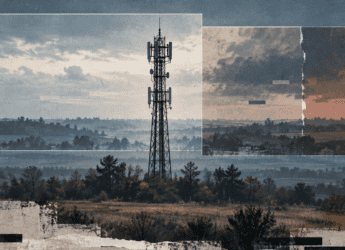

Editor’s Note: Estonia’s restored republic turned 35 on Thursday. The flag went up over Toompea, the Tallinn seat of the Riigikogu, Estonia’s parliament, in the hands of four men who defended the city’s TV tower against Soviet paratroopers in 1991. They held the tower on the day Estonia voted to restore its independence. That vote came just after 11 p.m., and it settled less than the anniversary suggests: recognition arrived within weeks, Soviet troops stayed until 1994, and the nuclear site at Paldiski stayed in Russian hands until 1995.
Estonia has spent the years since separating administration from geography, which is why the date is relevant to cybersecurity, information governance and eDiscovery readers. Copies of its state data and information systems sit in Luxembourg under an agreement that makes them inviolable. Company formation opened to non-residents online, and ComplexDiscovery OÜ is one of those companies. Both arrangements separate administrative access and control from physical location. The limits show as well: when a cryptographic flaw surfaced in 2017, Estonia demonstrated operational resilience by blocking certificates on 740,000 ID cards in a system used across public- and private-sector services. Digital statehood depended not only on remote access, but on the ability to suspend that access at national scale.
Content Assessment: Estonia marks 35 years since the vote that restored the republic
Information - 94%
Insight - 92%
Relevance - 90%
Objectivity - 90%
Authority - 88%
91%
Excellent
A short percentage-based assessment of the qualitative benefit expressed as a percentage of positive reception of the recent article from ComplexDiscovery OÜ titled, "Estonia marks 35 years since the vote that restored the republic."
News Analysis – Digital Residency Beat
Estonia marks 35 years since the vote that restored the republic
ComplexDiscovery Staff
Estonia marked 35 years of restored independence Thursday, and the flag went up over Toompea, seat of the Riigikogu, Estonia’s parliament, in the hands of four men who defended the Tallinn TV Tower in 1991. They held the tower on the day of the restoration vote itself, before anyone knew how it would end.
The vote that came before the troops left
The vote came just after 11 p.m. on Aug. 20, 1991, on a night when Soviet paratroopers were already inside the country. The Supreme Council of the Republic of Estonia adopted its resolution on Estonia’s national independence with 69 members voting in favor. Arnold Rüütel, then chairman of the Supreme Council, signed it. He later served as president. Estonia’s legal position was that it was restoring a republic proclaimed in 1918 and never lawfully extinguished, which is why the day is called restoration rather than founding.
Three points made up the resolution, and only the first was about independence itself. It confirmed Estonia’s national independence and called for the restoration of diplomatic relations. The second created a Constitutional Assembly, seated by delegation from both the Supreme Council and the Congress of Estonia, to draft a constitution for referendum. The third set parliamentary elections under that new constitution for 1992. The vote was a starting instruction, not a finish line.
The timing was not accidental either. Hardliners in Moscow had moved against Mikhail Gorbachev on Aug. 19, and Soviet forces were dispatched toward Estonian communications sites. Volunteers went to Toompea and to the TV tower. The coup failed within days.
Recognition came in days, sovereignty took years
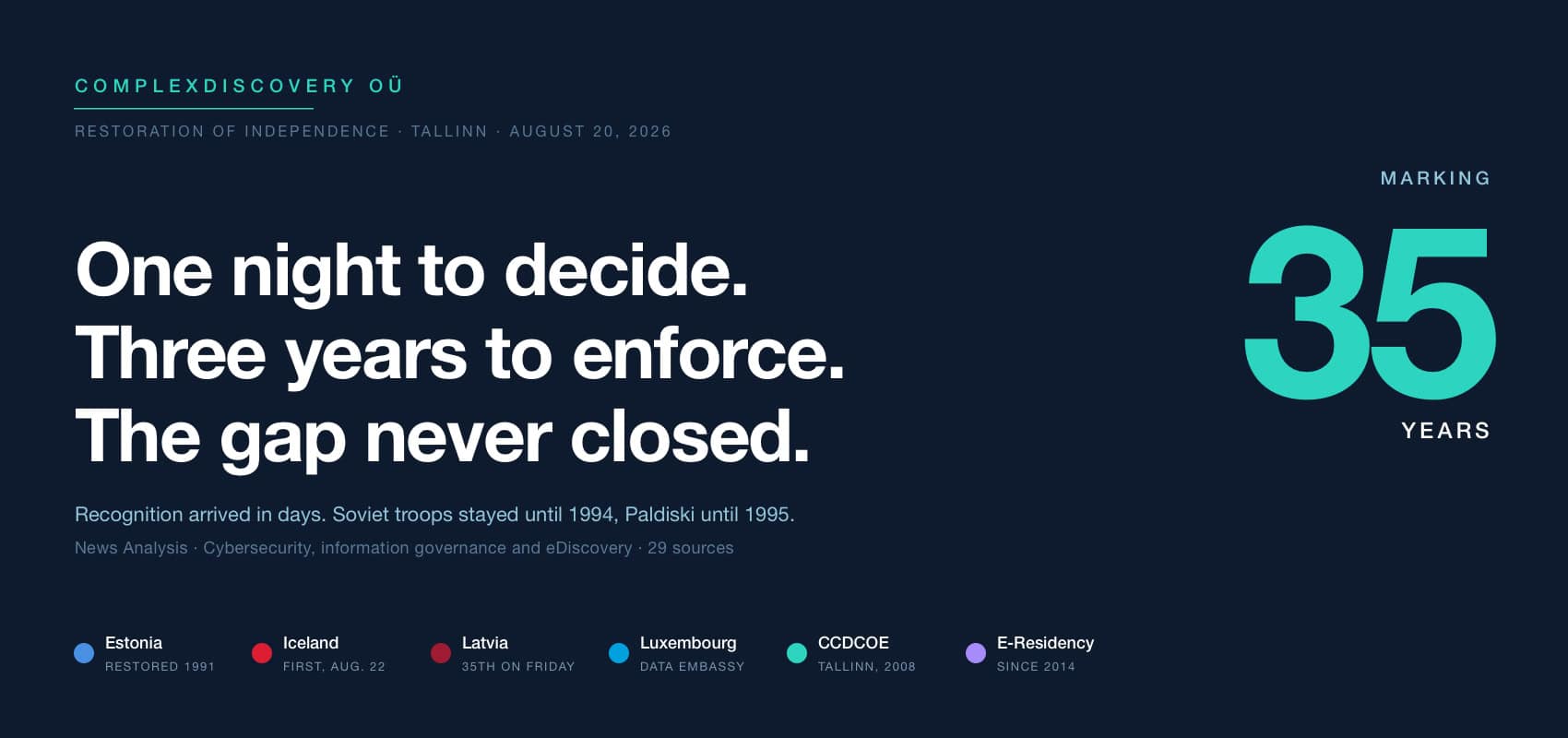
Iceland formally recognized Estonia’s restored independence on Aug. 22, and Latvia’s presidency describes Iceland as the first country in the world to recognize the restored independence of the Baltic states. Russian Federation President Boris Yeltsin followed by decree on Aug. 24. Sweden re-recognized Estonia on Aug. 27 and was the first foreign country to appoint an ambassador after the restoration; Lars Arne Grundberg began work in Tallinn on Aug. 29. The Soviet Union’s State Council recognized the independence of Estonia, Latvia and Lithuania on Sept. 6, and Estonia joined the United Nations on Sept. 17. Latvia marks the 35th anniversary of its own de facto restoration Friday, with a special sitting of the Saeima, Latvia’s parliament, at noon.
Foreign troops proved harder to move than foreign ministries. Soviet forces held at least 570 military sites in Estonia in August 1991. Counts of who was there differ, and they do not measure the same thing: Estonian Public Broadcasting put the August 1991 presence at over 40,000 military personnel and family members, while Estonian World counted about 35,000 people serving at the sites. The broadcaster separately reported that 7,600 military personnel and associated individuals remained in 1993. Estonian President Lennart Meri and Russian President Boris Yeltsin signed the withdrawal treaty July 26, 1994. Troops left Aug. 31, 1994, just over three years after the vote, though a separate neutralization agreement kept the Paldiski nuclear site under Russian control, no longer as a military base, until it was handed to Estonia on Sept. 30, 1995.
Membership took longer than either. Estonia joined NATO on March 29, 2004, when its instruments of accession were deposited in Washington, and the European Union 33 days later, on May 1. The euro arrived Jan. 1, 2011.
How Tallinn marked the 35th
The day opened at 7 a.m. with the flag raising in the Governor’s Garden at Toompea Castle. Jüri Joost, Peeter Milli, Jaanus Kokk and Uno Kasväli, who held the Tallinn TV Tower against Soviet paratroopers in 1991, raised the flag.
Riigikogu Speaker Lauri Hussar, Prime Minister Kristen Michal, President Alar Karis and Archbishop Urmas Viilma attended, along with President Halla Tómasdóttir of Iceland, which recognized Estonia days after the 1991 vote. So did Ants Veetõusme, president of the August 20 Club, an association formed in 1994 that unites the Supreme Council members who voted in favor that night.
The parliament’s program called for an ecumenical service at St. Mary’s Cathedral at 9 a.m., flowers at the 20 August memorial stone at 10 a.m., a stamp presentation at 11 a.m. and a ceremonial joint sitting of the 15th Riigikogu and the August 20 Club at noon. A naming ceremony for the parliament’s Conference Hall was set for 1 p.m. and a free concert for the Governor’s Garden at 3 p.m.
The presidential election opens Sept. 2
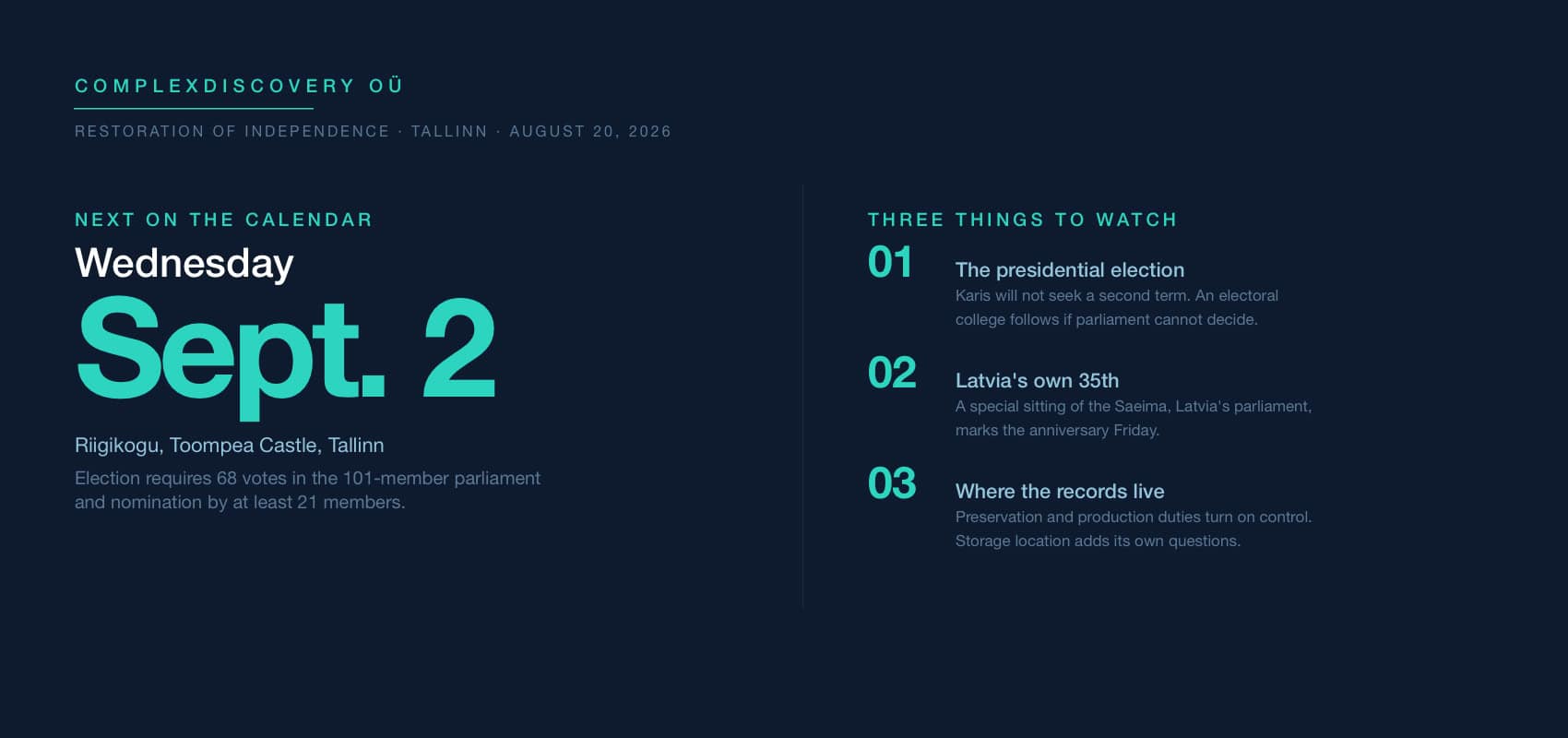
The anniversary arrives with a succession in motion. Karis said at the June 23 Victory Day parade that he would not seek a second term, and the Riigikogu is set to begin the presidential election Sept. 2. The election requires 68 votes in the 101-member parliament and nomination by at least 21 members, and the process moves to an electoral college if parliament cannot decide. Chancellor of Justice Ülle Madise announced her candidacy Aug. 17, having collected the signatures of 62 members of parliament by Aug. 13.
Cyber institutions, before and after 2007
Presidential leadership changes, but Estonia’s data infrastructure endures. That enduring architecture is what turns a national anniversary into a practical case study for cybersecurity, information governance, and eDiscovery teams.
That resilience was forged under fire. The 2007 cyberattacks that impacted the entire country were denial-of-service actions, which work by burying a target in traffic until it stops answering. They ran from April 27 to May 18 that year and reached the state portal, the websites of the government, the president and the Riigikogu, the foreign and defence ministries, and education, media and private sites, in the Information System Authority’s own account a decade later.
Estonia’s institutional cyber planning predated the attacks. It had proposed the concept for a cyber defence centre of excellence to NATO in 2004, after joining the alliance, and the Supreme Allied Commander Transformation approved the concept in 2006, the year before the attacks. The Cooperative Cyber Defence Centre of Excellence was established in Tallinn on May 14, 2008, by Estonia with six other founding nations, and the North Atlantic Council awarded it full accreditation and international military organization status that October. By the centre’s own account, the attacks were the alarm that reached other governments and the alliance.
Then came the state’s own data. Prime Ministers Jüri Ratas and Xavier Bettel signed an agreement on June 20, 2017, creating what the Estonian government called the world’s first data embassy, a Luxembourg facility the government said should begin work at the start of 2018. It holds copies of Estonian state data and information systems. The agreement makes the premises inviolable and designates the stored data as archives of the Republic of Estonia, likewise inviolable and exempt from search, requisition, attachment or execution. Diplomatic-mission treatment is narrower than the label suggests: it attaches to official communications and the transmission of documents, and the agreement is governed by international and European Union law supplemented, where applicable, by the laws of Luxembourg.
A digital identity for non-residents
The data embassy put copies of Estonia’s state data and information systems outside its borders. E-Residency runs the other way: nothing moved, but company formation and management opened to non-residents, online. Estonia launched the program in 2014, and its own knowledge base reports over 137,000 applicants from 170-plus countries and upwards of 36,000 Estonian companies established. The program presents those as separate cumulative totals, not as a conversion rate between applicants and companies. ComplexDiscovery OÜ has been one of them since 2020.
What e-Residency is not matters as much as what it is, and the program says so itself: it does not confer citizenship, tax residency, physical residency, or a right of entry to Estonia or the European Union without a visa should one be required. It confers a digital identity and access to Estonia’s e-services. An e-resident can establish and manage an EU-based company online from anywhere; the resulting company remains registered in Estonia.
It cuts both ways, and the sharpest illustration is a success of resilience rather than of prevention. The Estonian ID-card system served citizens, legal residents, e-residents and diplomats posted in Estonia; the Information System Authority counted 1,295,844 valid ID cards in 2018, including 26,199 e-Residency cards.
On Aug. 30, 2017, a researcher at Masaryk University in Brno notified Estonia’s national computer emergency response team that the chips in those cards carried a cryptographic flaw. About 800,000 cards issued since autumn 2014 were affected. On Nov. 3, the state blocked the certificates on 740,000 of them, having opened remote updating the previous month. Estonia’s Information System Authority recorded no known case of successful exploitation. Its completion figure covers a narrower group than the cards just blocked: 94 percent of ID cards that had been electronically used were updated by April 1, 2018. A state that had built its administration on digital identity found that identity also had to be revocable, at national scale, about nine weeks after a foreign researcher reported the flaw.
That is the practitioner lesson, and it is the same one the withdrawal taught in 1994. Preservation and production duties commonly turn on possession, custody or control. Storage location may add data-protection, blocking-statute and comity questions on top. So name the jurisdiction where each critical record set sits, not only the vendor hosting it. An e-resident company makes the point concrete: the founder may be anywhere, the servers may be elsewhere, and the company stays registered in Estonia.
Thirty-five years on, the state those four men were defending keeps copies of its data and information systems on Luxembourg soil and offers digital identity to non-residents anywhere. The decision took one night. The enforcement took three years. That gap never closed; it moved. If your organization had to prove tomorrow that its most consequential records survive the loss of a data center, a vendor or a border, and could still be preserved and produced on demand, which of those three would you least want to test?
News sources
- Restoration of independence: Events of August 20, 1991 explained (ERR News)
- Gallery: TV Tower defenders lead Independence Restoration Day flag-raising (ERR News)
- Estonia to mark 35 years since the restoration of independence (Estonian World)
- 20 August, Flag-Raising Ceremony and Free Concert on the Day of Restoration of Independence (Riigikogu)
- The 33rd anniversary of restoration of independence of the Republic of Estonia was celebrated at Toompea (Riigikogu)
- Gallery: August 20 Club holds annual meeting (ERR News)
- Supreme Soviet of the ESSR and Supreme Council of the Republic of Estonia (Riigikogu)
- Eesti riiklikust iseseisvusest, the resolution of Aug. 20, 1991 (linked for readers; would not open to automated retrieval) (Riigi Teataja)
- Iceland (Estonian Ministry of Foreign Affairs)
- Estonia in the United Nations (Estonian Ministry of Foreign Affairs)
- Estonia and the European Union: Timeline of Relations (Estonian Ministry of Foreign Affairs)
- Timeline of Estonia’s accession to NATO (Estonian Ministry of Foreign Affairs)
- Thirty years since Russian troops left Estonia (Estonian World)
- About us (NATO Cooperative Cyber Defence Centre of Excellence)
- Estonia to establish the world’s first data embassy in Luxembourg (Government of Estonia)
- Who wants to be Estonia’s next president? (ERR News)
- Estonia’s president Alar Karis says he will not seek a second term (Estonian World)
- Special Saeima sitting will mark 35th restoration of de facto independence (LSM English, Latvian Public Media)
- Estonia: Analysis From Washington, A Decree That Changed The World (RFE/RL)
- Thirty years since the last Russian forces left Estonia (ERR News)
- Baltics get independence from U.S.S.R., Sept. 6, 1991 (UPI Archives)
- In 1991 Iceland broke the geopolitical ice by being the first country in the world to recognise the restored independence of the Baltic States (Chancery of the President of Latvia)
- Sweden (Estonian Ministry of Foreign Affairs)
- About us (e-Residency, Republic of Estonia)
- What is e-Residency? (e-Residency Knowledge Base, Republic of Estonia)
- ROCA Vulnerability and eID: Lessons Learned (Estonian Information System Authority (RIA))
- Agreement between the Republic of Estonia and the Grand Duchy of Luxembourg on the hosting of data and information systems, signed June 20, 2017 (Riigi Teataja)
- Head of CERT-EE: Estonia’s capability to manage cyber crises has improved significantly in 10 years (Estonian Information System Authority (RIA))





Assisted by GAI and LLM Technologies
Additional reading
- Estonia tops Rumavi’s 2026 relocation index as institutions beat sunshine
- European investors see a strong pipeline and a capital gap at home
- Nine months across Europe’s tech-sovereignty arc, from Tallinn to London (ComplexDiscovery)
- The flame and the frontier: how Estonia carries a 1919 victory into a tense 2026 (ComplexDiscovery)
- Estonia aims to be first to give AI agents official digital IDs (ComplexDiscovery)
- Britain bets billions on sovereign AI as London Tech Week opens (ComplexDiscovery)
- Ireland’s AI regulator role gets a hard look at Dublin Tech Summit (ComplexDiscovery)
- When you can’t trust the evidence: deepfakes force a forensic reckoning in Dublin (ComplexDiscovery)
- Latitude59 final day in Tallinn: AI sovereignty, a driverless permit and €450,000 to three startups (ComplexDiscovery)
- Estonia opens Latitude59 with sandbox framework for legal exemptions (ComplexDiscovery)
- FutureLaw 2026 closes: hard truths, the billable hour, and what gets built next (ComplexDiscovery)
- FutureLaw 2026 opens in Tallinn with a sharp question: who governs the governors? (ComplexDiscovery)
- The Sovereignty Paradox: Europe’s $4 Trillion Tech Dilemma at Slush 2025 (ComplexDiscovery)
- How Finland Is Reshaping Defense: BORDERLAND at Slush 2025 (ComplexDiscovery)
- Kaja Kallas Warns of Democracy’s Algorithmic Drift at Tallinn Digital Summit (ComplexDiscovery)
- Defending the Digital Frontier: European Nations Forge Resilience Against Relentless Cyber Warfare (ComplexDiscovery)
- Tallinn Digital Summit 2025 to Focus on Secure AI Futures, Cyber Resilience, and Digital Transformation (ComplexDiscovery)
Source: ComplexDiscovery OÜ

ComplexDiscovery’s mission is to enable clarity for complex decisions by providing independent, data‑driven reporting, research, and commentary that make digital risk, legal technology, and regulatory change more legible for practitioners, policymakers, and business leaders.