
Editor’s Note: California’s Legislature has until Aug. 31 to pass Senate Bill 574, which would impose express duties on lawyers who use generative AI and require personal verification of citations in papers covered by Code of Civil Procedure Section 128.7. As rewritten in the Assembly, the bill would also bar delegating the practice of law to generative AI, require disclosing generative AI use to the court for every document submitted, and forbid arbitrators from handing any part of their decision-making to a generative AI tool.
For cybersecurity, data privacy, compliance and eDiscovery professionals, the operative text is a governance specification. Its confidentiality test turns on who can access what a lawyer inputs into a generative AI system, not on whether a tool is labeled public, and its definition of personal identifying information reads like a data classification schedule. The three August rulings the article sets beside the bill involved adjacent but different problems, and neither appellate opinion said AI caused the errors.
Watch the Assembly floor and the Senate concurrence vote by Aug. 31, the governor’s Sept. 30 deadline if the bill passes, and the State Bar’s parallel rule amendments, which need the Supreme Court of California’s adoption.
Content Assessment: California lawmakers have days to decide whether to put personal citation verification into statute
Information - 94%
Insight - 92%
Relevance - 92%
Objectivity - 93%
Authority - 91%
92%
Excellent
A short percentage-based assessment of the qualitative benefit expressed as a percentage of positive reception of the recent article from ComplexDiscovery OÜ titled, "California lawmakers have days to decide whether to put personal citation verification into statute."
News Analysis – Artificial Intelligence Beat
California lawmakers have days to decide whether to put personal citation verification into statute
ComplexDiscovery OÜ Staff
Three August rulings exposed adjacent but different problems involving alleged judicial AI use and defective legal citations. A Nevada federal court held that judicial immunity barred a suit alleging that a state judge had delegated her ruling to AI. The Fifth Circuit found missing record citations and systematically defective case citations, while an Arizona appellate court struck an apparently false quotation. Neither appellate opinion said AI caused the errors.
California lawmakers have until Aug. 31 to decide whether Senate Bill 574 should impose express duties on lawyers who use generative AI and require personal verification of citations in papers covered by Code of Civil Procedure Section 128.7.
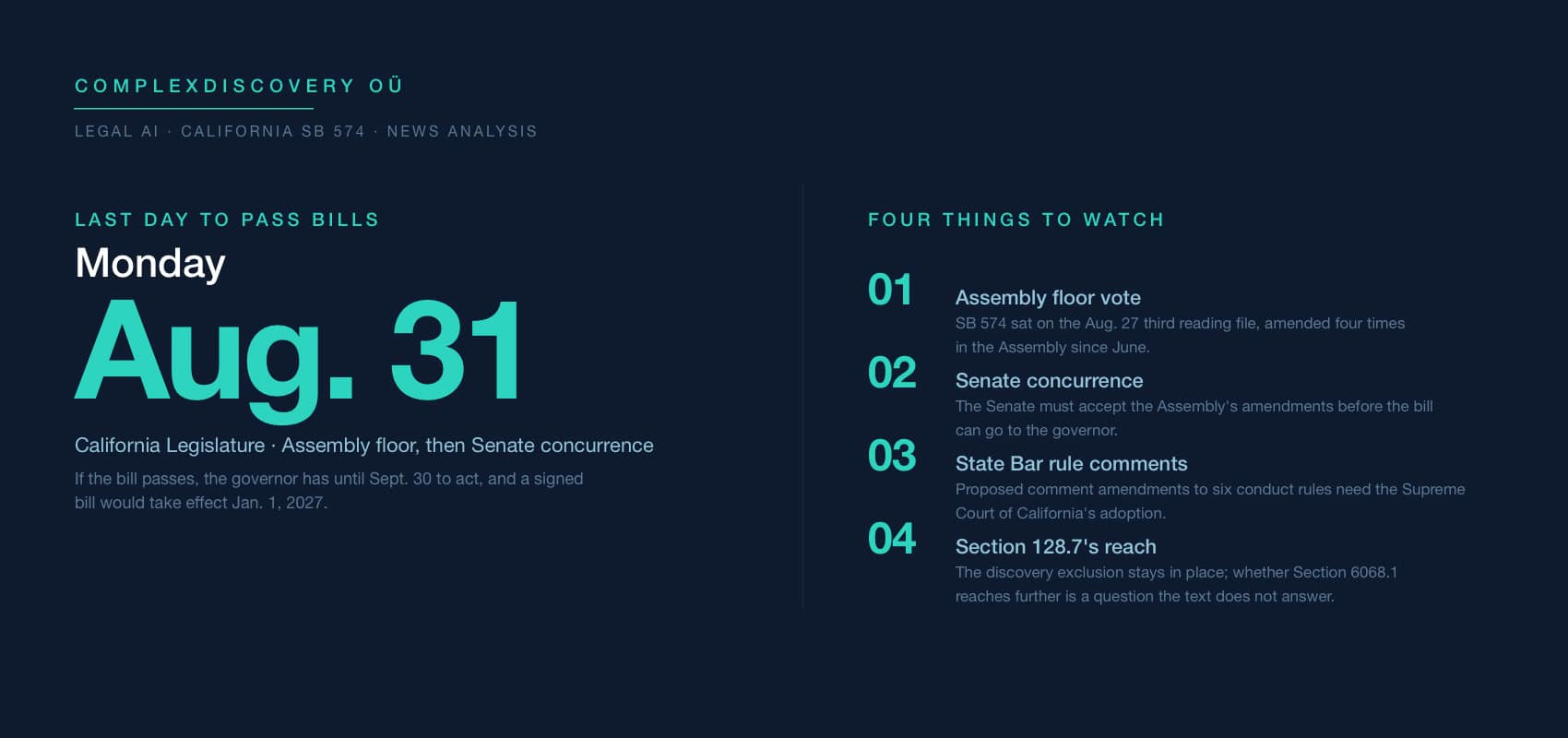
The bill, authored by Sen. Tom Umberg, an Orange County Democrat who chairs the Senate Judiciary Committee, sat on the Assembly’s third reading file as of Aug. 27. It cleared the Senate 39-0 in January and has been amended four times in the Assembly since June. Aug. 31 is the last day for each house to pass bills.
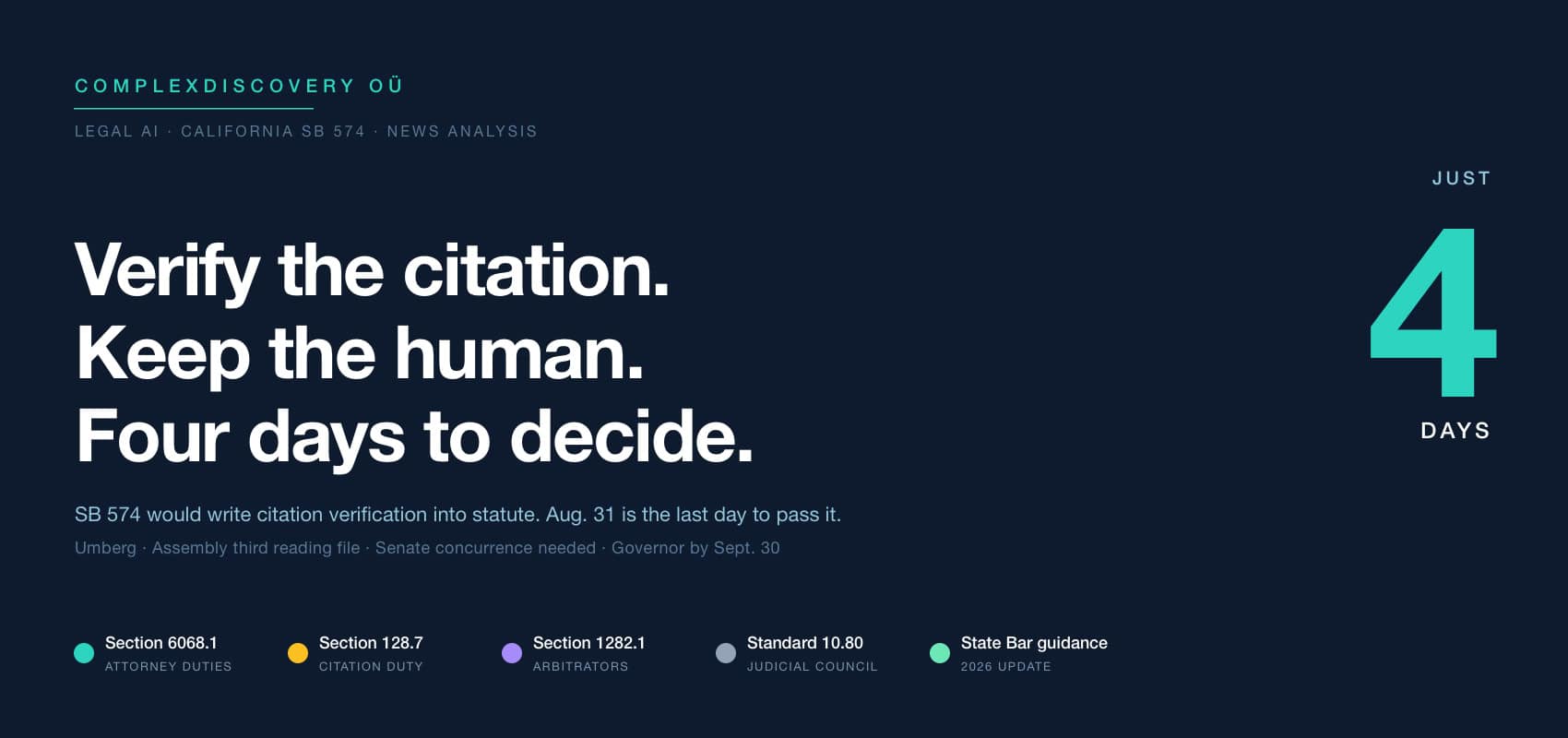
Duties the bill would place on lawyers
The bill’s core is a new Section 6068.1 of the Business and Professions Code. An attorney “shall not delegate the practice of law to generative artificial intelligence,” it reads, and an attorney who uses the technology to assist in practice takes on three duties. The first bars entering confidential, personal identifying or other nonpublic information into any generative AI system where access to that information “is not restricted to the attorney and persons authorized by the attorney under obligations to protect the confidentiality of the information.” The bill’s definition of personal identifying information reads like a data classification schedule. It lists driver’s license numbers, dates of birth, Social Security numbers, criminal-history identifiers, the addresses and phone numbers of parties, victims, witnesses and court personnel, medical or psychiatric information, financial information, account numbers, and anything sealed by court order or made confidential by rule or statute. Security teams asked to enforce the access test would be writing prompt-level controls against that list.
The second duty requires reasonable steps to verify outputs, “including, but not limited to, the accuracy of all case and statutory citations,” and to fix output that is wrong or hallucinated. The third requires the attorney to “disclose the use of generative artificial intelligence to the court for all documents submitted to the court” and to consider disclosing it when generative AI is used to create content for the public.
A companion amendment to Section 128.7 of the Code of Civil Procedure, the state’s analog to Rule 11, is the part of the bill most likely to reach a sanctions motion. Unlike the State Bar Act duties in Section 6068.1 or the arbitrator rule, it sits inside a section that already carries its own sanctions procedure. “A brief, pleading, motion, or any other paper filed in any court shall not contain any citations that an attorney responsible for submitting the pleading has not personally verified, including any citation provided by generative artificial intelligence,” the new paragraph reads. The duty attaches whether or not generative AI produced the citation. Because the new paragraph sits in the same subdivision as the signature certification, a violation would fall under the existing sanctions machinery, including the 21-day window to withdraw a challenged paper.
The bill leaves another Section 128.7 limitation unchanged: the section “shall not apply to disclosures and discovery requests, responses, objections, and motions.” That language complicates any description of the new citation paragraph as covering every citation a California lawyer files, particularly in discovery practice. Section 6068.1’s separate output-verification duty applies when an attorney uses generative AI to assist in practice; the two provisions do not necessarily have identical reach.
One apparent cross-reference effect of the renumbering appears on the bill’s face. Existing law bars monetary sanctions against a represented party for violating “paragraph (2) of subdivision (b),” which today is the requirement that legal contentions be warranted. The bill leaves that sentence unchanged while making the new citation rule paragraph (2). The Legislative Counsel’s Digest does not address the shift. If the cross-reference is applied as written, the shield that today protects represented clients from monetary sanctions for their lawyers’ unwarranted legal contentions would instead attach to unverified citations. For in-house counsel and compliance teams, that changes which failures a client can be made to pay for, a point to raise with outside counsel and to watch in any later amendment.
Arbitrators get a shorter rule. Under a new Section 1282.1, an arbitrator “shall not delegate any part of their decision-making process to any generative artificial intelligence tool.” Nor may an arbitrator rely on information generated by generative AI from outside the record without disclosing that to the parties in advance and, where practical, giving them a chance to comment. The bill does not say what happens to an award if an arbitrator breaks the rule.
How the Assembly rewrote it
The version that cleared the Senate on Jan. 29 is not the version now pending, and the spring client alerts from firms including Hunton Andrews Kurth and Farella Braun + Martel describe the earlier text. That bill imposed a duty to ensure generative AI use did not unlawfully discriminate against protected classes and required lawyers to remove biased, offensive or harmful content. It barred confidential data from any “public” generative AI system and required that citations be “personally read and verified.” The bill itself began in February 2025 as a housing-approval measure. The generative AI text arrived by amendment on Jan. 5 and passed the Senate 24 days later on the consent calendar.
The Assembly Privacy and Consumer Protection Committee’s amendments, printed July 2, added the non-delegation rule and the mandatory court disclosure. They added the functional access test that the Appropriations Committee later made the sole test by deleting the word “public.” They also stripped a June provision that would have required a judicial officer to disclose whether anyone involved in researching or drafting a ruling relied on generative AI. In its place, the bill directs the Judicial Council to “publicly revisit, and revise as necessary,” Standard 10.80 of the Standards of Judicial Administration, the standard that covers judges’ adjudicative use of generative AI.
Umberg framed the bill as a transparency measure at the committee’s July 1 hearing. “What this bill does, it just adds transparency to the use of artificial intelligence,” he said, according to a machine-generated transcript published by CalMatters’ Digital Democracy. Committee Chair Rebecca Bauer-Kahan, a Democrat, said the practitioners she had spoken with treat AI output as a first draft they are obligated to review. Assembly Member Jacqui Irwin, also a Democrat, asked how the clause requiring lawyers to remove biased or harmful AI-generated content would be defined, calling it possibly “a little nebulous.” Umberg closed with his own experience. “I’ve seen hallucinations,” he said, adding that not long ago he saw “a citation to a code section that doesn’t exist in California. So it’s appropriate that we put this in law.”
Six weeks later, in a different committee, the clause Irwin asked about was gone. The Assembly Appropriations Committee’s Aug. 13 amendments deleted the anti-discrimination duty and the bias-removal duty, dropped the word “read” from the citation rule, and pared the arbitrator section. Out went the requirement that generative AI use not replace an arbitrator’s independent analysis and the bar on delegating tasks that could influence decisions. Gone too were the rule on unverifiable sources and the language that an arbitrator “shall assume responsibility for all aspects of an award.” The committee sent the bill out 11-0. The Assembly amended it once more on Aug. 21, the last day floor amendments were allowed, to narrow a State Bar complaint procedure for certified dispute resolution providers.
No one spoke in opposition at the July 1 hearing, and Oakland Privacy was the only registered supporter in the Senate Judiciary Committee’s January analysis, which listed no opposition. The Assembly committee and floor analyses, which would record later support and opposition, could not be retrieved for this article, so the record after January is unknown here. In a statement to Reuters after the Senate vote, Umberg said the state needs “clear guardrails to protect clients’ confidentiality and ensure that real people, not algorithms, are making legal decisions.” One published objection came from an AI-forward lawyer.
An objection from an AI-forward lawyer
Erin Fraser, a trusts and estates attorney and member of Legal Quants, a community of AI-forward lawyers, took aim at the non-delegation sentence in an Aug. 26 Artificial Lawyer essay. The sentence “operates differently than the rest of the law,” he wrote, because it forbids delegation outright rather than requiring supervision. California courts have never settled what “the practice of law” means, he wrote, and a rule that bars delegating it to generative AI could reach research, drafting and client communication. He raised a second question: whether regulating attorneys’ AI use belongs to the courts, which admit and discipline lawyers, or to a Legislature acting in consumer protection. Fraser wrote that the bill could be “an existential threat” to AI-native legal tools in the state if the language stands. The essay is labeled as his own opinion.
Farella raised the cost point in a May analysis of the earlier text. A personal verification requirement, the firm wrote, leaves no room for the signing attorney to delegate cite-checking to junior staff and could raise the price of legal services. That reading survives the Assembly’s edits, which removed “read” but kept “personally verified.”
Three August rulings, three different problems
Set the bill beside the August rulings and the first thing to notice is that they are not one problem.
In Phillips v. Parlade, a District of Nevada case, the plaintiff alleged that a state judge had let artificial intelligence make the ruling in his case with no human deliberation. The case involved no attorney citations. U.S. District Judge Gloria M. Navarro dismissed the complaint with prejudice in an Aug. 12 order, reasoning that issuing a ruling is a normal judicial function and therefore immune, without deciding whether the judge had used AI at all. Michael Berman, who writes the eDiscovery LLC blog, wrote that nothing in the order’s recital of the complaint showed factual support for the AI allegation. Eugene Volokh, writing at Reason, wrote that the plaintiff’s remedy, if the allegation were true, would be appeal or judicial discipline rather than a federal suit.
On Aug. 14 the Fifth Circuit affirmed the dismissal of claims by an uncle and nephew, both born in Mexico, who asserted U.S. citizenship in Guerra Quezada v. United States. Judge Leslie H. Southwick’s opinion found that the appellants’ briefs quoted a 1922 Supreme Court case for language “this court’s research has failed to locate” in that case “or in any other opinion.” The briefs also cited a Seventh Circuit decision as a Fourth Circuit one and attributed to a majority opinion a line from a dissent in a different case. The panel held the due process claims forfeited because the briefing offered no record citations and its case citations were “systematically defective.” Then it stopped. “The court takes no action now for the foregoing deficiencies, but counsel must take this obligation seriously in the future,” the opinion said. It never mentions artificial intelligence.
The same day, Arizona’s Court of Appeals decided Boettcher v. Boettcher, a family law special action. Judge Jennifer M. Perkins wrote that the petitioner had, in the superior court and again before the appellate court, attributed a quotation to two cases “neither of which contains that language.” She struck what she called “the apparently false quotation” and declined sanctions “because we identified no additional citation concerns, and opposing counsel raised none.” The opinion quoted a July ruling from the same court: “citing a hallucinated case in a legal filing is sanctionable conduct.” Neither appellate opinion says how the errors arose.
Immunity, forfeiture and a strike without penalty came from three courts facing adjacent but different problems in one month. The Nevada court never reached whether the judge used AI, and neither appellate opinion attributes its citation errors to a machine. Damien Charlotin’s AI Hallucination Cases database, which tracks legal decisions worldwide and includes some in which AI use was alleged but not confirmed, listed nearly 2,000 cases when checked Aug. 27. Its August U.S. entries ranged from warnings to bar referrals. SB 574 would not tell judges what penalty fits. It would make an unverified citation in a paper covered by Section 128.7 a violation of the statute itself.
A related analogy is developing on a different docket, in confidentiality rather than citations. Berman’s Aug. 21 post cataloged five consent protective orders entered in the Southern District of New York this month, in criminal cases including United States v. Marrow and United States v. Spatola. Each bars submitting produced materials to publicly accessible AI tools or to tools that retain and train on submitted data. Those orders bind the parties to specific cases; SB 574 would set a statewide duty for attorneys. The line they draw is close to the bill’s, written one case at a time.
A regulator already moving
The bill lands on top of a regulator that has been busy. The State Bar of California’s Board of Trustees approved an updated Practical Guidance for the Use of Generative Artificial Intelligence on May 14, replacing the November 2023 version. The new document adds a section on agentic AI, says the duty of candor to the tribunal cannot be delegated to AI, and tells lawyers to review every output, including citations, before it reaches a court. The State Bar’s Standing Committee on Professional Responsibility and Conduct separately proposed comment amendments to Rules 1.1, 1.4, 1.6, 3.3, 5.1 and 5.3 of the Rules of Professional Conduct, with the comment period closing May 4. The committee acted on an Aug. 22, 2025, letter from the Supreme Court of California asking the State Bar to consider folding the guidance into the rules. Any rule change requires that court’s adoption.
The judiciary’s own rule, Rule of Court 10.430, took effect Sept. 1, 2025, and required courts that permit generative AI to adopt a use policy by Dec. 15, 2025. The Senate Judiciary Committee’s analysis of the January text said the bill modeled its provisions on Standard 10.80 and on Noland v. Land of the Free, the 2025 Court of Appeal decision that, as the analysis described it, fined a lawyer $10,000 over a brief whose quotations were nearly all fabricated. The practical consequence for a firm is that three instruments, a statute, a rule comment and an advisory guidance document, could describe overlapping duties in slightly different words.
Jobs for practitioners if the bill passes
A litigation team preparing for the bill’s duties has three concrete jobs. The first is an inventory of every in-scope generative AI system in use against the access test. The bill no longer turns on whether a tool is “public” but on whether confidential material a lawyer inputs can be reached by anyone other than the attorney and persons the attorney authorizes under confidentiality obligations. Vendor terms on access, retention, and model training help answer that question, and the S.D.N.Y. orders show what opposing counsel will ask for. The second is a disclosure practice. The bill requires disclosing generative AI use to the court for all documents submitted, without saying how and without defining “the court.” Whether the duty follows a California-licensed lawyer into a federal courtroom that already runs its own AI standing order is a question the text does not answer. The third is a cite-check protocol that ends with the attorney responsible for the filing, because the statute puts the verification duty on that role.
Discovery teams face a separate, fourth question. The non-delegation sentence does not say whether generative-AI-assisted document review, privilege screening or deposition summarization counts as delegating the practice of law, and Fraser’s essay lists review for diligence among the uses the sentence could reach. The State Bar’s 2026 guidance supplies a relevant working standard. It tells lawyers not to let agentic systems make substantive legal determinations, communicate advice or file pleadings without meaningful lawyer supervision, and not to let any document reach a court without lawyer review and approval. A review workflow documented against that standard, with the lawyer’s judgment recorded at each decision point, is the defensible position whether or not the statute passes.
Arbitration providers face a narrower question with a wider market behind it. The American Arbitration Association began offering an opt-in AI arbitrator for two-party, documents-only construction cases in November 2025, with human arbitrators reviewing and authorizing each outcome before an award issues, according to its announcement. Whether a human who confirms a machine-drafted outcome has delegated “any part” of the decision-making process is a question the bill’s text leaves open. The Senate Judiciary Committee’s analysis of the January text flagged the AAA product and concluded the bill should not conflict with the Federal Arbitration Act because it governs how generative AI is used rather than whether disputes are arbitrable.
Timing now belongs to the Assembly floor, where SB 574 is one of about two dozen AI bills the Transparency Coalition, an AI-transparency advocacy group, counted heading into the final week. Because the Assembly amended the bill, the Senate must concur in those amendments before it can go to Gov. Gavin Newsom, and both votes must happen by Aug. 31, the last day for each house to pass bills. Bills that miss that deadline are dead for the session. If the bill reaches him, the governor would have until Sept. 30 to sign or veto it, and a signed bill would take effect Jan. 1, 2027. In January, Reuters wrote that the measure “appears to be one of the first pending in a state legislature on the use of AI by lawyers.” California would then have a statute telling the attorney responsible for a paper covered by Section 128.7 that its citations are theirs to verify.
If a legislature writes the duty down while the courts are still deciding what the penalty should be, which body ends up defining the standard of care?
News sources
- Bill Text: SB-574 Attorneys, arbitrators, judicial officers, and alternative resolution providers (California Legislative Information)
- Bill History: SB-574 (California Legislative Information)
- Bill Votes: SB-574 (California Legislative Information)
- SB 574 (Umberg) Senate Judiciary Committee Analysis, Jan. 13, 2026 (California State Senate Judiciary Committee)
- Assembly Standing Committee on Privacy and Consumer Protection, July 1, 2026 (hearing transcript) (CalMatters Digital Democracy)
- 2026 Tentative Legislative Calendar (California State Senate)
- California SB 574: Will AI’s Home State Kill Off AI for Law? (Artificial Lawyer)
- Guardrails for Legal AI: What California’s SB 574 Would Require of Attorneys and Arbitrators (Hunton Andrews Kurth)
- California’s SB 574: New AI Rules for Lawyers and Arbitrators (Farella Braun + Martel)
- Reuters: California Senate Passes Bill Regulating Lawyers’ Use of AI (reproduced) (Office of Sen. Tom Umberg)
- Bill Regulating Attorney AI Use Passes California Senate (Law360)
- Guerra Quezada v. United States, No. 25-10372 (5th Cir. Aug. 14, 2026) (U.S. Court of Appeals for the Fifth Circuit)
- Boettcher v. Boettcher, No. 1 CA-SA 26-0121 (Ariz. Ct. App. Aug. 14, 2026) (CourtListener)
- Phillips v. Parlade, No. 2:25-cv-01464 (D. Nev.), Order Dismissing Complaint (CourtListener RECAP Archive)
- Judge’s Allegedly “Relying Wholly” on AI in Order Is Covered by Judicial Immunity, Court Rules (Reason, The Volokh Conspiracy)
- Absolute Judicial Immunity Applies Even IF a Judge’s Decision Was “Wholly” Made by AI (eDiscovery LLC)
- Another A.I. Protective Order, Part 10 (eDiscovery LLC)
- AI Hallucination Cases Database (Damien Charlotin)
- Practical Guidance for the Use of Generative Artificial Intelligence in the Practice of Law (2026) (State Bar of California)
- Proposed Amendments to the Rules of Professional Conduct Related to Artificial Intelligence (State Bar of California)
- Board of Trustees Agenda Item 6.3, May 14, 2026: Updated 2026 Practical Guidance (State Bar of California)
- California Bar Proposes Rule Requiring Lawyers to Verify Every AI Output (LawSites)
- Rule 10.430. Generative artificial intelligence use policies (California Courts)
- AAA-ICDR AI Arbitrator Now Available for Documents-Only Construction Cases (American Arbitration Association)
- It’s finals week in Sacramento. Here’s a scorecard with California’s 24 AI bills (Transparency Coalition)

Assisted by GAI and LLM Technologies
Additional reading
- DoorDash AI inquiry turns model selection into a governance test
- Ninth Circuit vacates Amazon injunction; AI agent logs emerge as eDiscovery issue
- Federal magistrate judge treats LinkedIn’s Relativity aiR workflow as TAR
- One benchmark, three directions: 2026 legal rates rise, flatten and fall at once
- Confidence cools, commitment holds: full results from the 1H 2026 eDiscovery Business Confidence Survey
- Complete look: ComplexDiscovery OÜ’s 2025 to 2030 eDiscovery market size mashup
- The workstream of eDiscovery: Considering processes and tasks
- Andrew Haslam’s eDisclosure Systems Buyers Guide at 14: What the 1H 2026 update reveals
- A Complete Analysis of the Winter 2026 eDiscovery Pricing Survey
- The M&A Risk of Confusing Market Velocity with Marketing Capability
Source: ComplexDiscovery OÜ
ComplexDiscovery’s mission is to enable clarity for complex decisions by providing independent, data‑driven reporting, research, and commentary that make digital risk, legal technology, and regulatory change more understandable for practitioners, policymakers, and business leaders.