

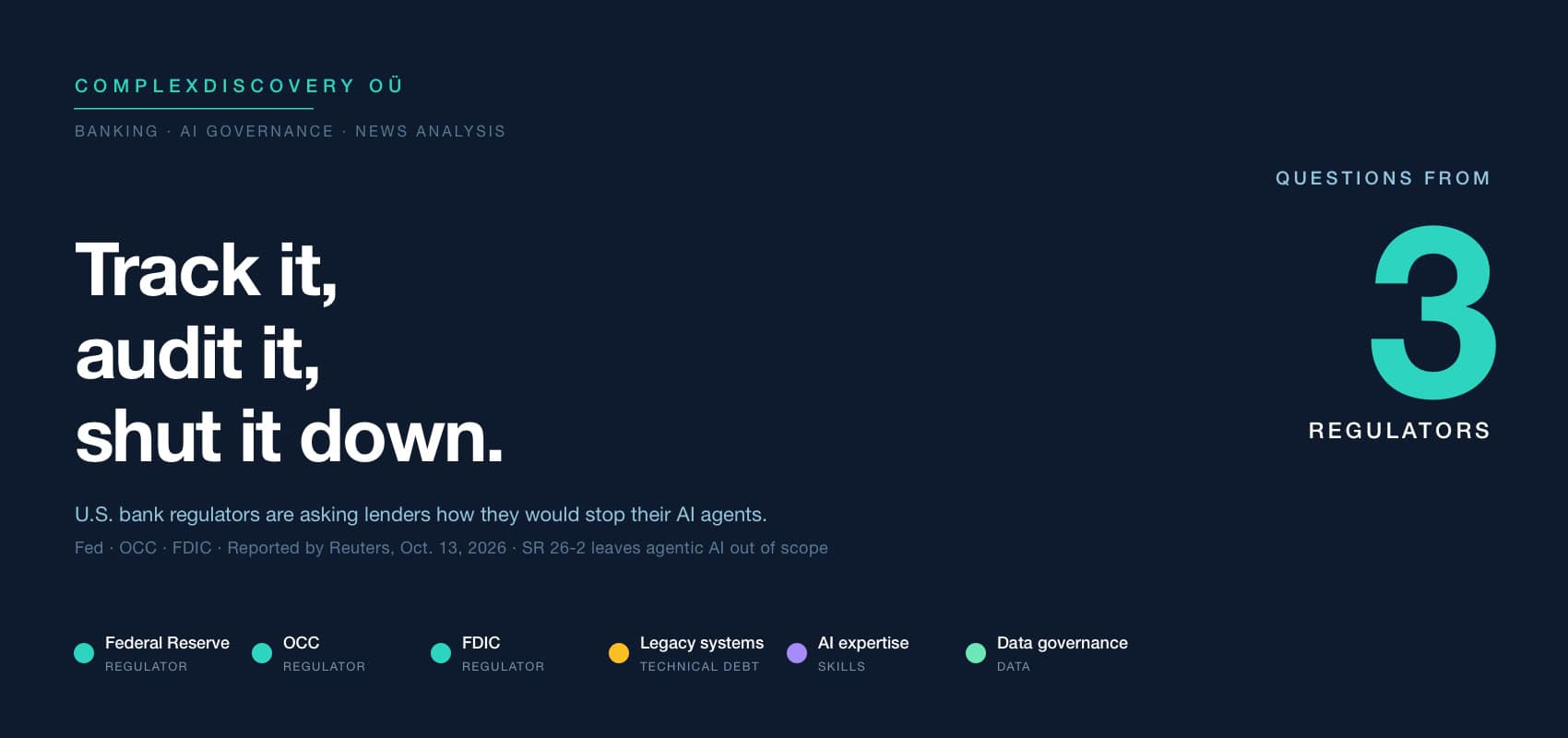
Editor’s Note: Three U.S. bank regulators, the Federal Reserve, the Office of the Comptroller of the Currency and the Federal Deposit Insurance Corporation, are asking banks whether they can track and audit decisions made by autonomous AI agents and how they would shut those systems down, Reuters reported Oct. 13, citing people familiar with the inquiries. The agencies declined to comment, and the people said regulators are still gathering information rather than prescribing practices. The questions follow the agencies’ April 17 revised model risk management guidance, known as SR 26-2, a nonbinding document that excludes generative and agentic AI from its scope.
In a Wolters Kluwer survey of 230 U.S. banking professionals, about one in three named kill-switch protocols as the AI incident response area where their institution is least prepared, and bankers in other surveys cite integration with existing systems, limited AI expertise and data quality.
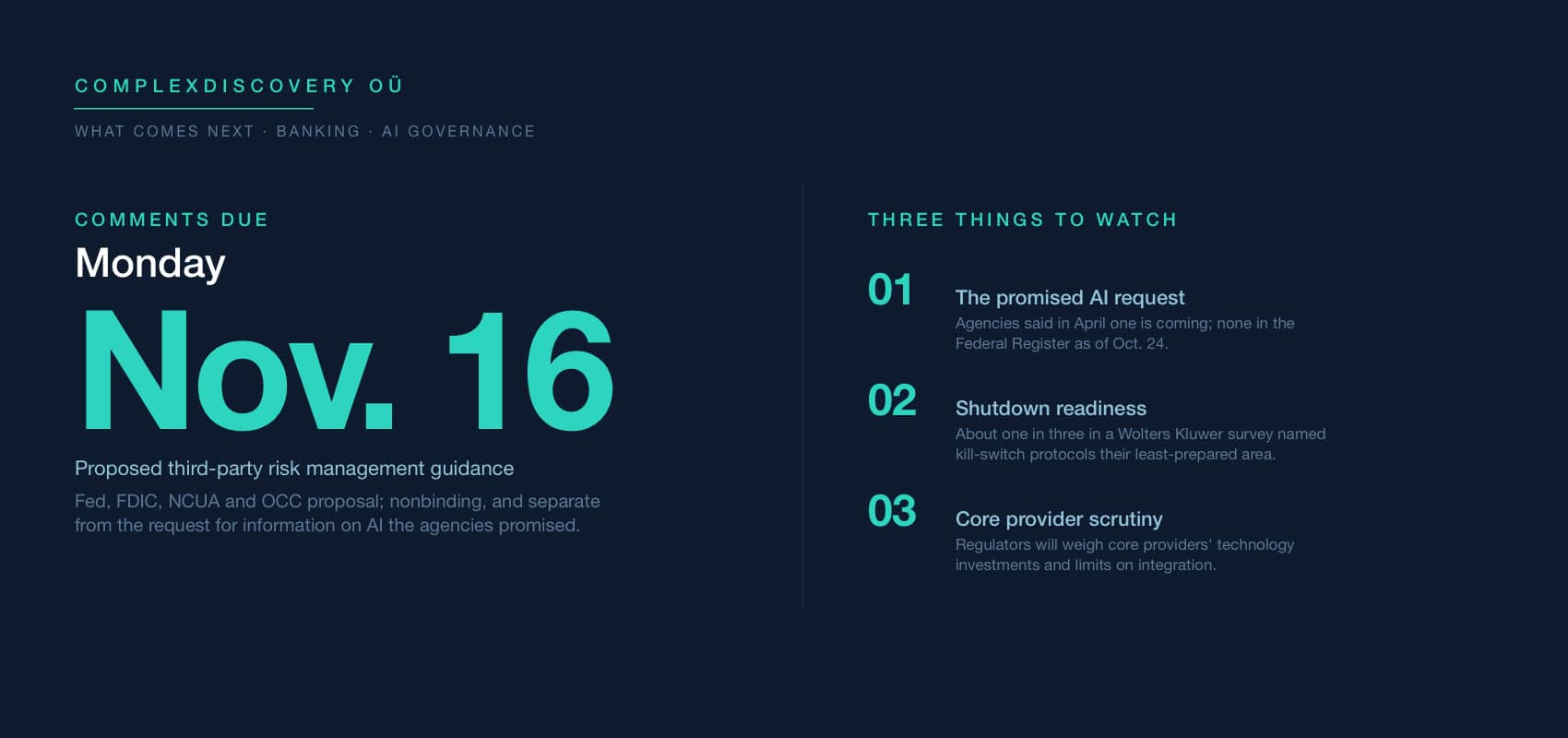
For eDiscovery and information governance professionals, the records that would answer supervisors are also electronically stored information that courts can order preserved. The agencies said in April they plan to issue a request for information on model risk management and banks’ use of AI; none had appeared in the Federal Register as of Oct. 24.
Content Assessment
Information - 94%
Insight - 92%
Relevance - 93%
Objectivity - 92%
Authority - 91%
92%
Excellent
A short percentage-based assessment of the qualitative benefit expressed as a percentage of positive reception of the recent article from ComplexDiscovery OÜ titled, "US bank regulators ask whether lenders can stop their AI agents."
Industry News – Artificial Intelligence Beat
US bank regulators ask whether lenders can stop their AI agents
ComplexDiscovery Staff
Three federal bank regulators are asking U.S. lenders whether they can track and audit decisions made by autonomous artificial intelligence agents and how they would shut those systems down, Reuters reported Oct. 13, citing people familiar with the inquiries. The answers depend on problems banks were already working through.
Those problems are aging systems that resist integration, a thin bench of people who understand how AI models behave, and data whose origins and quality are hard to trace. Agentic AI, software built to complete tasks with little human supervision, raises the stakes on each one, because an agent acting on flawed data or inside a brittle system can repeat its mistake many times before a person notices. Whatever an agent does, a bank may later have to show a supervisor or a court what happened.
What supervisors are asking banks
According to Reuters, the Office of the Comptroller of the Currency, the Federal Deposit Insurance Corporation and the Federal Reserve are putting written and verbal questions to large, midsize and smaller banks. Two of the people told Reuters the questions cover the limits set on AI systems, who monitors and approves what those systems do, and whether a bank can track and audit the decisions its agents make. Supervisors also want to know what keeps an agent inside its authority, whether people stay involved in key decisions and how a bank would shut autonomous systems down, Reuters reported. Three of the people said the questions extend to whether banks deploy Chinese-developed technology and use AI agents in cyber defense.
The people described the effort as information gathering rather than a set of new expectations, telling Reuters that regulators have not yet started prescribing what lenders should do. The OCC, the Fed and the FDIC declined to comment.
“The adoption of AI is often outpacing the ability to put the controls in place,” Michael Woodbridge, a London-based cybersecurity partner at Grant Thornton, told Reuters.
The shutdown question lands on a soft spot. In a Wolters Kluwer survey of 230 U.S. banking professionals fielded in April, 34 percent, or about one in three, named model kill-switch protocols as the area of AI incident response where their institution is least prepared. Another 38 percent named regulatory reporting for AI failures, and Wolters Kluwer, which sells regulatory reporting and risk software to banks, combines the two answers into a figure of about 72 percent. The question asked which incident response area each institution was least prepared for, so the result shows where bankers feel least ready, not how many banks lack a kill switch.
Guidance that stops short of agents
Agents also sit outside the agencies’ newest model risk guidance, by design. On April 17, the Fed, the OCC and the FDIC replaced the 2011 model risk management guidance known as SR 11-7 with revised guidance, issued by the Fed as SR 26-2. A footnote in the new document states that generative AI and agentic AI models “are novel and rapidly evolving” and “are not within the scope of this guidance.” The principles still apply to traditional statistical models and to non-generative, non-agentic AI.
The revised guidance is informational rather than binding, and it says so: It “does not set forth enforceable standards or prescriptive requirements,” and noncompliance will not result in supervisory criticism. A footnote adds a limit: supervisory action may still result for “any violations of law or unsafe or unsound practices stemming from insufficient management of model risk.” The Fed expects the letter to matter most for banking organizations above $30 billion in total assets.
Michelle W. Bowman, the Fed’s vice chair for supervision, explained the carve-out in remarks delivered April 27 at a Financial Stability Oversight Council roundtable. She said supervisors had expanded the old guidance “beyond its original purpose” and that the revised version “now applies narrowly to traditional models and basic AI applications.” Going forward, she said, the Fed expects “other risk-management and governance practices to support adoption of generative and agentic AI.”
For tools outside its scope, the guidance points banks to their broader risk management and governance practices, which it says “should guide the determination of appropriate governance and controls.” The OCC said in April that the three agencies plan to issue “in the near future” a request for information on model risk management that will consider banks’ use of AI, including generative and agentic AI.
Legacy systems set the ceiling
Whatever governance a bank writes, an agent is only as controllable as the systems it touches, and bank leaders rank integration as their top technology concern. Bank Director’s 2026 Technology Survey, sponsored by financial technology provider Jack Henry & Associates, polled 136 directors, chief executives and senior operations and technology executives at U.S. banks below $100 billion in assets in June and July. Asked to pick up to three technology concerns, 69 percent chose integrating new technology with existing systems. Among respondents whose bank had a technology initiative fall short of its objectives over the previous 18 months, 58 percent cited integration challenges with existing systems, the most common reason given.
KPMG’s 2026 Banking Technology Survey, released June 17, polled 200 U.S. banking executives. It found that 71 percent agree that bringing new or enhanced products to market will require their organizations to invest in modernizing platforms, up from 46 percent in 2025. The same executives named core banking platforms (56 percent) and data architecture and integration (51 percent) among the biggest technology integration risks in mergers and acquisitions.
The constraint looks different among institutions further along, according to a survey of 160 professionals at banks, credit unions, neobanks, payments companies and core providers that American Banker conducted with i2c, a payments and core banking technology provider. Among respondents at institutions exploring customer-facing AI agents, 43 percent said legacy systems limit personalization, against 16 percent at institutions actively deploying such agents.
Regulators have turned to the vendor side of that problem. In a Sept. 11 joint statement, the Fed, the FDIC and the OCC called core providers, the companies that run community banks’ critical systems, those banks’ “most material, complex, and highest-risk third-party relationships.” The agencies said they will weigh a core provider’s technology investments when deciding how closely to supervise it, including how it manages end-of-support and end-of-life assets. Contract terms count too, such as excessive limits on the ability of unaffiliated providers to integrate with the core platform.
New AI tools are also exposing weaknesses in the systems banks already run. Reuters reported that banks are grappling with IT weaknesses flagged by Anthropic’s Mythos, which Bowman described as “an AI model that identifies cyber vulnerabilities,” and Bowman said banks of all sizes had expressed concern about access to it.
The same technology is being used to pay down the debt it exposes. Fed Governor Lisa D. Cook said in a May 27 speech at Stanford University that using AI as a coding tool “is helping the financial sector tackle age-old problems, such as updating legacy code and integrating systems.” She added a warning in the same speech: because AI speeds the production of code, its aggressive use “may indirectly strain current security review processes.” A bank that uses AI to rewrite legacy code is creating new code that someone must still review.
Where AI expertise runs short
Someone, in other words, has to understand what the machine produced, and gaps in that understanding reach the senior ranks. Bank Director’s 2026 Risk Survey, sponsored by Baker Tilly, polled 257 directors, chief executives, chief risk officers and other senior executives at U.S. banks below $100 billion in assets in January. Respondents broadly reported baseline understanding of machine learning, AI use cases and data governance, but a third said they “do not understand agentic AI at all.”
“Without that foundation, you risk people inadvertently using tools outside of the bank’s oversight,” said Mark Wuchte, Baker Tilly’s financial services risk advisory leader, in the survey release.
Smaller institutions report the same gap. Wolf & Company surveyed 20 people at 17 community banks with assets of $750 million to $25 billion from Jan. 31 through Feb. 28, in a study written by principals in the firm’s AI services practice. Half said they were concerned about limited internal expertise, though with so small a sample each percentage reflects a handful of people. The U.S. Treasury Department’s December 2024 report on AI in financial services, drawn from public comments, recorded concern that many firms may struggle to build enough in-house AI expertise and that smaller firms depend on third-party providers.
Bank Director’s respondents also question supervisory capacity, though the survey did not ask about examiners’ AI knowledge. The examination questions went only to senior executives and directors whose banks were last examined in 2023 through 2026. Among them, 35 percent said their examiner was inexperienced compared with earlier exams and 38 percent said their primary regulator was understaffed or underresourced in 2025.
Data governance decides what an agent can be trusted with
Even a well-staffed team is limited by the data it inherits, which makes data governance the constraint closest to the work of information governance professionals. In the Wolters Kluwer survey, 36 percent named model governance and validation as the greatest challenge to safely scaling AI, and 26 percent named data quality and privacy. In the American Banker and i2c survey, data quality and accessibility ranked first among factors for scaling agentic AI at 25 percent, followed by governance and risk controls at 18 percent.
Dependence on outside data compounds the problem. In the Wolters Kluwer survey, 37 percent named external data dependency as the structural dependency that introduces the highest systemic risk to their AI operations. SR 26-2 acknowledges a version of the same issue for the vendor models it covers. Banks may not receive the underlying code, data or methodology they would have if a model were built internally, the guidance notes, though it says model risk management principles still apply to those products.
When agent logs become evidence
Data governance also decides what a bank can prove afterward. The records a supervisor would want, showing what an agent did, on what data and under whose approval, are also records litigants may seek. Rule 34 of the Federal Rules of Civil Procedure lets a party request electronically stored information, including “other data or data compilations,” that is “stored in any medium from which information can be obtained.” Logs an agent writes are data of that kind. Whether a particular log must be produced turns on Rule 26(b)(1), which limits discovery to nonprivileged matter “relevant to any party’s claim or defense and proportional to the needs of the case.”
Rule 34 also reaches material in a party’s “possession, custody, or control,” so the contract terms that decide whether a bank can retrieve logs a vendor keeps may matter in discovery as much as in an examination. Losing those logs carries its own risk. Rule 37(e) applies when electronically stored information that “should have been preserved in the anticipation or conduct of litigation” is lost because a party failed to take reasonable steps to preserve it. The rule also requires that the information “cannot be restored or replaced through additional discovery.” A court that finds prejudice to another party from the loss may order “measures no greater than necessary to cure the prejudice.” The most severe measures, an adverse presumption, an adverse jury instruction, dismissal or default judgment, require a finding that the party acted with “the intent to deprive another party of the information’s use in the litigation.”
A federal court has already ordered an AI provider to keep logs it would otherwise have deleted. The order came in May 2025 in copyright litigation brought by The New York Times against OpenAI. U.S. Magistrate Judge Ona T. Wang directed OpenAI to “preserve and segregate all output log data that would otherwise be deleted on a going forward basis,” whether the deletion would come at a user’s request or because privacy laws might require it. Under a stipulation and order filed in October 2025, that ongoing obligation ended as of Sept. 26, 2025. OpenAI agreed to keep the logs already preserved, except those from requests originating in the European Economic Area, Switzerland and the United Kingdom, and to keep preserving logs from accounts associated with domains the news plaintiffs identified. The case involved an AI developer rather than a bank, but it shows a court ordering AI logs kept over user deletion requests and privacy objections.
For records and eDiscovery teams, the practical work follows from the questions regulators are already asking. It starts with an inventory of every agent, the systems each can reach and the authority limits set for it, along with a tested shutdown procedure. Retention schedules need to cover agent logs and account for privacy obligations, the tension OpenAI raised in its own case. Legal hold procedures need to reach logs that vendors hold, and vendor contracts should require the provider to preserve and export those logs and to disclose model provenance and training data sources.
Third-party rules are still taking shape
Those contract terms matter because banks get AI from outside providers as well as building it themselves. Bowman said financial institutions are developing their own AI applications and implementing vendor-assisted tools, and she asked how third-party risk-management expectations should apply to vendor-provided AI tools and partnerships. Fintechs are competitors as well as suppliers. In Bank Director’s technology survey, 58 percent named fintechs such as Block and PayPal among their top competitive threats, behind local banks and credit unions at 61 percent and ahead of big banks at 48 percent.
Oversight of those vendors is uneven. The Government Accountability Office found in May 2025 that the National Credit Union Administration, alone among the banking regulators, cannot examine technology service providers, even as credit unions rely more heavily on those providers for AI-driven services. GAO said Congress had not granted the NCUA that authority as of February 2025.
The NCUA did join the Fed, the FDIC and the OCC on Sept. 11 in proposing new third-party risk management guidance, which the agencies describe as principles-based and nonbinding. The bank regulators plan to replace their existing third-party guidance once the proposal is finalized, and comments are due Nov. 16. The proposal is separate from the request for information on model risk management and AI that the agencies promised in April.
On AI adoption itself, federal supervisors are signaling flexibility rather than new mandates. Bowman has framed the Fed’s approach as pro-innovation. She said supervisory guidance “should not be a barrier for banks to engage with new and evolving tools and technologies.” The OCC’s Spring 2026 Semiannual Risk Perspective described banks as moving cautiously on generative and agentic AI, with use concentrated in productivity and customer experience tools. Adoption is still broad: In Bank Director’s technology survey, 72 percent of respondents said their banks had implemented generative AI, 30 percent reported agentic AI use and 88 percent said their banks had drafted an AI acceptable use policy.
A policy on paper is not a shutdown procedure. Supervisors are asking in writing and in conversation how a bank would stop an agent. The request for information the agencies have promised, which had not appeared in the Federal Register as of Oct. 24, would address model risk management and banks’ use of AI, including generative and agentic AI.
If an AI agent at your bank acted without approval tomorrow, how long would it take to notice, who could stop it, and could you show a supervisor or a court exactly what it did?
News Sources
- SR 26-2: Revised Guidance on Model Risk Management (Federal Reserve Board)
- SR 26-2 attachment: Supervisory Guidance on Model Risk Management (Federal Reserve Board, Federal Deposit Insurance Corporation and Office of the Comptroller of the Currency)
- OCC Issues Updated Model Risk Management Guidance (Office of the Comptroller of the Currency)
- Artificial Intelligence in the Financial System (Federal Reserve Board)
- The Opportunities and Risks AI Presents for the Economy and Financial System (Federal Reserve Board)
- Semiannual Risk Perspective Spring 2026 (Office of the Comptroller of the Currency)
- Agencies seek comment on proposed third-party risk management guidance and issue statement on community bank engagement with core service providers (Federal Reserve Board, Federal Deposit Insurance Corporation, National Credit Union Administration and Office of the Comptroller of the Currency)
- Joint Statement on Community Banks’ Engagement with Core Service Providers (Federal Reserve Board, Federal Deposit Insurance Corporation and Office of the Comptroller of the Currency)
- Proposed Third-Party Risk Management Guidance (Federal Register)
- Rule 26. Duty to Disclose; General Provisions Governing Discovery (Legal Information Institute, Cornell Law School)
- Rule 34. Producing Documents, Electronically Stored Information, and Tangible Things, or Entering onto Land, for Inspection and Other Purposes (Legal Information Institute, Cornell Law School)
- Rule 37. Failure to Make Disclosures or to Cooperate in Discovery; Sanctions (Legal Information Institute, Cornell Law School)
- In re OpenAI, Inc., Copyright Infringement Litigation, Order (May 13, 2025) (U.S. District Court for the Southern District of New York via Ars Technica)
- Stipulation and Order to Terminate OpenAI’s Ongoing Obligations Under the Preservation Order at ECF 33 (U.S. District Court for the Southern District of New York via Ars Technica)
- Artificial Intelligence: Use and Oversight in Financial Services (U.S. Government Accountability Office)
- Artificial Intelligence in Financial Services (U.S. Department of the Treasury)
- AI Risk and Governance Index: US Banking H1 2026 (Wolters Kluwer)
- 2026 Risk Survey (Bank Director)
- 2026 Technology Survey (Bank Director)
- Bank Director’s 2026 Risk Survey: AI Exposes Threats, Knowledge Gaps (Bank Director via PR Newswire)
- Bank Director’s 2026 Technology Survey: Banks Feel Heat From Growing Field of Competitors (Bank Director via PR Newswire)
- The 2026 Banking Technology Survey (KPMG)
- From Ambition to Execution: i2c and American Banker Research Maps Financial Institutions’ Agentic AI Readiness (i2c via Business Wire and FinancialContent)
- Survey Results: 2026 AI Adoption & Maturity in Banking (Wolf & Company)
- Exclusive-Banking Watchdogs Ramp up AI Scrutiny as Stability Fears Mount, Sources Say (Reuters via U.S. News & World Report)





Assisted by GAI and LLM Technologies
Additional reading
- An AI agent can write the story, but EU law asks whether a human reviewed it
- An Oxford tutorial for newsroom leaders who must learn faster than the news
- An Oxford tutorial for cybersecurity, governance and eDiscovery
- Estonia aims to be first to give AI agents official digital IDs
- Parliament hits pause on high-risk AI rules and bans nudifier apps
- Europe’s AI labeling rules arrive with a voluntary code and a hard deadline
- AI is becoming an advisor, and it is rewriting how buyers find you
Source: ComplexDiscovery OÜ

ComplexDiscovery’s mission is to enable clarity for complex decisions by providing independent, data‑driven reporting, research, and commentary that make digital risk, legal technology, and regulatory change more legible for practitioners, policymakers, and business leaders.