

Editor’s Note: The diagram that has organized eDiscovery vocabulary for two decades is final, and EDRM published the argument along with it. EDRM 2.0 arrived Tuesday carrying four structural shifts: information governance moves underneath the whole lifecycle, four early-stage activities group into a Data Acquisition framework, disposition becomes a phase of the diagram for the first time, and analysis runs as a continuous band across every stage. EDRM then grouped public comment into eight sections. The trustees say one produced two adjustments, both to how the diagram reads. The other seven asked to change what the diagram contains or what it calls things and received written responses explaining why the trustees made no change. Those answers are the part worth reading twice.
Practitioners across three disciplines have work to do here. Records and governance teams get a disposition definition they can hold against their retention schedules. Security teams get a widely used framework that names deletion as a phase, which strengthens the internal argument for minimization on breach-hold data. Legal operations groups and providers should test their RFP and statement-of-work language against the Data Acquisition grouping before buyers start quoting it.
Watch the thought leadership phase now beginning, because the terms that settle there may shape procurement documents later.
Editor’s Disclosure: ComplexDiscovery OÜ is a Guardian Partner of EDRM. ComplexDiscovery’s Rob Robinson sits on EDRM’s Global Advisory Council and is named among the EDRM 2.0 contributors on EDRM’s project page and in the organization’s June 30 and September 1 releases. Holley Robinson, EDRM’s marketing operations director, also serves as marketing operations director for ComplexDiscovery OÜ.
Content Assessment: EDRM published its new map and the reasoning behind what it kept
Information - 94%
Insight - 94%
Relevance - 95%
Objectivity - 90%
Authority - 93%
93%
Excellent
A short percentage-based assessment of the qualitative benefit expressed as a percentage of positive reception of the recent article from ComplexDiscovery OÜ titled, "EDRM published its new map and the reasoning behind what it kept."
News Analysis – eDiscovery Beat
EDRM published its new map and the reasoning behind what it kept
ComplexDiscovery OÜ Staff
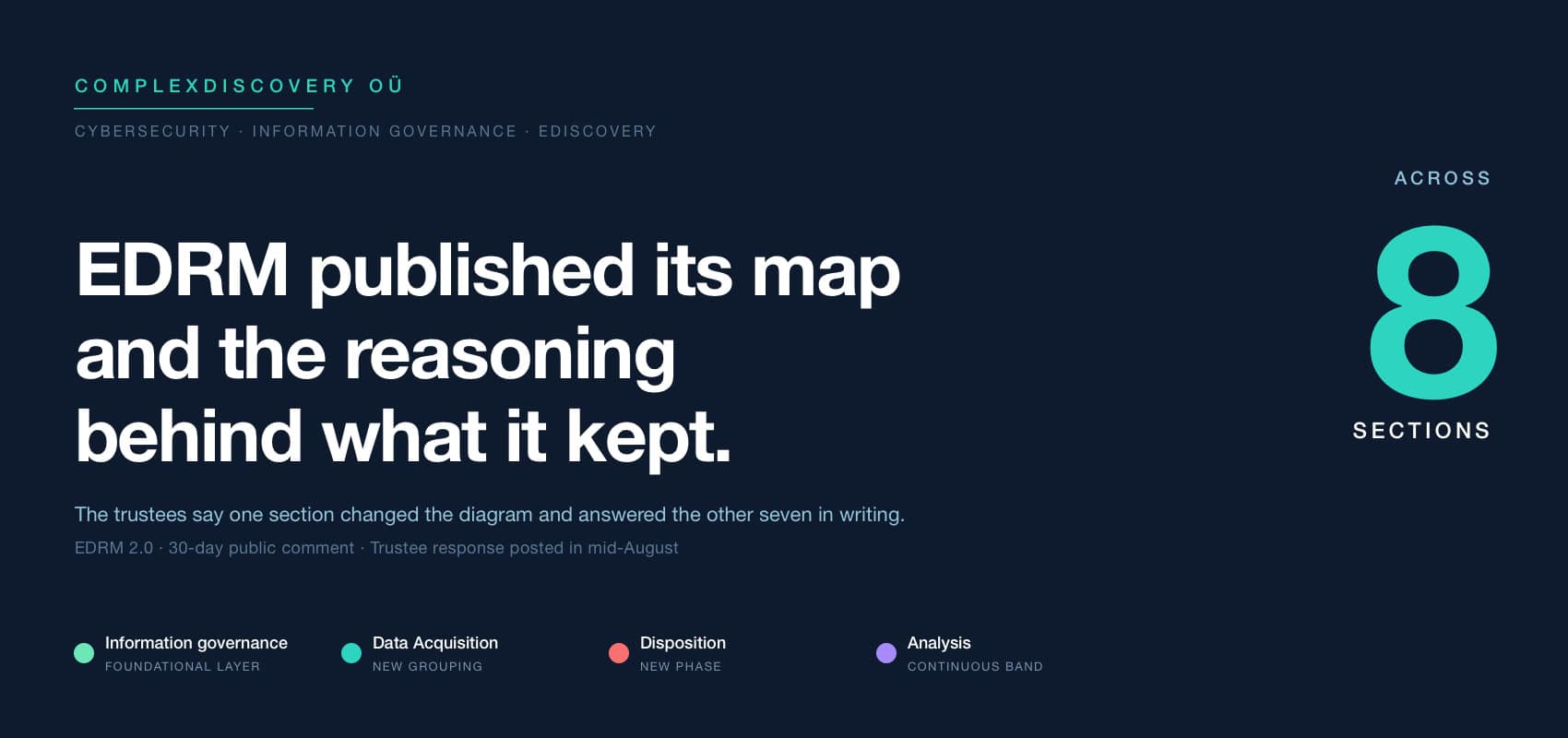
EDRM grouped public comment on the EDRM 2.0 draft into eight sections. The trustees say one of them changed the diagram. The reasoning behind the seven no-change responses is the part practitioners should read twice.
EDRM asked the profession to grade its redrawn map of electronic discovery, and the profession did. On Tuesday, the organization published the final model, EDRM 2.0. It also pointed readers to the accounting it had posted in mid-August, a document that sorts the submissions into eight sections and answers each one.
EDRM grouped the submissions into eight sections. The trustees say one of them changed the diagram.
The Electronic Discovery Reference Model (EDRM) has organized how lawyers, technologists and judges talk about electronic evidence since Tom Gelbmann and George Socha launched the project in 2005. EDRM calls the new version its first substantive update since the model absorbed the full Information Governance Reference Model (IGRM). About 150 volunteer contributors developed it over roughly two years, EDRM says, inside a project it announced in March 2023. Public comment opened June 30 and ran 30 days.
What the model is matters as much as what it says. The trustees call it “intentionally broad, flexible, and high-level,” and “a reference model, not a prescriptive workflow or an exhaustive technical standard.” It prescribes nothing and binds nobody. Its authority comes entirely from adoption, which is why a change to it eventually reaches training decks, service catalogs and statements of work. This version brings four changes.
Four shifts define the final version
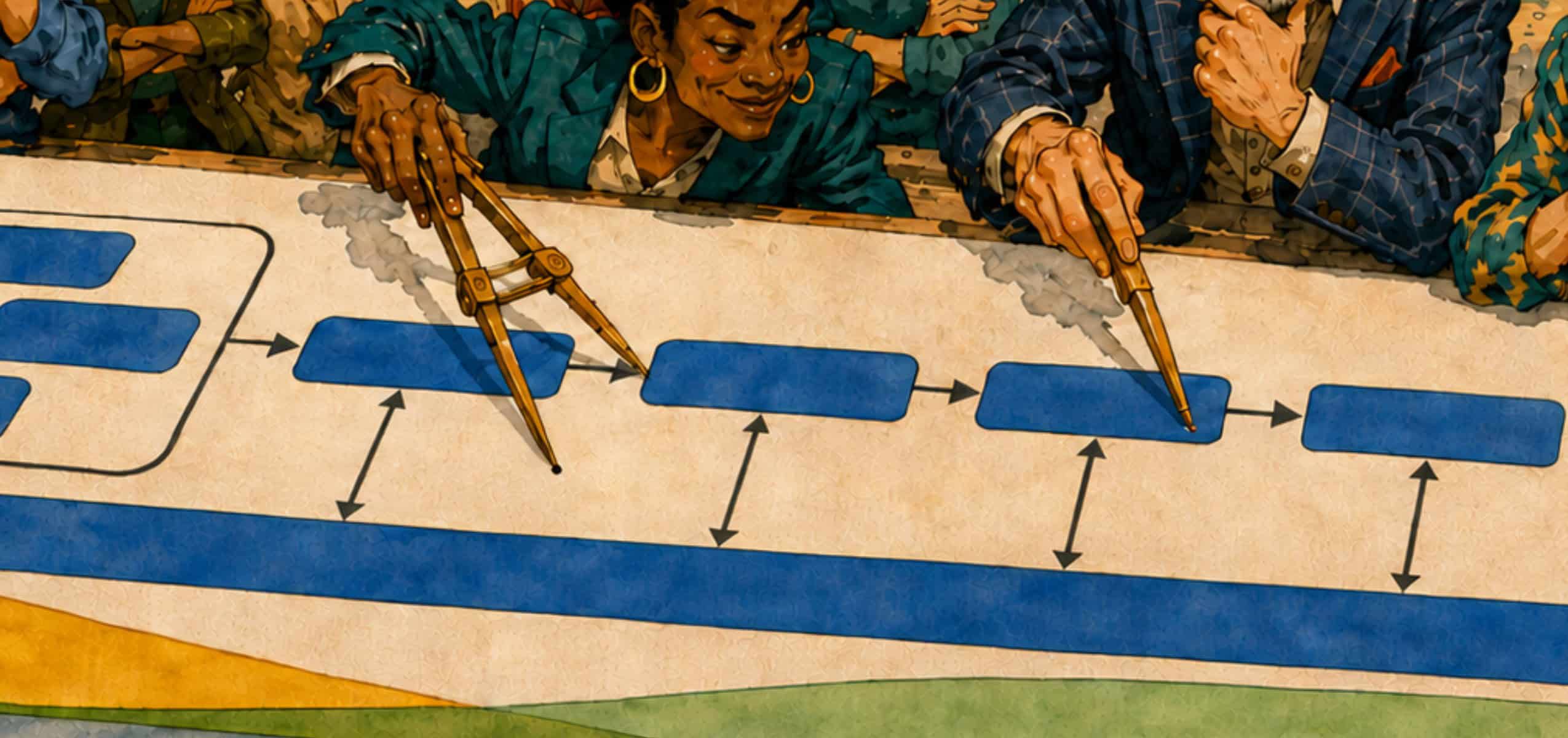
The IGRM now sits underneath the whole lifecycle as its foundational layer rather than off to one side. Identification, Preservation, Collection and Processing move inside a new Data Acquisition framework. Disposition joins the EDRM diagram for the first time as a discrete phase, defined as “a systematic, defensible process to retain, delete, transfer or return data after use.” And Analysis becomes a continuous band spanning every phase. The 2023 model gave it a box of its own, stacked with Processing and Review.
Rian Kennedy, a co-project trustee and director of legal hold sales at the discovery vendor DISCO, wrote in July that the grouping tracks what the tools now do. In-place indexing, he wrote, lets identification, preservation and processing run together rather than in sequence. The diagram also drops the color coding that distinguished earlier versions, giving every phase the same blue. EDRM says that helps readability for viewers with color-vision differences, an accessibility rationale the trustees concede “may not be immediately apparent from viewing the graphic alone.”
One of the eight sections produced the only changes the trustees say they made after the window closed. Both are matters of degree rather than structure. Commenters questioned why the relevance wedge appeared to keep climbing past Review and Production, and why the Analysis band seemed to run past Disposition. The trustees agreed on both counts. They wrote that the relevance triangle now levels off after Production, and that the Analysis element was adjusted to end with Disposition. The trustees describe no other changes.
Seven structural and naming requests answered in writing
The other seven sections collect requests of a different kind, ones that would alter what the diagram contains or what it calls things: pulling Processing out of a grouping, adding a node, rearranging a box, renaming a phase, restoring the old design. All seven received written responses explaining why the trustees made no change. Reading those answers together is the most useful thing a practitioner can do with the document. Six are treated here; the seventh, which asks whether the redesign was worth doing at all, comes later.
Two commenters attacked the IGRM placement from opposite directions. One said the diagram claims too much for governance, because plenty of relevant data in real organizations is not governed at all. The other said the revision buries it: “I would keep the IGRM graphic fully visible on the left side of the graphic to ensure that practitioners do not lose sight of IG as the foundation on which ediscovery stands.” The trustees held the placement. They answered the first with a caveat worth carrying into any deck built on the new model: it “communicates a conceptual relationship between the models rather than an assessment of the maturity or effectiveness of any particular organization’s Information Governance program.”
Processing drew the most technical objection. “I’d still strongly advocate for maintaining Processing outside the Acquisition box as a separate stage,” one commenter wrote, on the ground that processing runs on its own tools, shrinks the data it touches and demands a different skill set. The trustees kept it inside the grouping while conceding the substance: “Data Acquisition is used as an umbrella grouping in the model. It is not intended to redefine Processing as Collection or to suggest that the activities are technically identical.” A related request to add an Early Data Assessment node went the same way. Assessment happens at different moments in different matters, and the trustees preferred to let the continuous Analysis band absorb it.
Three further requests drew the same treatment. The trustees left the volume curve whole rather than splitting it into separate acquisition and culling processes, calling that detail the model does not exist to carry. They kept the Presentation label despite a commenter’s case that the phase is overwhelmingly preparation and coordination rather than display, on the ground that every phase label covers multiple activities. And they held the Data Acquisition arrangement against two competing proposals, one hierarchical and one circular. The project team had already voted on several options, including depictions close to some of the commenters’ suggestions.
Why votes outweighed comments
Underneath several of those answers sits one procedural fact, and the trustees stated it plainly rather than leaving readers to infer it.
Several public comments raised questions the larger project team had already settled by ballot, sometimes across multiple iterations. “The result of each vote was given greater weight than individual public comments, though the substance of each individual comment was still considered,” the trustees wrote. That is a defensible rule for a volunteer consensus body. It is also the rule the trustees invoke for several of the outcomes above. The voting group they name is the project team, which they put at over 100 participants; EDRM counts about 150 contributors on the project overall.
Tuesday’s announcement puts it in one sentence, which is as close as the release comes to naming its own limits. Changes went into the model after public comment, it says, but some submissions raised questions the wider contributor group had already settled by vote.
Money is the other question a consensus body funded by commercial partners has to answer, and EDRM answers it in writing. The organization says it “operates with a strict separation between sponsorship, Trusted Partner status and community consensus project work,” that commercial support “does not weight or accelerate any comment,” and that its trustees “adjudicate on substance alone.” Readers can weigh that against the trustee group’s composition. It pairs a vendor sales director with a law firm litigation support manager, a director at a plaintiffs’ firm and an independent consultant.
The trustees describe their own process in warmer terms, writing that where objections ran deep they “sharpened our pencils, revisited our assumptions, and worked to get it right.” Mary Mack, EDRM’s CEO and chief legal technologist, put it this way in Tuesday’s announcement: “We are grateful to our eDiscovery community and celebrate the trustees, contributors and public comment participants supported by our global advisory council and trusted partners.” Both things hold at once, and they are not in tension. The document engages every issue it takes up on the substance, and the structure the project team arrived at held. That structure had critics before the draft ever appeared.
Whether the map needed redrawing at all
The argument ran in public months before the comment window opened. Craig Ball, who serves as EDRM’s general counsel but wrote in March that the views were his alone, argued the model was never broken because it was never a workflow. “Think of it as a compass, not a GPS turn-by-turn,” Ball wrote March 18. “It orients you. It doesn’t drive for you, and it ain’t broke.” He called the EDRM “a durable, vendor-neutral conceptual foundation that helps you ask the right questions in the right sequence.”
Doug Austin, who has published the daily eDiscovery Today blog since 2010, accepted the premise and rejected the conclusion. Austin was consulted on the update by the project trustees, sits on EDRM’s Global Advisory Council, and writes a blog EDRM lists among its media partners. Perception had already won, he wrote March 23. Software companies market on which half of the diagram they cover, and the arrows taught an industry to read a reference model as an assembly line. “It looks too much like a workflow now for most people to see it as anything else,” Austin wrote.
The finished model speaks to both arguments in a line of guidance printed alongside the diagram: “Although the diagram flows generally left to right, the EDRM is a conceptual view of the eDiscovery process, not a literal or linear workflow. Practitioners may perform the steps in a different order, repeat them, or circle back to earlier phases as their understanding of the data improves.” That is Ball’s position, published as EDRM’s own reading instruction. It is attached to the redesign Austin said was the only thing that would change how the diagram gets read.
The seventh section took Ball’s premise and drew the opposite remedy from Austin’s. “On a substantive level, it adds nothing that isn’t already in the standard model,” the commenter wrote. “Worse, it damages the original, which is vital, defining our industry and a great brand.” The trustees kept the redesign, saying the project team had seriously weighed retaining the original and concluded that two decades of change required an update. That leaves practitioners with a settled diagram and some homework.
Practical homework before the vocabulary sets
Start with the license, because it is the part most teams overlook. The diagram carries a Creative Commons Attribution 4.0 International license, so any firm or provider can adapt it for training, marketing or client work without permission or payment. EDRM sums the condition up as attribution back to edrm.net plus a note if the diagram has been modified. The license itself asks for slightly more: appropriate credit, a link to the license, and an indication that changes were made. A compliance team should work from the license rather than the summary.
Then test the language against documents that outlive the news cycle. Records teams should read the Disposition definition against their own retention schedules. A diagram that names disposition as a phase gives governance staff a citation the previous model did not offer. Legal operations groups should check whether their identification, preservation, collection and processing handoffs still describe four sequential steps. RFPs and statements of work written to the old sequence will read as dated once buyers start quoting the Data Acquisition grouping.
Security teams have the clearest gain available and the shortest path to using it. Data assembled under a breach hold, including forensic images, log exports and collected mailboxes, is the kind of post-use material the Disposition phase is drawn to cover once preservation and retention obligations end. A widely used framework that treats deletion as part of the lifecycle strengthens the internal argument for minimization. It also shrinks stale-data exposure, since every unnecessary copy adds to the volume a later discovery request or a security incident can reach.
Providers should move fastest of all. EDRM says the project has entered a thought leadership phase in which each element and the relationships among them get built out. The terms that settle during that phase are the ones most likely to turn up in procurement documents later. All four co-project trustees appear on Sept. 15 at 1 p.m. Eastern in a free webinar, Inside EDRM 2.0: The Trustees Discuss the New Model. David R. Cohen, chair of EDRM’s board of project trustees and CEO of ATJustice, moderates.
The model will get the attention. The document published beside it may prove the more durable artifact, because it shows what consensus work compromises and what it does not. The approach compromises. Any one drawing is a settlement among several defensible ones, and the trustees concede as much, granting that Processing is not Collection and that governance maturity varies from one organization to the next. The striving does not compromise. A profession that stops working toward a single shared map does not end up with a better map; it ends up with several, each read differently across the table in every meet-and-confer. After two decades of practicing to one diagram, which is worth more to your work: a model drawn exactly as you would draw it, or a model everyone else reads the same way?

News sources
- EDRM Releases EDRM 2.0, Modernizing the Global Framework for Electronic Discovery (EDRM)
- EDRM 2.0 Public Comments: Key Issues and Trustee Responses (EDRM)
- Current EDRM Model (EDRM)
- EDRM 2.0 Project Page (EDRM)
- EDRM Invites Global Community to Shape EDRM 2.0 via Public Comment (EDRM)
- EDRM 2.0 Public Comment: Three Big Changes (EDRM)
- The EDRM Isn’t Broken; It’s Misunderstood (Ball in Your Court)
- I Agree with Craig Ball That the EDRM Isn’t Broken. It Doesn’t Matter (eDiscovery Today)
- EDRM Releases EDRM 2.0 (eDiscovery Today)
- EDRM opens public comment on EDRM 2.0, inviting the profession to redraw its own map (ComplexDiscovery)

Assisted by GAI and LLM Technologies
Additional reading
- Complete look: ComplexDiscovery OÜ’s 2025 to 2030 eDiscovery market size mashup
- The workstream of eDiscovery: Considering processes and tasks
- Complete Look: ComplexDiscovery’s 2024-2029 eDiscovery Market Size Mashup
- Andrew Haslam’s eDisclosure Systems Buyers Guide at 14: What the 1H 2026 update reveals
- A Complete Analysis of the Winter 2026 eDiscovery Pricing Survey
- The M&A Risk of Confusing Market Velocity with Marketing Capability
- Confidence Meets Complexity: Full Results from the 2H 2025 eDiscovery Business Confidence Survey
- Making the Subjective Objective: A Scoring Framework for Evaluating eDiscovery Vendor Viability in 2026
- eDiscovery Vendor Viability Scoring Tool: Making the Subjective Objective
- Beyond Public Cloud: The Enduring Case for Deployment Flexibility in eDiscovery
Source: ComplexDiscovery OÜ
ComplexDiscovery’s mission is to enable clarity for complex decisions by providing independent, data‑driven reporting, research, and commentary that make digital risk, legal technology, and regulatory change more legible for practitioners, policymakers, and business leaders.