

Editor’s Note: Business planning fails often enough to have its own literature, and The Planning Paradox puts that literature under cross-examination. The three-session tutorial framework from ComplexDiscovery OÜ pairs each of its propositions (overthinking, overplanning, overestimating) with a model essay and a constructed interrogation, so readers watch an argument survive pressure rather than accept a conclusion.
The subject reads as general strategy, but the discipline transfers directly to this publication’s core audiences. Discovery teams scope collections and review timelines against the planning fallacy every quarter. Governance leaders write multiyear roadmaps into environments that will not hold still. Security teams maintain incident response plans whose entire value depends on whether they are treated as hypotheses or mandates. Each faces the same question the tutor asks: when does the planning stop earning its keep?
Watch for readers to run the framework’s closing challenge against their own documents: structuring a plan that stays true even while its predictions fail. The three worked examples below show what that argument looks like when it is made well, and where a skilled examiner will press.
Content Assessment: The Planning Paradox: an Oxford-style tutorial tests why business plans fail
Information - 93%
Insight - 94%
Relevance - 94%
Objectivity - 95%
Authority - 94%
94%
Excellent
A short percentage-based assessment of the qualitative benefit expressed as a percentage of positive reception of the recent article from ComplexDiscovery OÜ titled, "The Planning Paradox: an Oxford-style tutorial tests why business plans fail."
Industry News – Leadership Beat
The Planning Paradox: an Oxford-style tutorial tests why business plans fail
ComplexDiscovery Staff
An explanatory feature on the third installment of The ComplexDiscovery Tutorial, a strategy and decision-making exercise for business, legal, cybersecurity, information governance and eDiscovery professionals rather than a reported news feature. It explains the method, summarizes the source base and reproduces three illustrative worked examples, so it runs long by design and functions as both an article and a complete tutorial package. As first-party coverage, it presents a ComplexDiscovery OÜ publication rather than an outside development.
Business plans necessarily contain predictions, and those predictions can age quickly. ComplexDiscovery OÜ has adapted the Oxford tutorial method to that uncomfortable fact. The result is The Planning Paradox, a three-session tutorial framework that puts the discipline of planning itself under interrogation, built for professionals in fields that often move faster than they reflect.
A framework built to be argued with
The Planning Paradox organizes a familiar failure into three contestable propositions: that overthinking substitutes for action, that overplanning mistakes a hypothesis for a mandate, and that overestimating builds the planning fallacy into the budget. Each proposition arrives with a governing inquiry, a pair of core readings set deliberately against each other, and a debate question designed to leave neither side comfortable. Each is then paired with a worked example: a model essay that argues the proposition, and a constructed tutor and student interrogation that tries to take the essay apart. The format has a purpose. Readers watch the method at work rather than take its conclusions on faith.
The framework closes with an assignment brief and a challenge. The brief asks the student to critically assess the view that “the failure of business planning is primarily an emotional problem disguised as a logistical one.” It also asks whether the “over-” prefix in the three concepts describes a flaw in strategy or a fundamental human limitation in predicting the future. The closing challenge is blunter. Structure a business plan that you know will be wrong by next month so that it remains true even while its predictions fail.
What a tutorial is, in this usage
In this framework’s Oxford-inspired usage, the tutorial is less a lecture than a disciplined conversation. Oxford itself describes tutorials more broadly: small, discussion-based sessions in which students test ideas and receive direct feedback. The Planning Paradox sharpens that model into something narrower and harder: a written argument followed by sustained skeptical questioning, with the tutor hunting for the weakest claim. The essay begins the exercise; the defense is its center. The framework applies that pressure to documents most organizations treat as settled artifacts: the strategic plan, the budget forecast, the project timeline.
A method, then three sessions
The three sessions run in sequence, and each sharpens the one before it. The first asks whether the thinking is real. The second asks whether the plan can survive being wrong. The third asks whether the numbers were ever honest.
Tutorial one: overthinking vs. the bias of action
The first proposition holds that business plans are often artifacts of analysis paralysis: a psychological buffer against the fear of failure rather than a map for execution. The governing inquiry asks a plain question. To what extent does thinking about a strategy become a substitute for enacting one?
The readings are set against each other deliberately. On one side sits Daniel Kahneman’s Thinking, Fast and Slow (Farrar, Straus and Giroux, 2011), which divides cognition into two systems. System 1 delivers conclusions instantly and without effort. System 2, the slow and deliberate checker, is lazy by design, and it often ratifies what System 1 has already decided. The proposition’s worry lives in that gap: months of analysis that look like System 2 at work while decorating a conclusion reached intuitively at the start. On the other side sits Sun Tzu’s The Art of War, which treats prolonged campaigns as ruinous however clever their design.
The debate question presses on the limit case. If overthinking is the exhaustive pursuit of information to reduce uncertainty, is there a provable point past which new information makes the decision worse Herbert Simon’s satisficing (choosing the first option that meets a predefined standard rather than continuing to search for the optimal one), introduced in Psychological Review in 1956, hovers over the session as the rational exit: stop searching for the best option and take the first one good enough to clear a bar set in advance.
Tutorial two: overplanning vs. the resilience of strategy
The second proposition treats a plan as a hypothesis, not a mandate. The trap of overplanning, on this view, is the assumption that the environment will stay still long enough for a complex plan to hold its shape. The inquiry asks whether a plan is valuable for its content or for the thinking that produced it.
The readings pair a soldier with a scholar. Dwight D. Eisenhower told the National Defense Executive Reserve Conference on Nov. 14, 1957, that he had always found that “plans are worthless, but planning is everything.” Henry Mintzberg and James Waters, writing in the Strategic Management Journal in 1985, supplied the theory. The strategy a firm realizes is rarely the strategy it intended; what actually happens is a weave of deliberate intention and emergent response, patterns that form in decisions no one planned.
The debate question raises the stakes. How does a forecast-built plan account for Black Swan events, the shocks no forecast contains? And at what threshold does a plan stop being a guide and become an anchor, holding the firm in place while the data argues for a pivot?
Tutorial three: overestimating vs. the optimism bias
The third proposition attributes most planning failure to the planning fallacy. Daniel Kahneman and Amos Tversky named the pattern in work published in 1979, describing the tendency to underestimate how long a task will take, or what it will cost, by neglecting the outcomes of similar cases. Dan Lovallo and Kahneman later carried the diagnosis into business, describing executive forecasts that minimize risks and exaggerate expected benefits. The inquiry asks how a business tells a visionary goal, which may require a degree of positive delusion, from a fatal misestimation of capability.
The readings pair a warning with a corrective. Nassim Nicholas Taleb’s The Black Swan (Random House, 2007) warns that rare, high-impact outliers can defeat forecasts built on ordinary expectations. Reference class forecasting answers with a colder discipline: price a plan against the recorded outcomes of similar projects, not against the intentions of its authors. The method builds on Kahneman and Tversky’s outside view; Bent Flyvbjerg later brought it into major-project forecasting.
The debate question is the sharpest of the three. Is under-promising and over-delivering an honest practice or a failure of ambition? And in a competitive market, does being realistic equate to being irrelevant?
The form in motion
The three worked examples are illustrative demonstrations provided by ComplexDiscovery OÜ. Each pairs a model essay with a constructed interrogation: a written simulation of the exchange, not a transcript of a live session between named people. The scholars, studies and speeches the essays cite are real and verified. The student and tutor voices are composite.
The first example argues the overthinking proposition to a qualified acceptance. It builds a stopping rule from Simon’s satisficing, then defends it against a tutor who presses on selection effects, on who sets the satisficer’s bar, and on what a board should change on Monday.
The second takes Eisenhower’s maxim seriously as an operating manual and reads Mintzberg’s emergent strategy as a theory of information rather than improvisation. It ends defending an amendment: a plan’s value as a coordination device decays at the same rate as its predictive value.
The third accepts the planning fallacy as incurable at the level of temperament and relocates the cure to the architecture of the plan itself. It runs an outside-view book for commitments and an inside-view book for ambitions, with the tutor pressing hardest on why optimism would conveniently stop at the fuel gauge.
Running it against your own work
The assignment brief converts the three sessions into deliverables that transfer directly to working documents. A defense of ambiguity: articulate how good businesses thrive without perfect information. A stopping rule: define exactly when planning stops and building starts, and justify the line with organizational theory or case evidence. A risk taxonomy: categorize which risks are worth overestimating and which are worth ignoring.
The closing challenge is the piece worth carrying out of the document. If the plan will be wrong by next month, structure it so that it remains true even while its predictions fail. The essays’ collective answer is architectural rather than motivational. Label the assumptions. Stage the commitments. Date the document like milk. And keep the promise and the ambition in separate books that never blur.
For readers, the practical payoff is the examiner’s habit. Put the load-bearing sentence of your own plan in front of a hostile examiner and see what survives. Which sentence in your current plan would you least like to defend?
The tutorials in full
The three worked examples below are illustrative demonstrations provided by ComplexDiscovery OÜ. Each pairs a model essay with a constructed tutor and student interrogation: a written simulation of the tutorial exchange, voiced by composite figures, not a transcript of a live session between named individuals. The cases, studies, speeches and scholars cited within them are real and were verified against primary or authoritative sources. The propositions themselves are written to be argued either way, and neither the essays nor the interrogations represent the editorial position of ComplexDiscovery OÜ.
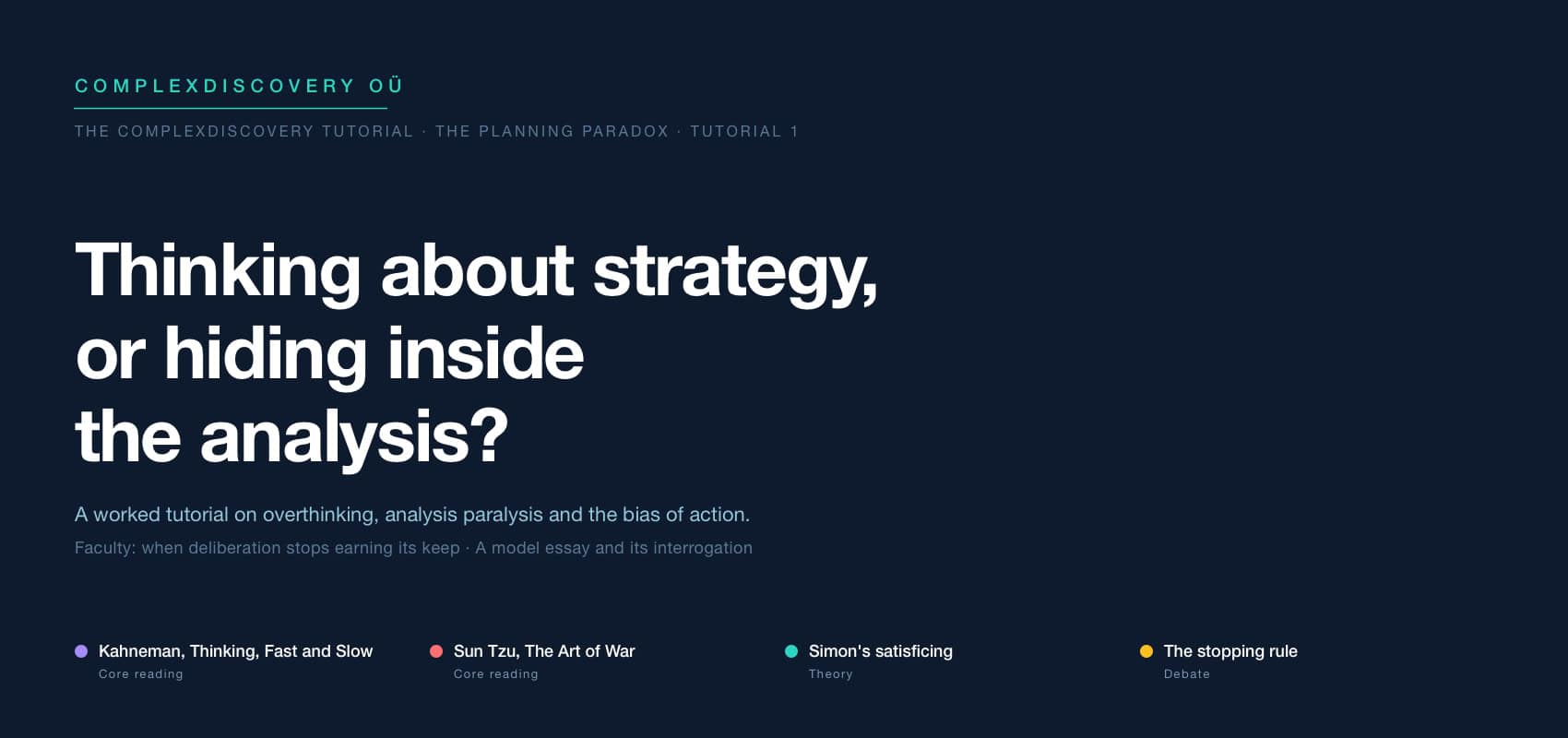
Tutorial one: “Business plans are often artifacts of analysis paralysis, serving as a psychological buffer against the fear of failure rather than a map for execution”
Explainer
This example trains the reader to separate deliberation from deferral. Watch how the essay converts a psychological claim into a testable one (the design of the question, not the stability of the answer), and how the interrogation forces the student to defend the stopping rule with a sequence, a clock and a Monday-morning instruction rather than a slogan.
The essay
The brief: to what extent does the act of thinking about a strategy become a substitute for the enactment of a strategy? The model essay argues the proposition. The interrogation tests it.
A business plan is the most respectable way ever devised to postpone starting a business. Stated that bluntly, the proposition sounds like a provocation. It survives scrutiny better than a provocation should, because it rests on an asymmetry every planner knows and few admit: a plan cannot fail; only an executed plan can. As long as the strategy remains in the document, its author remains a person whose idea might work. The moment the strategy meets a customer, that comfort ends. Overthinking is what the fear of that moment looks like when it wears a spreadsheet.
Kahneman supplies the mechanism. Thinking, Fast and Slow divides cognition into System 1, which is fast, intuitive and always on, and System 2, which is slow, effortful and lazy. The planner believes a long analysis is System 2 at work. Often it is System 1 wearing System 2’s clothing: the conclusion arrived intuitively and early, and the subsequent months of research were spent arming it rather than testing it. The tell is simple. If three successive market studies arrive and the recommendation never moves, the studies were armor, not input. Deliberation that cannot be swayed is not deliberation; it is ritual.
The ritual has a cost structure. Information carries a declining marginal value and a constant carrying cost: analyst salaries, executive attention, and above all the movement of the market while the firm sits still. Herbert Simon described the rational exit in 1956. The organism that searches a complex environment for the optimal choice will search forever; the one that survives sets an aspiration level and takes the first option that clears it. Satisficing is not a concession to laziness. It is the recognition that in a changing environment, the perfect answer to last quarter’s question is worth less than a good answer to this quarter’s. Sun Tzu reached the same conclusion by harder means: The Art of War treats prolonged campaigns as ruinous whatever their cleverness, because the resource that deliberation consumes, time, is the one resource no stratagem recovers.
Can the point of diminishing returns be proven mathematically? In general, no, and the essay should not pretend otherwise. Decision theory prices information by how much it would change the decision, and there are constructed cases in which the millionth data point matters. But the conditions under which additional information degrades real decisions are well documented and common: models overfit to noise, data goes stale while it is being gathered, and confidence rises faster than accuracy, so the late-stage planner is both surer and staler than the early one. In a competitive market those conditions are the norm. The burden of proof therefore belongs to the planner who wants another month, not to the builder who wants to start.
The honest objection is that some domains punish action far harder than delay. No one wants a bias toward action in nuclear safety, in irreversible acquisitions, or in the disclosure of a breach. The objection is correct, and it does not rescue the general practice, because the planner rarely distinguishes these cases. The discipline the proposition demands is not “act sooner” but “know which kind of decision this is”: reversible decisions deserve satisficing and speed; irreversible ones deserve the full apparatus. Much business planning inverts this, spending its months on the reversible questions (pricing, feature order, channel choice) precisely because they are safe to analyze, while the genuinely irreversible commitments hide inside assumptions no one interrogates.
Accepted, then, in qualified form: business plans are not always artifacts of analysis paralysis, but the psychological incentives, the organizational rewards for visible rigor, and the personal safety of the unexecuted idea all push in one direction. A firm that wants the truth about itself should ask one question of every analysis it commissions: what decision is waiting on this, and what answer would change it? Where no one can say, the plan has stopped being a map. It has become the destination.
The interrogation
Tutor: You open with an aphorism: a plan cannot fail, only an executed plan can. Yet Brinckmann, Grichnik and Kapsa’s 2010 meta-analysis found business planning correlates positively with small-firm performance, however context-dependent the effect. If plans were mostly self-protection, why would they correlate with performance?
Student: The correlation runs through selection. Founders disciplined enough to finish a plan tend to be disciplined in execution too. My claim is about the marginal month spent planning, not the existence of a plan. The first draft buys orientation. The fourth buys comfort.
Tutor: Your tell for ritual deliberation is a recommendation that never moves. But a stable recommendation might mean the first analysis was right. You have made robustness look like guilt.
Student: Only if disconfirmation was impossible. If the studies were designed so that no result could have moved the recommendation, stability is guilt. If any of them could have killed the idea and did not, stability is evidence. The test is the design of the question, not the stability of the answer.
Tutor: Simon’s satisficer sets an aspiration level and takes the first option above it. Who sets the level? A coward sets it low and calls the first comfortable option rational.
Student: The level has to be set before the options are seen, and by reference to the outside world: the return the capital could earn elsewhere. Set it after seeing the options and satisficing collapses into rationalization, I agree. That is an argument about sequence, not against the rule.
Tutor: You concede that no mathematical proof of diminishing returns exists, then assign the burden of proof anyway. Why does the builder get the presumption?
Student: Because the errors are asymmetric in time. The planner’s error becomes visible only later; the builder’s error is visible immediately and can be corrected. Markets reward fast correction over slow perfection wherever moves are reversible. Where they are not, I have already surrendered the presumption.
Tutor: Sun Tzu is an odd witness for your side. The same text says the victorious army wins first and then seeks battle. That is a hymn to calculation.
Student: To calculation with a deadline. The campaign season ends, supplies are consumed, and the assessment must finish while the army can still march. Sun Tzu prizes assessment and despises delay, and holds the two together with a clock. That is the stopping rule I am defending.
Tutor: Your emotional argument proves too much. By its logic every cautious executive is a coward and every reckless one is brave.
Student: It proves that hesitation and prudence look identical from the outside, which is why I need the tell. The prudent planner can name the evidence that would trigger action and the date they expect it. The hesitating one can name neither. Ask for the trigger and the date, and courage and cowardice separate quickly.
Tutor: Last question. A board takes your qualified proposition seriously. What changes on Monday?
Student: Three things. Every analysis request carries the decision waiting on it. Every plan carries the sentence “this is what would change our minds.” And planning gets a budget in weeks, set in advance, the way capital gets a budget in dollars. Thinking is the firm’s most expensive activity. It should be the one we account for most honestly.
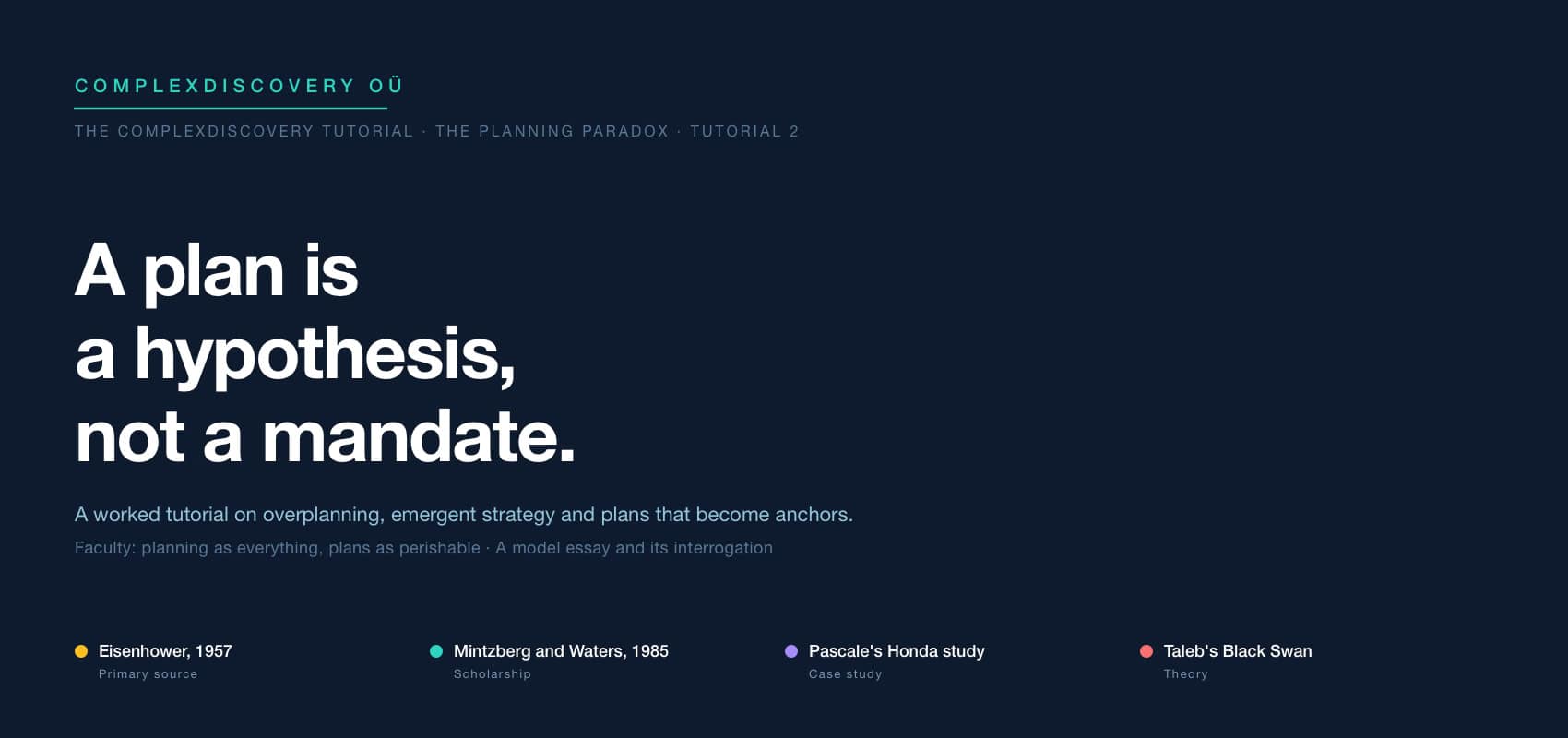
Tutorial two: “A plan is a hypothesis, not a mandate”
Explainer
This example trains the reader to hold two ideas at once: that the document is perishable and that the process that produced it is not. Watch how the essay converts Eisenhower’s paradox into an operating manual, and how the interrogation attacks the survivor bias in emergent strategy and the real cost of robustness in the years the shock does not arrive.
The essay
The brief: is a plan valuable for its content, or for the cognitive process of planning itself? The model essay argues the proposition. The interrogation tests it.
On Nov. 14, 1957, Dwight D. Eisenhower told the National Defense Executive Reserve Conference a maxim he attributed to his soldiering days: “plans are worthless, but planning is everything.” The sentence is usually quoted as a paradox. It is closer to an operating manual. The document that emerges from planning is a snapshot of yesterday’s assumptions; the value that persists is the planner, who now knows the terrain, the constraints, the second-best options and the places where the estimate was soft. When the emergency arrives and the plan no longer fits, Eisenhower said, you start from what you know, not from the paper.
The proposition before us puts the same point in analytic dress: a plan is a hypothesis, not a mandate. Overplanning is what happens when that distinction is lost, when the organization mistakes the document’s precision for the environment’s stability. A hypothesis invites refutation; a mandate resents it. The overplanned firm treats divergence from plan as underperformance to be corrected rather than as data to be interpreted, and so it corrects its way steadily into a world that no longer exists.
Mintzberg gives the theory its sharpest form. In “Of Strategies, Deliberate and Emergent” (1985), Mintzberg and Waters observed that the strategy a firm realizes is rarely the strategy it intended: realized strategy is a weave of deliberate intention and emergent response, patterns forming in a stream of decisions no one planned. Their point is not that intention is futile but that emergence is information. Richard Pascale’s account of Honda’s entry into the American motorcycle market makes it concrete: the strategy that succeeded, the small Super Cub sold to ordinary consumers, was not the strategy in the plan, which centered on larger machines. Honda’s advantage was not superior forecasting. It was the speed with which the organization noticed what the market was doing to its hypothesis and promoted the anomaly into the strategy.
What of the Black Swan? Taleb’s challenge is often read as a refutation of planning altogether: the events that matter most are precisely the ones no forecast contains. But the challenge only destroys plans that are read as mandates. A hypothesis-plan absorbs the point structurally, by planning the firm’s exposure rather than the world’s behavior. One cannot forecast the shock, but one can decide in advance how much of the firm a single surprise is permitted to consume. The plan that survives a Black Swan is not the one that predicted it; it is the one that kept the commitments reversible and the reserves intact. Helmuth von Moltke, commonly paraphrased as warning that no plan survives contact with the enemy, drew the same conclusion and did not stop planning. He planned in branches.
The threshold question answers itself once the terms are set. A plan becomes an anchor at the moment disconfirming data starts arriving and the organization spends the data defending the plan instead of revising it. The practical test is institutional, not psychological: does the firm have a scheduled, blameless occasion on which the plan is treated as the defendant? If divergence can only be discussed as someone’s failure, every incentive points toward concealment, and the plan will be defended until it fails at scale. The planning process, Eisenhower’s “everything,” must be continuous, and the plan, his “worthless,” must be dated like milk.
The proposition holds, with one amendment. A plan is a hypothesis, but it is also a coordination device: hundreds of people act coherently because the document exists. The amendment is that coordination value decays at the same rate as predictive value. A firm coordinated around a refuted hypothesis is coherent in the wrong direction, which is worse than incoherence, because it arrives at the wrong place faster.
The interrogation
Tutor: You lean on Eisenhower, a man who planned the largest amphibious invasion in history down to the tide tables. Would Overlord have gone better with less paper?
Student: Overlord is my case, not my counterexample. The paper was enormous and the planners treated it as perishable. The planning prepared the force, and execution still required rapid improvisation the moment events diverged from the plan, by units whose officers had internalized the intent. What survived contact was the preparation, not the paper.
Tutor: Mintzberg’s emergent strategy has a survivor problem. Honda noticed the right anomaly. The firms that chased anomalies into ruin wrote no articles. Why is emergence wisdom rather than luck canonized after the fact?
Student: Partly it is luck canonized, and Pascale’s account is one case, chosen because it succeeded. What generalizes is not “follow anomalies” but the capacity underneath: Honda could notice, decide and redeploy within a season. Emergence without a filter is drift. The filter is the hypothesis. Because the plan states what we expect, the anomaly is legible as an anomaly.
Tutor: Then you need the plan precise enough to be refuted and loose enough to be revised. Those pull in opposite directions.
Student: They pull at different objects. Precision belongs in the expectations: numbers, dates, thresholds. Looseness belongs in the commitments: options, staging, reversibility. The overplanned firm gets this backwards. It is vague about what it expects and rigid about what it will do.
Tutor: Your Taleb answer plans exposure instead of events. That is insurance with better vocabulary, and insurance is priced. What does your robustness cost in the years the swan does not arrive?
Student: It costs real return, and the essay should own that. Reserves drag, reversible commitments price at a premium, optionality is never free. The defense is that the firm is not pricing a fair lottery; it is avoiding absorbing states. Ruin is not a bad year. It is the year after which there are no years.
Tutor: The scheduled occasion where the plan is the defendant: boards have those. They are called reviews, and they mostly ratify. Why will yours differ?
Student: Because of what is on trial. A review asks whether people hit the plan. My occasion asks whether the plan deserved to be hit. The agenda item is the assumption list, in writing, each marked confirmed, wounded or dead, and the person who kills an assumption is thanked publicly. Incentives make the difference, not calendars.
Tutor: Your amendment says coordination value decays with predictive value. A false shared map still coordinates, and armies have won on worse. Is coherence in the wrong direction really worse than incoherence?
Student: For an army in contact, perhaps not; retreating together beats scattering. For a firm, the market punishes speed in the wrong direction with compounding losses. Incoherence at least produces variance, and variance contains information. Coherent error produces confidence and a single large bill.
Tutor: Final question. Eisenhower makes planning everything. Budgets are finite. How much is “everything” allowed to cost?
Student: As much as keeps the map current, and no more. Planning spend should track environmental volatility, not corporate ambition. Stable terrain: thin plans, annual cadence. Turbulent terrain: continuous planning, and thin plans still. The paper stays cheap. The thinking is what we pay for.
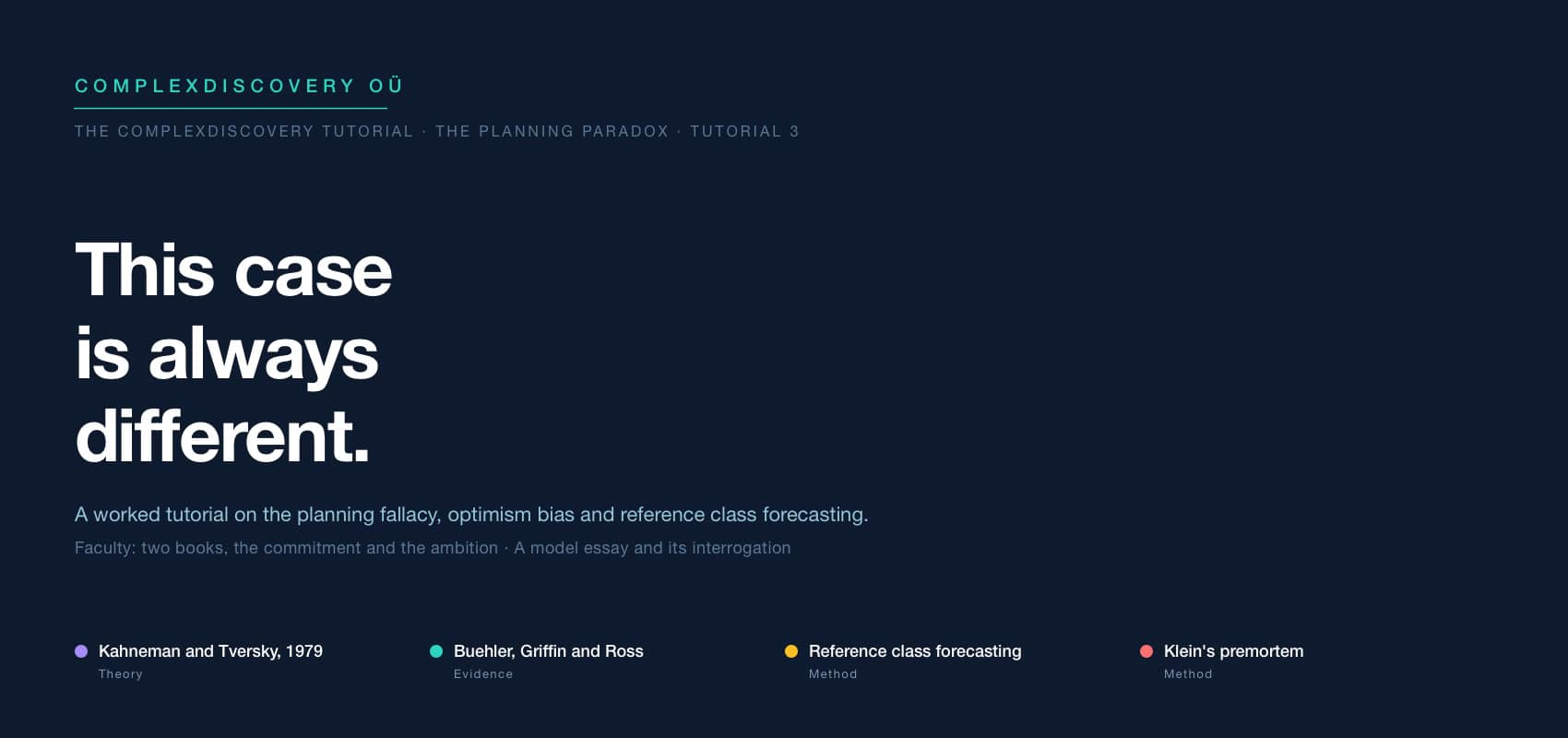
Tutorial three: “Most business plans fail because they are built on the planning fallacy”
Explainer
This example trains the reader to separate the forecast from the structure around it. Watch how the essay distinguishes a visionary goal from a fatal misestimation architecturally rather than psychologically, and how the interrogation presses on the method’s weakest joints: the frontier that has no reference class, and the board that blurs the two books under pressure.
The essay
The brief: how does a business distinguish between a visionary goal, which requires a degree of positive delusion, and a fatal misestimation of capability? The model essay argues the proposition. The interrogation tests it.
In 1979, Daniel Kahneman and Amos Tversky gave a name to a pattern anyone who has renovated a kitchen already knew: the planning fallacy, the tendency to underestimate how long a task will take by neglecting how long similar tasks have taken before. The finding’s power lies in its resistance to experience. Buehler, Griffin and Ross followed 37 psychology students completing honors theses. Among the 33 who finished within the study’s observation window, the average forecast was 33.9 days and the average actual completion time was 55.5. Four unfinished theses were excluded from that comparison. The researchers found that participants tended to focus on future scenarios rather than on relevant past experience. The fallacy, in other words, is not ignorance of base rates. It is the conviction, renewed each time, that this case is different.
Lovallo and Kahneman carried the diagnosis into business, widening its scope to executive forecasts that minimize risks and exaggerate expected benefits, and located the mechanism in the point of view. The planner takes the inside view: this project, these people, this timeline, a story built from the case at hand, and stories omit the accidents that have not happened yet. The outside view asks a colder question: what happened to projects like this one? Reference class forecasting turned that question into a method, pricing a plan against the distribution of its ancestors rather than the intentions of its authors. Flyvbjerg carried the method into major-project forecasting, and his project database suggests how wide the gap runs. By his and Dan Gardner’s count, a fraction of one percent of large projects deliver on cost, on time and on the promised benefits together. Against numbers like these, the proposition seems to close the case: plans fail because planners are optimists, and the cure is statistical humility.
The case should not close that easily, for two reasons. The first is Taleb’s. Reference classes are strongest where a defensible comparison set exists, and they weaken where precedents are sparse or the outcome distribution is poorly understood. The Black Swan warns that rare, high-impact outliers can escape ordinary expectations entirely, and the entrepreneur founding a category has few ancestors worth pricing against. The problem at the frontier is not that reference classes are useless by definition. It is that the wrong class can create false confidence, which is worse than none. Statistical humility, misapplied at the frontier, quietly forbids the frontier.
The second reason is the one the proposition is designed to force. Some degree of overestimation appears to be load-bearing. A founder who believed the base rates about founders would not found. The visionary goal and the fatal misestimation are both departures from the reference class, and the difference between them is not visible in the forecast. It is visible in the structure around the forecast. A visionary misestimates the size of the prize and survives to revise, because the commitments were staged and the runway was real. A fatal misestimation miscounts the runway itself. The distinction, in other words, is not psychological but architectural: delusion about the destination is compatible with rigor about the fuel.
This yields an answer to the debate question. Under-promising and over-delivering is honest exactly where the promise is load-bearing for someone else’s decisions (an investor’s, a court’s, a regulator’s), and it is a failure of ambition where the promise is the fuel. The practitioner’s synthesis is to run both books deliberately. An outside-view book governs the commitments, where Flyvbjerg’s method and Gary Klein’s premortem (imagine the project dead, and write its history) discipline the numbers. An inside-view book carries the ambition, undiscounted, because the discounted version motivates no one. The dishonesty is not optimism. It is letting the two books blur: promising the mission and budgeting the miracle.
So amended, the proposition stands. Most plans do fail on the planning fallacy, and the fallacy is incurable at the level of temperament: planners will always be the people who believed this case was different. The cure lives one level up, in the design of the plan. Reference-class numbers where others must rely on them. Staged commitments where the vision must breathe. And a written record of which is which. Realism about the odds is not the enemy of ambition. Undifferentiated realism is, and so is undifferentiated hope.
The interrogation
Tutor: Your architectural distinction is elegant: delusion about the destination, rigor about the fuel. But the fuel forecasts are made by the same deluded planner. Why does the optimism conveniently stop at the runway?
Student: It does not stop voluntarily. It is stopped. The runway numbers are the ones I hand to the outside view: reference classes, premortems, someone else’s base rates. The founder does not become a realist. The founder is outvoted on a specific page of the plan.
Tutor: Flyvbjerg’s fraction of one percent. If the base rate of full success is that low, the rational move is never to build anything large. The number refutes optimism, and then it refutes action itself.
Student: It refutes a definition. Full success in that count means on cost, on time and on benefits together, and a project can miss all three and still have been worth building. The base rate disciplines the promise, not the undertaking. I use it to size commitments, not to counsel paralysis.
Tutor: Taleb cuts against you harder than you allow. If the frontier has no reference class, your two-books method has no outside book exactly where you need it most.
Student: At the frontier the outside book changes subject. It cannot price the upside, so it prices survival: months of cash, rate of burn, the cost of being wrong by half. Frontier ventures still have ancestors in their failure modes even when they have none in their ambitions. Companies die in reference classes even when they succeed outside them.
Tutor: The thesis study is four decades old and concerns undergraduates. Give me a reason to believe corporate planners, with careers at stake, behave like students.
Student: Careers at stake make it worse, not better. The student misses her own deadline. The executive is rewarded for the confident forecast at approval time and has often moved on by delivery time. Lovallo and Kahneman were writing about executives, and the pattern held. Incentives amplify the inside view. They do not correct it.
Tutor: You call under-promising honest where others rely on the promise. A vendor who sandbagged every estimate would be honest and unemployed. Markets punish your honesty.
Student: Markets punish uncalibrated sandbagging, which is the fallacy with the sign flipped. The honest promise is the reference-class number, not the padded one. If a market systematically selects for promises the sellers know to be false, that is not an argument against my rule. It is a description of a market pricing in later disputes.
Tutor: The premortem asks a team to imagine failure. A team that has just committed is the least able to imagine it. Is Klein’s exercise anything besides theater?
Student: It is theater with a license. Klein’s insight is permission: the exercise reframes doubt as a contribution, prospectively, before positions harden. I hold it as a cheap partial corrective, not a cure. Its real product is a written list of named risks that someone must now own.
Tutor: Final question. Your synthesis requires the organization to know which book it is reading at any moment. Boards blur categories under pressure. What is the enforcement mechanism?
Student: Writing, mostly. The plan carries two labeled sections. Commitments: outside-view numbers others may rely on. Ambitions: inside-view numbers no one may borrow against. Auditors and courts already understand the difference between a forecast and a target. The mechanism is making the label as durable as the number, so blurring them costs someone a signature.
An invitation
None of the three sessions ends in a verdict, and that is the design. The propositions (that plans are buffers against the fear of failure, that plans are hypotheses rather than mandates, that plans fail on the planning fallacy) are built to be argued from either chair, and each essay above wins only in the qualified, amended form that survives its interrogation.
The invitation, then, is not to agree. It is to take the chair opposite your own conviction. If you believe in the thick plan, argue the buffer. If you believe in the bias for action, defend the month of analysis. The framework’s assignment brief and its closing challenge are printed above in full; they work on a strategic plan, a budget forecast, an incident response playbook or a discovery project timeline exactly as written.
Sources and reference materials
References are cited in full below. Titles link to a freely accessible public version where one exists; entries without links are cited from the print or paywalled original.
ComplexDiscovery OÜ
ComplexDiscovery OÜ, The ComplexDiscovery Tutorial: The Planning Paradox (tutorial framework, worked examples and assignment brief), 2026, complexdiscovery.com.
Primary documents and institutional guidance
- Dwight D. Eisenhower, Remarks at the National Defense Executive Reserve Conference, Washington, Nov. 14, 1957 (The American Presidency Project, University of California, Santa Barbara).
- Helmuth von Moltke (the Elder), essay on strategy (1871), in Moltke on the Art of War: Selected Writings, ed. Daniel J. Hughes (Presidio Press, 1993).
- University of Oxford, “Tutorials at Oxford,” Oxford Students: Study Skills.
- Naval History and Heritage Command, “Operation Overlord: Invasion of Normandy, 6 June 1944.”
Scholarship and commentary
- Daniel Kahneman, Thinking, Fast and Slow (Farrar, Straus and Giroux, 2011).
- Sun Tzu, The Art of War, trans. Samuel B. Griffith (Oxford University Press, 1963).
- Herbert A. Simon, “Rational Choice and the Structure of the Environment,” Psychological Review 63, no. 2 (1956): 129-138.
- Henry Mintzberg and James A. Waters, “Of Strategies, Deliberate and Emergent,” Strategic Management Journal 6, no. 3 (1985): 257-272.
- Richard T. Pascale, “Perspectives on Strategy: The Real Story Behind Honda’s Success,” California Management Review 26, no. 3 (1984): 47-72.
- Daniel Kahneman and Amos Tversky, “Intuitive Prediction: Biases and Corrective Procedures,” TIMS Studies in Management Science 12 (1979): 313-327.
- Roger Buehler, Dale Griffin and Michael Ross, “Exploring the ‘Planning Fallacy’: Why People Underestimate Their Task Completion Times,” Journal of Personality and Social Psychology 67, no. 3 (1994): 366-381.
- Dan Lovallo and Daniel Kahneman, “Delusions of Success: How Optimism Undermines Executives’ Decisions,” Harvard Business Review, July 2003.
- Bent Flyvbjerg, “From Nobel Prize to Project Management: Getting Risks Right,” Project Management Journal 37, no. 3 (2006): 5-15.
- Nassim Nicholas Taleb, The Black Swan: The Impact of the Highly Improbable (Random House, 2007; 2nd ed. 2010).
- Gary Klein, “Performing a Project Premortem,” Harvard Business Review, September 2007.
- Bent Flyvbjerg and Dan Gardner, How Big Things Get Done (Currency, 2023).
- Jan Brinckmann, Dietmar Grichnik and Diana Kapsa, “Should Entrepreneurs Plan or Just Storm the Castle? A Meta-Analysis on Contextual Factors Impacting the Business Planning-Performance Relationship in Small Firms,” Journal of Business Venturing 25, no. 1 (2010): 24-40.





Assisted by GAI and LLM Technologies
Additional reading
- An Oxford tutorial for newsroom leaders who must learn faster than the news
- An Oxford tutorial for cybersecurity, governance and eDiscovery
- Estonia aims to be first to give AI agents official digital IDs
- Parliament hits pause on high-risk AI rules and bans nudifier apps
- Europe’s AI labeling rules arrive with a voluntary code and a hard deadline
- AI is becoming an advisor, and it is rewriting how buyers find you
- What marketing confidence actually looks like
- When credibility comes first, capability sells itself: The case for news-led marketing
- The one question that reveals whether your marketing plan is actually a plan
- How Prompt Marketing Is Redefining Thought Leadership In The AI Era
- Raising The Age Ceiling: How AI Is Extending Executive Leadership
- Staying Curious: One Practical Defense Against Creative Burnout
- From Longbows To AI: Lessons In Embracing Technology
- 20 Ways Creative Professionals Battle Burnout And Find Fresh Ideas
- 14 Points For Brands To Consider Before Making Sociopolitical Statements
Source: ComplexDiscovery OÜ

ComplexDiscovery’s mission is to enable clarity for complex decisions by providing independent, data‑driven reporting, research, and commentary that make digital risk, legal technology, and regulatory change more legible for practitioners, policymakers, and business leaders.