

Editor’s Note: Hypothetically, on Aug. 18, a prosecutor in Warsaw gains the power to order subscriber data from a hosting provider’s designated recipient in Dublin without any Irish authority reviewing the demand first. Regulation (EU) 2023/1543 becomes directly applicable in seven days, and it compresses cross-border evidence expectations from months to days: 10-day response windows, eight-hour emergency clocks, and penalties of up to 2 percent of a provider’s total worldwide annual turnover for the preceding financial year. The catch, as this week’s reporting lays out: most member states have not finished transposing the companion directive, the transmission system is unfinished even though the rules supply an alternative-means fallback, and no EU-U.S. agreement resolves the potential collision with the Stored Communications Act.
For cybersecurity, data privacy, regulatory compliance and eDiscovery professionals, the exposure is operational and contractual at once. Designated recipients come due the same day the first orders can issue, production orders are built to reach the data controller, and a preservation order served on a vendor may never reach the client absent a notice clause.
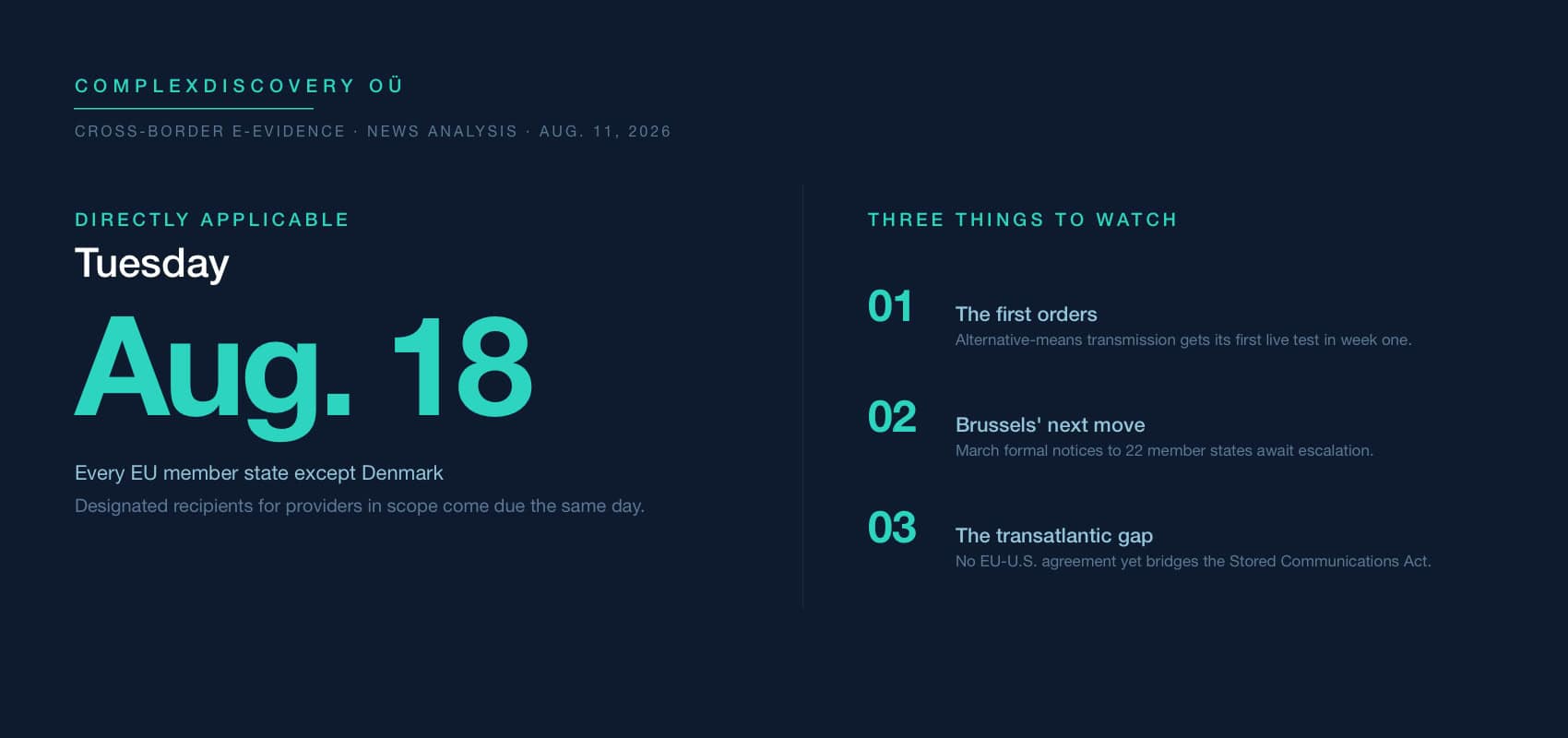
Watch three things after go-live: how the alternative-means fallback performs in week one, whether the Commission escalates its March infringement letters, and whether transatlantic negotiations move.
Content Assessment: Seven days out, and most of Europe isn't ready for e-evidence
Information - 93%
Insight - 91%
Relevance - 91%
Objectivity - 93%
Authority - 92%
92%
Excellent
A short percentage-based assessment of the qualitative benefit expressed as a percentage of positive reception of the recent article from ComplexDiscovery OÜ titled, "Seven days out: the EU's e-evidence regime goes live Aug. 18."
Industry News – Data Privacy and Protection Beat
Seven days out: the EU’s e-evidence regime goes live Aug. 18
ComplexDiscovery OÜ Staff
Seven days from now, a prosecutor in one EU member state can send a subscriber-data demand straight to a provider’s designated recipient in another, with no authority in that second state reviewing it first.
The diplomatic machinery that made cross-border evidence slow enough to plan around is about to get a bypass lane.
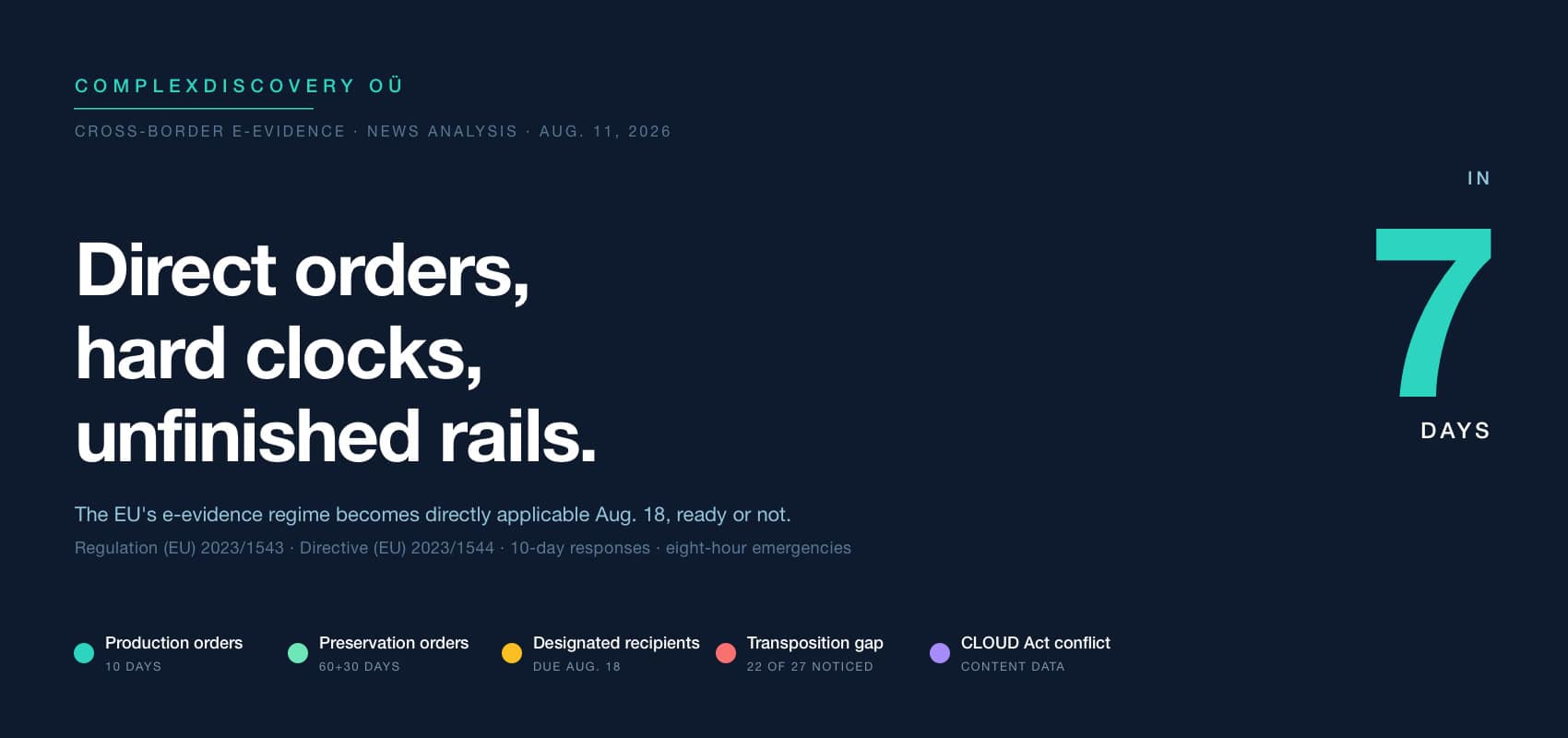
Regulation (EU) 2023/1543 becomes directly applicable Aug. 18, activating European Production Orders and European Preservation Orders across every EU member state except Denmark, which does not participate. From that date, a judicial authority in one member state may direct an order to a provider whose establishment or legal representative sits in another, and the obligation follows the provider, not the server: under Article 1 of the regulation, orders reach data no matter where it is physically stored.
Speed is the regime’s central objective. The European Commission, which proposed it, says over half of all criminal investigations now involve a cross-border request for electronic evidence, and it has long cited an average of about 10 months to obtain data through mutual legal assistance channels, against up to 120 days for a European Investigation Order. The new orders compress that timeline to 10 days, and to eight hours in emergencies.
Most EU member states had not notified complete transposition of the companion directive when its February deadline passed, and nearly six months on, progress is visible but incomplete: most still have not finished, and the two items examined below, the technical rails and the transatlantic conflict rules, remain open.
What actually changes on Aug. 18
The regulation creates two instruments. A European Production Order, transmitted through a certificate known as an EPOC, compels a provider to produce data within 10 days of receipt, or within eight hours where the issuing authority invokes an emergency. A European Preservation Order, transmitted through an EPOC-PR, freezes data for 60 days, extendable by an additional 30 days, while investigators pursue a follow-on production request.
Not every order is available for every offense, and not every authority can issue one. Orders for subscriber data and for data sought solely to identify a user may be issued or validated by prosecutors as well as judges, and are available for any criminal offense, provided the order is necessary and proportionate and could have been issued in a comparable domestic case. Orders for traffic data beyond identification, and for content, must be issued or validated by a judge, court or investigating judge, and are limited to offenses carrying a maximum custodial sentence of at least three years or to specific enumerated offenses, including certain cyber, terrorism and child sexual abuse crimes, according to the regulation’s threshold provisions. For those higher-tier orders, the issuing authority must in most cases also notify an enforcing authority in what the regulation calls the enforcing state, the member state where the provider’s designated establishment sits or its legal representative resides; that authority has 10 days to raise limited refusal grounds, and absent an objection the data moves at the end of the window. The notification duty falls away where the issuing authority has reason to believe the offense was committed on its own territory and the person whose data are sought resides there.
Noncompliance is priced at up to 2 percent of a provider’s total worldwide annual turnover for the preceding financial year.
A designation deadline that lands the same day
The regulation travels with a companion, Directive (EU) 2023/1544, which member states were required to transpose into national law by Feb. 18. The directive obliges providers within its scope to maintain an addressee for orders: providers established in a member state that takes part in the underlying instruments designate an establishment there, while everyone else, non-EU providers and those based in nonparticipating member states alike, appoints a legal representative in a participating member state. One carve-out matters: under Article 1(5), a provider established in a single member state that offers services only in that member state sits outside the directive. Providers in scope and already offering services in the Union on Feb. 18 must have their recipient in place by Aug. 18, the same day the first orders can issue. Companies entering the market later get six months from the day they start offering services.
The designation is not a mailbox. Provider and designated recipient carry joint and several liability for noncompliance, and the directive requires that the recipient be resourced and empowered to act. The EU published a notification tool this year through which providers register their designated recipients’ contact details and working languages, according to a July analysis by the German law firm Rickert and a client briefing from Bird & Bird. In Germany, registration runs through the Federal Office of Justice and recipients must be able to operate in German, Baker McKenzie attorneys Anika Schürmann and Lukas Greiner wrote in a March client alert.
Transposition enforcement is already underway
Brussels has not waited for the go-live date to show its posture. On March 27, the European Commission sent letters of formal notice to 22 of the EU’s 27 member states for failing to notify complete transposition of the directive, the first formal step in infringement proceedings, giving each two months to respond. MLex reported the action the same day. That count leaves at most five member states uncited, and Germany is one of them: its implementing statute cleared the Bundestag in late January and was published in March.
The two-month clocks have since expired, and as of Aug. 11 the Commission’s June 4 and July 8 infringement packages contain no e-evidence item, meaning no reasoned opinions have issued in public view. The March letters remain the most recent formal step. A regime built on designated national recipients goes live in a week with most member states’ implementing law incomplete and the transmission system still under construction.
The infrastructure is still under construction
Orders and responses are supposed to move through a decentralized IT system connecting authorities and providers. The Commission adopted the system’s technical specifications in Implementing Regulation (EU) 2025/1550 on July 28, 2025, an act that aligns exchange interfaces with an ETSI technical standard where possible and directs electronic evidence above 25 megabytes to alternative means, Covington & Burling special counsel Paul Maynard wrote in a 2025 analysis.
The system itself is not finished. EuroISPA, the trade association for European internet services providers, whose members would bear the connection costs, said in a June 29 statement that the technical infrastructure is not ready, that most member states had yet to fully transpose the directive, and that building compliant systems takes providers at least 18 months once confirmed technical specifications arrive. None had arrived anywhere in the EU, the group said, a year after the implementing regulation was adopted. The association asked for a compliance grace period that would run until the system actually works, and for protection from penalties for good-faith providers caught in the gap. As of Aug. 11, no postponement of the Aug. 18 date had surfaced in public sources, and the date sits in the regulation’s own text, a place only new legislation could reach.
None of that suspends the calendar, and the framework does not wait for its own rails. The regulation’s obligations bind from Aug. 18 whether or not the decentralized system is deployed, and Article 19(5) of the regulation, fleshed out by the implementing rules, supplies the fallback: where the system cannot be used, exchanges shift to what the rules call the most appropriate alternative means, provided they are swift, secure and reliable and let the recipient establish authenticity. When electronic evidence itself moves by those means, the implementing rules add a documented manifest, including at least one cryptographic hash digest of the data. What has no track record is practice: which channels authorities will actually use in week one, and how smoothly provider intake desks will handle them. The receiving end is the part providers own: a registered recipient, reachable and resourced, whatever the transport turns out to be.
Where the CLOUD Act collides with Brussels
For U.S. providers whose services fall under the Stored Communications Act, the countdown carries a potential conflict of laws that predates the regime and survives it. That statute generally bars the providers it covers from disclosing the content of communications to foreign governments, and the CLOUD Act of 2018 created a path around the bar through bilateral executive agreements, which the United States has concluded with the United Kingdom and Australia. No such agreement exists with the EU. Negotiations that began in September 2019 and resumed in March 2023, per a joint announcement by the European Commission and the U.S. Department of Justice, remained unresolved as of Aug. 11, with the two sides split over architecture: Washington has favored a framework agreement completed by bilateral deals with member states, while Brussels has insisted on a single union-wide instrument, as previously reported.
The regulation anticipates the collision. Under Article 17, a provider that believes compliance would force it to violate a third country’s law has 10 days to file a reasoned objection; unless the issuing authority withdraws the order, a court in the issuing state then weighs the competing interests, attorneys Andreas Dürr, Kai Gesing, Katharina Humphrey and Benno Schwarz wrote in a 2023 Gibson Dunn client alert on the final text. The design matters: a foreign prohibition does not by itself defeat the order. A U.S. provider’s designated recipient in Dublin or Frankfurt may soon hold a content order that U.S. law forbids it to honor, with a statutory clock running and a balancing test it does not control.
Contract language becomes the client’s early-warning system
For corporate legal departments and the eDiscovery vendors that serve them, the exposure is quieter and closer to home. The regime’s service-provider definitions sweep in information society services for which storing or processing user data is a defining component. Read against those definitions, many eDiscovery platforms, legal hold tools and legal technology SaaS products hosting client matter data in or for the European market may qualify, depending on whether a given product meets the regulation’s service, storage and EU-connection criteria.
The regulation sorts some of this by role. In its vocabulary, an eDiscovery vendor typically holds client matter data as a processor for a client that is the controller, and Article 5 directs a European Production Order to the provider acting as controller by default. An issuing authority may address the processor instead where reasonable efforts fail to identify the controller, or where routing the order through the controller would risk prejudicing the investigation; a processor that produces data must then inform the controller, though the issuing authority may delay that notice for as long as necessary and proportionate. Production, in short, is designed to reach the client eventually.
Preservation is where the contract does the work. A European Preservation Order served on a vendor freezes data the vendor holds, and the processor notice duty the regulation spells out attaches to the disclosure of data. Where the master services agreement is silent on notice of legal process, a preservation order can arrive, run its 60-day course with a 30-day extension, and lapse without the client learning an investigation ever touched its data. Axel Spies of Potomac Law Group, writing in a July 13 client alert, urged U.S. companies in scope to stand up documented intake procedures, assign order-handling responsibilities across legal, privacy and compliance teams, build the technical capability to preserve data on command, and keep audit trails.
The same questions belong on the client side of the vendor relationship, and the homework fits inside seven days. Confirm the designated recipient exists and is registered where it must be. Staff the intake channel for an eight-hour clock, August vacations included. Dry-run one emergency order end to end. Map the regulation’s data categories, subscriber data, traffic data and content data, plus the separately defined data sought solely to identify a user, to the systems that actually hold each, because a 10-day clock punishes discovery-at-response-time. Confirm deletion pipelines can pause for identified accounts across the full preservation window without freezing everything else.
Then decide how the team authenticates an order that arrives outside the new system: which issuing authorities it recognizes, what a complete certificate and transmission manifest contain, who calls back to verify. Until the authenticated rail is running, intake validation is what separates a real order from a well-dressed fake. And read the legal-process and confidentiality clauses of every European vendor contract against a preservation order that arrives Aug. 19.
When the first EPOC lands, it will land on whatever workflow exists that morning. Will yours be a documented process with a named owner, or an unmonitored inbox with a statutory deadline already running?
News sources
- The EU’s E-Evidence Framework Goes Live in August and Most of Europe Isn’t Ready (ComplexDiscovery)
- Regulation (EU) 2023/1543 on European Production Orders and European Preservation Orders for Electronic Evidence (EUR-Lex)
- Directive (EU) 2023/1544 on Designated Establishments and Legal Representatives for Gathering Electronic Evidence (EUR-Lex)
- Commission Implementing Regulation (EU) 2025/1550 Establishing Technical Specifications for the Decentralised IT System (EUR-Lex)
- E-Evidence: Cross-Border Access to Electronic Evidence (European Commission)
- Commission Takes Action to Ensure Complete and Timely Transposition of EU Directives (European Commission via The European Sting)
- Failure to Implement e-Evidence Directive Prompts Warnings to 22 EU Countries (MLex)
- e-Evidence Regulation: Closing the Implementation Gap Before August 2026 (EuroISPA)
- European Commission Adopts Technical Standards for the Decentralized Communication System (Covington & Burling, Global Policy Watch)
- EU Strengthens Cross-Border Access to E-Evidence in Criminal Proceedings (Gibson Dunn)
- European Union: European Criminal Law Enforcement Is Stepping Up (Baker McKenzie)
- EU e-Evidence Rules Become Operational on August 18, 2026 (Potomac Law Group)
- The e-Evidence Package: ‘Happy Ending’ of a Long Negotiation Saga (eucrim, Gianluca Forlani)
- EU E-Evidence: What’s a Legal Representative and Who Needs One (Rickert)
- Frequently Asked Questions About the U.S. CLOUD Act (Cross-Border Data Forum)
- EU-U.S. Announcement on the Resumption of Negotiations on an Agreement to Facilitate Access to Electronic Evidence (European Commission)

Assisted by GAI and LLM Technologies
Additional reading
- California’s AI Transparency Act arrives alongside Europe’s Article 50
- Federal magistrate judge treats LinkedIn’s Relativity aiR workflow as TAR
- One benchmark, three directions: 2026 legal rates rise, flatten and fall at once
- Confidence cools, commitment holds: full results from the 1H 2026 eDiscovery Business Confidence Survey
- Complete look: ComplexDiscovery OÜ’s 2025 to 2030 eDiscovery market size mashup
- The workstream of eDiscovery: Considering processes and tasks
- Andrew Haslam’s eDisclosure Systems Buyers Guide at 14: What the 1H 2026 update reveals
- A Complete Analysis of the Winter 2026 eDiscovery Pricing Survey
- The M&A Risk of Confusing Market Velocity with Marketing Capability
Source: ComplexDiscovery OÜ

ComplexDiscovery’s mission is to enable clarity for complex decisions by providing independent, data‑driven reporting, research, and commentary that make digital risk, legal technology, and regulatory change more understandable for practitioners, policymakers, and business leaders.