

Editor’s Note: A litigation fact-intelligence engine is set to change hands, and the buyer is not an eDiscovery vendor. Legora’s July 29 announcement that it is acquiring Wexler would place chronology building, actor mapping, and fact verification inside a $5.6 billion agentic platform reaching over 100,000 lawyers, by the company’s count.
For cybersecurity, privacy, and compliance professionals, the sharper development sits upstream of any courtroom: a fact engine deployed with persistent access to contract and communication archives would be a governance event, with access scoping, retention alignment, and privilege discipline to settle before the first query runs. For eDiscovery teams, the deal would redraw a competitive map in which fact development has lived across review platforms and case-analysis tools. Two July orders from the Northern District of California frame the moment: one treated generative AI review as technology-assisted review, and the other entered a stipulated protocol requiring disclosure of prompts and configurations when a party elects AI review.
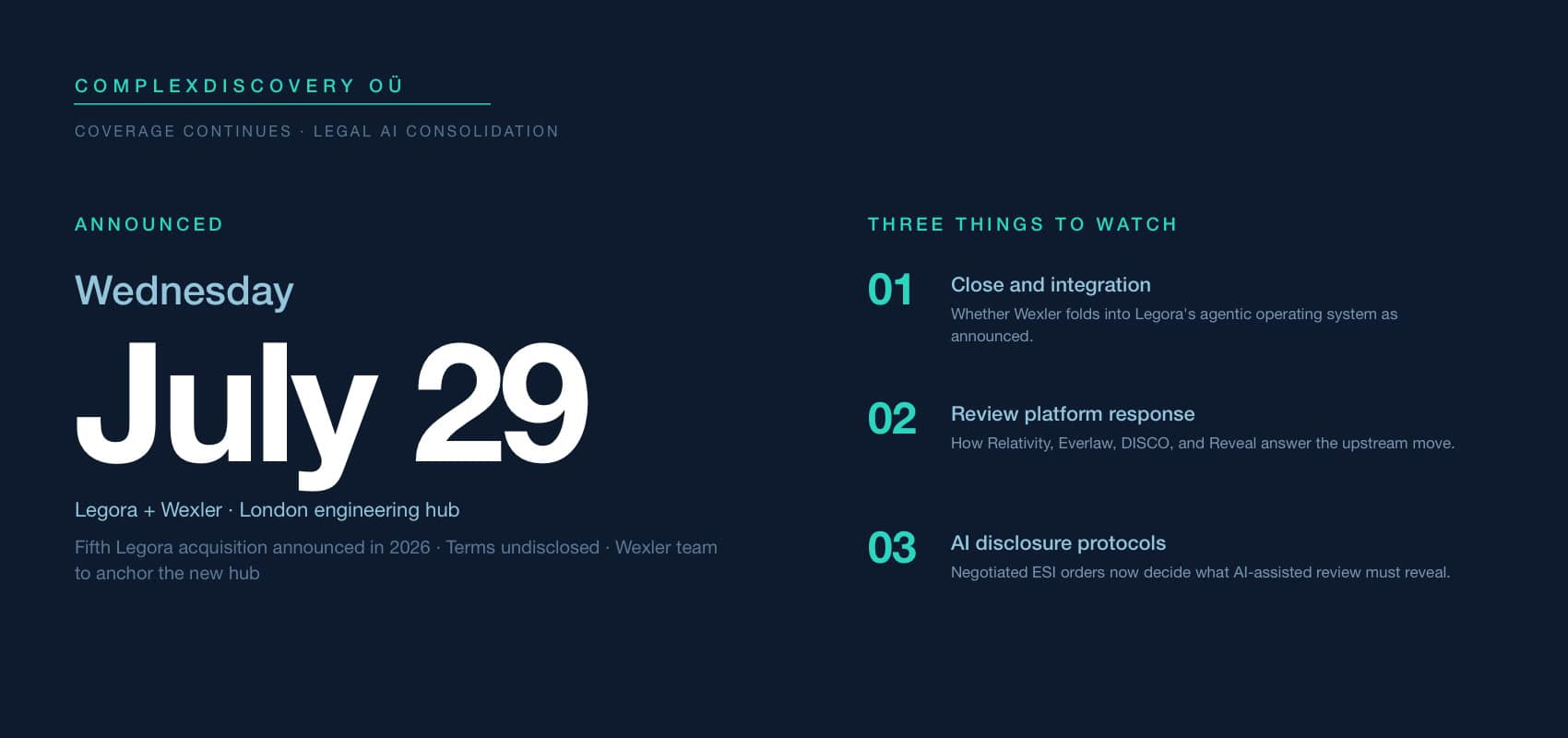
Watch next for whether the deal closes as announced, how Relativity, Everlaw, DISCO, and Reveal answer, and whether Wexler’s law firm customers hold their contracts through integration.
Content Assessment: Legora to acquire Wexler as fact intelligence moves into the legal AI workspace
Information - 92%
Insight - 91%
Relevance - 93%
Objectivity - 91%
Authority - 90%
91%
Excellent
A short percentage-based assessment of the qualitative benefit expressed as a percentage of positive reception of the recent article from ComplexDiscovery OÜ titled, "Legora to acquire Wexler as fact intelligence moves into the legal AI workspace."
Industry News – eDiscovery Beat
Legora to acquire Wexler as fact intelligence moves into the legal AI workspace
ComplexDiscovery OÜ Staff
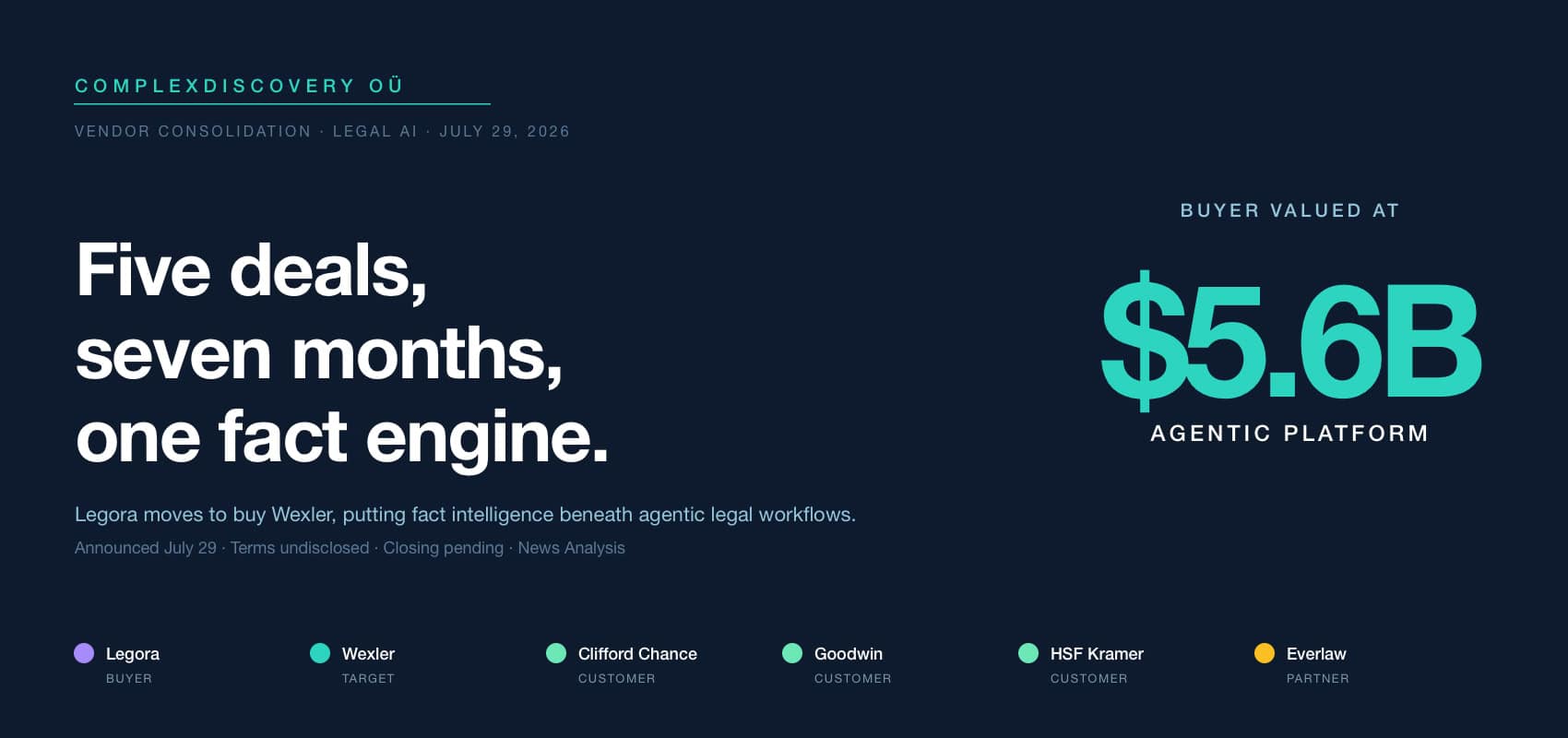
Legora, the Stockholm-founded legal AI platform valued at $5.6 billion, announced Wednesday it is acquiring Wexler, a London startup whose engine extracts and verifies case facts and is built, the company says, to handle over 1 million documents per case. Terms were not disclosed, and closing has not been independently confirmed. The deal would be Legora’s fifth acquisition of 2026, and its most pointed: fact development, the work of building the chronology, mapping the actors, and tracing what was known and when, has long been spread across review platforms, standalone case-analysis tools such as LexisNexis CaseMap and Opus 2, and the lawyers who read their output. With Wednesday’s announcement, a general legal AI platform is moving to make that work infrastructure.
What Legora is buying
Wexler is small and specialized. Gregory Mostyn and Kush Madlani founded it in January 2023, and its 18-person team splits between London and New York. The product routes each document population through what the company calls a gated pipeline: staged checks meant to yield individually sourced, checkable findings that capture the actor, the statement, the audience, the date, and the reason it matters to the case. The stated design goal is a verified fact record rather than “summaries or loosely sourced excerpts.” In May, the company published a technical explanation of how it says its architecture can handle over 1 million pages; the post describes capability and design, not a documented completed deployment, and no independent benchmark of the platform exists in the public record.
The customer list helps explain Wexler’s strategic appeal. Disputes and litigation teams at Clifford Chance, Goodwin, and Herbert Smith Freehills Kramer use the platform, as do in-house legal and compliance teams at global enterprises. Burges Salmon extended a firmwide deployment in May. Legora said Wexler grew revenue eightfold year-on-year with net revenue retention above 400 percent. Under the conventional definition, that retention figure would mean recurring revenue from Wexler’s starting customer cohort at least quadrupled over the period after expansion, contraction, and churn, though the announcement did not disclose the cohort size, revenue base, or calculation method. Wexler had raised modestly: $1.4 million in pre-seed funding in December 2024 and a $5.3 million seed round led by Pear VC in September 2025.
“Fact-lawyering is the most challenging part of disputes work: the endless, painstaking review needed to map the facts, the issues and the characters into a compelling theory of the case,” Mostyn said in the announcement. Wexler, the companies said, will be folded into what Legora calls its “agentic operating system,” its team anchoring the London engineering hub announced in June.
A buyer from outside the eDiscovery stack
Legora is not a traditional eDiscovery vendor, and that is the story. It does sell review at scale, its Tabular Review product converts thousands of documents into searchable tables, but it does not compete as an end-to-end eDiscovery platform for the litigation-support budget. Founded in 2023 as Leya and rebranded in February 2025, Legora sells an agentic workspace used by over 100,000 lawyers at over 1,500 law firms and in-house legal teams in 50-plus markets, by its own count, and said in April it had passed $100 million in annual recurring revenue. Its $550 million Series D in March grew to $600 million in April when Atlassian and Nvidia’s venture arm NVentures joined at a $5.6 billion valuation. Legora has announced five acquisitions in seven months: Walter AI in March, then Qura, Graceview, Cadastral, and now Wexler.
“Every dispute and every investigation comes down to the facts, and finding them is often the most manual and expensive part of legal work,” Max Junestrand, Legora’s chief executive and co-founder, said in the announcement. “As agentic systems take on more of that work, fact queries won’t just grow, they’ll multiply by orders of magnitude. Wexler is the infrastructure built to handle that scale today.”
That framing deserves attention. Junestrand is not describing a feature; he is describing a load-bearing layer beneath agentic workflows. Review platforms and case-analysis tools have treated chronology and fact management as destination features, places where human reviewers deposit findings. Everlaw built Storybuilder and a fact management architecture around that idea; CaseMap organized facts, issues, and timelines for a generation of litigation teams before that. Legora’s bet inverts the model: if agents do the reading, the fact record becomes the substrate everything else consumes, and whoever owns the substrate owns the workflow above it.
The pre-litigation claim worth examining
The announcement’s quietest sentence may be its most competitive. Corporate legal teams, Legora said, will be able to run Wexler’s engine across contract and communication archives to catch what the announcement calls “factual exposure before it becomes a claim.” Mostyn described the same ambition from the seller’s side, citing “the in-house teams trying to get ahead of those cases before they’re ever filed.”
Pre-litigation fact development inside the corporate data estate is territory eDiscovery vendors have circled for over a decade under the banners of information governance and early case assessment. The pitch was always the same: the platform that knows your data can warn you before the dispute arrives. What would change is the direction of entry. Legora approaches from the lawyer’s daily workflow, not from the litigation-support budget line, and its Wexler engine would sit beside contract repositories and communication archives that may never enter a review database.
If deployed with persistent access to enterprise communications, a fact engine of this kind would create governance questions the announcement does not address: security teams would need to scope its access and log its queries, privacy teams would need to square ongoing or repeated fact mining with retention schedules and minimization commitments, and counsel would need discipline around analytical output generated before any dispute exists. In-house teams evaluating the promise should ask early where the fact record would live, who could reach it when a dispute arrives, and whether analytical output created to prevent a claim is defensibly segregated from material that could later become subject to discovery or production.
Two orders sketch the disclosure map
Two recent Northern District of California orders illustrate how much the governing ESI protocol shapes what AI-assisted work must reveal. In Schulte v. LinkedIn Corp., Magistrate Judge Laurel Beeler on June 30 treated review with Relativity aiR as a form of technology-assisted review, allowed keyword pre-culling under existing reasonableness and proportionality standards, and declined to compel additional validation metrics absent a showing of a specific production deficiency. A week later, in James v. Cerebras Systems Inc., Magistrate Judge Robert M. Illman entered the parties’ stipulated ESI order on July 7. Under that case-specific protocol, a responding party that elects to use AI for responsiveness or privilege determinations must disclose the system’s identity, version, and hosting environment along with the prompts, templates, instruction sets, and parameter configurations guiding it, subject to the order’s privilege and confidentiality provisions.
Neither order makes prompts generally discoverable, and neither addresses fact extraction of the kind Wexler performs. Together they make a narrower point with broader consequence: what parties must disclose about AI-assisted discovery turns on the protocol they negotiate, not on a settled default. Litigation teams adopting any fact extraction engine, Wexler’s included, should negotiate AI disclosure and validation terms expressly, and should document prompts and settings with the discipline once applied to TAR validation, rather than assuming either broad secrecy or automatic production.
Where the review platforms go from here
The competitive question for Relativity, Everlaw, DISCO, and Reveal is whether fact intelligence remains inside review platforms and case-analysis tools or migrates upstream to the workspace where lawyers spend their day. Everlaw’s own May partnership with Legora now reads differently. Announced as a bridge carrying “the factual record directly into the drafting and legal analysis process,” in the words of Legora vice president of product Adrian Parlow, the integration connects Everlaw’s discovery output to a partner that is acquiring a potentially overlapping fact engine. Wexler’s existing law firm customers face a version of the same question and should press for roadmap and contract-continuity commitments while the deal is fresh.
Wexler was easy to file under litigation point solutions; its Burges Salmon expansion in May read as one more firmwide deployment. Wednesday’s announcement argues otherwise: the point solution was the layer. Procurement and litigation support leaders reviewing platform commitments this year should press every vendor on the same question Legora just answered with an acquisition. When the facts of the case become a queryable asset, who holds it, and what does everyone else become?
News sources
- Legora is acquiring Wexler (Legora)
- Press release: Legora acquires Wexler to bring fact intelligence to agentic legal work (Wexler)
- Legora is acquiring Wexler, its fifth acquisition in 2026 (Legal IT Insider)
- Wexler at scale: reasoning at 1 million pages (Wexler)
- Legora extends Series D to $600M with backing from Atlassian and NVentures, reaching $5.6B valuation (Tech.eu)
- Legal teams’ adoption of AI propels Legora past $100 million in annual recurring revenue (Legora)
- Order re discovery letter briefs, Schulte v. LinkedIn Corp., No. 22-cv-00237 (N.D. Cal. June 30, 2026) (Justia)
- Stipulated ESI order, James v. Cerebras Systems Inc., No. 25-cv-09361 (N.D. Cal. July 7, 2026) (Justia)
- Everlaw + Legora partner for litigation workflows (Artificial Lawyer)
- Wexler bags $5.3m: interview with CEO Gregory Mostyn (Artificial Lawyer)

Assisted by GAI and LLM Technologies
Additional reading
- Confidence cools, commitment holds: full results from the 1H 2026 eDiscovery Business Confidence Survey
- Complete look: ComplexDiscovery OÜ’s 2025 to 2030 eDiscovery market size mashup
- The workstream of eDiscovery: Considering processes and tasks
- Andrew Haslam’s eDisclosure Systems Buyers Guide at 14: What the 1H 2026 update reveals
- A Complete Analysis of the Winter 2026 eDiscovery Pricing Survey
- The M&A Risk of Confusing Market Velocity with Marketing Capability
Source: ComplexDiscovery OÜ

ComplexDiscovery’s mission is to enable clarity for complex decisions by providing independent, data‑driven reporting, research, and commentary that make digital risk, legal technology, and regulatory change more understandable for practitioners, policymakers, and business leaders.