Editor’s Note: The Pilgrim’s Reception Office in Santiago issued 530,987 Compostelas in 2025, its highest annual figure, and the Portuguese routes accounted for roughly 190,300 of them. Members of the ComplexDiscovery team walk the coastal one this month, from Matosinhos to Santiago, with the Variante Espiritual for the final stages.
What the route offers, beyond the Atlantic and the granite, is an unusually clear view of how institutions handle their own histories. A monastery on this walk publishes its founding legend and labels it a legend. A Spanish national archive supports Baiona’s Columbus claim and states in the next sentence that no testimony of the report behind it survives. Set against those are a heritage decree credited with a property count it never states, a hillfort population that circulates as a figure and was produced as an estimate, promotional superlatives with no institutional origin, and a World Heritage listing the route does not hold.
For readers whose work turns on provenance, that contrast is the story. The habits that separate a documented fact from an attached tradition are the habits that separate an established finding from a confidently repeated claim.
This piece opens Camino Month at ComplexDiscovery OÜ. Throughout much of September, ComplexDiscovery Staff will be walking the Portuguese Coastal Camino from Porto to Santiago de Compostela, publishing from the trail rather than from a desk and sharing updates through social media instead of traditional blog posts.
Expect an irregular cadence as notes and photographs from the walk are shared along the way.
Regular publishing will resume in early October.
Content Assessment: Camino Portugués Coastal Route: what the record shows and what tradition added
Information - 94%
Insight - 92%
Relevance - 92%
Objectivity - 94%
Authority - 92%
93%
Excellent
A short percentage-based assessment of the qualitative benefit expressed as a percentage of positive reception of the recent article from ComplexDiscovery OÜ titled, "Camino Portugués Coastal Route: what the record shows and what tradition added."
News Feature
Camino Portugués Coastal Route: what the record shows and what tradition added
ComplexDiscovery Staff
Beneath the high altar of the parish church at Padrón sits a block of granite that pilgrims have rubbed smooth for centuries. It is a Roman votive altar.
It stands about 167 centimeters tall, and its flat back suggests it once stood against a wall. The front carries a Latin inscription with several letters effaced, reconstructed as a dedication to Neptune, god of the waters, made by the community of Forum Iriense at its own expense; the Latinist Manuel C. Díaz y Díaz dated the stone no later than the second century AD. A cross was afterward carved into its upper surface, Christianizing a pagan object, and the stone was moved into the presbytery in the 15th century, according to the historian Antonio López Ferreiro, though the date is not recorded. The most widespread later tradition identifies it as the mooring post for the stone boat that carried the body of the apostle James up the Ulla River; narrower readings make it his preaching chair, or the support of an early altar. A Roman object, then, with a Christian meaning laid over it, both describing the same rock. The Camino Portugués runs on that arrangement for its entire length, and learning to hold the two apart without discarding either turns out to be most of what the walk teaches.
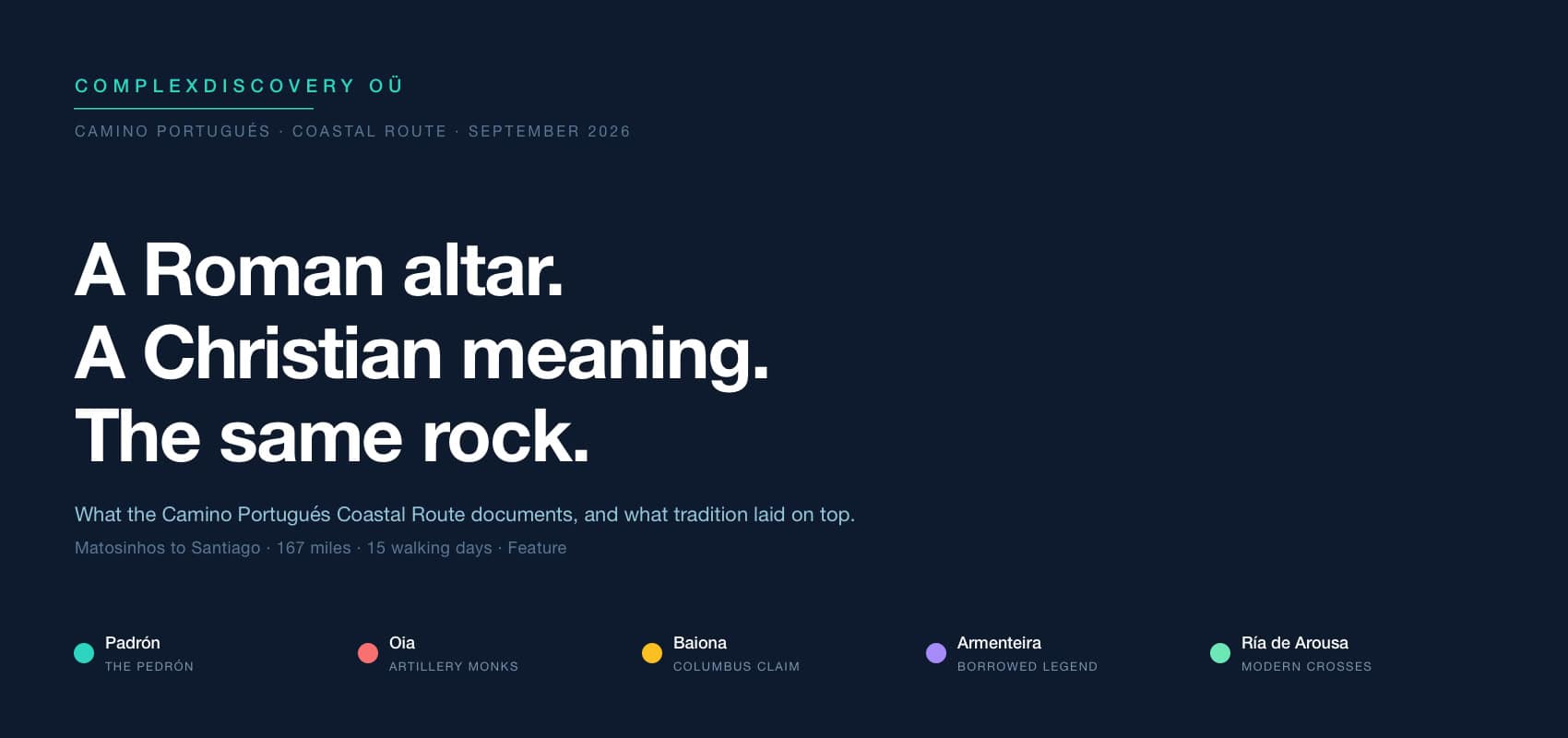
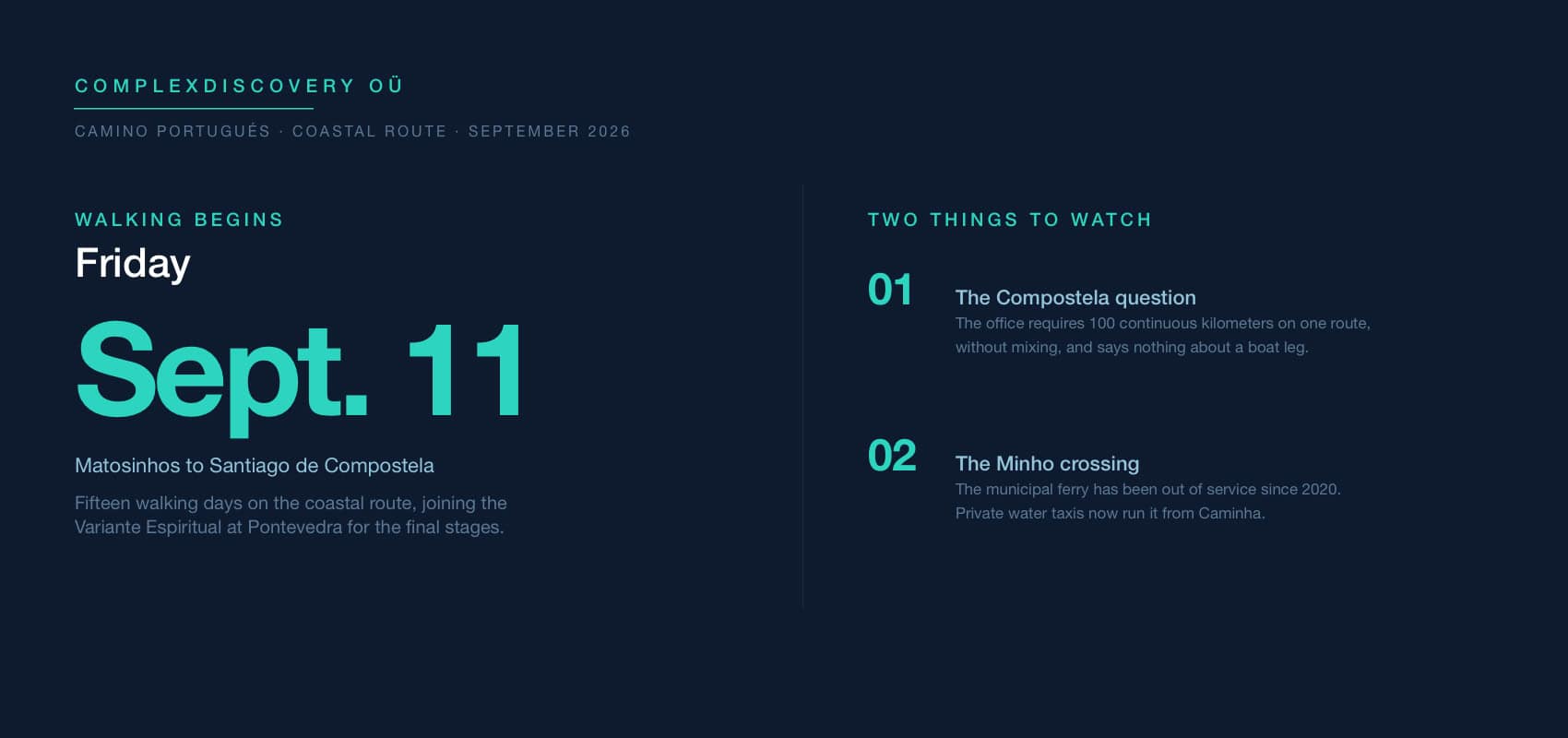
Members of the ComplexDiscovery OÜ team will walk that route in September. They start at Matosinhos, on the Atlantic shoulder of northern Portugal, and finish at the cathedral in Santiago de Compostela roughly 170 miles later, following the coastal route north along the Portuguese shore, crossing the Minho River into Spain by boat, and picking up the Variante Espiritual at Pontevedra for the last stretch through Armenteira and down the Ría de Arousa.
They will have company. The Pilgrim’s Reception Office in Santiago issued 530,987 Compostelas in 2025, the highest annual figure in its records. The Camino Francés accounted for 242,040 of them, and the two Portuguese routes for about 190,300, of which the Portuguese Coastal Way carried 89,512, against roughly 43,000 for both Portuguese routes together a decade earlier.
Those numbers warrant reading carefully, in two ways. They are certificates rather than traffic: they count people who asked for one, leave out everyone who did not, and include cyclists, who qualify at 200 kilometers. And they move. The office keeps purging records after a year closes, so its own live panel summed to 530,844 across nine routes when it was read on Aug. 25, 2026, against the 530,987 announced that January, and the route figures above come from a reading taken Sept. 2. They reach this article through santiago.es, an unofficial independent guide to the city that relays the panel, with American Pilgrims on the Camino publishing its own reading of the same source.
What the coast gives, and what it withholds
Geography sets the character of this route before any of its history does. The Senda Litoral runs on boardwalks and sand for long stretches out of Matosinhos, exposed to Atlantic wind with almost no shade, and it trades the shelter and the Romanesque churches of the inland Camino Central for open ocean on the left shoulder. Walkers pay for the views in heat and glare.
The route also crosses a national border by water. From Caminha, private water taxis carry walkers over the mouth of the Minho to A Pasaxe, a landing a few kilometers south of A Guarda itself. The municipal ferry that once ran the crossing has been out of service since 2020, when pandemic border restrictions stopped it; A Guarda’s tourism office dates the halt to October 2021, which is consistent with a brief return in between. Its future is unsettled rather than closed. Caminha’s mayor, Rui Lages, said in July 2025 that the vessel had gone to a shipyard for assessment and that the council intended to repair it if that proved viable, and Caminha said in December 2025 that it wanted the link restored. Galician regional press reported in May 2026 that the boat would not return. Anyone walking this stage should check what is actually running. Then the terrain changes with the flag: Galicia arrives as granite, eucalyptus and the drowned river valleys the Spanish call rías, which the path then traces inland toward Vigo and Pontevedra.
One correction is worth making early, because it appears constantly in travel writing about this coast. The Roman Via XIX, the road of the Antonine Itinerary that ran from Bracara Augusta to Asturica Augusta, did not follow the shoreline. It went inland through Ponte de Lima and crossed the Minho at Tui, which is the corridor the Camino Central approximates. Coastal walkers spend most of the way clear of it and then join its line in Galicia: milestones from the road have been recovered at Ponte Sampaio and around Pontevedra, both of them stages on the coastal way. Which Roman town stood exactly where is still argued over. The milestones are not.
A second correction travels with the first: the Camino Portugués carries no UNESCO World Heritage listing. The inscription made in 1993 and extended in 2015 covers the Camino Francés and four routes across northern Spain, one of which UNESCO calls the Coastal Route, meaning the Camino del Norte along the Bay of Biscay rather than anything Portuguese. Its description names no Portuguese route at all. A separate listing from 1998, Routes of Santiago de Compostela in France, covers four routes departing from Paris, Vézelay, Le Puy and Arles; Santiago’s old town has been inscribed in its own right since 1985. The Portuguese routes, coastal and central alike, appear on none of them.
The layers under the boardwalk
Iron Age hillforts sit above the path at intervals the whole way north. At Matosinhos, the Castro do Monte Castêlo was occupied from the start of the first millennium BC, when the Leça River was navigable to the foot of the hill; the amphorae recovered there indicate regular trade with southern Iberia from the second century BC. At Esposende, the Castro de São Lourenço passed through the Late Bronze Age, the Iron Age, Roman rule and a medieval reoccupation, and was probably transformed into a vicus after the first century A.D., in the tentative wording of Portugal’s national archaeological register. Above Viana do Castelo, the Citânia de Santa Luzia commands the Lima estuary; roughly a third of it has been exposed, and a sizable part of the original area was lost to the hotel built on the summit and its access roads.
Across the Minho, the castro on Monte Santa Trega above A Guarda has a chronology that is easy to misread as a dispute. A Guarda’s municipal tourism office describes documented origins from the fourth century BC. The Xunta de Galicia’s museum service puts the settlement’s greatest period between the first century BC and the first century AD, in wording that marks that span as the peak rather than the whole. Those describe when occupation began and when it flourished, which is one sequence rather than two competing claims. The population figure that circulates, 3,000 to 5,000, is an estimate: only a small share of the site has been excavated, and the municipality notes that even its measurements of the enclosure are not firmly confirmed.
Roman administration left the route its most consequential inheritance at Iria Flavia, beside Padrón, which walkers reach in the final days. The town took its honorific from the Flavian dynasty and appears as a stop on the Via XIX, the road the coastal route has been shadowing since Pontevedra. It held a bishop’s seat from at least 561, when a bishop named Andrés attended the First Council of Braga. The see moved to Compostela in 1095, and everything the modern pilgrim walks toward grew from that transfer.
A quieter fact ties four of the route’s landmarks together. The monasteries at Oia and Armenteira, the basilica of Santa María a Maior in Pontevedra and the castro on Santa Trega were all protected on the same day, by a Spanish decree of June 3, 1931. That decree names no total. Its first article runs province by province through hundreds of buildings and ruins in continuous prose, folding several structures into a single entry wherever they share a town, and its second article then adds every palace and garden of the former Crown patrimony without listing any of them. Their shared status records a sweep of Second Republic heritage policy, not a judgment reached about each site on its merits.
Buildings that remember being attacked
The monastery of Santa María de Oia stands directly on the Atlantic, close enough that surf breaks against the ground its walls occupy, and it describes itself as the only monastery of the Cistercian order sited by the sea. Those walls carried guns. On April 20, 1624, the monastery’s shore battery engaged five corsair vessels that were pursuing merchant ships, and the exchange ran about three hours. The account survives as a printed news pamphlet by Andrés de Almansa y Mendoza, cataloged among the relaciones de sucesos held by the library of the Universidad de Sevilla, whose title opens by calling the episode a victory won by the monks of the monastery of Our Lady of Oia. The monks earned a nickname that stuck: the monjes artilleros. Casualty numbers in that pamphlet belong to a news genre prone to inflation and read better as a contemporary claim than as a count, though the engagement itself is documented, and Philip IV afterward gave the house the title Santa María la Real de Oia and confirmed its standing as a royal and imperial monastery.
Oia’s own founding date resists the same certainty. A privilege of Alfonso VII dated 1137 is the earliest notice, and scholars have long doubted that it is genuine; Carmen Manso Porto, writing in the Cuadernos de Estudios Gallegos, records the doubt while observing that even a forgery would suggest monks were at Oia by then. A document of 1149 has monks there under the Benedictine rule, and the monastery’s own history begins at that date and calls it the first reliable one. Incorporation into the Cistercian order in 1185 rests on a 17th-century annalist rather than a surviving charter. Three dates circulate, and the honest version says so.
Farther south, the sanctuary crowning Monte de Santa Luzia above Viana do Castelo appears as a basilica in guidebooks that predate its right to the word. Its formal name is the Sanctuary of the Sacred Heart of Jesus. Construction began in 1904 to a design by Miguel Ventura Terra, the exterior was finished at the end of 1943 and the interior in 1959. The Vatican’s Dicastery for Divine Worship and the Discipline of the Sacraments, under its prefect, Cardinal Arthur Roche, granted the rank of minor basilica by decree dated June 27, 2025, announced to the diocese that August. A 20th-century building took a 2025 honor while standing on top of an Iron Age settlement.
Baiona offers the route’s most instructive complication. The town holds that the caravel Pinta reached its harbor in 1493 carrying the first news of Columbus’s crossing to reach Europe, and a plaque installed in 1928 dates the arrival to March 1. Begoña Fernández Rodríguez, an art historian at the Universidad de Santiago de Compostela, examined the claim in the heritage journal e-rph in 2013 and found the date unsettled between Feb. 28 and March 1, because the news left so faint a trace in contemporary documents that the question cannot be closed from them. Her wider argument is that the arrival went largely unremarked until the 19th century, and that Baiona’s identification with it was assembled afterward through monuments and urban renewal.
Spain’s own national archive supports the event and confirms the gap in the same breath. The Archivo Histórico de la Nobleza, describing a letter from King João II of Portugal to Ferdinand of Aragon found among the papers of the counts of Villagonzalo, states that Martín Alonso Pinzón reached Baiona some days before Columbus made Lisbon and did report the existence of land beyond the Atlantic to the Catholic Monarchs. It then adds that no testimony of that report survives. The absence is precisely why the archive treats João II’s letter, dated May 3, 1493, as probably the first official document attesting Columbus’s return. Baiona’s replica of the Pinta was built for the 1992 quincentenary, its shipboard museum opened in 1999 and the Festa da Arribada dates from 1996. The festival is 30 years old; the arrival it commemorates is five centuries old, still not firmly dated, and known only at second hand, since what the archive says is missing is any surviving testimony of the report Pinzón made to the monarchs.
How recent the spiritual variant is
The Variante Espiritual, which the group joins at Pontevedra, is younger than most of the people who walk it. Tino Lores, president of the Asociación de Amigos del Camino Portugués, developed the itinerary with public managers in O Salnés around 2011 and 2012, linking the monasteries of Poio and Armenteira to the boat route up the Ría de Arousa. Lores has been quoted describing the route as an invention while defending its grounding in the Translatio tradition and in the recorded travels of Padre Sarmiento.
Its legal standing is harder to state than that suggests. Galicia’s cultural heritage law, Ley 5/2016, carries two additional provisions bearing on this ground: one headed Ruta Xacobea do Mar de Arousa e Río Ulla, the maritime route the variant borrows for its final leg, and one on protection of the Camino Portugués. So the water is named in statute, and the main Portuguese route is named in statute, while no decree delimiting the land itinerary branded Variante Espiritual was located. A section of its first stage, through Poio, holds a 2023 Sendeiro Azul environmental award, and the route is listed by the Galician federation of Camino associations.
Armenteira itself carries the route’s best story about stories. Tradition places the monastery’s founding in 1150 under San Ero, a knight of Alfonso VII who is said to have stepped into the woods to listen to a bird and returned to find that centuries had passed in what he took for an hour. The monastery’s own website records the tradition and then notes, without prompting, that the same legend is repeated at numerous medieval monasteries. The house first appears in Cistercian documentation in 1162, which is the date its own historians start from. Even the monk’s identity is an attachment rather than a given. Cantiga 103 of the songbook compiled under Alfonso X in the 13th century tells of a monk who listens to a bird for what he takes to be a short while; its rubric fixes the elapsed span at “trezentos anos,” or 300 years, and it names neither the man nor his monastery. Armenteira’s tradition supplies both, and the monastery’s own page, citing that Cantiga as its source, puts the figure at 200. Cistercian nuns from the monastery of Alloz, in Navarra, restored religious life in the house and remain there.
The boat leg from Vilanova de Arousa to Pontecesures passes 17 stone crosses set in the ría and along the banks of the Ulla, which route operators describe as the only maritime via crucis of its kind. The formulation appears on boat-operator and route-promotion sites; searches of Galician museum, university and Xunta heritage pages turned up no institution making it. The crosses themselves are not ancient. They were erected largely in the 1960s on the initiative of one man, José Luis Sánchez-Agustino, and they look, from the water, as though they have always been there.
Walkers joining the variant should read the Compostela rules closely, because they are stricter than the familiar summary of them. The Pilgrim’s Reception Office requires 100 continuous kilometers on foot toward Santiago on a single one of the routes it recognizes, in its own words without alternating or mixing routes, with the last stage at least the one immediately before arrival. Pilgrims who begin outside Spain must cover at least 70 of those kilometers inside Spanish territory. The alternative, for pilgrimage under sail, is 100 nautical miles navigated, followed by the rest on foot. The crossing of the ría is neither 100 nautical miles nor a walked stage, and the published rules do not address a boat leg inside a walking itinerary at all. What that combination means for this particular route is a question only the office can settle, and nothing it has published settles it.
Why the sorting matters after the walk
None of this makes the route less moving, and the sorting is not a modern conceit. Ambrosio de Morales looked at the stone at Padrón in 1572 and called it a Roman pedestal. Fray Martín Sarmiento looked at it in 1745 and called it a Roman milestone. Both set the tradition aside, and the tradition went on without them. The stone is worn smooth because generations of people believed something about it, and the wider belief it belongs to, that the apostle’s tomb lay at Compostela, built a cathedral, drew pilgrim roads across medieval Europe, and last year ended in over half a million certificates issued by that cathedral’s own office. The devotion is itself a matter of record, whatever the record holds about the story underneath it. What the walk offers, over 15 days and roughly 167 miles, is the unhurried time to notice which is which, and to find that the noticing costs the experience nothing.
That habit transfers. Professionals who spend their working lives with records, evidence and disclosure obligations know the failure mode intimately: a claim repeated confidently enough starts to function as a finding, a promotional formulation hardens into an established fact, and nobody asks who first said it. The discipline of separating what a document establishes from what tradition has attached to it is the same discipline on a Galician headland and in a production review. So is the willingness to say plainly that a date is contested, or that a search came up empty, rather than reaching for the version that reads better.
Long walks are good at this because they remove the incentive to hurry. Two weeks of granite, eucalyptus and Atlantic wind will not make anyone a better fact-checker on its own. What they do provide is a stretch of time in which the difference between believing something and having checked it becomes obvious, uncomfortable, and easier to carry back.
What claim in your own professional practice have you been repeating because it is widely repeated, rather than because you have gone back to the record and confirmed it?
News Sources
- Routes of Santiago de Compostela: Camino Francés and Routes of Northern Spain (UNESCO World Heritage Centre)
- Santiago de Compostela (Old Town) (UNESCO World Heritage Centre)
- La Compostela (Oficina de Acogida al Peregrino, Catedral de Santiago)
- Primer documento sobre la vuelta de Cristobal Colón de América (Archivo Histórico de la Nobleza, Ministerio de Cultura)
- Pedrón (Xacopedia)
- Iria Flavia (Xacopedia)
- Leyenda, historia y arte (Monasterio de Santa María de Armenteira)
- La leyenda de la Translatio (Museo das Peregrinacións e de Santiago, Xunta de Galicia)
- La creación de una identidad patrimonial. Baiona y el descubrimiento de América (e-rph, Universidad de Granada)
- Viana do Castelo: Vaticano atribuiu o título de basílica menor ao Santuário do Sagrado Coração de Jesus (Agência ECCLESIA)
- Cantigas de Santa María: 103 (Wikisource)
- Cuántos peregrinos llegan a Santiago: datos 2025 y 2026 (santiago.es, unofficial independent guide)
- Statistics for the Camino de Santiago, 2025 Edition (American Pilgrims on the Camino)
- Catálogo de relaciones de sucesos en la Biblioteca de la Universidad de Sevilla (Universidad de Sevilla)
- El Camino Portugués crece un 341 por ciento en una década (Diario de Pontevedra)
- Cantiga 103, Cantigas de Santa María database (University of Oxford)
- Ley 5/2016, de 4 de mayo, del patrimonio cultural de Galicia (Boletín Oficial del Estado)
- El monasterio de Santa María la Real de Oia. Estudio histórico-artístico (Carmen Manso Porto, Cuadernos de Estudios Gallegos)
- Cómo llegar en barco a A Guarda (Turismo de A Guarda)
- Caminha ultima o barco para retomar a linha (Atlántico)
- Routes of Santiago de Compostela in France (UNESCO World Heritage Centre)





Assisted by GAI and LLM Technologies
Additional reading
- Nine months across Europe’s tech-sovereignty arc, from Tallinn to London
- One hexagon, three industries, two feet: a brand lesson in sneakers
- When the agent becomes a witness: an Oxford-style tutorial on AI evidence, accountability and discovery
- An Oxford tutorial for newsroom leaders who must learn faster than the news
- An Oxford tutorial for cybersecurity, governance and eDiscovery
- The Planning Paradox: an Oxford-style tutorial tests why business plans fail
Source: ComplexDiscovery OÜ
ComplexDiscovery’s mission is to enable clarity for complex decisions by providing independent, data‑driven reporting, research, and commentary that make digital risk, legal technology, and regulatory change more legible for practitioners, policymakers, and business leaders.