Editor’s Note: A court of last resort struck an institutional litigant’s brief this month over four citations that did not exist. Its most quotable line, that “every firm attorney who signed the brief bears some responsibility,” is real. Senior Judge Stephen H. Glickman wrote separately to urge a narrower reading, and to argue that existing rules appear to leave the court little beyond a published admonishment and the strike itself. Rule 38 in the District reaches frivolous appeals, but not briefs; its Rule 46 covers only bar admission, and inherent authority needs a bad-faith finding this record would not support.
Practitioners who stop at that line will miss the qualification, and that gap is where compliance effort can get misdirected. Anyone building AI governance for a regulated function should read what the order leaves unanswered: who reviewed the brief, and how the drafter was trained and supervised.
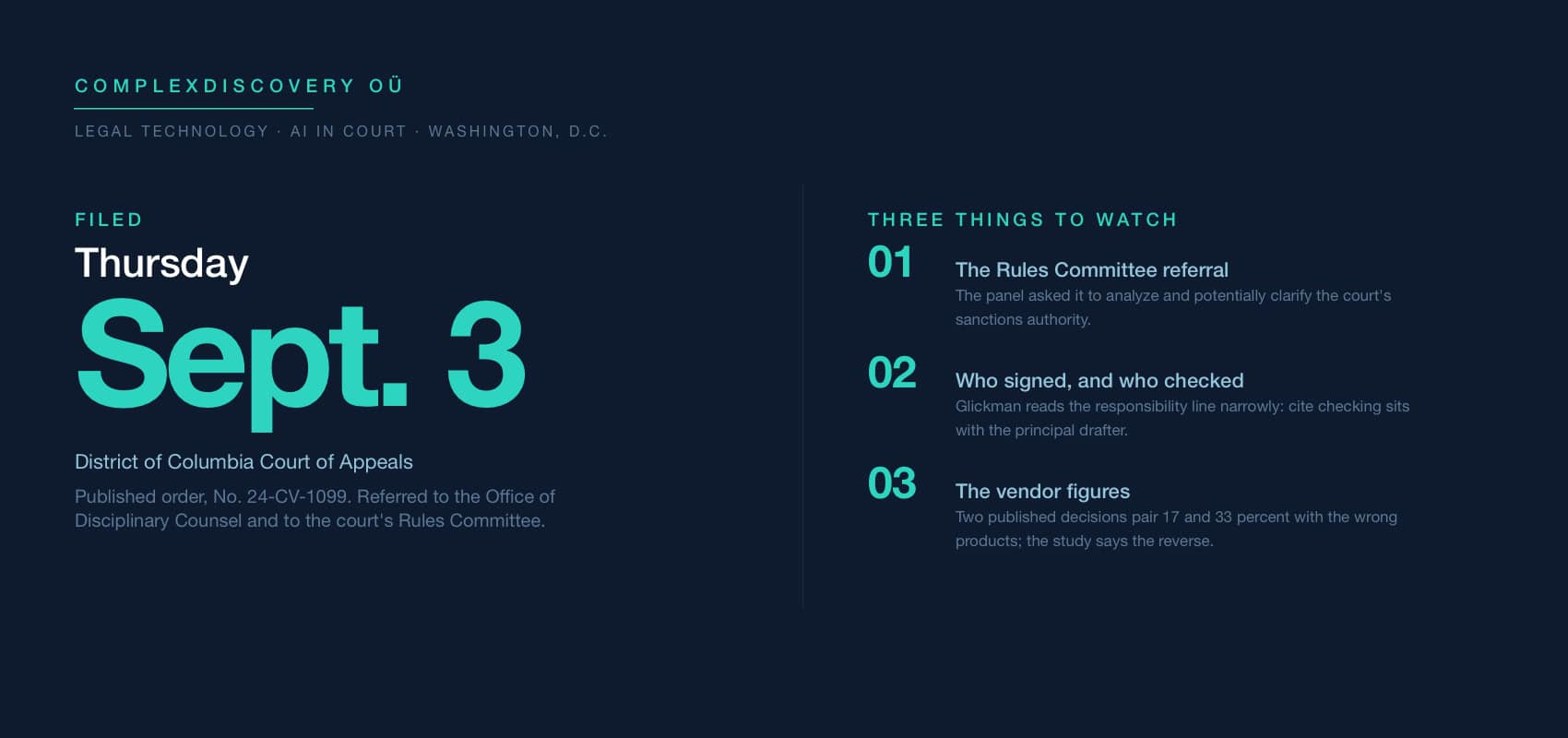
Two things to carry. The panel called the full scope of its sanctions authority unclear and sent the question to its Rules Committee, where the answer will come from. And the vendor hallucination figures the order quotes, now in two published decisions, assign the numbers to the wrong products; the Stanford study says the reverse.
Content Assessment: D.C.'s highest court struck a brief over four fake citations and called its own sanctions authority unclear
Information - 94%
Insight - 93%
Relevance - 93%
Objectivity - 93%
Authority - 92%
93%
Excellent
A short percentage-based assessment of the qualitative benefit expressed as a percentage of positive reception of the recent article from ComplexDiscovery OÜ titled, "D.C.'s highest court struck a brief over four fake citations and called its own sanctions authority unclear."
News Analysis – Artificial Intelligence Beat
D.C.’s highest court struck a brief over four fake citations and called its own sanctions authority unclear
ComplexDiscovery OÜ Staff
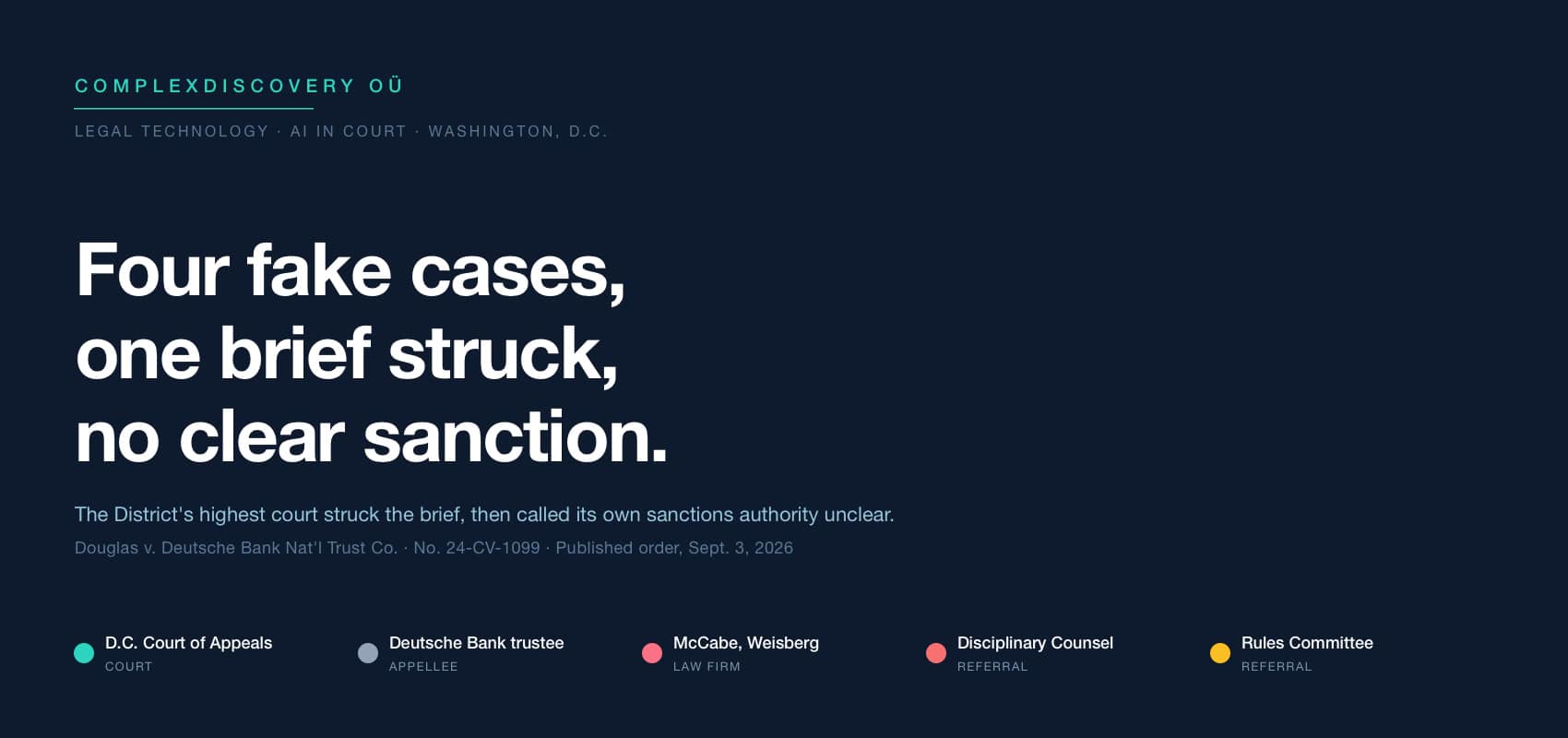
The District of Columbia Court of Appeals struck a Deutsche Bank trustee’s brief on Sept. 3 after four cited cases turned out not to exist. The harder question took the rest of the order: how much more this court can actually do.
The order’s most quotable line, that “every firm attorney who signed the brief bears some responsibility,” is real, and it comes from the District’s local court of last resort, not the federal D.C. Circuit. One judge on that panel immediately urged a narrower reading of it, at length, in the same document.
Four cases that did not exist
The appeal was ordinary. Barry Douglas, who is self-represented, challenged a Superior Court order granting judgment on the pleadings to Deutsche Bank National Trust Company, which sued as trustee for a 2006 mortgage securitization trust in a judicial foreclosure action.
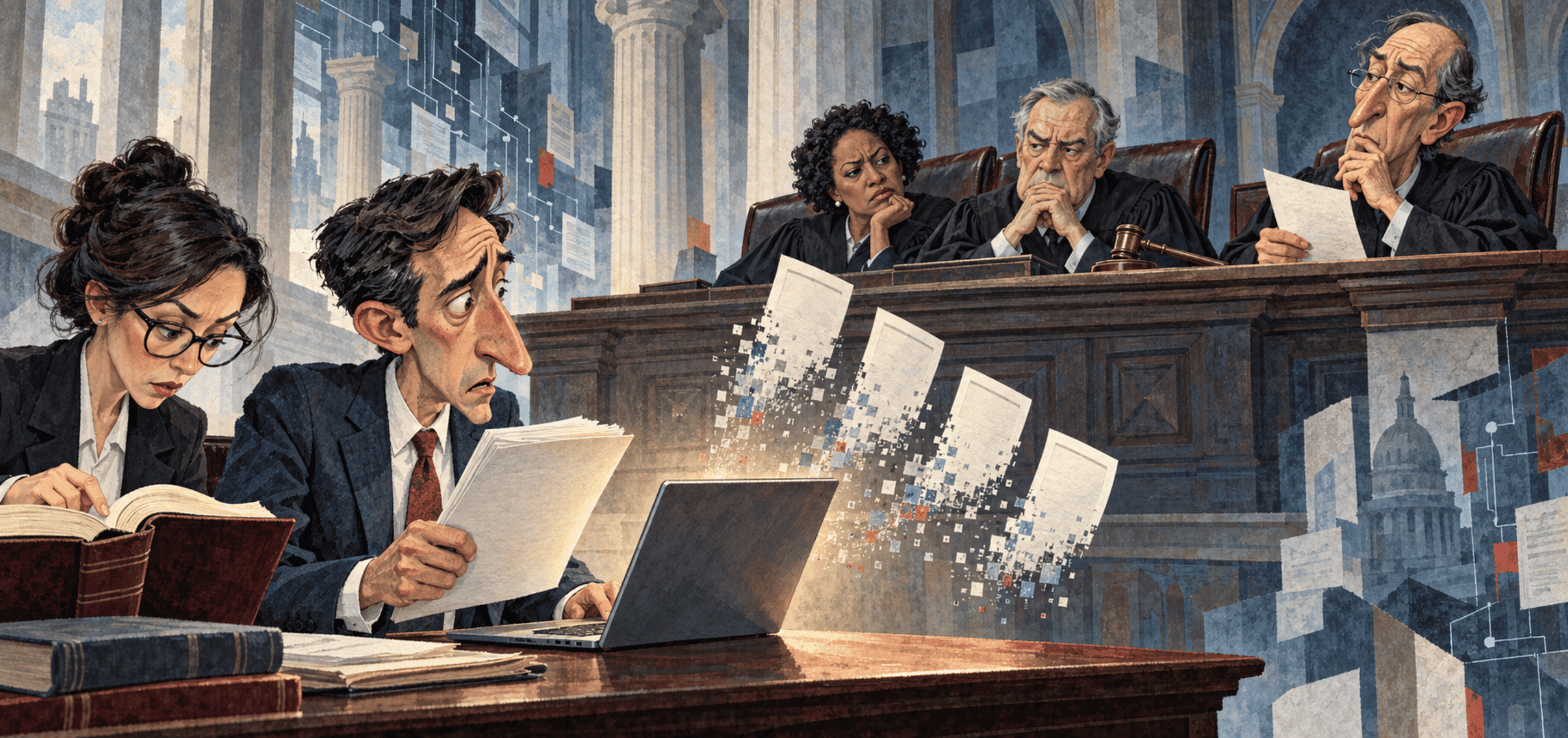
Reviewing the appellee’s brief, the panel could not locate several of the cases it cited, and on June 22 it ordered the bank to show cause why the brief should not be stricken for citing nonexistent cases possibly produced by AI hallucinations. Loishirl W. Hall, an attorney at McCabe, Weisberg & Conway LLC when the brief was filed, answered the next day in her own capacity. She confirmed that four of the brief’s authorities did not exist, said she had “used Google’s generative artificial intelligence search tool to assist in locating case authority,” and acknowledged that she never verified what it returned. She had also told the court this was the first appellate brief she ever filed.
The fabrications were Abadie v. District of Columbia, Cason v. Nat’l Consumer Co-op Bank, Osborne v. District of Columbia and Woods v. United States. The panel named them but withheld the full citations, saying it did so to avoid memorializing them.
The firm’s separate response drew the sharpest language. It said it had been “unaware” of Hall’s actions when the brief was filed, and that it “only became fully aware of the situation” once the show-cause order issued. The panel called that implication “surprising, to say the least.” Jianna Jaquez Santos and Michael T. Cantrell were listed on the brief alongside Hall, and about their review the firm said nothing at all. On supervision, it acknowledged only that “further review should have been undertaken.”
One detail there should stop any compliance officer. The firm told the court it maintains a policy barring employees from using AI to draft legal documents, and that all employees are made aware of it in initial and annual training. It did not attach the policy, and Glickman noted separately that the firm never explained how that policy reached its lawyers. A control the court never sees is a control the court cannot weigh.
Then the firm proposed a fix, and the fix is why this order reaches past its own docket. It asked the court to keep the brief on file with the bad citations redacted. The panel rejected that in a footnote as “effectively no sanction at all,” struck the brief in its entirety, and referred the matter to the Office of Disciplinary Counsel. That referral carries no finding of misconduct, because the panel expressly declined to decide whether any ethical rule was broken.
How Glickman reads attorney responsibility
Senior Judge Stephen H. Glickman joined that order and then wrote separately, and his concurrence is where the supervision story gets complicated. He accepted the principle that every signing attorney bears some responsibility, and declined to read it as a rule that each one must personally check every citation.
“If the quoted statement is understood to mean that every signatory on any brief with multiple signatories must personally check every citation in the brief for accuracy, I demur,” Glickman wrote. The term signatory may be misleading, he added, because appellate briefs list many attorneys and ordinarily only one of them signs.
His alternative divides the labor rather than duplicating it. Each associate owns the citations in the section that associate drafted, and cite checking belongs in general to the principal drafter. His example is the government’s own filing: a criminal appellate brief lists the trial prosecutors, the section chief and the U.S. attorney, none of whom can realistically cite check every brief carrying their names.
Eugene Volokh, the Gary T. Schwartz Distinguished Professor of Law Emeritus at UCLA and the Thomas M. Siebel Senior Fellow at the Hoover Institution, flagged the concurrence the next day and found it persuasive, while noting that other judges may disagree and that lawyers should not feel safe merely because someone else drafted the offending passage. Still, “the judge’s point that it’s not reasonable to expect every signing lawyer to personally check each citation seems sound to me.”
The internal record worth keeping is therefore narrower than the headline suggests, and more specific: who drafted which section, who verified the citations inside it, and how the firm trained and supervised that drafter. No rule requires it. But Glickman added that supervisory lawyers may be accountable “if training and oversight have been neglected,” and this firm described a policy the court never saw.
One sanction imposed, and an authority left unclear
The concurrence opens on the question the panel left in a footnote, and for anyone tracking sanctions risk it is the buried lede. This is, Glickman wrote, “the first reported case in which this court has received a brief containing fabricated citations,” and the court had never before mapped its authority to punish one.
What he found is a thin bench. Striking the brief under Appellate Rule 28 was “an appropriate but comparatively weak response that unfortunately penalizes the innocent client for its counsel’s offense.” D.C. Appellate Rule 38 authorizes sanctions for frivolous appeals, petitions and motions, but not briefs, and none of the court’s previous 21 cases citing Rule 38 has applied it to sanction a frivolous brief. Rule 46 in the District covers only bar admission, unlike the federal Rule 46(c) the Fifth Circuit used in Fletcher v. Experian and the Seventh Circuit in Perez-Castillo v. Blanche to discipline counsel. Superior Court Civil Rule 11 reaches this conduct but does not govern appeals.
That leaves inherent authority, which under Chambers v. NASCO requires a finding of bad faith, and that door closed on the facts. Neither Hall nor the firm appeared to have acted in bad faith on the existing record, Glickman wrote, and their conduct was “only negligent or grossly negligent,” a state of mind the court’s precedent keeps distinct from bad faith. Recklessness was a closer question for Hall, but the record needed to support that finding was never made.
The panel’s own answer was procedural and easy to miss. In a footnote, it called the full scope of its sanctions authority unclear and sent the question to the court’s Rules Committee “for analysis and potential clarification.” Watch that referral. Glickman named the two models already in view: a rule like Superior Court Civil Rule 11, which reaches unwarranted claims without any bad-faith finding, and a counterpart to federal Rule 46(c), which lets a federal appeals court discipline an attorney for conduct unbecoming a member of the bar.
What firms can do before the brief goes out
Glickman’s prescription is narrower than the compliance apparatus the headline implies. Ban lawyers from asking AI to draft a brief from scratch, which he suspects is where the errors start, then train on permitted use, adopt a written policy, and require attorneys to confirm they followed it. Cite checking itself stays with the principal drafter in his account. What can move is the optional second pass: “vetting” of citations and case descriptions “may be done cost-effectively by a trained paralegal.” Piling on beyond that he rules out, since “triple and quadruple checking by other attorneys (whether they are signatories on the brief or not) is uncalled for and would be unduly burdensome and costly.”
Because the panel called redaction effectively no sanction, the defensible workflow is verification before filing rather than cleanup afterward. A vendor category has grown up around that job, and The Daily Record surveyed it in late August, a week before this order landed. Jackie Schafer, a former Paul, Weiss litigation associate who founded Clearbrief in 2020, told the paper the fake-case framing is too narrow, because “briefs often contain hundreds of citations, and generative AI can do subtle things like alter specific numbers in a citation that are extremely challenging to spot.” Her sharper point: “It’s making up facts, not just the law.” Tom Martin, who created CiteCheck AI, set the limit on the category: “This is ultimately a human problem, not an AI problem.” Both sell verification tools, and their reading of the market should be weighed with that in mind.
A vendor statistic that arrived reversed
Glickman’s third section carries the number that will end up in procurement decks, and it needs a correction before it gets there. Quoting the Ninth Circuit’s June decision in Malkeet Lnu v. Blanche, he reports that the legal-specific generative AI tools from Westlaw and Lexis hallucinated on 17 percent and 33 percent of answers, in that order, across a representative set of queries run in 2024.
The underlying source is the preregistered, Stanford-led study by Varun Magesh and five co-authors, published in the Journal of Empirical Legal Studies in 2025, and it assigns those figures the other way around. The study reports Lexis+ AI as the best performer of the three legal research tools tested, accurate on 65 percent of queries. Westlaw’s AI-Assisted Research was accurate 41 to 42 percent of the time and hallucinated in about one-third of its responses, which the authors call nearly twice as often as the other legal tools they tested.
The arithmetic runs in only one direction, which is how the error shows itself. A tool hallucinating 33 percent against a 17 percent field is failing nearly twice as often; at 17 percent against 33 it is failing roughly half as often, and the study’s own sentence about Westlaw would then be false. The pairing appears in the Ninth Circuit’s decision and reaches the District’s published order unchanged. Anyone citing these figures to a court, a client or a procurement committee should cite the study rather than either opinion, should note that its band spans three products rather than two, and should say that the measurements describe the versions tested in 2024.
Glickman’s own point survives the mix-up, and it is the one worth carrying. Fabrications are the visible failure. “Inaccuracies,” real citations that do not support the proposition, may prove the more dangerous failure, because they are likelier to survive the facial check that catches a fake case and often surrender only to close reading of the authority itself. A checker that confirms a case exists does not touch that problem, and a comparable asymmetry appears in AI-assisted document review, where the tool returns a real document and mischaracterizes what it says.
One more detail belongs in the record, because it makes the order’s own argument. The per curiam places Amarsingh v. Frontier Airlines in the Eleventh Circuit, while Glickman’s footnote puts it in the Tenth, and the Tenth Circuit’s docket lists it as filed there on Feb. 9.
The panel has told the District’s bar that the full scope of its sanctions authority is unclear, and has asked its Rules Committee to analyze it and potentially clarify it. Glickman, writing only for himself, read existing law as allowing little beyond a published admonishment and striking the brief. If a show-cause order arrived at your firm this week and the response had to describe, in writing, who supervised the drafter, what would it say?
News sources
- Douglas v. Deutsche Bank National Trust Co., No. 24-CV-1099 (D.C. Sept. 3, 2026) (published order) (District of Columbia Court of Appeals)
- Malkeet Lnu v. Blanche, No. 24-4790 (9th Cir. June 3, 2026) (U.S. Court of Appeals for the Ninth Circuit)
- Hallucination-Free? Assessing the Reliability of Leading AI Legal Research Tools (Journal of Empirical Legal Studies)
- Lawyers’ Responsibility for Hallucinations in Briefs That They Sign (The Volokh Conspiracy)
- DC appeals court blames Deutsche Bank lawyers for AI hallucinations (ABA Journal)
- New legal tech tools aim to help lawyers avoid AI hallucinations (The Daily Record)
- Court of Appeals (District of Columbia Courts)
- Amarsingh v. Frontier Airlines, No. 24-1391 (docket and opinion record) (U.S. Court of Appeals for the Tenth Circuit)

Assisted by GAI and LLM Technologies
Additional reading
- A lawyer fed AI citations to his own regulator, and the tribunal struck him off
- Europe’s draft cloud rule would put vendor ownership in the audit file
- The eight-hour clock starts today: EU e-evidence orders now land on covered U.S. providers’ EU addressees
- California’s AI Transparency Act arrives alongside Europe’s Article 50
- Federal magistrate judge treats LinkedIn’s Relativity aiR workflow as TAR
- One benchmark, three directions: 2026 legal rates rise, flatten and fall at once
- Confidence cools, commitment holds: full results from the 1H 2026 eDiscovery Business Confidence Survey
- Complete look: ComplexDiscovery OÜ’s 2025 to 2030 eDiscovery market size mashup
- The workstream of eDiscovery: Considering processes and tasks
Source: ComplexDiscovery OÜ
ComplexDiscovery’s mission is to enable clarity for complex decisions by providing independent, data‑driven reporting, research, and commentary that make digital risk, legal technology, and regulatory change more understandable for practitioners, policymakers, and business leaders.