

Editor’s Note: Legal rate growth stopped behaving like one number in 2026. LegalVIEW Insights Volume 2026-2, the Wolters Kluwer ELM Solutions benchmarking report published July 27, shows corporate work up 9.9 percent, San Francisco up 17.3 percent and associate rates at Am Law 151 to 200 firms down 10.2 percent, all drawn from the same three months of invoice data. The report’s own conclusion is that broad market averages are becoming less useful as standalone benchmarks.
For cybersecurity, data privacy, regulatory compliance and eDiscovery professionals, the practical stakes sit in the benchmarking method rather than any single figure. Three vendor datasets covering this market give different answers because they measure different cohorts with different rate definitions, and a department comparing itself against one blended number is measuring against a portfolio that does not exist.
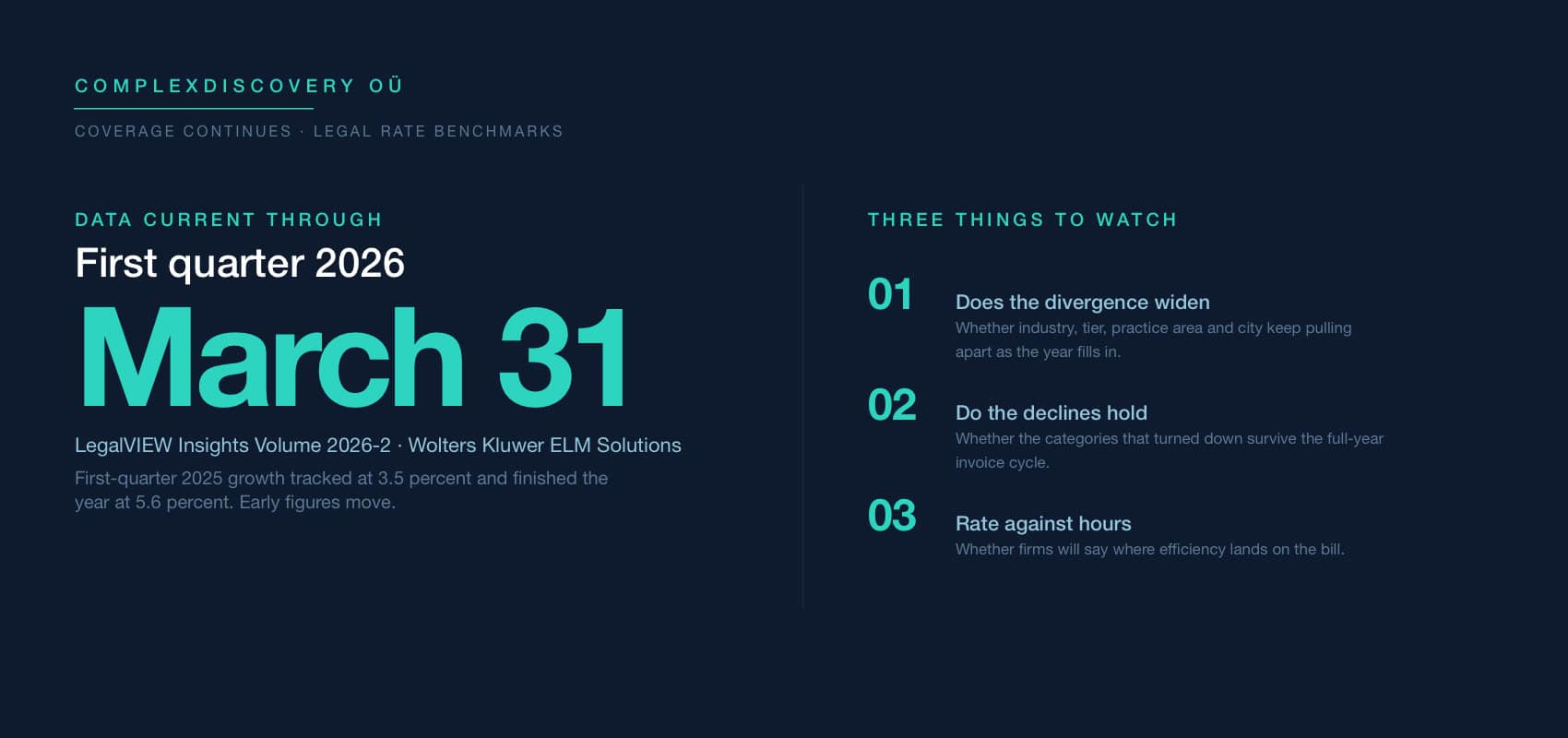
Watch three things as the 2026 dataset matures: whether the divergence widens, whether the categories that turned down survive the full-year invoice cycle, and whether outside counsel will say in writing where efficiency lands on the bill.
Content Assessment: One benchmark, three directions: 2026 legal rates rise, flatten and fall at once
Information - 93%
Insight - 92%
Relevance - 90%
Objectivity - 90%
Authority - 92%
91%
Excellent
A short percentage-based assessment of the qualitative benefit expressed as a percentage of positive reception of the recent article from ComplexDiscovery OÜ titled, "One benchmark, three directions: 2026 legal rates rise, flatten and fall at once."
Industry News – Artificial Intelligence Beat
One benchmark, three directions: 2026 legal rates rise, flatten and fall at once
ComplexDiscovery OÜ Staff
A single marketwide legal rate average is becoming a poor guide to what any one department pays, and the benchmark making that case shows rates rising, flattening and falling at once.
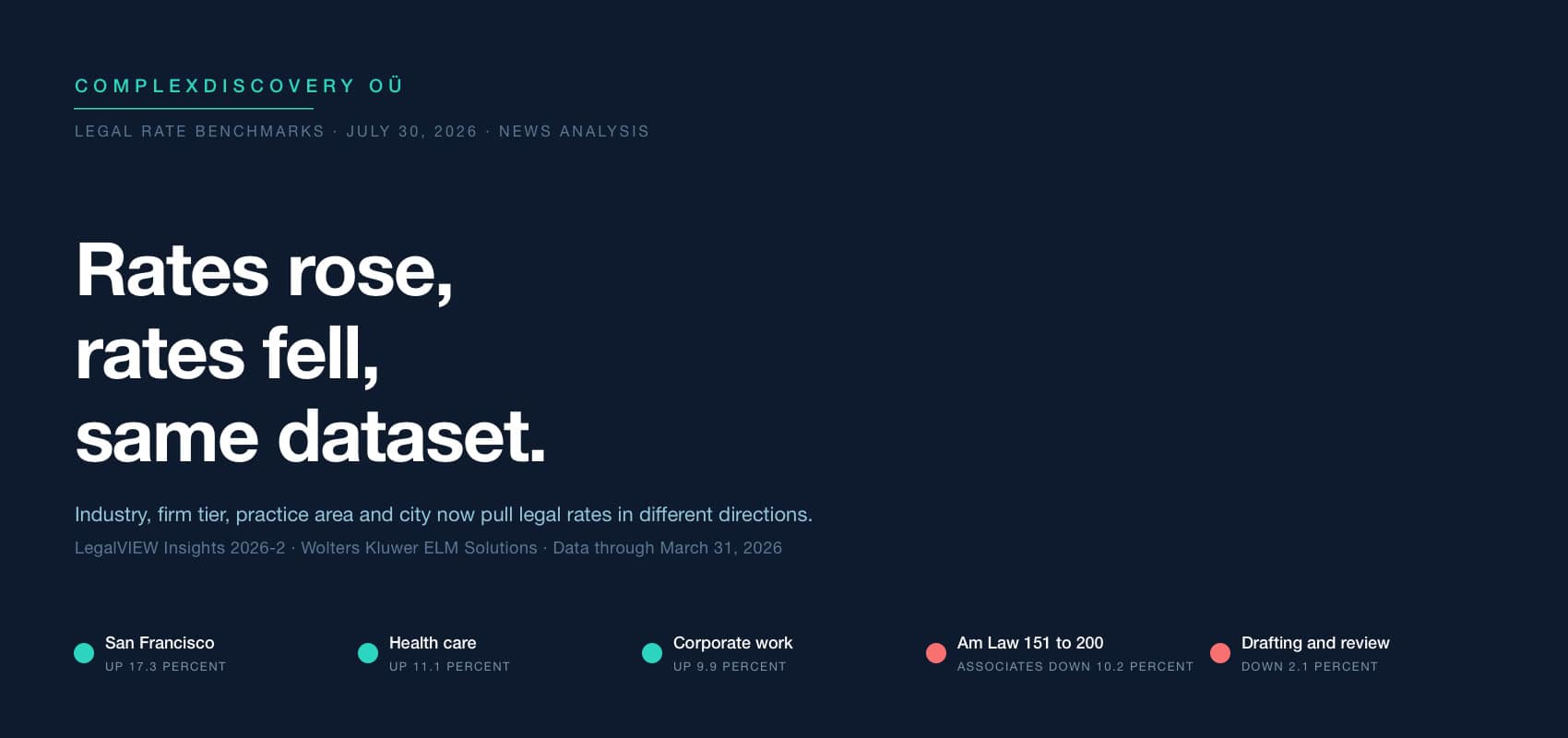
Corporate work is up 9.9 percent. San Francisco is up 17.3 percent. Associate rates at Am Law 151 to 200 firms are down 10.2 percent. All three figures come from the same dataset, covering the same three months.
Wolters Kluwer ELM Solutions published the figures July 27 in LegalVIEW Insights Volume 2026-2, the second edition of its rate benchmarking series this year. Its own conclusion is that broad market averages are becoming less useful as standalone benchmarks, and that industry, firm tier, practice area and geography now shape legal costs enough that comparison requires more precision than most departments apply. The associate decline is the sharpest decrease in the set: rates at Am Law 151 to 200 firms fell from an average of $434 an hour to $390, a drop the report associates most with corporate work and real estate.
The analysis is vendor research, and buyers should weigh it accordingly. Wolters Kluwer sells enterprise legal spend management software, and the LegalVIEW database behind the report holds over $230 billion in invoices drawn from the company’s own medium-size and enterprise clients. The methodology measures rates by the date legal services were provided rather than the billing date, holds sample size and client composition constant across periods, and excludes insurance defense data unless otherwise specified. Data is current as of March 31, 2026. Two terms recur below. A blended rate combines rates across timekeeper levels, partners and associates included, so it can shift with timekeeper mix as well as with prices. A third-quartile rate is the level a quarter of billings exceed, which reads as the ceiling a client faces rather than the typical charge.
Where rates kept climbing
The climbing side of the ledger is where most of the market still sits. Manufacturing led all industries in 2025 with a reported 12.2 percent average rate increase. Its average blended timekeeper rate reached $765 and its third-quartile partner rate reached $1,340, the highest of any industry in the dataset. Manufacturing associates crossed a threshold no other industry reached, hitting $1,020 at the third quartile. Consumer services posted an 11.5 percent increase on top of 16.1 percent in 2024. Its blended rate reached $797 in 2025, up from $616 in 2023, and it displaced the financial industry as the most expensive sector in which to buy legal work, according to the LegalVIEW data.
Both are moderating in 2026, consumer services to 6.8 percent and manufacturing to 8.6 percent year-to-date. The acceleration moved elsewhere. Health care is tracking an 11.1 percent increase against 7.3 percent last year, and technology and telecom 9.5 percent against 6.4 percent. Corporate work stayed the most expensive category of legal service delivery, up 9.9 percent so far in 2026 at a blended $936 an hour, with third-quartile partner rates at $1,469.
Geography told a similar story of divergence. New York City and Washington hold the highest blended rates of any U.S. city in the dataset at $993 and $979, both closing on a $1,000 average, with third-quartile New York partner rates at $1,949. Neither city led growth. San Francisco did, at 17.3 percent through March, followed by Chicago at 13 percent, Philadelphia at 9.8 percent and Boston at 8.8 percent. Los Angeles went nearly flat at 0.3 percent, a sharp break from its recent history of double-digit movement.
The categories that turned down
Against all of that, a handful of categories moved the other way. Regulatory and compliance rates slipped 0.9 percent, which the report ties to a softer enforcement climate in 2025 rather than to technology. Finance and securities blended rates dipped from $837 to $826. Commercial transactions and agreements, along with bankruptcy and collections, also showed slight decreases. The report presents these declines as early signs that rate growth may no longer be universal, which earns them a line item in any midyear budget review.
The associate decline is the movement the report spends most time on, and it offers three candidate causes: turnover at lower-tier firms, client bargaining, and an early pricing effect from generative AI. None can be ruled out from rate data alone, which is why the report ranks none of them. The AI candidate is also narrower than it sounds, since what the report floats is a pricing effect on standardized associate work rather than a broad displacement of lawyers. Wolters Kluwer said it will examine what kinds of matters those associates are billing and whether the work itself is shifting in ways consistent with AI-driven task displacement.
How narrow the AI question is
The most interesting decline is also the smallest. Within information technology work, general drafting and review, a detailed practice area the report associates with generative AI use, showed a 2.1 percent decrease so far in 2026. Set that against the parent category, which is up 14.5 percent over the same period and ranks among the fastest-rising areas in the dataset. The broad category is climbing while one AI-adjacent slice inside it is not.
Jennifer McIver, listed on the report as director of legal operations and industry insights at Wolters Kluwer ELM Solutions, flagged the same variable in December, when the company released its prior volume. McIver said then that rate movement would stay uneven across firm tiers and regions, and that legal teams hoping to hold costs down through 2026 would have to plan for that unevenness and for AI’s growing effect.
Reading the discovery and governance lines
For readers who buy discovery and governance work rather than set firm-wide budgets, the practice-area lines are where this touches the day job. International matters, a category the report ties to cross-border legal work, cleared a blended $1,057 an hour and rose 12.7 percent. The information technology category is up 14.5 percent, but the report does not break out whether data mapping, review-platform, eDiscovery, privacy or incident-response matters sit inside it. These figures give directional context rather than a benchmark for those services. A department renewing outside counsel rates for cross-border review is negotiating inside them anyway.
Why three benchmarks disagree
Neither of the two comparison datasets cited here reports a comparable associate-rate decline, and the two do not report the same finding as each other. Thomson Reuters shows midsize firms losing rate ground relative to the Am Law 100: they grew worked rates 5.3 percent in the first quarter of 2026 while Am Law 100 firms grew 9.8 percent, according to Thomson Reuters Institute analysis of its Law Firm Financial Index published May 26. Thomson Reuters sells research and workflow software to the firms that index measures. The gap widened from a year earlier, when the same comparison stood at 5.9 percent against 9.4 percent. Zoe Miranda, an industry data analyst at the institute, wrote that midsize firms are growing revenue per hour of work at roughly half the pace of their Am Law 100 counterparts, a differential she said compounds over time into a profitability disadvantage.
LexisNexis CounselLink identifies a different pattern, one of concentration rather than tier divergence, with the largest firms capturing a growing share of corporate legal spending. It draws on a separate pool of $75 billion in legal spend across nearly 2 million matters, collected through the e-billing platform its parent company sells, and found average partner rates up 5.1 percent in 2025 with firms of 750 or more lawyers taking over half of total legal spend. Donna McCoy, senior director of services at CounselLink, said in the April 22 announcement accompanying the report that rate increases were staying high while work kept concentrating in the largest firms, and that the combination was reshaping how legal services get sourced and priced.
Legal operations teams should resist reading these numbers as a single verdict, because they are not measuring the same thing. LegalVIEW tracks average billed rates sorted by Am Law revenue rank. Thomson Reuters tracks worked rates, a measure of fees recorded per hour of work, sorted by firm segment. CounselLink groups firms by headcount band, and its 501 to 750 lawyer cohort posted a 19 percent median partner rate increase, which points the opposite way from the LegalVIEW associate finding. Different cohorts, different timekeeper mixes, different denominators. A decline in one does not falsify an increase in another, and a benchmarking exercise that blends them will produce a number that describes no actual firm.
What the data cannot settle
Whatever is driving the associate figures, there is a structural question underneath them, and it is about people rather than prices. Firms across the market have slowed associate hiring or trimmed summer associate programs, Axios reported May 2. Nik Guggenberger, a professor at the University of Houston Law Center, told Axios that junior work has always served two purposes, billing and training, and that automating the share of it that trains junior associates leaves them without the material they learn from.
One example from last year shows why the lawyer-versus-staff distinction matters. Clifford Chance announced plans to eliminate about 50 London business services roles across finance, human resources and information technology, citing increased use of AI. Those were business services professionals, not associate lawyers, and The Guardian reported Nov. 21 that softer demand and a relocation of work to Poland and India also drove the decision. Reductions in business support functions and reductions among the lawyers who become partners are different stories, and this one is the first.
The training concern is real, and it is a separate question from the one this dataset can answer. LegalVIEW measures hourly rates. It does not measure hours worked, staffing levels, or tasks automated. A lower associate rate could reflect a negotiated discount, a shift in firm or timekeeper mix, or a client expectation that AI-assisted work should carry a lower price. Telling those apart would take task-level hours, staffing records, write-down data and disclosure of where AI was actually used, none of which appear in rate data drawn from invoices.
Before the 2026 data matures
The report’s own caution belongs ahead of any action taken on these numbers. In the first quarter of 2025, overall rate growth was tracking at 3.5 percent. By year-end it reached 5.6 percent, because updated rates enter invoice data gradually across the year. Any first-quarter figure, the associate decline included, may look different in December. Treat these as signals to monitor, not conclusions to build a budget on.
That argues for specific moves rather than a wait-and-see posture. Benchmark by portfolio segment instead of market average. A department buying health care regulatory work in San Francisco and a department buying real estate work from Am Law 175 firms now live in different rate markets, and one blended number serves neither. Check whether your own firm mix straddles the drop from the Am Law 26 to 50 tier into the 51 to 100 tier, where the LegalVIEW data puts blended rates 29 percent lower and partner rates 31 percent lower. Price any redistribution strategy off that arithmetic rather than off intuition.
Two more, both cheap. Ask outside counsel directly where AI is being used and whether the efficiency arrives as fewer hours, a lower rate, or neither, then put the answer in the engagement letter rather than leaving it in a panel discussion. And re-baseline at midyear instead of annually, since the categories that moved down this year were invisible in last year’s data.
The harder question is what any of these numbers should mean to a buyer. A lower hourly rate against unchanged hours is a price change. A lower hourly rate against fewer hours is a change in how the work is being done. Invoice rate data on its own cannot separate the two. Before benchmarking against a market average again, does your own reporting pair rate against hours at each timekeeper level, and if it does not, how would you know which one you are looking at?
News sources
- LegalVIEW Insights Volume 2026-2: 2026 Rate Reality, Reading the Signals Beneath the Averages (Wolters Kluwer ELM Solutions)
- Q1 2026 LFFI analysis: The quiet rate erosion impacting Midsize law firms (Thomson Reuters Institute)
- LexisNexis CounselLink Releases 2026 Trends Report as Rising Rates and Big Law Share of Wallet Continue to Climb (LexisNexis PressRoom)
- AI threatens Big Law’s talent pipeline (Axios)
- Wolters Kluwer study sets the stage for 2026 with sharp contrasts in regional law firm rates and shifting negotiation dynamics (Wolters Kluwer)
- Q1 2026 LFFI analysis: The productivity puzzle and the shift toward value per lawyer (Thomson Reuters Institute)
- State of the US Legal Market 2026 analysis: Will the AI bubble burst? (Thomson Reuters Institute)
- Law Firm Rates at a Crossroads: Why 2026 Will Demand a New Strategy for Legal Spend (ComplexDiscovery)

Assisted by GAI and LLM Technologies
Additional reading
- Confidence cools, commitment holds: full results from the 1H 2026 eDiscovery Business Confidence Survey
- Complete look: ComplexDiscovery OÜ’s 2025 to 2030 eDiscovery market size mashup
- The workstream of eDiscovery: Considering processes and tasks
- Andrew Haslam’s eDisclosure Systems Buyers Guide at 14: What the 1H 2026 update reveals
- A Complete Analysis of the Winter 2026 eDiscovery Pricing Survey
- The M&A Risk of Confusing Market Velocity with Marketing Capability
Source: ComplexDiscovery OÜ

ComplexDiscovery’s mission is to enable clarity for complex decisions by providing independent, data‑driven reporting, research, and commentary that make digital risk, legal technology, and regulatory change more understandable for practitioners, policymakers, and business leaders.