

Editor’s Note: Two deadlines are bearing down on Relativity Server customers, and the one the industry keeps quoting is not the nearer. Jan. 1, 2028 restricts what may be created in Server. Included technical support and critical patches for Server 2024 stop on Dec. 31, 2026, and Server 2023 passed that point in March.
Reveal’s 2026 eDiscovery Buyers Report, released Tuesday, puts numbers on how 200 U.S.-based senior buyers are approaching the deployment decision those deadlines raise. Reveal sells a private-deployment offering, worth stating plainly. The report discloses its field dates, sample size and chart bases, and its durable core holds: security concerns and CISO-driven governance policies lead the reported drivers, 77.5 percent rate sovereignty requirements important, and portability is a deal-breaker for 30 percent.
The survey engages the 2028 restriction and does not address the version-support schedule. Two cautions: one headline number is a composite the published document does not let readers reconstruct, and the migration chart does not show the incumbent’s own cloud among its four destinations.
For cybersecurity, privacy, compliance and eDiscovery professionals, the immediate action is a contract question about whether matter data can train shared models, and a look at which Server version is running.
Disclosure: ComplexDiscovery’s publisher is also chief marketing officer of HaystackID, a legal services and eDiscovery provider that is a Relativity partner and operates in the market this report covers. However, ComplexDiscovery is editorially independent of HaystackID, and no company named in this analysis reviewed it before publication.
Content Assessment: Reveal's new buyers report addresses the later of two clocks running on Relativity Server
Information - 93%
Insight - 91%
Relevance - 90%
Objectivity - 88%
Authority - 90%
90%
Excellent
A short percentage-based assessment of the qualitative benefit expressed as a percentage of positive reception of the recent article from ComplexDiscovery OÜ titled, "Reveal's new buyers report addresses the later of two clocks running on Relativity Server."
News Analysis – eDiscovery Beat
Reveal’s new buyers report addresses the later of two clocks running on Relativity Server
ComplexDiscovery OÜ Staff
Jan. 1, 2028 is the Relativity Server deadline the industry keeps quoting. It is not the nearest one.
Relativity’s own support policy ends included technical support and critical patches for Server 2024 on Dec. 31, 2026. A survey published Tuesday reports the destinations named by 132 respondents migrating from Relativity Server. The company that published it comes first among the four destinations on its own chart.
Reveal released its 2026 eDiscovery Buyers Report on Tuesday morning. Censuswide fielded it between June 30 and July 9, 2026, surveying 200 U.S.-based senior-level and executive legal technology decision-makers, all with direct involvement in platform selection, evaluation or procurement. Law firms account for 50.5 percent of respondents, legal service providers 22.5 percent, in-house legal 14 percent and advisory firms 13 percent. Reveal sells a private-deployment offering, and the report emphasizes demand for private and mixed deployment options.
That is worth knowing before the first number. It is not a reason to set the report aside.
In a market this small, vendor-commissioned research supplies a good deal of the available current data, and this one discloses its field dates, its sample size and the base for nearly every chart. Censuswide is listed by the Market Research Society as a Company Partner, which establishes the firm’s standing rather than validating this particular survey.
The Word version Reveal circulated to reporters under embargo, dated July 31, disclosed one thing more: 10 of its charts named the survey question behind the data, and the published PDF drops those labels. Where the two overlap, all 23 shared percentage values agree.
“The buyers we surveyed have made their position clear: they want AI capability and deployment control, and they see every reason to have both,” Eric Harmon, chief executive of Reveal, said in the announcement.
What 200 buyers said they want
The headline finding is unanimous. All 200 respondents said running proprietary or fine-tuned AI models inside their own eDiscovery environment is important to their operations. On a related question about AI parity between private and software-as-a-service environments, 64 percent said critically important or important, with 10 percent picking the top box. Read together, AI model independence registers as a baseline requirement and cross-environment parity as a strong preference rather than an absolute.
Deployment demand is moving the same direction. The report puts the average share of matters requiring private cloud or on-premises deployment at 46 percent, measured across respondents rather than across all matters in the market. Figure 5 groups respondents into six ranges, and applying conventional midpoints produces 45.7 percent, consistent with the published figure, though neither document prints the question wording or states how the average was calculated. The share has grown over the past 24 months for 91 percent of respondents, and 60 percent described their organization’s AI adoption strategy as active or aggressive.
Then there is the trust number. Some 68 percent agreed that their primary eDiscovery vendor is steering them toward a deployment model suiting the vendor’s commercial interests over their own. The report prints the full statement respondents were asked to evaluate in a footnote, which is worth crediting. Its wording is also explicit. It embeds two premises: that steering is occurring, and that the vendor’s commercial model is being favored over the customer’s. Both belong in any reading of the 68 percent.
The findings with the strongest legs
Strip out everything a commissioning vendor could plausibly have shaped, and a durable core remains.
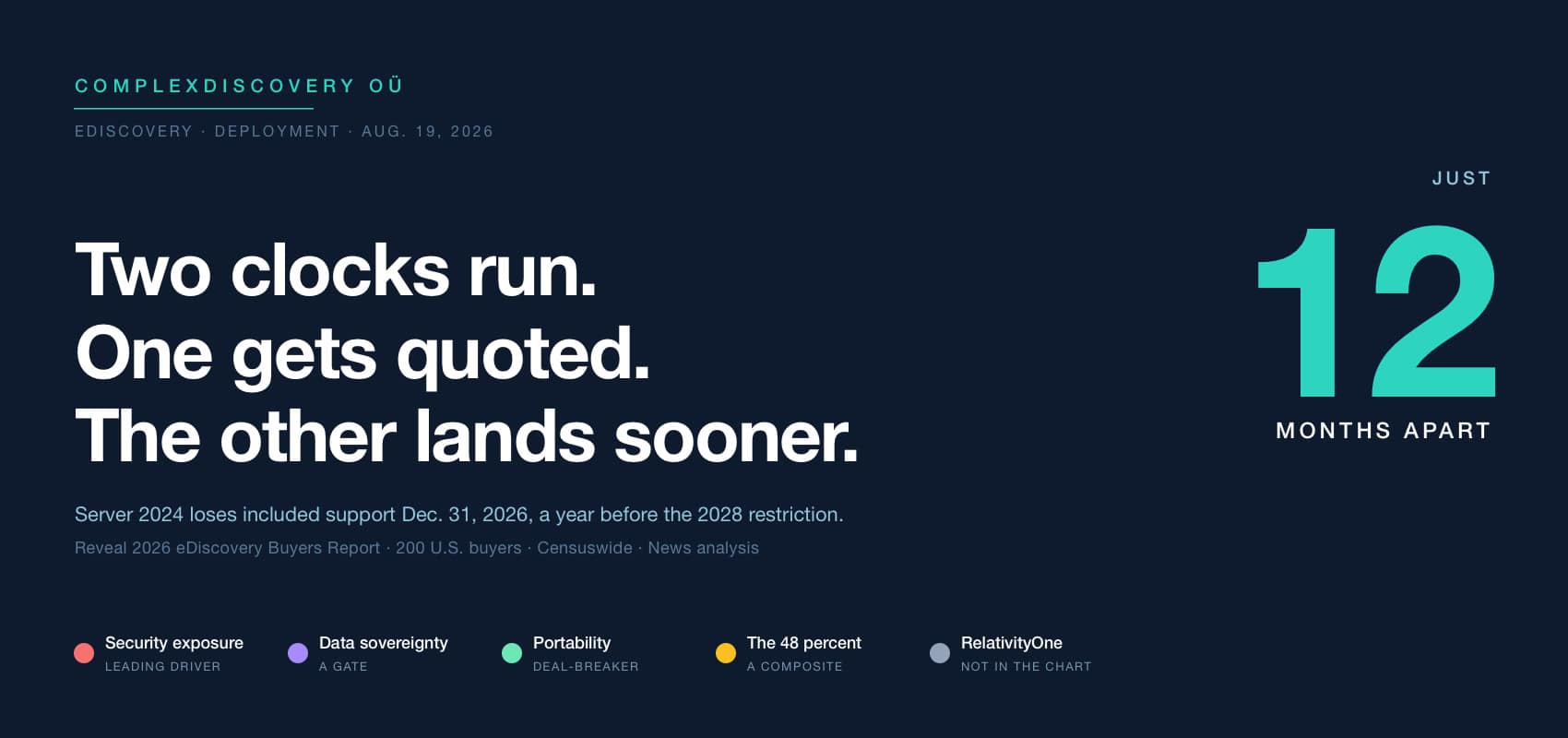
Start with security. Among the 181 respondents whose private-deployment share had grown, the leading driver was concern that sensitive matter data could be exposed to AI training in multi-tenant environments, at 40.9 percent. That is the highest value in the n=181 driver list, and cybersecurity ranks first again in the all-respondent question allowing up to two selections.
The rest of the list clusters. Internal cybersecurity and CISO-driven governance policies followed at 37.6 percent. Regulatory requirements, client contract terms and multi-tenant pricing each drew 36.5 percent, and concern about foreign government data access drew 26.5 percent, the lowest of seven listed drivers. Those shares total 250.4 percent, indicating multiple selections and an average of about 2.5 selected drivers per respondent.
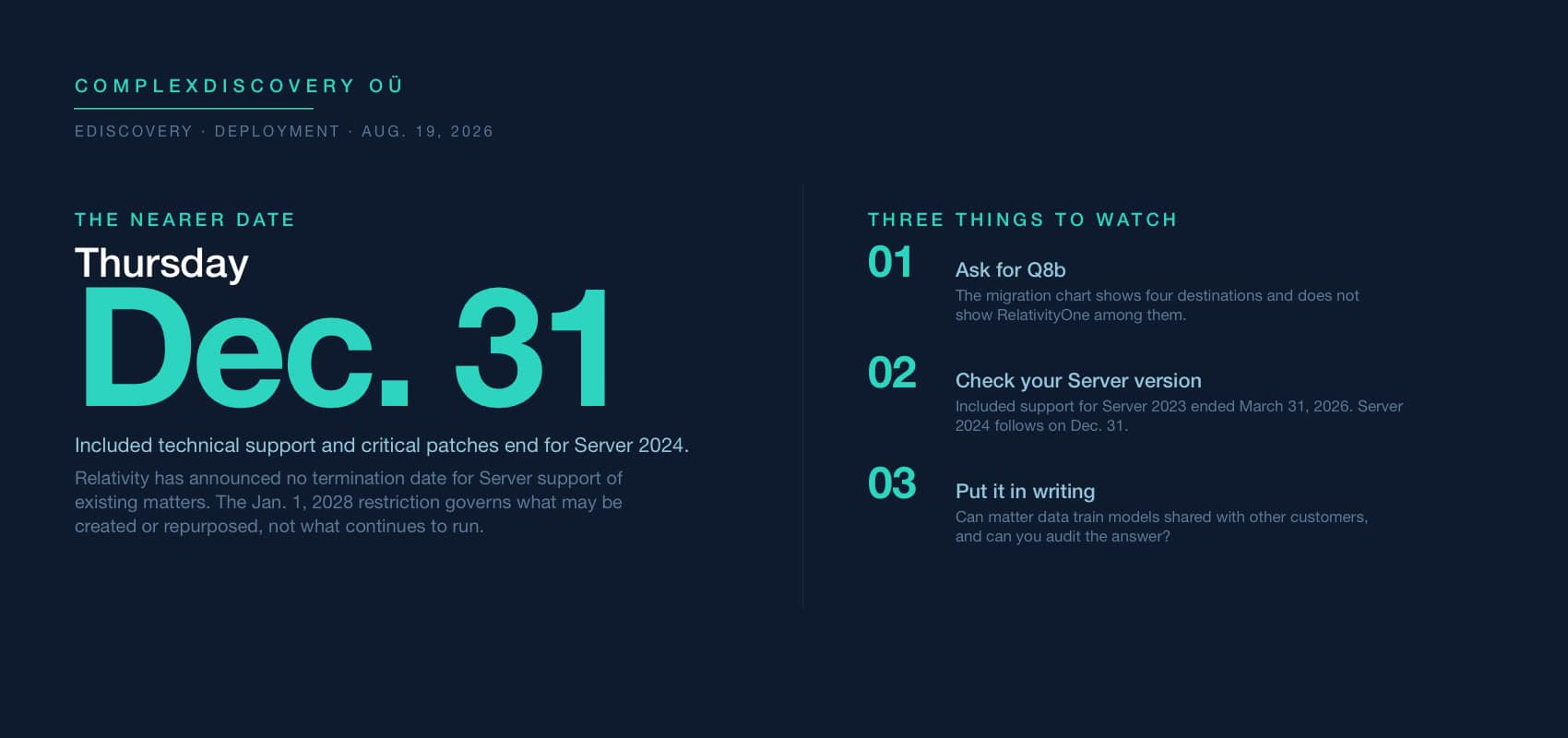
That top driver converts straight into a procurement question, and security leaders should be asking it whatever they make of the survey. Put to any multi-tenant provider, in writing: can matter data in this environment be used to train or fine-tune models shared with other customers, under what circumstances, and can we audit the answer? The report describes teams that are uncertain on exactly that point. Uncertainty in a contract is a term, not a fact, and terms are negotiable.
Sovereignty has an instructive shape. Some 77.5 percent rated regulatory or jurisdictional data sovereignty requirements important, yet only 17.5 percent placed them in their top two. The gap is the finding. Sovereignty is not a preference competing with other preferences; it is a gate. Where a regulator, a cross-border transfer rule or a client mandate dictates where data sits, no platform choice overrides it, which is precisely why it loses a popularity contest and still decides the matter.
Portability rounds it out, with 30 percent of buyers calling it “a deal-breaker if a vendor cannot offer it” and another 38 percent “a meaningful factor, though not a deal-breaker.” A vendor that cannot move a matter between environments without a fresh negotiation is exposed, and that is true regardless of who ran the survey.
Two numbers worth understanding before you quote them
Two figures in the report need a footnote before they travel. Neither appears to be an arithmetic error. The 48 percent is a composite the published document does not let a reader reconstruct independently, and the ACEDS statement is a subgroup ratio whose base has to travel with it.
The report labels 48 percent of respondents as expecting a hybrid approach within 24 months. Figure 10 directly identifies 24.5 percent who “expect to operate a mix of deployment models,” and another 23 percent who “expect current mix to stay the same.”
Getting from those two entries to 48 percent requires knowing what that second group runs today, and the report does not say. There is no cross-tab and no published question wording, so the document does not permit an independent reconstruction of the composite. Its definitions section counts two or more concurrent deployment categories as hybrid, but a definition is not a measurement: it does not establish that every respondent expecting no change is hybrid already. Figure 10 establishes one thing directly. At least 24.5 percent expect to operate a mix.
The same care applies to the companion survey Reveal ran with the Association of Certified E-Discovery Specialists. Among those 60 practitioners, 45 percent use private or on-premises eDiscovery in some form, 13 percent exclusively, and the report says hybrid users outnumber the rest by over 2 to 1. That ratio describes the 45 percent, where hybrid leads exclusive roughly 2.5 to 1. Across all 60 respondents it runs the other way. Quote the ratio with its base attached.
One labeling note, offered as housekeeping. Figure 4 is titled a “share of all industry mentions,” but its plotted values are percentages of respondents and total 190.5 percent across 381 mentions. The caption underneath says so plainly and gives the per-respondent readings, so the chart corrects itself; only the title is loose.
One open question about the migration chart
Figure 14 is the report’s most directly competitive claim. It rests on 132 respondents migrating from Relativity Server, who answered a follow-up question the embargoed Word version identifies as Q8b, and it shows four destinations. Reveal Private Deployment takes 31.1 percent, the highest of the four. The others are a proprietary or internally built platform at 24.2 percent, OpenText at 23.5 percent and Nuix at 21.2 percent. They total exactly 100 percent, and RelativityOne is not among them.
Reveal’s own ACEDS companion records same-vendor cloud moves as a destination category. Of 30 ACEDS respondents whose privately deployed platform is being retired, 12 have picked a destination, splitting into three even groups of four: the same vendor’s cloud, a competitor’s cloud, and a different vendor’s private deployment. The other 18 have picked nothing yet. That is what makes the absence worth asking about.
The report prints neither the question wording nor the full response options, so whether the incumbent’s cloud was excluded by design, offered and unselected, or simply left off the published chart cannot be determined from the document.
The published document does not settle it, and this analysis did not ask Reveal to. Anyone citing the 31 percent in a procurement conversation should put the question themselves, and should ask for the complete response options before repeating the number.
Relativity’s policy is narrower, and its other clock is faster
The report describes a “forced deplatforming” inside a “rapidly closing window.” Relativity’s stated policy is both narrower than that and, on one axis, more urgent.
Take the 2028 restriction first. Relativity announced in January 2025 that matters created on or after Jan. 1, 2028, must be hosted in RelativityOne, as Bob Ambrogi reported at LawSites. The restriction has three limbs rather than one: from that date customers may not create new workspaces, may not create new matters, and may not repurpose existing workspaces in Server.
The carve-out is narrower than it is usually described, too. Relativity’s published support policy conditions it on the company’s specific written permission, in circumstances where RelativityOne is not available to that customer.
What the restriction does not do is end Server. Matters created before Jan. 1, 2028, continue to be supported. Relativity Chief Customer Officer Andrew Watts wrote in a June 2025 post that the policy does not mean Server reaches end-of-life status on that date, and that existing matters and workspaces can continue to be supported. Relativity has announced no termination date for them.
The direction of travel is not in doubt. Chief Executive Phil Saunders framed the shift as a conviction that native cloud software is the most promising path forward, and the company said, as of that January 2025 announcement, that over 75 percent of its business had already moved to the cloud offering.
The faster clock runs on version lifecycles rather than on the 2028 policy, and the two are independent. According to Relativity’s published Server support policy, included technical support and critical patches for Server 2023 ended March 31, 2026. Server 2024 reaches the same point on Dec. 31, 2026, a little over four months out. Server 2025 runs until 12 months past the Server 2026 release, slated for the fourth quarter of this year.
The distinction matters. One clock governs what a customer may create. The other governs how long Relativity includes technical support and critical patches for the version they already run. A firm sitting on Server 2023 today is past support and has been since spring, whatever it decides about 2028.
Reveal’s report mentions none of this, and the omission cuts both ways. The exceptions and the continued support of existing matters make the window less closed than “forced deplatforming” implies. The version-support schedule makes parts of it closer than 2028 implies.
The affected population appears substantial either way. An industry estimate cited by ComplexDiscovery in October 2025 put the share of Relativity users still on Server infrastructure at about 25 percent. This outlet attributed the figure to industry estimates rather than to a count, and it does not specify whether “users” means individuals, customer organizations or installations.
Two other numbers in Reveal’s report rest on lighter support. Respondents self-reported eDiscovery costs rising 20 percent a year over three years. A separate claim that data doubles on average every 21 months is attributed to organizations rather than to the survey’s respondents. Neither carries a chart or a stated base.
Back to the clocks
Which returns to the Server customer with a decision to make, and two dates to make it against.
The report supports a narrower conclusion than its promotional framing suggests. The report puts the average share of matters requiring private deployment at 46 percent, and 91 percent report that share has increased over the prior 24 months. Security-related concerns and CISO-driven data-governance policies rank among the leading reported reasons for the increase, and 77.5 percent rate regulatory or jurisdictional data sovereignty requirements as important.
What that establishes is continuing demand for deployment choice. What it does not establish is that private deployment has won, or that nearly half of all matters are being run privately today. On the first point Figure 10 cuts the other way: 22 percent of respondents expect to consolidate onto a single multi-tenant SaaS platform against 13 percent onto a single privately deployed one.
The next 16 months run to the Jan. 1, 2028 restriction. Server 2024 reaches the end of included technical support and critical patches after a little over four of them, leaving a 12-month interval between the two policy dates, and anyone still on Server 2023 passed that point in March.
One caution for anyone building the business case. The report’s 46 percent measures a share of matters, not a share of spend, and ComplexDiscovery’s current market model does not provide a like-for-like spend-side comparator.
ComplexDiscovery’s current market model, published by this outlet in June 2026, splits eDiscovery software spending into on-premise and off-premise rather than along the public-versus-private line the report uses. It puts on-premise software at about $1.37 billion in 2025, rising to about $2.08 billion in 2030, within a total software market it estimates at about $6.67 billion and $10.95 billion. That category is not the report’s private deployment, which expressly covers private cloud as well. The two measures do not convert into one another, and treating them as if they did will misprice a migration.
So, before the included patches stop and well before Jan. 1, 2028: when a vendor tells you which deployment model suits you, can you tell the difference between the answer its architecture supports and the answer its commercial model requires?
News sources
- 2026 eDiscovery Buyers Report: AI and Deployment Trends (Reveal)
- Relativity Server support policy (Relativity)
- Reach new heights: paving the way for your journey to the cloud (Relativity)
- Putting a nail in the coffin of its on-prem product, Relativity sets 2028 deadline for all new cases to move to the cloud (LawSites)
- Reveal expands private deployment investment by 50 percent as enterprise demand surges (Business Wire)
- Wendell Jisa transitions to chairman of Reveal’s board of directors and announces new CEO (Business Wire)
- Censuswide Limited, Research Buyers Guide (Market Research Society)
- Complete look: ComplexDiscovery OU’s 2025 to 2030 eDiscovery market size mashup (ComplexDiscovery)
- Consilio and Reveal partner on private-cloud eDiscovery as Relativity Server deadline approaches (ComplexDiscovery)

Assisted by GAI and LLM Technologies
Additional reading
- Complete look: ComplexDiscovery OÜ’s 2025 to 2030 eDiscovery market size mashup
- The workstream of eDiscovery: Considering processes and tasks (ComplexDiscovery)
- Complete Look: ComplexDiscovery’s 2024-2029 eDiscovery Market Size Mashup (ComplexDiscovery)
- Andrew Haslam’s eDisclosure Systems Buyers Guide at 14: What the 1H 2026 update reveals
- A Complete Analysis of the Winter 2026 eDiscovery Pricing Survey
- The M&A Risk of Confusing Market Velocity with Marketing Capability
- Confidence Meets Complexity: Full Results from the 2H 2025 eDiscovery Business Confidence Survey
- Making the Subjective Objective: A Scoring Framework for Evaluating eDiscovery Vendor Viability in 2026
- eDiscovery Vendor Viability Scoring Tool: Making the Subjective Objective
- Beyond Public Cloud: The Enduring Case for Deployment Flexibility in eDiscovery
Source: ComplexDiscovery OÜ

ComplexDiscovery’s mission is to enable clarity for complex decisions by providing independent, data‑driven reporting, research, and commentary that make digital risk, legal technology, and regulatory change more legible for practitioners, policymakers, and business leaders.