
Editor’s Note: ComplexDiscovery OÜ has published an Oxford-style tutorial that tests whether the Chatham House Rule, the 1927 convention that lets meeting participants use what they hear but bars them from revealing the identity or affiliation of a speaker or any other participant, still works as a requirement for reporting on modern industry events.
Across three terms, each with a model essay and a tutor’s interrogation written as illustrative simulations, the tutorial puts three contestable propositions under questioning: that the Rule cannot survive recorded rooms, that anonymity shifts the cost of verification to readers, and that reporting should be on the record by default. Chatham House’s own FAQ rules out recording and AI notetakers under the Rule, yet the institute plans to hold every session of its Nov. 17 Competition Policy Conference 2026 under the Rule while naming the speakers, a choice the tutorial weighs against the risk that published rosters make speakers easier to identify.
The questions matter to eDiscovery, information governance and legal operations professionals weighing candor against accountability, as well as to lawyers and judges whose confidentiality and judicial-ethics obligations apply whether or not they are named.
Watch whether organizers adopt session-level designations, “not for attribution” labels and written press-access and recording policies.
Content Assessment: Is the Chatham House Rule outdated? An Oxford-style tutorial for event reporting
Information - 93%
Insight - 92%
Relevance - 90%
Objectivity - 92%
Authority - 92%
92%
Excellent
A short percentage-based assessment of the qualitative benefit expressed as a percentage of positive reception of the recent article from ComplexDiscovery OÜ titled, "Is the Chatham House Rule outdated? An Oxford-style tutorial for event reporting."
News Analysis – Leadership Beat
Is the Chatham House Rule outdated? An Oxford-style tutorial for event reporting
ComplexDiscovery Staff
The Chatham House Rule fits in a single sentence. Participants may use what they hear at a meeting, but may not reveal the identity or affiliation of a speaker or of any other participant. ComplexDiscovery OÜ has adapted a traditional, essay-based form of the Oxford tutorial, in which an argument is defended under close questioning, to test that sentence against modern industry events. Those events are where cybersecurity, information governance and eDiscovery professionals compare notes, in a field that often moves faster than it reflects.
The test is practical for any event that announces the Rule for an entire program after publishing its panelists’ names, titles and employers. Such rooms can be large and streamed, and AI meeting assistants are available on the major platforms used to stream them. Chatham House, which created the Rule in 1927 and refined it in 1992 and 2002, answers “No” in its frequently asked questions to recording and to AI notetakers under the Rule. It also says it uses the Rule “not often” for its own large events.
Yet the institute’s own calendar complicates that picture. Every session of its Competition Policy Conference 2026, set for Nov. 17 in London, is held under the Rule, and the conference page names the speakers and their affiliations. The tutorial treats that choice as the strongest counterargument to its own propositions and returns to it in every term.
What it is
That tension is what the format is built to examine. The ComplexDiscovery Tutorial on the Chatham House Rule and event reporting sets three contestable propositions across three terms, one per term, and pairs each with a worked example: a model essay and a tutor’s interrogation of it. Readers watch the method at work rather than take a conclusion on faith. A closing collections question, set without a model answer, asks whether a published speaker list can coexist with the Rule at all. Each proposition is written to be argued either way, and none represents ComplexDiscovery OÜ’s editorial position.
An argument under questioning
The Oxford tutorial behind that format is less a lecture than a disciplined conversation. This package adapts one traditional, essay-based version of it, in which a student writes an essay, reads it aloud and then defends it while a tutor presses on its weakest joints. Each essay here takes a position, marshals evidence and anticipates objections in roughly 900 words. The point is not to win the hour but to learn which parts of an argument survive pressure and which only sounded persuasive on the page.
A method, then three terms
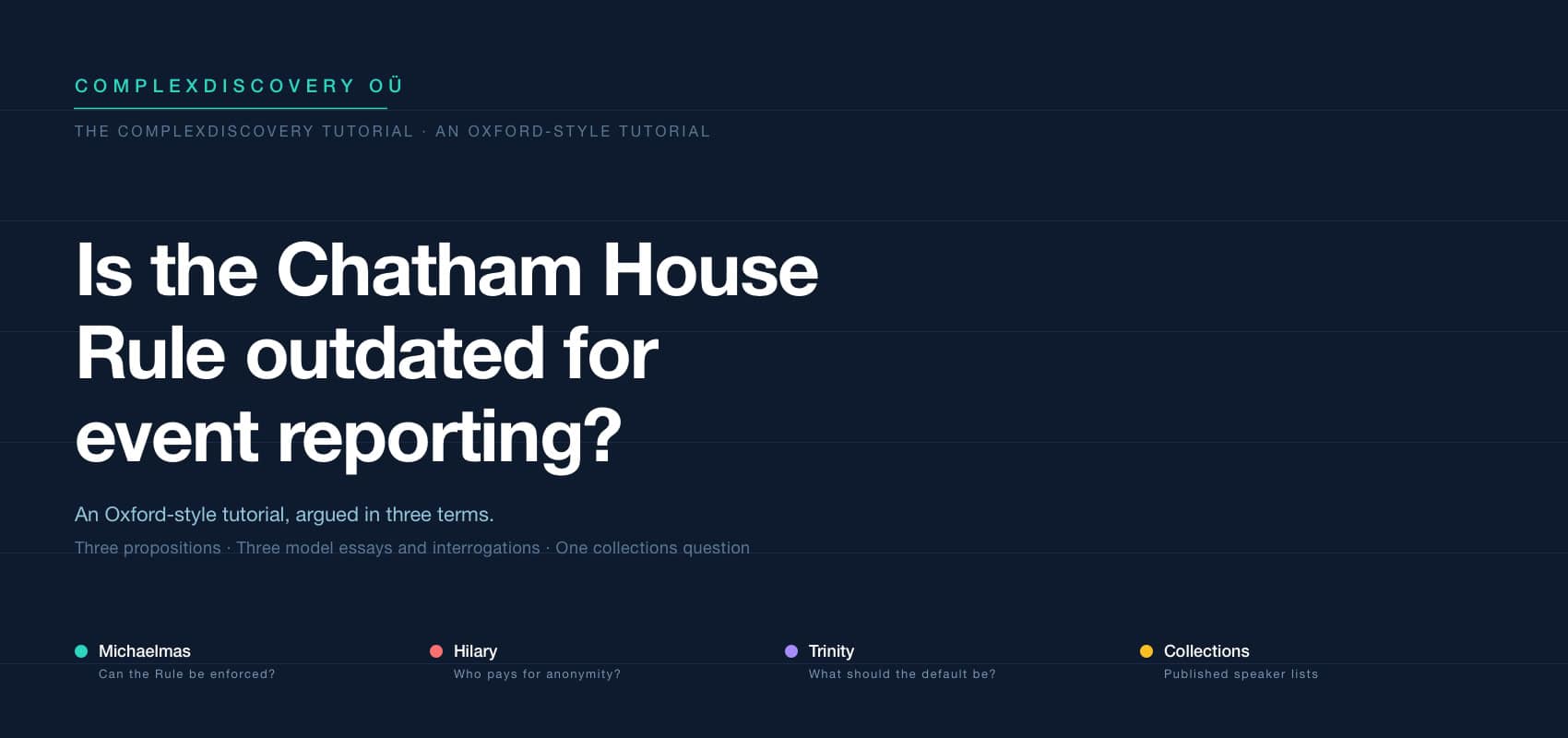
Across the package’s three terms, each argument builds on the last, moving from whether the Rule can be enforced, to who bears the cost of the anonymity it grants, to what practice should replace its blanket use. The sections take their names from Oxford’s three academic terms, which the university labels autumn, spring and summer: Michaelmas (October to December), Hilary (January to March) and Trinity (April to June), according to its dates of term.
Michaelmas: Can the Rule be enforced?
The first proposition holds that the Chatham House Rule cannot survive the recorded room. Its readings start with the Rule’s text and FAQ, which rule out recording and AI notetakers under the Rule. In an answer about photographs taken outside the room, the FAQ also says people may repeat what was said so long as they do not identify the speaker or another participant “directly or indirectly.”
That phrase is where the term’s argument turns. Latanya Sweeney’s 2000 working paper, “Simple Demographics Often Identify People Uniquely,” shows how quickly description becomes identification. Using 1990 census data, she estimated that 87 percent of the U.S. population could likely be uniquely identified by five-digit ZIP code, gender and date of birth. Helen Nissenbaum’s “Privacy as Contextual Integrity” (2004) supplies the theory, treating privacy as a question of whether information flows match the norms of the context in which they began. The term asks whether the bar on indirect identification can be met once an organizer has published who is on each panel, and whether any failure belongs to the Rule or to the organizer. Chatham House’s own named roster for a conference held entirely under the Rule is the counterweight the term must reckon with.
Hilary: Who pays for anonymity?
If the first term asks whether the Rule can protect speakers, the second asks what that protection costs readers. Its proposition holds that at an industry event, anonymity is a privilege the speaker enjoys and the reader pays for. The readings set journalism’s own sourcing standards against the Rule. The Associated Press’s News Values and Principles allow material from anonymous sources only when three conditions hold. The material must be information rather than opinion or speculation and vital to the report; it must be unavailable except under anonymity; and the source must be reliable and in a position to have direct knowledge. The Society of Professional Journalists Code of Ethics, revised Oct. 4, 2026, tells journalists to reserve anonymity as a last resort for sources with information of substantial public interest who may face danger, retribution or other harm.
Those standards assume a reporter can refuse a bargain, and the law suggests a bargain, once struck, can bind. The U.S. Supreme Court held in Cohen v. Cowles Media Co. (1991) that the First Amendment does not bar a promissory estoppel claim against a newspaper that broke a promise of confidentiality to a source. The decision does not determine whether an event’s accreditation terms are such a promise, and the tutorial treats it as illustrating a risk rather than settling one.
Speakers have their side of the bargain too, and against journalism’s standards the term sets those with good reasons to prefer anonymity. A legal operations director may have her employer’s permission to discuss what went wrong in a technology rollout, yet worry that her observations will be presented as the company’s formal position. Chatham House’s own FAQ describes that purpose: the Rule lets people speak as individuals and express views that may not be those of their organizations. Anonymity can draw out that kind of candor, but the reader still loses context that would help weigh it, including who the speaker is and what interests stand behind the remark.
Judges and lawyers face limits of their own. Rule 2.10 of the ABA Model Code of Judicial Conduct, the model for state judicial codes, tells judges not to make public statements that might reasonably be expected to affect the outcome of pending or impending matters. The rule reaches some nonpublic statements as well. ABA Model Rule of Professional Conduct 1.6 bars a lawyer from revealing information relating to the representation of a client. The exceptions are the client’s informed consent, disclosure impliedly authorized to carry out the representation and a short list of specified circumstances. Federal Rule of Evidence 502, enacted in 2008, limits in subdivisions (a) and (b) the waiver of attorney-client privilege and work-product protection for disclosures made in a federal proceeding or to a federal office or agency. A conference remark would not appear to fall within those provisions. Neither the judicial-ethics rule nor the confidentiality rule turns on whether a speaker is named. The Rule can make people more comfortable sharing information they are permitted to discuss. It does not change what they are permitted to disclose.
Together these readings frame the term’s central question: whether anonymity is sometimes the price of the information itself, and what readers give up when they accept that price. The term also asks whether a published speaker list lets speakers collect credit without accountability, and what an organizer is doing when it invokes the Rule’s name to impose access or editorial restrictions the Rule does not contain.
Trinity: What should the default be?
The first two terms diagnose, and the third prescribes. Its proposition holds that event reporting should be on the record by default, with the Chatham House Rule as a designated exception. The readings begin with Chatham House’s description of its own meetings as normally on the record, with the Rule only occasionally invoked, usually for smaller groups. Its code of conduct adds that only a small proportion of the institute’s meetings employ it. The FAQ allows a single session of a conference to be designated under the Rule but bars hosts and speakers from switching back and forth within one. The code asks that participants be clear from the outset whether the Rule applies to all or part of a meeting, and it defines off the record as information that cannot be used for publication.
Reporting standards point the same way: the AP tells its reporters to proceed with interviews on the assumption they are on the record. Erving Goffman’s “The Presentation of Self in Everyday Life” (1959) adds a distinction between the front region, where people perform for an audience, and the back region, where performances are prepared or dropped. Onora O’Neill’s 2002 BBC Reith Lectures, published as “A Question of Trust,” argue that transparency may not improve trust. From those readings the essay builds a design with four defined terms: on the record, not for attribution, under the Chatham House Rule and off the record. “Not for attribution,” the essay’s proposed term, covers named panelists whose remarks may not be tied to any one of them.
The design also asks agendas to match each session’s designation, labels press access separately from publication terms and asks events run by media companies to say so. Its hardest test is Chatham House’s own conference, which holds every session under the Rule, names its speakers, stays in person, makes no recordings available and still invites requests for press passes. The term asks what defaults do to speaker behavior, who enforces a designation and whether commercial events have reasons to keep exceptions narrow.
Three worked examples
Those questions are easier to see argued than summarized, and the worked examples that follow show the propositions under pressure. Each is an illustrative simulation written by ComplexDiscovery OÜ, pairing a model essay with a constructed interrogation in composite voices rather than a transcript of a live session. The cases, rules and scholarship they cite are real, and the sources listed at the end show where each can be checked.
In the Michaelmas example, the essay builds its case from scale, capture and identification, arguing that a published agenda makes the bar on indirect identification far harder to honor. The tutor shows that the essay’s title names its weaker argument, then makes the organizer’s case with Chatham House’s own named roster for a conference held entirely under the Rule. The student ends by naming the evidence that would prove the essay wrong.
The Hilary example picks up where that exchange leaves off, with the people the Rule is meant to protect. The essay argues that unattributed claims leave readers unable to weigh a speaker’s expertise or commercial interest. The tutor answers with three speakers (a legal operations director, a judge and in-house counsel) who have reasons to prefer anonymity. The exchange then draws out the distinction the term turns on: the Rule can make people more comfortable sharing information they are permitted to discuss, but it does not change what they are permitted to disclose. Publisher-run events and Chatham House’s own account of the Rule’s purpose follow, and the student moves the duty to apply journalism’s anonymity test from the Rule to the publisher.
The Trinity example turns that duty into a design. The essay builds on an on-the-record default and four defined terms, adding agendas that match each designation, recording limits in protected sessions, separate press-access labels, disclosure of media-owned events and on-the-record sponsored content. The tutor tests incentives, enforcement and Chatham House’s own conference, and the student arrives at disclosure in coverage, rather than the default itself, as the reader’s final safeguard.
Running it against your own work
The format travels beyond these three examples. A reporter planning conference coverage can write the essay for the side he or she rejects before deciding how to handle a session under the Rule. An organizer drafting a press policy can play the tutor against the draft, asking of each restriction who it protects and who pays for it, and whether the published agenda matches the rule the event announces. A speaker can test a planned remark by asking whether it would survive attribution, and if not, why it belongs on a stage at all.
The examples also show three failure modes a tutor listens for: a title that names the weaker of two arguments, a citation offered as if it settled a question it only illustrates, and an argument resting on an unmeasured ratio. The practical payoff is simple: put the sentence in front of a hostile examiner before putting it in front of readers.
That discipline returns the tutorial to the single sentence it began with, a rule that, in Chatham House’s own words, “has spread well beyond the building where it began in 1927.” One question to carry into the next event on the calendar: Which of its sessions would pass the test journalism applies to any other grant of anonymity?
The tutorials in full
The three worked examples that follow were written by ComplexDiscovery OÜ. Each is an illustrative demonstration of a traditional, essay-based Oxford tutorial: a model essay paired with a constructed interrogation, written as a simulation of the exchange in composite, illustrative voices. They are not transcripts of a live tutorial, and the student and tutor are not real individuals. The cases, rules and scholarship the essays cite are real, and each is listed in the sources at the end. Each proposition is written to be argued either way and does not represent ComplexDiscovery OÜ’s editorial position.
Tutorial one, Michaelmas: “The Chatham House Rule cannot survive the recorded room”
Explainer
This first example trains the most basic tutorial skill: telling a rule that has failed from a rule that is being misapplied. The essay makes a largely empirical case that scale, capture and identification have hollowed out the Rule’s promise of anonymity at large events. Watch for the moment the tutor turns the essay’s own evidence against it, since Chatham House already rules out recording under the Rule and says it does not often use the Rule for its own large events. The exchange then sets the essay’s best evidence, an agenda that names panelists in advance, against the organizer’s strongest reply. Chatham House supplies that reply itself: it holds every session of its Competition Policy Conference 2026 under the Rule and still names the speakers.
The essay
Setup: The student was asked to defend the proposition in an essay of roughly 900 words, drawing on the text of the Rule and Chatham House’s own guidance, a typical published conference agenda, Latanya Sweeney’s work on re-identification, and Helen Nissenbaum’s theory of contextual integrity. The essay was read aloud at the start of the hour.
The Chatham House Rule is a single sentence built for a particular kind of room. When a meeting, or part of one, is held under the Rule, participants may use the information they receive, but may not reveal the identity or affiliation of the speaker or of any other participant. The bargain is elegant: information flows outward, identities stay inside. My argument is that the bargain depends on a condition the modern industry event no longer meets. The Rule works best in a room whose memory is human, partial and perishable. Many of the rooms in which cybersecurity, information governance and eDiscovery professionals now gather are recorded rooms, and in a recorded room the Rule’s promise cannot be kept.
Consider first the problem of scale. A Rule that binds 20 people around a table is enforced by the fact that each of them can see the other 19. Breach is detectable and socially costly. A Rule that binds 600 people in a ballroom is enforced, in Chatham House’s own words, at “the discretion of the organizer,” which at that scale means breach is hard to detect and its consequences are whatever the organizer decides. Many of those attendees are strangers to one another, many are there for a single session, and a meaningful share are posting to LinkedIn before the panel ends. Chatham House’s own practice points the same way. Asked whether it uses the Rule for all of its meetings, the institute answers “not often for large events” and more frequently for smaller ones. When the institution that wrote the Rule seldom uses it for its own large events, we should take the hint.
Scale makes breach hard to see; capture makes it permanent. Chatham House’s guidance is unambiguous: no recordings, and no AI notetakers or transcription tools, under the Rule. What leaves a compliant room is what participants remember or write down, with names withheld. But guidance is not physics. Every attendee carries a recording device, and AI meeting assistants are now available in the major platforms through which many sessions are streamed, ready to capture a session once someone enables them. Once a recording or transcript exists anyway, the protection is no longer structural. It is reduced to a hope that every person holding a copy will behave well, indefinitely, in every jurisdiction.
Even a room with no recording at all faces the third and most important problem, which is identification. Chatham House’s FAQ anticipates it. In an answer about photographs taken outside the room, it says people may repeat what was said so long as they do not identify the speaker or another participant “directly or indirectly.” The standard is right, but the modern event makes it nearly impossible to meet. Begin with the agenda. Many industry events publish every panelist’s name, title and employer, along with a description of each session, weeks in advance. A reporter covering a three-person panel cannot write “a panelist said” without narrowing the field to one in three, and the content of a remark usually narrows it further: only the regulator speaks of “our enforcement actions.” Latanya Sweeney’s research shows how quickly a few attributes collapse a crowd into an individual. Using 1990 census data, she estimated that 87 percent of the U.S. population could likely be uniquely identified from just three ordinary attributes: five-digit ZIP code, gender and date of birth. If three data points can likely single out most of some 248 million people, a published roster and a single descriptive phrase can single out one speaker on a stage of three. Our professional world is small, and its rooms are smaller. Description becomes identification quickly.
Why does it matter that a remark becomes identifiable when the names were public all along? Helen Nissenbaum’s theory of contextual integrity offers an answer. Nissenbaum argues that privacy is not a matter of secrecy but of appropriate flows: information shared within a context carries norms about where it may travel next. The Rule is an attempt to write one such norm down. The trouble is that the norm was calibrated for a context (the private policy discussion) that the modern conference only imitates. The panel is sponsored, streamed and summarized. Its information flows are governed by the platform’s retention settings and by the attendee’s social media habits, not by the norm the organizer announces from the stage. The Rule’s words persist, but the context that gave them meaning has dissolved.
One might reply that the Rule still does useful work even if imperfectly honored. It signals a norm, and norms shape behavior. I accept that. But a requirement that cannot be enforced does a different kind of work than one that can: it disciplines the conscientious and frees the careless. The journalist who honors it reports the remark without the speaker’s name, while the attendee who ignores it posts the same remark online with the name and title attached. The careful account becomes the less informative one. Over time, the Rule’s effect at large events is not to protect speakers but to sort participants by scrupulousness.
None of this means that confidential discussion is impossible. It means that the confidentiality of a recorded room must be engineered rather than declared: by limiting attendance, by barring devices, by holding sensitive sessions in genuinely small rooms. Where those conditions are met, the Rule survives. Where they are not, invoking it is a ritual. The proposition is therefore true in the form that matters to event reporting. As a requirement imposed on large, recorded, streamed events, the Chatham House Rule cannot survive the room it has been asked to govern.
The interrogation
Tutor: Thank you. Let me begin with your own evidence. You quoted Chatham House saying it does not often use the Rule for its own large events, and that recording and AI notetakers are not permitted under it. Doesn’t that suggest the recorded ballroom isn’t a room the Rule was built for?
Student: In principle, yes. In practice, organizers announce the Rule in exactly those rooms.
Tutor: Then what has failed: the Rule, or the organizers?
Student: I would say the Rule fails when it is applied there.
Tutor: That’s a careful sentence. Now look at your title. It names recording. Your strongest evidence, the published agenda and the three-person panel, has nothing to do with recording. Which argument are you defending?
Student: Both, but the identification argument is the stronger one. It would hold even if every phone in the room were switched off.
Tutor: Then your title names the weaker of your two arguments. Examiners notice when a title and its best evidence point in different directions. Stay with identification, then. Sweeney’s figure concerns linking records in datasets. Is a conference report a dataset?
Student: Not formally, which is why the agenda is the stronger evidence. The organizer has already published the names. The reporter is asked not to reveal identities that anyone can look up.
Tutor: Then let me make the organizer’s case, and Chatham House makes it for me. Every session of its Competition Policy Conference 2026 is held under the Rule, and its public page lists the speakers and their affiliations. The agenda reveals who will speak. The Rule, read that way, protects who said what. Isn’t being known to have spoken on a panel nearly costless, and being tied to a particular sentence the real risk?
Student: Then Chatham House seems to read its own Rule that way, at least for what an organizer publishes before the meeting. The text binds what participants reveal; the agenda isn’t something a participant received in the room. But the guidance still asks participants not to identify a speaker indirectly, and the roster makes that easy. What organizers practice in effect is closer to “not for attribution.”
Tutor: Grant the organizer that narrower rule. Does even that survive a three-person panel?
Student: Barely. It leaves one-in-three deniability, which still matters to a speaker worried about a pending case or about being read as speaking for an employer. A keynote given by a single named speaker leaves none at all. And many substantive remarks identify their speaker by content.
Tutor: Good. You’ve found a better argument than the statistic, and it’s yours: the organizer’s own documents make the Rule’s bar on indirect identification far harder for participants to honor, even if publishing them is no breach. Lead the identification section with it. Now turn to Nissenbaum. You used contextual integrity against the Rule. Couldn’t someone use it for the Rule? It’s a written context norm. Isn’t writing the norm down exactly what Nissenbaum would want?
Student: She would want the norm to match the context. My claim is that it no longer does.
Tutor: Or that the context can be rebuilt. Your final paragraph proposes limiting attendance and barring devices. If that works, haven’t you described the Rule’s survival rather than its death?
Student: I’ve described the conditions for its survival. Most events won’t meet them.
Tutor: That’s an empirical prediction. What would show you were wrong?
Student: Evidence that events which declare the Rule also enforce device restrictions, and that reporting from them rarely produces identification disputes.
Tutor: Good. Name the falsifier and the argument becomes testable. One last question. Your paragraph about the conscientious and the careless is the strongest in the essay. Why?
Student: Because it shows the Rule at a large event can reward breach. The attendee who attaches a name to a quote publishes the more informative account, and the reporter who honors the Rule publishes the less informative one.
Tutor: Yes. That’s an argument about incentives, not about technology, and it would hold even in a room with no microphones. For next week, rewrite the essay so it opens there.
Tutorial two, Hilary: “At an industry event, anonymity is a privilege the speaker enjoys and the reader pays for”
Explainer
The second example moves from enforcement to accountability. The essay argues that unattributed claims shift the cost of verification onto readers, who cannot weigh a speaker’s expertise or commercial interest, and it measures the Rule against journalism’s own standards for anonymous sourcing. It also argues that a published speaker list lets speakers collect credit without accountability. The interrogation tests the essay’s hidden premise, that the information would exist without the Rule. Watch how the tutor uses a legal operations director wary of speaking for her employer, a judge bound by ethics rules and in-house counsel bound by client confidentiality. Together they show that anonymity can encourage sharing, while the reader still loses context that would help weigh what is shared. The tutor also draws out a limit the essay missed: the Rule can make people more comfortable sharing information they are permitted to discuss, but it does not change what they are permitted to disclose. The tutor then turns to publisher-run events and to Chatham House’s own account of the Rule’s purpose, and the student narrows the claim to the sessions where the price of anonymity is not worth paying.
The essay
Setup: The student was asked to defend the proposition in an essay of roughly 900 words, using the Associated Press’s News Values and Principles on anonymous sources, the SPJ Code of Ethics as revised in October 2026, and the U.S. Supreme Court’s decision in Cohen v. Cowles Media Co. The essay was read aloud at the start of the hour.
Every grant of anonymity is a transfer. Something is given to the speaker (protection from consequence) and something is taken from the reader (the ability to judge who is speaking and why). Journalism has long treated that transfer as expensive. The Associated Press permits material from anonymous sources only when three conditions hold. The material must be information rather than opinion or speculation, and vital to the report. It must be unavailable except under the anonymity the source imposes, and the source must be reliable and in a position to have direct knowledge of the information. The Society of Professional Journalists, in its October 2026 revision of its code, tells journalists to reserve anonymity or confidentiality as a last resort for sources with information of substantial public interest who may face danger, retribution or other harm. It also tells them to consider motives before agreeing not to identify a source, and to explain those decisions to audiences. My argument is that the Chatham House Rule, as applied at industry events, can grant that privilege without any of those tests, and that the reader pays.
Begin with what the Rule actually withholds: not the information, which may be used, but identity and affiliation. In our field, identity and affiliation are often the most important facts about a claim. When a panelist says that a technology-assisted review workflow reached a certain recall rate, the reader needs to know whether the panelist sells that workflow. When a speaker says that regulators are softening their position on cross-border transfers, the reader needs to know whether the speaker is a regulator, a lobbyist or a consultant whose clients would benefit from that impression. Strip away affiliation and the claim does not become neutral. It becomes unweighable.
This is why the AP’s first condition matters so much. It limits anonymous material to information and excludes opinion and speculation. Much of what is said on conference panels is opinion and speculation: predictions about enforcement, assessments of market direction, judgments about which tools work. The Rule lets that material be reported while removing the one thing that would let a reader discount it, which is the name and affiliation of the person who said it. A reporter following AP standards would decline most of it. A reporter following only the Rule may print all of it.
Consider, too, who benefits most. The speakers who most need protection (a whistleblower, an official contradicting policy, a security leader describing an active incident) are rare on conference stages. The speakers who most often benefit are those who have something to promote and something to avoid defending. The sponsored panel under the Rule is the clearest case. The sponsor buys the stage, the audience and the reputational lift of association with peers, while purchasing immunity from the one consequence that accompanies public speech: being held to what one said. The published agenda completes the bargain. The sponsor’s executive is named, titled and pictured in the program; the remarks are not attributable. The speaker collects credit without accountability.
One might object that the reader loses nothing, because without the Rule the information would not be shared at all. I take that objection seriously, and I will return to it. But it proves less than it seems, because it is true of some speakers in some sessions and not of others. It does not describe the vendor executive who would happily say the same thing in a press release, or the consultant whose talk is substantially the same at every event on the circuit. For those speakers the Rule does not create information. It launders it.
Laundering is one misuse; exclusion is another, and it asks the Rule to do work it was never written to do. Its text allows participants to use the information they receive. An organizer may invoke its name to deny press credentials, to require that quotes be approved before publication or to bar coverage of whole sessions. Each of those imposes access, editorial-control or publication restrictions that the Rule itself does not impose. When the Rule’s name is borrowed to keep reporters out, the reader pays twice: once for the unattributed claims that are reported, and again for the claims that are never reported at all.
The reporter bears a cost too, and passes it on to the reader. In Cohen v. Cowles Media Co. (1991), the Supreme Court held that the First Amendment does not bar a promissory estoppel claim against a newspaper that broke a promise of confidentiality to a source. Whatever one thinks of the case, it reminds us that confidentiality promises can carry legal weight. A reporter who accepts accreditation on Chatham House terms has accepted constraints whose legal force is uncertain and whose editorial costs are borne by readers who never agreed to them. The reader receives a story shaped by a bargain the reader did not make.
My conclusion is not that the Rule should never be used at industry events. It is that its use should be justified the way journalism justifies any grant of anonymity: by the vulnerability of the speaker, the necessity of the information and the reliability of the source, and then explained to readers. At many industry events, none of these is examined in public. Anonymity is handed out by default, enjoyed by those with the most to sell, and paid for by those with the least ability to check.
The interrogation
Tutor: You promised to return to the objection that without the Rule the information wouldn’t exist. You didn’t quite. Let’s do it now. A legal operations director has her employer’s permission to talk about a technology rollout that failed. Why might she still want the Rule?
Student: Because her observations could be presented as her employer’s formal position. She can say what went wrong, but she may not want every judgment she offers read as the company’s verdict on the project or on the vendor.
Tutor: So the Rule isn’t hiding anything she’s forbidden to say.
Student: No. She’s allowed to discuss it. The Rule makes her more comfortable saying more of it, and saying it frankly.
Tutor: And a judge on a panel?
Student: Judicial ethics rules restrict public statements that might reasonably be expected to affect the outcome of a pending or impending matter. The ABA Model Code puts that in Rule 2.10.
Tutor: And in-house counsel describing litigation strategy?
Student: Client confidentiality first. ABA Model Rule 1.6 bars a lawyer from revealing information relating to the representation of a client. The exceptions are informed consent, disclosure impliedly authorized to carry out the representation and a short list of specified circumstances. An attributed public account of legal advice could also invite waiver arguments.
Tutor: Is waiver settled? Federal Rule of Evidence 502 limits it.
Student: Rule 502’s waiver limits in subdivisions (a) and (b) deal with disclosures made in a federal proceeding or to a federal office or agency. A conference remark doesn’t appear to fall within them, so the risk is less predictable, not smaller.
Tutor: Fair. But be careful what you’re claiming for the Rule. Does anonymity make it permissible for the judge to say what Rule 2.10 forbids, or for counsel to reveal what Rule 1.6 protects?
Student: No. Rule 2.10 reaches some nonpublic statements too, and Rule 1.6 doesn’t depend on whether the lawyer is named. The Rule can make people more comfortable sharing information they are permitted to discuss. It does not change what they are permitted to disclose.
Tutor: Keep that distinction. Now, for these three speakers, what does the reader pay?
Student: Less than my essay claims, but not nothing. The reader gets information that might not otherwise be shared, and still loses context that would help weigh it: who the speaker is, where she works and what interests stand behind the remark.
Tutor: Then your title overstates the cost for them, though not the fact of it.
Student: Yes. For them the trade is worth making. My essay distinguishes them from the vendor and the consultant, for whom it isn’t.
Tutor: It distinguishes them in one paragraph and then condemns the Rule in the conclusion as if they weren’t there. Which population is larger at the events you have in mind?
Student: I don’t know. I assumed the commercial speakers.
Tutor: An honest answer. An examiner will notice that your argument depends on a ratio you haven’t measured. Now access. You say the Rule’s name is borrowed to keep reporters out. Can’t a private event exclude the press if it likes?
Student: Of course. My point is narrower: it shouldn’t call the exclusion the Chatham House Rule, because the Rule allows the information to be used.
Tutor: Good. A complaint about labels is smaller than a complaint about rights. Make sure the essay knows which one it’s making. Now, you blame sponsors and organizers. Who else runs industry events?
Student: Trade publications, among others.
Tutor: And when a publisher hosts its own summit under the Rule, whose interests does the Rule serve?
Student: Partly its own. Competing reporters are constrained or kept out, while the host keeps the sponsor and speaker relationships.
Tutor: So the press isn’t only the injured party in your essay. It can be the beneficiary. Does your argument survive that?
Student: I think it’s strengthened. The cost to readers is the same whoever invokes the Rule. But it means coverage of such an event should disclose who ran it.
Tutor: Then add a paragraph on it, or an examiner will say your essay is the press arguing its own case. That brings us to the AP test. You treat it as a standard the Rule fails. Whose standard is it?
Student: The reporter’s.
Tutor: So who is failing to apply it: the Rule, or the reporter who prints unweighable speculation because the Rule allowed it?
Student: The reporter. The Rule permits use; it doesn’t require it.
Tutor: Then perhaps the privilege isn’t the speaker’s to enjoy unless the publisher grants it. What would that look like?
Student: A publisher applying the AP conditions to Chatham House material the same way it would to any anonymous source: printing information, not opinion, and verifying claims independently before relying on them.
Tutor: Good. Now let Chatham House answer you. Its FAQ says the Rule lets people speak as individuals and express views that may not be those of their organizations. That is your legal operations director’s case exactly. Your essay treats affiliation as the most important fact about a claim. The Rule treats removing it as the point. Who is right?
Student: Both, for different speakers. For the director, or an official thinking aloud, separating the view from the institution is the value. For a vendor describing its own product, the affiliation is the claim.
Tutor: Then the Rule isn’t hiding the fact you need in every case. Sometimes it removes a fact that would mislead. Your essay should say which sessions are which. Last point. You cited Cohen. What did the Court decide, exactly?
Student: That the First Amendment doesn’t bar a promissory estoppel claim against a newspaper that broke a confidentiality promise.
Tutor: Does it decide that an event accreditation term is such a promise?
Student: No. That would depend on state law and the facts.
Tutor: Then say so in the essay. A case that illustrates a risk is not a case that establishes one.
Tutorial three, Trinity: “Event reporting should be on the record by default, with the Chatham House Rule as a designated exception”
Explainer
The third example turns from critique to design, which tutors often find harder to defend. The essay builds on Chatham House’s own practice (meetings normally on the record, the Rule invoked occasionally and designated by session) and on Erving Goffman’s distinction between front and back regions. From them, it argues for an on-the-record default with narrowly designated exceptions. The design adds four defined terms, including a proposed “not for attribution,” along with agendas that match each designation, press-access labels kept separate from publication terms and disclosure of media-owned events. The interrogation presses on what defaults do to behavior, who enforces a designation and whether commercial events have reasons to keep exceptions narrow. It then confronts Chatham House’s own conference held entirely under the Rule. Watch for the student’s final move, which accepts the limits of design and makes disclosure the reader’s safeguard.
The essay
Setup: The student was asked to defend the proposition in an essay of roughly 900 words, drawing on Chatham House’s guidance on the Rule, the Associated Press’s News Values and Principles, Erving Goffman’s “The Presentation of Self in Everyday Life” and Onora O’Neill’s 2002 Reith Lectures, published as “A Question of Trust.” The essay was read aloud at the start of the hour.
The first two arguments of this course attacked the Chatham House Rule as it is applied to industry events: first because it cannot be enforced in recorded rooms, then because it shifts the cost of anonymity to readers. Both arguments are vulnerable to the same reply, that the Rule protects candor that would otherwise vanish, and I accept that reply. My proposition is designed to keep what it defends while ending what the earlier essays attacked. Event reporting should be on the record by default, and the Rule should be an exception that organizers designate, in advance, for specific sessions.
The strongest evidence for this design comes from Chatham House itself. Its guidance describes meetings at Chatham House as normally on the record, with the Rule only occasionally invoked, usually for smaller groups, and its code of conduct says only a small proportion of the institute’s meetings employ the Rule. Its FAQ anticipates the conference: parts of a meeting, such as a single session, may be designated as under the Rule, although a host or speakers cannot switch back and forth, declaring some remarks under the Rule and others not. The code adds that participants should be clear from the outset whether the Rule applies to all or part of a meeting, with the agreement recorded in writing. The Associated Press takes the same starting point for its own reporters, who are told to proceed with interviews on the assumption they are on the record. Chatham House can place an entire program under the Rule, and it does so for every session of its Competition Policy Conference 2026, on Nov. 17. But it announces that choice in advance, holds the event in person only and makes no recordings available. Restoring an on-the-record default would not abandon the Rule; it would return the Rule to the exception its author describes, chosen deliberately and announced before anyone speaks.
Why must the exception be announced rather than assumed? Erving Goffman offers a way to see it. In “The Presentation of Self in Everyday Life,” Goffman distinguished the front region, where people perform for an audience, from the back region, where performances are prepared, relaxed or contradicted. Professional life needs both. But a back region works only when everyone knows they are in it. A conference that is half front stage and half back stage, without telling anyone where the line falls, produces the worst of both: speakers who perform while believing they are protected, and audiences who report while believing they are free. Designation draws the line on the floor.
What would designation require? First, the published agenda would mark each session with one of four defined terms (on the record, not for attribution, under the Chatham House Rule, or off the record) so that attendees, speakers and press share a vocabulary. “Not for attribution” is this essay’s proposed term for the common case in which panelists are named but no remark may be tied to any one of them. Like any reporting condition, it works only if it is defined in advance. Second, the agenda would match the designation. Chatham House itself names the speakers for its all-sessions conference, so a published roster need not be a breach. But a roster makes indirect identification far easier for anyone reporting, and an event that publishes one should say whether it is offering the Rule or not for attribution. Third, sessions under the Rule would follow Chatham House’s own guidance on recording and AI notetakers, so that the protection is structural rather than aspirational. Fourth, sponsored and vendor-led sessions would be on the record by default, because commercial speech is speech whose author the reader most needs to know. Fifth, the press policy would state separately whether each session is open or closed to the press, and reporters admitted to sessions under the Rule could use what they hear, since that is what the Rule allows. Chatham House’s own conference page invites press-pass requests while noting that the conference is held under the Rule. Access is a different question from publication: Chatham House defines off the record as information that cannot be used for publication, not as a room reporters may not enter. Sixth, an event run by a media company would say so, so that coverage by its own outlet and by competitors can be read in that light. Finally, speakers in designated sessions could clear specific remarks for attribution afterward, so that candor and credit are not mutually exclusive.
Onora O’Neill’s Reith Lectures supply the deeper justification for this design. In the lecture she titled “Trust and Transparency,” O’Neill argued that more transparency may not improve trust. I take her point to be that what matters is whether people receive information they can assess. A blanket Rule fails that test from one direction: readers receive claims they cannot assess because the source is hidden. Total transparency would fail it from the other: speakers retreat into talking points, and readers receive assessable but empty material. A designated exception aims at the middle. Most sessions are attributable and therefore assessable, while a few are protected and labeled as protected, so that readers know how much weight the unattributed material can bear.
The design has costs: some speakers will decline to appear in on-the-record sessions, and some organizers will designate too many exceptions. I do not claim the default solves every problem, only that it moves the burden to the right place. Under a blanket Rule, the reader must assume every claim is unaccountable. Under a default with designated exceptions, the organizer must justify each grant of anonymity in public, before the session begins, a burden organizers should bear because they decide what kind of room they are building.
The interrogation
Tutor: A clear essay. Let’s test the design. You say some speakers will decline. Which ones?
Student: Probably the ones the Rule was meant for: officials, judges, security leaders.
Tutor: Then won’t your default drive the most valuable speakers into the designated sessions, and won’t organizers, wanting those speakers, designate more and more sessions?
Student: Possibly. But each designation is visible on the agenda. Overuse becomes obvious.
Tutor: Obvious to whom? Who reads agendas that closely?
Student: Reporters. Regular attendees.
Tutor: And what do they do about it?
Student: Reporters can decline accreditation for designated sessions, or disclose in their coverage how much of the program was protected.
Tutor: That’s the first time you’ve mentioned disclosure. Hold on to it. Next: incentives. Who pays for the commercial events you have in mind?
Student: Largely sponsors and exhibitors.
Tutor: And your design puts sponsored sessions on the record by default. Why would an organizer adopt a rule that its paying customers dislike?
Student: Because the organizer’s long-term asset is the credibility of the program. If coverage treats the event as an advertising venue, attendance suffers.
Tutor: That’s a hope about markets. Is there a mechanism?
Student: Press policy. A publication can make its coverage conditional on a published, session-level designation. If enough publications do that, the default spreads.
Tutor: So the reform runs through publishers, not organizers. Your essay assigned the burden to organizers. Which is it?
Student: Organizers bear the burden of designating. Publishers create the pressure to designate honestly.
Tutor: Better. Now Goffman. A back region works when everyone knows they’re in it. Does labeling a session make people behave as if they’re in a back region?
Student: Not necessarily. Labels don’t stop phones. That’s why my design also adopts Chatham House’s restriction on recording and AI notetakers.
Tutor: Which, in your first essay, you said couldn’t be enforced.
Student: I said it couldn’t be enforced across a ballroom. A designated session can be smaller, held in a separate room, with devices checked. Designation makes enforcement possible because it limits where enforcement is needed.
Tutor: That reconciles the two essays. One more design question. Your agenda test asks an event that publishes its roster to say whether it is really offering the Rule. Chatham House holds every session of its own Competition Policy Conference 2026 under the Rule and publishes the roster, and organizers sell tickets on names. Won’t they simply keep the Rule’s name and point to Chatham House?
Student: Some will, and they’ll have a fair precedent. But the precedent includes the rest of what Chatham House does: it announces the Rule for the whole event in advance, keeps the event in person and makes no recordings available. And the roster covers what the organizer publishes, not what participants may reveal afterward. An organizer that names the panel and then tells reporters they can’t say who said what, without any of those conditions, is offering something close to “not for attribution,” whatever it calls it. The accurate label tells readers what is actually protected: the link between a remark and a person, not the person’s presence.
Tutor: So the accurate label beats the prestigious one.
Student: Yes. The Rule’s name carries prestige. The design asks organizers to give up the prestige wherever they aren’t willing to meet its conditions.
Tutor: Last question. Suppose the design fails and an event designates half its program under the Rule. What protects the reader then?
Student: Disclosure. The story says the session was held under the Rule, describes the source without enabling identification, and declines to rely on any claim whose credibility depends on who made it.
Tutor: So your final safeguard isn’t the default at all. It’s the reporter’s discipline.
Student: The default makes that discipline rarer to need. It doesn’t make it unnecessary.
Tutor: That’s the sentence your conclusion was missing. Put it there.
Collections
At Oxford, collections are college examinations, typically set at the start of a term to test the work of the one before. This package closes with a single collections question, set without a worked answer.
Question: “A published speaker list is incompatible with the Chatham House Rule.” Discuss.
Points to consider:
- Chatham House’s FAQ, in an answer about photographs taken outside the room, says people may repeat what was said so long as they do not identify the speaker or another participant “directly or indirectly.” Can that standard be met for a panel whose members are named in advance?
- Chatham House holds every session of its Competition Policy Conference 2026 under the Rule and names the speakers on the conference page. Does that settle the question, or does it show only that an organizer’s advance publicity falls outside what the Rule binds?
- The same agenda names a single keynote speaker. What deniability does the Rule leave a speaker who is alone on the program?
- The FAQ allows a single conference session to be designated under the Rule. Does it follow that the session’s roster should be kept off the published agenda?
- Another FAQ answer lets a speaker say afterward that he or she was there and what he or she said. Does the Rule treat presence as protected, or only attribution?
- Is the narrower convention many organizers seem to intend (named panelists, no remark tied to any one of them) better described as “not for attribution”?
- How much protection does one-in-three deniability give a speaker, given that the Rule does not change what a speaker is permitted to disclose?
- What should a press policy say when an event publishes its roster and invokes the Rule?
An invitation
The tutorial ends without a tidy verdict, and that is by design. Each proposition survives in a narrower form than it began with, and each narrowing is where the useful thinking happened.
Treat it as an invitation to argue the side you do not believe: that the Chatham House Rule cannot survive the recorded room, that anonymity at industry events is a privilege readers pay for, and that event reporting should be on the record by default. Then argue the opposite of each, and take the collections question on the published speaker list cold, without a model answer.
The questions are free. The thinking is the work.
Sources and reference materials
References are cited in full. Titles link to a public version where one is freely available.
Cases and judicial decisions
- Cohen v. Cowles Media Co., 501 U.S. 663 (1991).
Statutes, rules and professional codes
- Fed. R. Evid. 502, added by Pub. L. No. 110-322 (Sept. 19, 2008).
- American Bar Association, Model Rules of Professional Conduct, Rule 1.6, Confidentiality of Information.
- American Bar Association, Model Code of Judicial Conduct, Rule 2.10, Judicial Statements on Pending and Impending Cases.
Standards and frameworks
- Chatham House, “Chatham House Rule” (Rule text and frequently asked questions).
- Chatham House, “Code of conduct,” Section 5, “Chatham House Rule and its application.”
- Chatham House, “Competition Policy Conference 2026” (event page, accessed Oct. 26, 2026).
- The Associated Press, News Values and Principles: Telling the Story, “Anonymous Sources” and “Fabrications” (accessed Oct. 26, 2026).
- Society of Professional Journalists, SPJ Code of Ethics (rev. Oct. 4, 2026), “Seek Truth and Report It.”
- University of Oxford, “Dates of term.”
- University of Oxford, “What are the term dates for a full-time graduate course?” (updated Sept. 10, 2026).
Scholarship and commentary
- Erving Goffman, The Presentation of Self in Everyday Life (Doubleday, 1959; first published by the University of Edinburgh Social Sciences Research Centre, 1956), Chapter III, “Regions and Region Behaviour.”
- Helen Nissenbaum, “Privacy as Contextual Integrity,” 79 Washington Law Review 119 (2004).
- Onora O’Neill, A Question of Trust: The BBC Reith Lectures 2002 (Cambridge: Cambridge University Press, 2002); see ABC Radio National, “The Reith Lectures 2002: A Question of Trust, Program 4: Trust and Transparency” (program description).
- Latanya Sweeney, “Simple Demographics Often Identify People Uniquely,” Data Privacy Working Paper 3, Carnegie Mellon University (2000).





Assisted by GAI and LLM Technologies
Additional reading
- Does marketing drive revenue? An Oxford-style tutorial for eDiscovery and legal tech
- When the agent becomes a witness: an Oxford-style tutorial on AI evidence, accountability and discovery
- An Oxford tutorial for newsroom leaders who must learn faster than the news
- An Oxford tutorial for cybersecurity, governance and eDiscovery
Source: ComplexDiscovery OÜ

ComplexDiscovery’s mission is to enable clarity for complex decisions by providing independent, data‑driven reporting, research, and commentary that make digital risk, legal technology, and regulatory change more legible for practitioners, policymakers, and business leaders.