

Editor’s Note: HaystackID announced Oct. 29, 2026, that an agentic version of its CaseBot case-analysis tool is available to its clients, meaning the software can work through multiple steps of analysis on a question rather than answering from a single search. The release adds eight Specialized Skill Agents that produce work such as chronologies, deposition kits, discovery-request analyses and record checks, each tied to the documents behind its findings. eDiscovery AI, a HaystackID company, first launched CaseBot in September 2025 and made it generally available in May 2026, and the tool runs on its own or inside Relativity’s platform, now called Relativity aiR.
HaystackID’s release states that CaseBot is not intended to confirm that information is absent or to provide legal advice, and that legal professionals remain responsible for verifying its findings. That limit matters to eDiscovery, information governance, cybersecurity and compliance professionals because American Bar Association Formal Opinion 512, a 2024 ethics opinion on generative AI, says the review a lawyer owes depends on the tool and the task and that the lawyer remains fully responsible for the work. Watch how teams scope and test each agent’s output and how contracts reflect a vendor’s no-training and retention statements.
Disclosure: Rob Robinson, founder and managing editor of ComplexDiscovery OÜ, is also the chief marketing officer of HaystackID and is listed as the media contact on HaystackID’s Oct. 29, 2026, CaseBot release.
Content Assessment: HaystackID's agentic CaseBot flags missing evidence but is not intended to confirm absence
Information - 94%
Insight - 92%
Relevance - 92%
Objectivity - 88%
Authority - 92%
92%
Excellent
A short percentage-based assessment of the qualitative benefit expressed as a percentage of positive reception of the recent article from ComplexDiscovery OÜ titled, "HaystackID's agentic CaseBot flags missing evidence but is not intended to confirm absence."
Industry News – eDiscovery Beat
HaystackID’s agentic CaseBot flags missing evidence but is not intended to confirm absence
ComplexDiscovery Staff
HaystackID announced Oct. 29 that an agentic CaseBot is available to its clients, with eight Specialized Skill Agents that draft chronologies, deposition kits and record checks, each finding linked to its source.
The same announcement draws a boundary around that work product. CaseBot “is not intended to confirm the absence of information or to provide legal advice,” the release states, and legal professionals “remain responsible for verifying findings, conducting appropriate follow-up review and applying professional judgment.” For litigation, investigations and information governance teams, that boundary is as useful a guide to the product as the agent list. It marks where the software’s job ends and the attorney’s begins, which is the line any evaluation has to test.
HaystackID, whose core offerings include advisory, cybersecurity and managed review services, describes the release as “agentic AI case intelligence” that “takes CaseBot beyond question and answer.” Given a complex question, the company says, CaseBot “can now work through multiple steps of analysis,” collecting evidence, chasing further leads and weighing the results before it composes an answer backed by the record. Each of the eight agents runs that process against a particular, recurring piece of legal work.
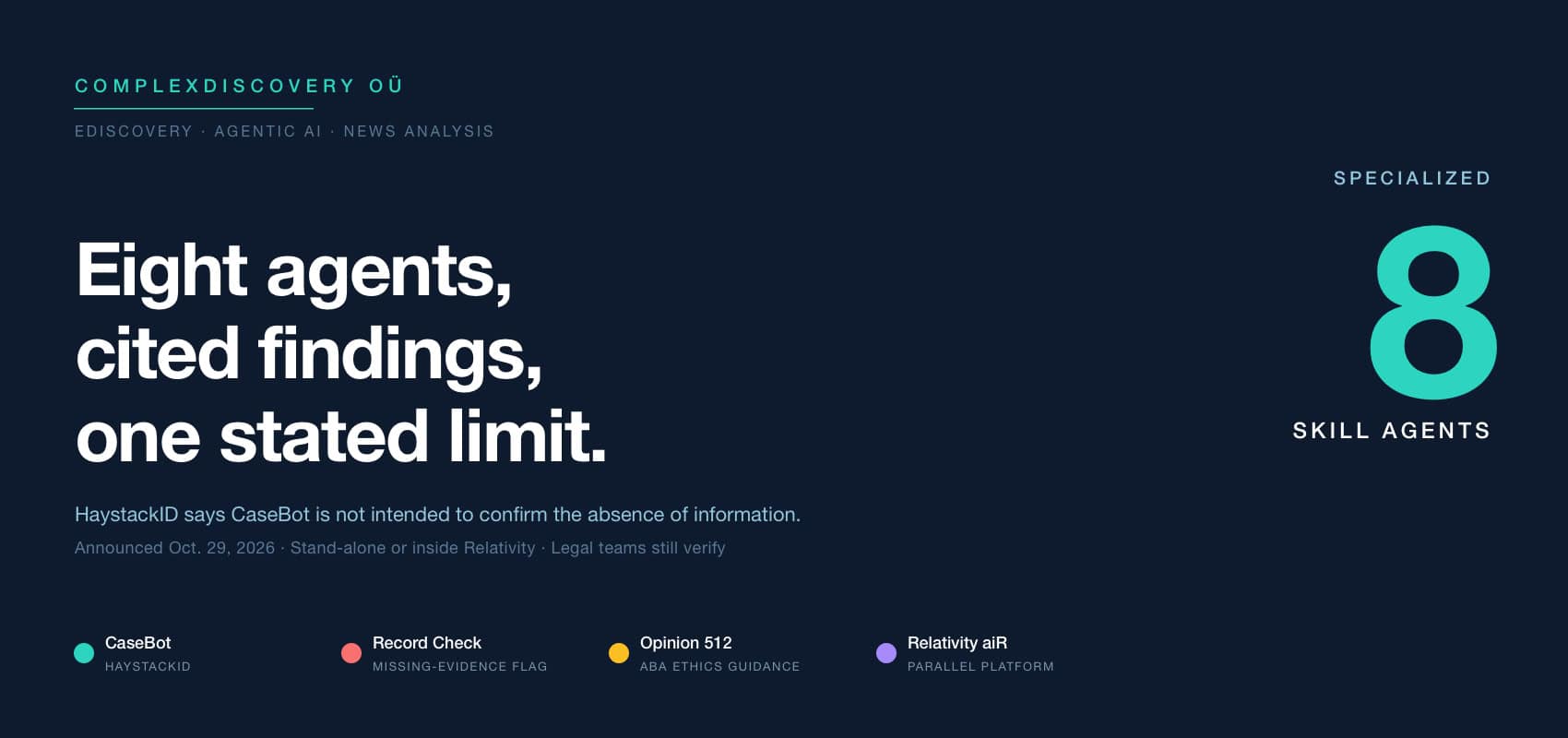
What the eight Skill Agents produce
HaystackID sorts the agents into two groups of four. The fact development group builds an understanding of the record: Fact Narrative writes an evidence-backed account of events, Chronology assembles a source-supported timeline, and Entity Map traces people, organizations and their relationships. Hot Document Finder, the fourth, surfaces documents with potential factual, strategic or evidentiary value.
The case preparation group turns that understanding into litigation work product. Deposition Kit prepares witness materials grounded in the documents, and Claim Analysis tests claims or case theories against the evidence for and against them. Request Analysis splits discovery requests into their component issues and then analyzes the record against each request, while Record Check compares testimony, statements or assertions with the documentary record and reports supporting, contradictory or missing evidence.
Each agent returns a structured deliverable that ties its findings to specific documents and passages, according to the release, so a team can check context and test the analysis before it depends on the result. Teams can export the deliverables as formatted PDF reports, which HaystackID said in August would let a team share the analysis with colleagues, clients or experts who lack access to CaseBot itself.
“A deposition kit or a record check has always started with long hours in the documents before the analysis could begin,” said Esther Birnbaum, executive vice president of data intelligence at HaystackID. “Now a team can launch that workflow, see what the record supports, what it contradicts and what is missing, and spend its time on judgment rather than assembly.”
From general availability to an agentic release
The product Birnbaum describes began as something narrower. eDiscovery AI, a company HaystackID announced in February that it had acquired, says it first launched CaseBot in September 2025, and a limited release with founding partners followed in January 2026. CaseBot reached general availability May 11 as a conversational assistant. That version fielded natural-language questions about a matter’s data and returned answers linked to the source documents, and it ran as a stand-alone product or inside Relativity workspaces, according to the May announcement. In that release, Purpose Legal Chief Innovation Officer Jeff Johnson said his company’s clients had seen results with the tool: “Faster answers, source-cited every time, and less time spent hunting through documents.”
eDiscovery AI put the agentic successor into limited beta Aug. 18, with general availability planned for September. HaystackID previewed it at ILTACON 2026, held in Nashville later in August. In a product blog published Aug. 23, the company said first-generation discovery chatbots, the original CaseBot among them, relied on a single retrieval pass. The post said Jim Sullivan, founder and chief executive officer of eDiscovery AI, told a prelaunch briefing that retrieval, not answer generation, had been the weak link. It also said Record Check grew out of a law firm telling HaystackID it had tried eight tools for checking transcripts against the facts and found none that could manage the job.
“Legal teams do not need another tool that answers a question and stops,” said Chad Pinson, chief executive officer at HaystackID. In his account, teams need help “with the work that follows: building the narrative, preparing the witness and checking the record,” and CaseBot ties each finding to a source that an attorney can inspect.
Why a missing-evidence flag is not an absence finding
Checking the record is also where the release draws its firmest line. Record Check, by HaystackID’s description, identifies evidence that is missing for a tested assertion, yet the same release disclaims any role in confirming that information is absent. The two statements fit together once two limits on any search are clear, and practitioners should carry both into their reading of a result.
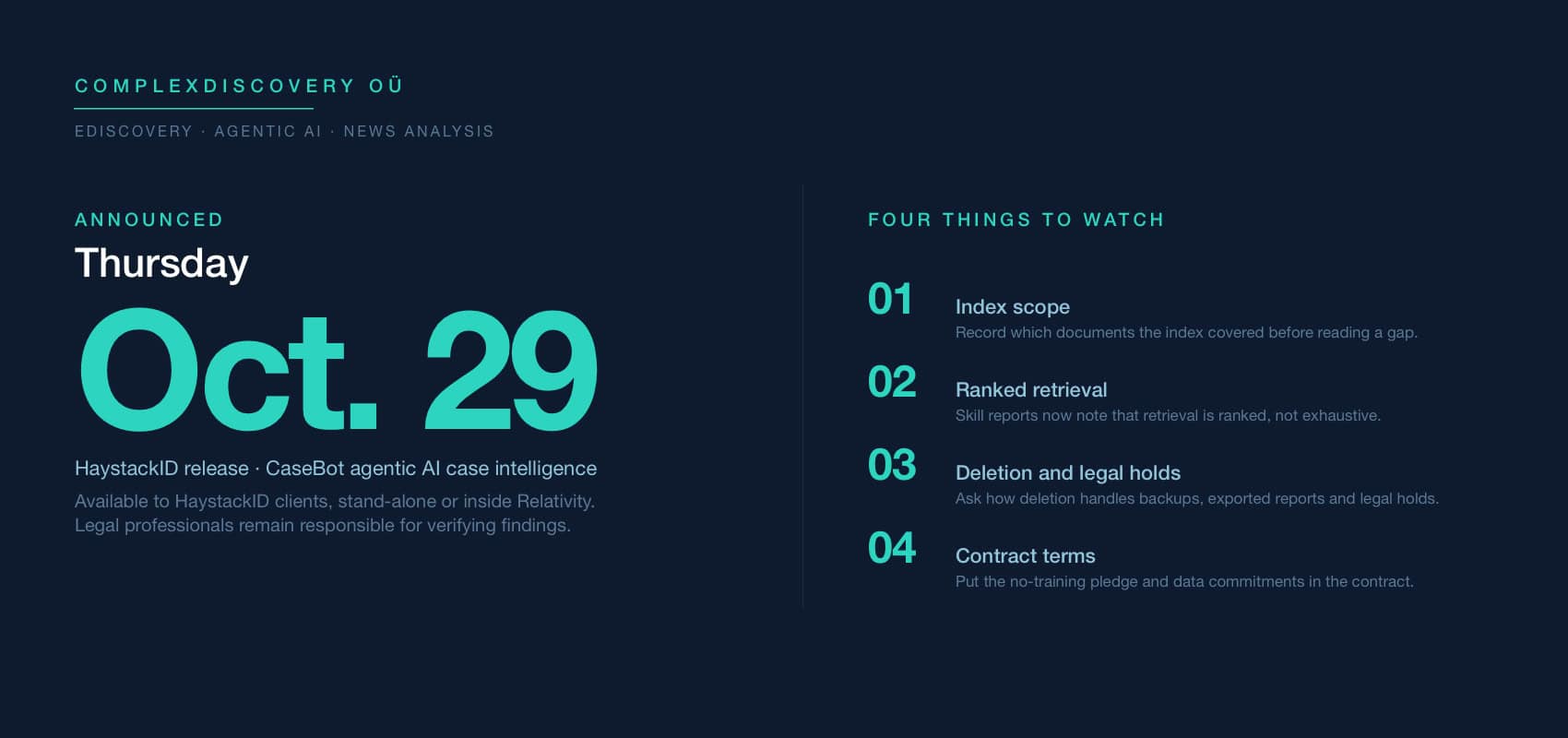
The first limit is scope. According to the release, CaseBot builds its matter index only from the documents chosen for the project, which may be the whole population, the relevant set or a narrower targeted subset. A gap the agent reports therefore describes, at most, the material it was given, which may be narrower than the full collection and never reaches data that was not collected.
The second limit is retrieval. According to eDiscovery AI’s Oct. 20 release notes, every skill report “now notes that document retrieval is ranked, not exhaustive.” HaystackID’s August blog likewise says CaseBot keeps searching “until it has assembled sufficient evidence to support a structured analysis,” so a relevant document inside the index can still go unsurfaced. Read that way, a missing-evidence flag is a lead for follow-up review rather than a finding that the evidence does not exist. Teams that run Record Check should record which document population the index covered, so anyone reading the result later knows what was in scope and what a follow-up search still needs to test.
ABA guidance ties verification to the tool and the task
How much follow-up is enough is a question the profession’s ethics guidance has already framed. Formal Opinion 512, issued July 29, 2024, by the American Bar Association’s Standing Committee on Ethics and Professional Responsibility, addresses lawyers’ use of generative AI tools. The opinion says it “is based on the ABA Model Rules of Professional Conduct as amended by the ABA House of Delegates through August 2023,” and it is ethics guidance rather than a court rule. It says relying on a tool’s output without “an appropriate degree of independent verification or review” could violate the duty of competent representation under Model Rule 1.1.
The right amount of review “will necessarily depend on the GAI tool and the specific task that it performs,” the opinion says, using GAI as its shorthand for generative AI. Its example is a lawyer who tested a tool’s contract summaries against a manually reviewed subset and found them accurate, and who then would not necessarily need to check every contract by hand. Whatever level of review a lawyer picks, the opinion adds, “the lawyer is fully responsible for the work on behalf of the client.”
Source links can lower the cost of that review without moving the responsibility. A team adopting the Skill Agents could apply the opinion’s testing principle by running an agent on a closed or well-understood matter and comparing the deliverable with work the team already trusts. The opinion says a tool built for legal work may require less review, “particularly where a lawyer’s prior experience with the GAI tool provides a reasonable basis for relying on its results.” It still ties the amount of review to the specific task, so a good result on one matter informs the review a later matter needs without settling it.
Relativity is building toward the same finished work
The same testing discipline applies to any vendor’s tool, and HaystackID is not alone in selling deliverables rather than answers. One parallel effort comes from Relativity, whose platform CaseBot can run inside. Relativity added aiR for Case Strategy, which extracts key facts, organizes chronologies and summarizes witnesses and key evidence, to the standard RelativityOne rate on July 1. On Sept. 16, Relativity renamed the RelativityOne platform Relativity aiR, a name it had previously used for its suite of agentic AI capabilities. At its RelFest Chicago conference, which opened Sept. 29, Relativity said KPMG and three global law firms had joined the Advanced Access program for claiR, a conversational AI tool it says is designed specifically for lawyers. Relativity says claiR will let legal teams “go from plain-language questions to finished work,” including memos. The company plans general availability in early 2027 and expects to include claiR in Relativity aiR pricing at no additional cost. HaystackID’s Oct. 29 release does not state CaseBot pricing.
One of the lawyers quoted in that announcement framed the buyer’s test in terms close to HaystackID’s own. “Clients don’t just want faster answers, they want answers they can rely on,” said Alison Grounds, managing partner of Troutman eMerge, in Relativity’s announcement of the claiR Advanced Access program.
HaystackID’s revenue chief describes that test from the seller’s side. “Clients are building AI requirements into their 2027 provider evaluations, and the questions have moved from speed to defensibility,” said Nate Latessa, chief revenue officer at HaystackID. He said those clients ask three things: whether a finding leads back to its source, whether evidence cutting the other way comes to light and whether their data remains protected.
Index retention and the training pledge as diligence items
The third of those questions is where the release makes its most specific commitments. HaystackID says client documents, prompts and responses “are never used to train, fine-tune or otherwise modify any language model,” and that client data “is not sent to third parties.” CaseBot runs in a secure Microsoft Azure environment, the company says, encrypting client data and keeping each client’s processing and storage in separate containers. Those are vendor representations, and the release does not name the language models CaseBot uses. Security and privacy teams can ask for the training and third-party commitments in the contract itself. Opinion 512 points the same way. As a baseline, it says, lawyers “should read and understand the Terms of Use, privacy policy, and related contractual terms and policies” of any such tool, or consult a colleague or outside expert who has analyzed them.
Retention deserves the same attention. The release says the matter index lasts as long as the project and is deleted at the earliest of three events: the project’s close, the matter’s close in Relativity or a request for deletion. The release does not say how that deletion reaches backups or PDF reports a team has already exported, or how it interacts with a legal hold. Those are questions to put to the vendor before a matter closes. HaystackID’s August blog advised teams to raise index retention when they scope a matter and set its governance. Information governance staff can act on that advice by adding the index to the matter’s data map and closing checklist, since it is a data store built from client documents that can outlast any single session.
CaseBot is available now to HaystackID clients, either on its own or inside Relativity, and works alongside the company’s Case Insight early-assessment tool. The release’s own limit remains the most practical place to start an evaluation, because agents that report what the record supports, contradicts and lacks still leave an attorney to decide whether a gap is real. When Record Check reports that evidence for an assertion is missing, what will your team check before treating that silence as an answer?
News Sources
- HaystackID Expands CaseBot Into Agentic AI Case Intelligence With Eight Specialized Skill Agents (HaystackID, Oct. 29, 2026)
- HaystackID expands CaseBot into agentic AI case intelligence with eight Specialized Skill Agents (HaystackID via PR Newswire, Oct. 29, 2026)
- Formal Opinion 512: Generative Artificial Intelligence Tools (American Bar Association Standing Committee on Ethics and Professional Responsibility)
- eDiscovery AI Officially Releases CaseBot™ (HaystackID via PR Newswire)
- HaystackID Acquires eDiscovery AI to Accelerate Client-Driven GenAI Workflows (HaystackID)
- eDiscovery AI Introduces Next Generation of CaseBot™ (eDiscovery AI)
- eDiscovery AI Release Notes: October 20, 2026 (eDiscovery AI Help Center)
- Relativity Announces Generative AI-Powered Solution for Case Intelligence Now Standard in RelativityOne (Relativity)
- RelativityOne Is Now Relativity aiR: The AI Platform for Legal Data Intelligence (Relativity)
- At RelFest Chicago, Relativity Announces KPMG and Three Global Law Firms to Join Relativity claiR Advanced Access Program (Relativity)
- eDiscovery AI Launches CaseBot, a Conversational AI Assistant for Case Data (LawSites)
- Next-Generation CaseBot™ Turns Case Data Into Instant, Defensible Insights (HaystackID)





Assisted by GAI and LLM Technologies
Additional reading
- Ransomware logs and Copilot memory put AI agent records on the eDiscovery agenda
- 5th Circuit reassigns Mississippi DEI case after judge’s orders cite fabricated parties, quotations and a nonexistent case
- An AI agent can write the story, but EU law asks whether a human reviewed it
- An Oxford tutorial for newsroom leaders who must learn faster than the news
- An Oxford tutorial for cybersecurity, governance and eDiscovery
- Estonia aims to be first to give AI agents official digital IDs
- Parliament hits pause on high-risk AI rules and bans nudifier apps
- Europe’s AI labeling rules arrive with a voluntary code and a hard deadline
- AI is becoming an advisor, and it is rewriting how buyers find you
Source: ComplexDiscovery OÜ

ComplexDiscovery’s mission is to enable clarity for complex decisions by providing independent, data‑driven reporting, research, and commentary that make digital risk, legal technology, and regulatory change more legible for practitioners, policymakers, and business leaders.