
Editor’s Note: Ireland’s Data Protection Commission (DPC) announced on Nov. 13, 2026, a fine of 11 million euros and a reprimand against MTCH Technology Services Ltd., the Match Group unit behind the Tinder service, and ordered it to make its processing compliant within three months. The DPC found that Tinder’s Download My Data tool, offered as a way for users to get a copy of their personal data, left certain categories out without notice or supplied them only in summary form, breaching Article 15(3) of the EU’s General Data Protection Regulation, which entitles people to a copy of the personal data a company processes about them. Match Group says it has strong defenses and intends to appeal, and court records show MTCH opened High Court proceedings against the DPC on Nov. 6, though not their subject.
For cybersecurity, privacy, compliance and eDiscovery professionals, the case shows how a regulator views exports that answer data subject access requests: the DPC’s deputy commissioner said such tools may be partial but must be transparent about how much data they provide. Watch whether the full decision names the omitted categories, how the court case proceeds and pending EU access-request changes.
Content Assessment: Tinder's Download My Data tool draws Irish fine of 11 million euros over incomplete exports
Information - 94%
Insight - 93%
Relevance - 92%
Objectivity - 93%
Authority - 92%
93%
Excellent
A short percentage-based assessment of the qualitative benefit expressed as a percentage of positive reception of the recent article from ComplexDiscovery OÜ titled, "Tinder's Download My Data tool draws Irish fine of 11 million euros over incomplete exports."
News Analysis – Data Privacy and Protection Beat
Tinder’s Download My Data tool draws Irish fine of 11 million euros over incomplete exports
ComplexDiscovery Staff
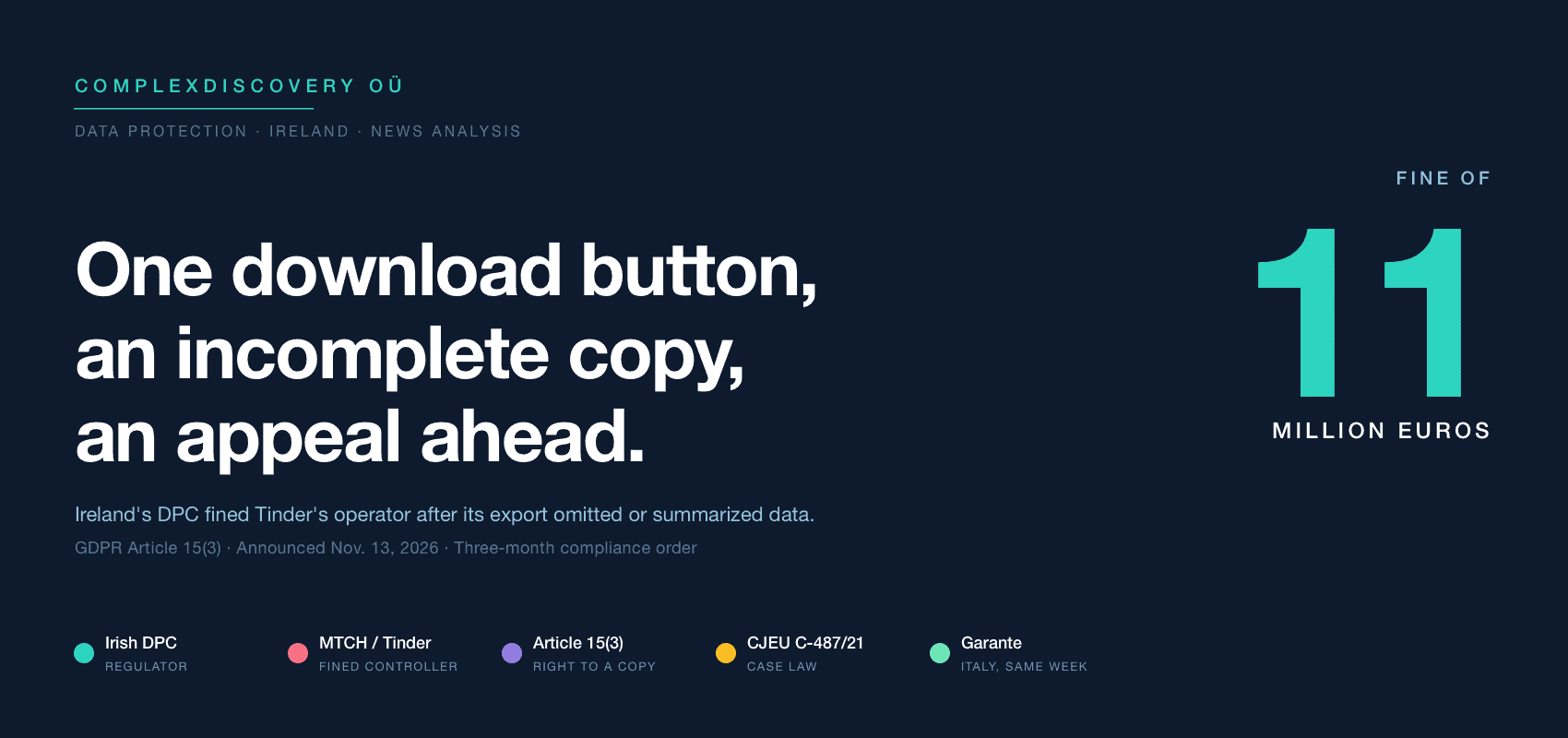
Tinder offered its users a self-service Download My Data tool, presented as a way to get a copy of their personal data. Ireland’s Data Protection Commission (DPC) said Nov. 13 that the copy was incomplete and announced a fine of 11 million euros and a reprimand against MTCH Technology Services Ltd., the Match Group unit behind the Tinder service.
The regulator’s quarrel was not with self-service exports as such, which the DPC’s deputy commissioner said can be an efficient way to give people their data. Its finding was narrower and, for anyone who builds exports, more exacting. Certain categories of information were left out without notice to users, or supplied only in summary form, while the app offered the tool as a route to a copy of their data.
That gives anyone who answers data subject access requests (DSARs) through an export, and any litigator who uses those requests to gather evidence early, a regulator’s marker of where a download stops counting as a copy. The marker is a rough one for now, because the full decision is not yet public and the company has said it will contest it.
Inside the regulator’s finding on the download file
According to the DPC’s announcement, the decision centers on Article 15(3) of the General Data Protection Regulation (GDPR). That provision requires a controller to provide “a copy of the personal data undergoing processing.” The DPC said the tool failed to give users all of their personal data and that what it did provide did not meet the GDPR’s requirements for the right of access. Alongside the fine, the commission ordered MTCH to make its processing compliant within three months. Commissioners for Data Protection Des Hogan, Dale Sunderland and Niamh Sweeney took the decision.
Deputy Commissioner Graham Doyle described what the DPC expects of automated access tools. Such tools need not deliver a complete copy of a user’s data, he said in the DPC’s announcement, but they must be “fair and transparent to individuals regarding the extent of the data provided.” Doyle also said tens of thousands of people used the tool in the period under review, and the commission gave no exact figure.
His comment and the finding fit together once the duty is placed on the company rather than on the button, though Doyle’s remarks are press-release commentary rather than the decision’s published reasoning. Article 15(3) obliges the controller, not any particular channel, to supply the copy, and a self-service tool is only one of the ways a company can meet that duty. On Doyle’s account, a tool may deliver part of the record if it is honest about how much it delivers. The DPC’s finding is that MTCH failed users who requested a complete copy, through a tool that did not tell them what it left out.
EU law already defines what a copy requires
The DPC’s announcement does not cite case law, and its reasoning will stay private until the commission publishes the full decision, which it has said it will do in due course. The European Union’s highest court has already said what a copy means, though. In May 2023, in Case C-487/21, the Court of Justice of the European Union (CJEU) answered questions from an Austrian court about CRIF, a consultancy that tells its clients how creditworthy other people are. The applicant had asked CRIF for his data and received, in summary form, a list of what it held.
The court held that the right to a copy means the person must receive “a faithful and intelligible reproduction of all those data.” A general description of the data, or a reference to the categories it falls into, does not meet that definition, the judgment said. Where a full copy would collide with other people’s rights, the court said, those rights must be balanced, but the outcome should not leave the requester with no information at all.
The European Data Protection Board (EDPB), which coordinates the bloc’s regulators, treats self-service tools as an acceptable way to provide access in its Guidelines 01/2022, which interpret the regulation without being law themselves. Where a tool cannot deliver everything the right of access covers, the guidelines say the remainder must be provided another way. They also allow a layered presentation only for controllers holding a large quantity of a person’s data, where the person would struggle to grasp it all at once. Access to later layers cannot depend on a new request.
Match Group plans to appeal the decision
The company on the other side of that standard disputes the finding. Match Group Inc., the Dallas-based parent, filed a quarterly report with the Securities and Exchange Commission (SEC) on Nov. 3. In it, the company said the DPC’s final decision came on Oct. 13, that it believes it has strong defenses and that it intends to appeal. The filing records a $12.6 million provision for the matter in the nine months ended Sept. 30, and the company’s August quarterly filing had recorded $9.1 million of it for the quarter ended June 30. A Match Group spokesperson said Tinder had taken part in the DPC’s investigation from start to finish and that “we stand behind the privacy protections we’ve built for our users,” according to TheJournal.ie.
The company’s filings frame the dispute as one over user protection. Match said a preliminary draft decision the DPC sent on Jan. 8, 2024, alleged that some of Tinder’s policies on access and retention breached the GDPR. The company described those policies as “largely relating to protecting the safety and privacy of Tinder’s users.” In 2020, The Irish Times reported that Tinder had told the DPC, in correspondence on one complaint, that it would not hand over messages other users had sent the complainant. Whether the categories in the final decision include material of that kind will not be known until the decision text appears.
Match’s own estimates moved as the case advanced. Its first-quarter 2024 filing put a reasonably possible loss anywhere from a nominal amount to $60 million. Its August 2026 filing said a July 9 draft decision proposed a fine between 8 million and 11 million euros, and the DPC imposed the top of that range. For breaches of data subject rights, Article 83(5) of the GDPR allows fines of up to 20 million euros or, for an undertaking, 4 percent of total worldwide annual turnover for the preceding financial year, whichever is higher.
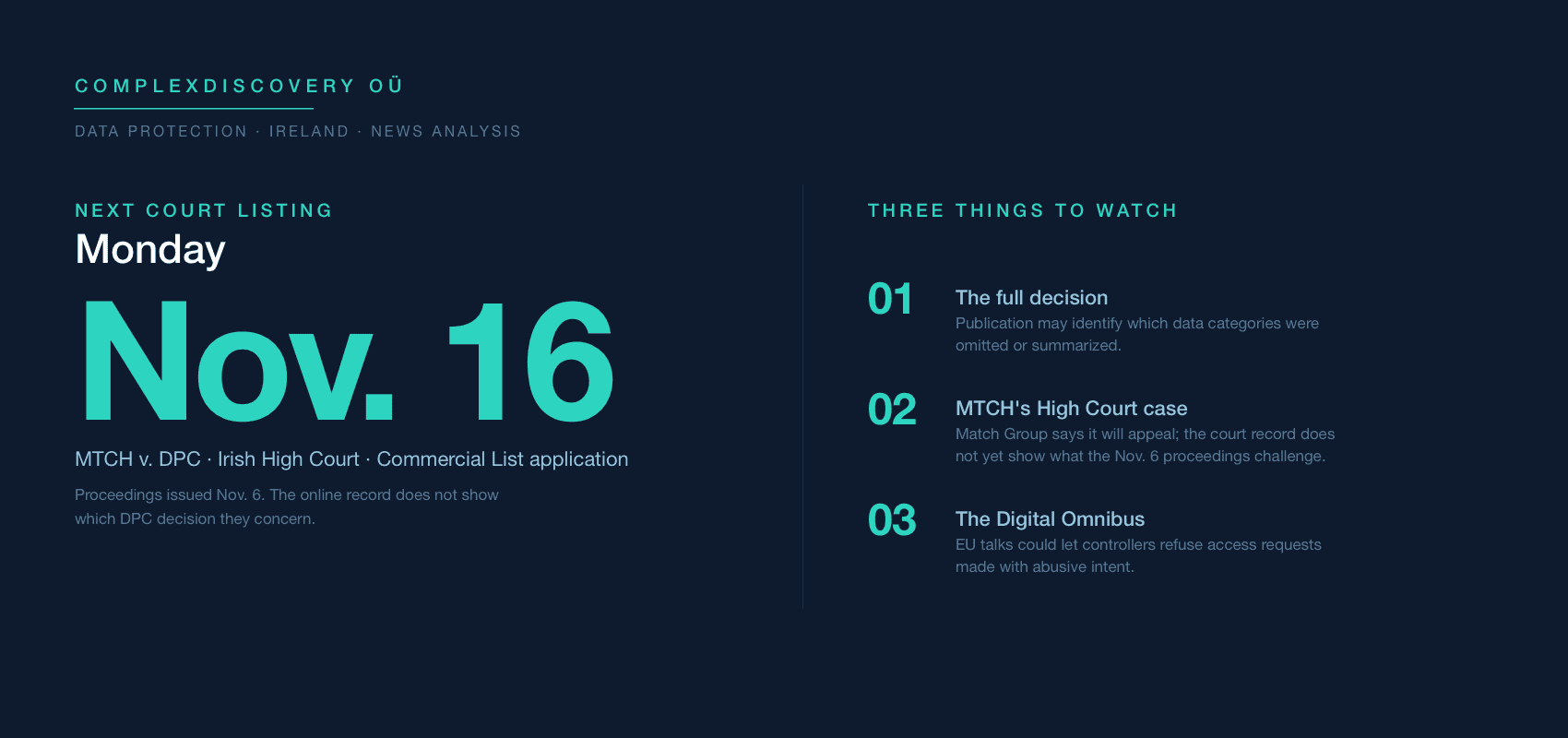
The decision remains open to challenge, and court records suggest the appeal Match has promised may already be underway. The Irish Courts Service’s online High Court record shows that MTCH issued proceedings against the DPC on Nov. 6. It filed an originating notice of motion, a second motion and affidavits, and the DPC entered an appearance on Nov. 11. The record does not show the documents’ contents, so it does not establish which DPC decision the case concerns. The case is listed for Nov. 16 on an application to enter the High Court’s Commercial List, and no orders had been made as of Nov. 13.
A statutory appeal would run through Ireland’s Data Protection Act 2018, under which a company fined over 75,000 euros may appeal to the High Court within 28 days of the date notice of the decision was given. The court may then confirm the decision, replace it with a different fine or none, or annul it. The DPC says its fines are not payable until a court confirms them and cannot be collected while an appeal is pending.
The route itself is still being litigated. An April 2026 High Court ruling in LinkedIn’s appeal of a separate DPC fine held that the fine-appeal provision covers only the fine, according to an analysis by law firm Byrne Wallace Shields. Challenges to infringement findings therefore run under Section 150 of the act, and the same ruling found that a fine can also be challenged under Section 150, the firm said. In an Oct. 9 determination, the Supreme Court gave the DPC leave to appeal three other preliminary issues directly from the High Court, on how closely a court reviews the DPC’s decisions and when it can admit new evidence. It also gave LinkedIn liberty to cross-appeal on the route question itself, and it said the appeal was likely to be heard in early 2027.
Nearly seven years, and questions still open
Whatever the courts decide, the case has already run a long course. The DPC opened the own-volition inquiry in January 2020 as lead supervisory authority for MTCH and announced it on Feb. 4, 2020. That announcement said the inquiry would examine whether the company had a legal basis for processing Tinder users’ data, how transparent the processing was and how it handled rights requests. Match’s filings say the inquiry also covered deletion requests and data retention policies.
The Nov. 13 announcement describes only the access finding. Whether the final decision reaches retention, deletion or other issues will be clear only when the text is published. The announcement concerns Tinder alone and names no other Match Group brand, and it credits other EU supervisory authorities with cooperating on the case without mentioning any referral to the EDPB for dispute resolution.
The three-month compliance clock carries its own uncertainty. Neither the DPC nor Match has said publicly when the period began, and the deadline for changes to Tinder’s tool will stay unclear until one of them does or a court addresses the order.
Rome publishes a late-reply fine the same week
Dublin was not the only regulator publishing an access-rights penalty that week. The Irish announcement came a day after Italy’s data protection authority, the Garante per la protezione dei dati personali, published a penalty of its own in its Nov. 12 newsletter. The Garante fined Techpartner Srl, a Modena supplier of equipment for the food industry, a total of 25,500 euros in a decision dated Oct. 20.
Of that total, 9,500 euros punished the company for answering a former employee’s access request about nine months after it was made, and only after the Garante had opened its inquiry. The GDPR sets a one-month deadline, extendable by two months where necessary given the complexity and number of requests, and the controller must tell the requester of any extension within the first month and explain the delay. The remaining 16,000 euros concerned former employees’ email accounts that the company kept active and readable after their jobs ended. The Garante said an access request must be answered on time even when it is part of a broader request about employment matters.
The two cases test different failures. Rome punished a reply that came about nine months after the request, while Dublin punished a self-service export that users could run on demand but that did not give them all of their data.
DSARs as discovery, and the export as evidence
The Italian request came wrapped in an employment matter, and access requests made with a dispute in view are not new. The EU’s top court has said the motive does not disqualify them. In October 2023, in Case C-307/22, the CJEU held that a controller must provide a first copy free of charge and that the requester need not give reasons. The requester in that case was a patient who wanted his records to assess a possible claim against his dentist.
That reading may narrow. The European Commission’s Digital Omnibus proposal of Nov. 19, 2025, would amend Article 12(5) of the GDPR, according to law-firm summaries of the text. Controllers could refuse or charge for requests where a person abuses GDPR rights for purposes other than protecting their data. The Council of the EU agreed its negotiating mandate on Oct. 21, 2026, keeping a narrower version built around requests made with abusive intent, according to a summary by law firm Cuatrecasas. As of Nov. 14, the European Parliament’s legislative tracker still listed the file as awaiting a committee decision, and the current rules remain in force.
For counsel who rely on DSARs, the Tinder decision suggests a practical sequence. Request the full Article 15 response rather than accepting a download alone. Compare the categories returned against the platform’s privacy notice and the information Article 15(1) lists, and ask in writing whether anything was omitted or summarized before relying on the file. Keep dated copies of what the tool produced, because its output on a given day may become the evidence.
Checks for compliance teams before the next inquiry
The same sequence works in reverse for the companies on the receiving end. A team that answers access requests through a portal should map every system that holds user data against the systems that feed the export, then record the categories the export leaves out or reduces to summaries. Where the tool is partial, it should say so, and the team should supply the rest of what the request covers through another channel without making the person ask again, subject to any restriction the law allows.
Version control matters as much as design. The DPC assessed a past period of the tool’s operation and reached its decision years after the inquiry opened. The export a company ships this quarter may be judged long after the engineers who built it have moved on, and release notes and sample outputs kept for each version give the company a record to answer with.
Professionals should watch for three things: publication of the full decision, which may identify the omitted categories; the next steps in MTCH’s High Court case; and the Digital Omnibus negotiations on access requests. Tinder presented its button as a way to get a copy of one’s data, and the regulator found the file did not say what was missing. If a regulator pressed your company’s download button tomorrow, would the file tell it what was left out?
News Sources
- Data Protection Commission fines MTCH €11 million following Inquiry into Tinder users’ personal data requests (Data Protection Commission)
- Data Protection Commission launches Statutory Inquiry into MTCH Technology Services Limited (Tinder) (Data Protection Commission)
- Fines (Data Protection Commission)
- MTCH Technology Services Limited v Data Protection Commission, H.MCA.2026.0000605 (Courts Service of Ireland, High Court Search)
- Linkedin Ireland Unlimited Company -v- Data Protection Commission, [2026] IESCDET 124 (Courts Service of Ireland)
- Form 10-Q (Match Group via SEC EDGAR, Nov. 3, 2026)
- Form 10-Q (Match Group via SEC EDGAR, Aug. 5, 2026)
- Form 10-Q (Match Group via SEC EDGAR, May 8, 2024)
- Data Protection Act 2018 | Law Reform (Law Reform Commission, Revised Acts)
- Regulation (EU) 2016/679 (General Data Protection Regulation) (EUR-Lex)
- Art. 15 GDPR: Right of access by the data subject (gdpr-info.eu)
- Art. 12 GDPR: Transparent information, communication and modalities for the exercise of the rights of the data subject (gdpr-info.eu)
- Art. 83 GDPR: General conditions for imposing administrative fines (gdpr-info.eu)
- Judgment of the Court (First Chamber), 4 May 2023, Case C-487/21 (Court of Justice of the European Union)
- GDPR: the right to obtain a ‘copy’ of personal data means that the data subject must be given a faithful and intelligible reproduction of all those data (Court of Justice of the European Union)
- Case C-307/22, FT (Copies of medical records): Judgment of the Court (First Chamber) of 26 October 2023 (EUR-Lex)
- Guidelines 01/2022 on data subject rights: Right of access (European Data Protection Board)
- NEWSLETTER del 12 novembre 2026 (Garante per la protezione dei dati personali)
- 14756/26: Digital Omnibus, Mandate for negotiations with the European Parliament (Council of the European Union)
- Procedure File: 2025/0360(COD) | Legislative Observatory | European Parliament (European Parliament)
- Data watchdog fines Tinder owner €11m over privacy failures (TheJournal.ie)
- No obligation to release entire chat logs, Tinder tells DPC (The Irish Times)
- High Court: Court determines preliminary issues in LinkedIn appeal of 2024 DPC decision (Irish Legal News)
- DPC Enforcement Update: Lessons from PTSB, University of Limerick and the LinkedIn Appeal (Byrne Wallace Shields)
- Digital Omnibus: EU Council establishes position (Cuatrecasas)
- DSARs and the Digital Omnibus: What the Leaked Draft Reveals (McCann FitzGerald)
- Has the EU been “Sic In Omnibus”? Or do all roads lead to a new world of Data and AI EU deregulation? (Lewis Silkin)





Assisted by GAI and LLM Technologies
Additional reading
- Notion AI chats surface in Fireworks breach, testing what zero retention covers
- France ties October supermarket fridge sabotage to Iran’s IRGC and seeks arrest warrants
- ENISA’s update advisory turns the patch pipeline into an evidence trail
- Britain’s cyber agency warns of a possible surge, and its own incident figures raise a question
- Supermarket freezer attacks reach at least six European countries, and the record linking them to US base failures stays thin
- Microsoft finds 2 North Korean groups using ARTEX, a tool that alone cannot name an attacker
- With over 40 percent of the record Binance theft frozen, getting it back becomes a legal project
- Estonia’s cyber authority saw no state-sector PHP crisis as three state institutions shut or restricted services
- AI recording spreads in Estonian health care as the regulator says the audio needs its own legal basis
Source: ComplexDiscovery OÜ

ComplexDiscovery’s mission is to enable clarity for complex decisions by providing independent, data‑driven reporting, research, and commentary that make digital risk, legal technology, and regulatory change more legible for practitioners, policymakers, and business leaders.