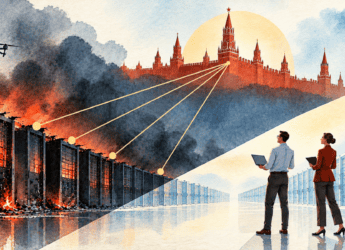

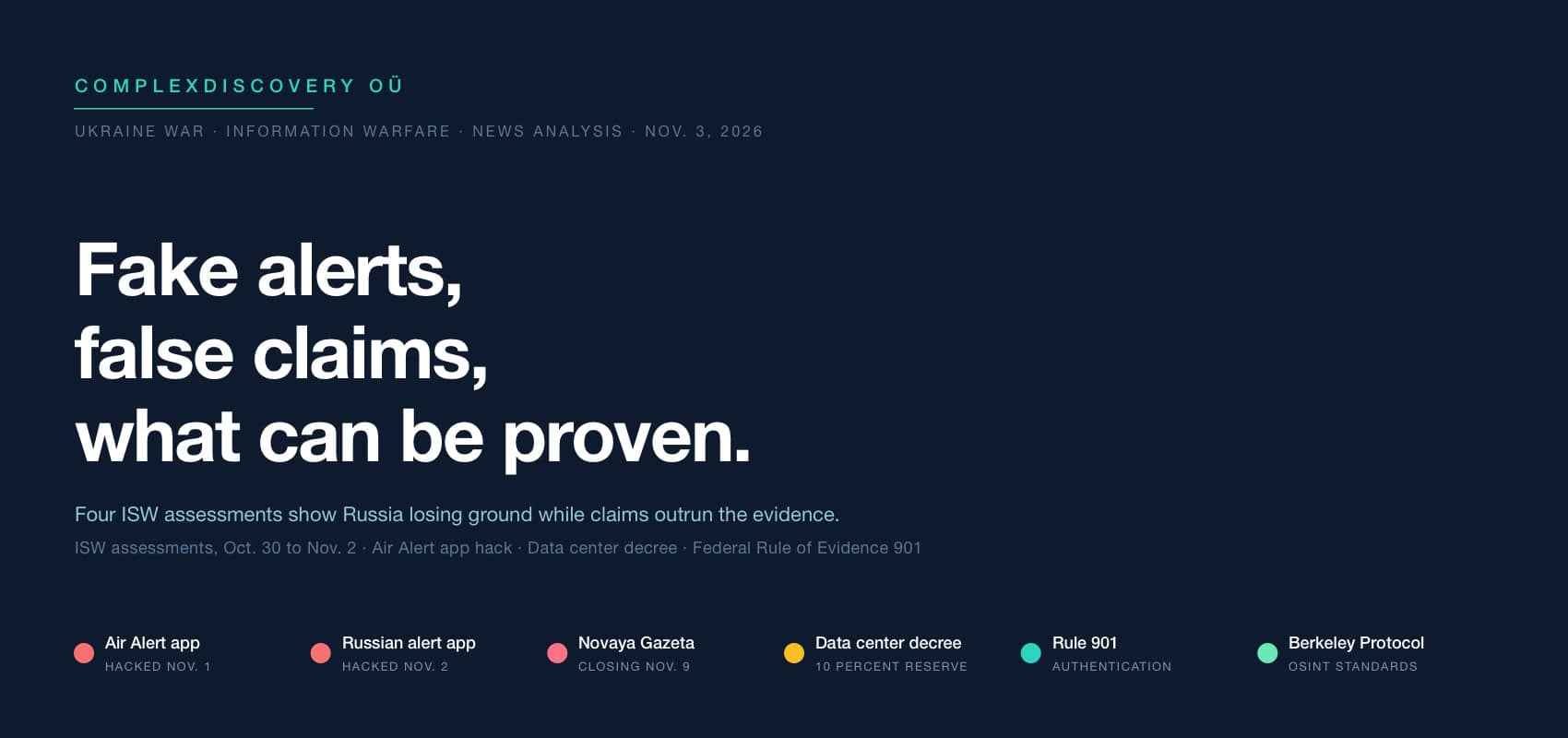
Editor’s Note: Ukraine’s Air Alert app pushed false nuclear warnings late Nov. 1, 2026, after what developers called unauthorized interference. Hours later, Russia’s emergencies ministry said its own app was used to send fake information, and Ukrainian President Volodymyr Zelenskyy said Ukraine hacked it in response. The hoaxes capped four assessments from the Institute for the Study of War (ISW), a Washington research group. ISW reported that Russian forces lost a net 27.29 square kilometers in October, and Ukraine’s General Staff counted 54,400 Russian troops killed or seriously wounded that month. ISW also called Vladimir Putin’s July claim to have captured Kostyantynivka false. In the same days, the independent newspaper Novaya Gazeta said authorities are forcing it to close, and it will cease operations by Nov. 9. Putin also ordered private Russian data centers to reserve 10 percent of capacity that a government body can direct to Russian information resources.
For cybersecurity, data privacy, compliance and eDiscovery professionals, the lesson: a record can be authentic and still false, because authentication under U.S. Federal Rule of Evidence 901 asks whether an item is what it is claimed to be, not whether its content is true. Watch for further alert-system intrusions and Russia’s winter strikes.
Content Assessment: Spoofed nuclear alert caps four days of Ukraine war assessments that separate claims from evidence
Information - 94%
Insight - 93%
Relevance - 90%
Objectivity - 90%
Authority - 94%
92%
Excellent
A short percentage-based assessment of the qualitative benefit expressed as a percentage of positive reception of the recent article from ComplexDiscovery OÜ titled, "Spoofed nuclear alert caps four days of Ukraine war assessments that separate claims from evidence."
News Analysis – Geopolitics Beat
Spoofed nuclear alert caps four days of Ukraine war assessments that separate claims from evidence
ComplexDiscovery Staff
A push notification sent to Ukrainian phones late Nov. 1 warned of a nuclear attack that never came, after attackers interfered with the officially supported Air Alert app, Ukrainian authorities said. Hours later, Russians received a similar fake warning on a government app. The paired hoaxes closed a four-day stretch in which the Institute for the Study of War (ISW) documented a Russian army losing ground while the Kremlin worked to shape how audiences at home and abroad understand the war.
ISW, a Washington-based nonprofit research organization that describes itself as nonpartisan and says its work supports U.S. strategic objectives, publishes a daily Russian Offensive Campaign Assessment. Unless otherwise noted, figures, assessments and official statements in this article come from its reports for Oct. 30 through Nov. 2. Those reports read as two stories at once: a battlefield account built from geolocated footage and official data, and a running ledger of claims that the evidence does not support. For cybersecurity, information governance and eDiscovery professionals, the second story carries the more durable lesson.
What four ISW assessments say about the front
ISW said it observed evidence that Russian forces lost ground in October for the second consecutive month. They seized or consolidated 139.85 square kilometers while losing 167.14 square kilometers, a net loss of 27.29 square kilometers, or about 0.88 square kilometers per day. Russian gains came only in the Sumy and Zaporizhzhia regions, with losses in every other sector, including the Donetsk region, Moscow’s priority objective.
The human cost on the Russian side rose as the line moved backward. Russian forces suffered 54,400 killed or seriously wounded in October, according to Ukraine’s General Staff. On those figures, October was Russia’s worst month for casualties since the full-scale invasion began in 2022 and the fourth straight month above 40,000. That count comes from the military of one combatant in the war, and readers should weigh it as a belligerent’s tally rather than an independent one.
ISW assessed that Russian forces have lost the initiative in much of the theater but keep it around Dobropillya in the Donetsk region, where most Russian offensive operations are concentrated. Ukrainian forces now hold it around Kupyansk, Lyman and Oleksandrivka, and the two sides are fighting over it in the western Zaporizhzhia region. Ukraine’s Operation Vivaldi defeated the Russian push north of Lyman, and Operation Veles cut off an underground pipeline that Russian troops had used to infiltrate Kupyansk. In Kostyantynivka, which Russian troops first infiltrated in October 2025, they have pushed into about 36.31 percent of the town and have advanced or infiltrated across 75.54 percent of it. Neither side advanced on Nov. 2.
Russia shifts weight to a winter strike campaign
Losing on the ground, Russian President Vladimir Putin has turned to a theory of victory built on a winter drone and missile campaign meant to coerce Ukraine into surrender, ISW assessed. Ukraine’s General Staff reported that Russia launched 6,473 Shahed and Geran strike drones in October and that Ukrainian forces downed 4,859, or 75 percent. Ukrainian Air Force data counted 6,158 launches and 5,169 interceptions, about 84 percent. The reason for the gap is unclear, though the Air Force count adds Gerbera, Italmas and Parodiya-type drones.
Russian long-range strikes have killed or injured over 7,500 Ukrainian civilians so far in 2026, according to ISW’s tally of U.N. human rights monitoring reports through September. On Nov. 2, a Russian airstrike hit Komyshuvakha, southeast of the city of Zaporizhzhia. As of Nov. 3, 29 people were dead and 48 missing, according to Mykhailo Semikin, head of the Zaporizhzhia regional military administration, up from initial reports of at least 18 dead. Ukrainian President Volodymyr Zelenskyy said glide bombs hit a school serving as a humanitarian aid site.
Blunting that winter campaign depends on Patriot interceptors that Ukraine is already short of. The U.S. State Department cleared a possible sale of 500 PAC-3 Patriot interceptors to Ukraine, but reports in Western outlets, citing unnamed sources, put delivery of the newly built missiles after 2030. ISW assessed that Ukraine’s shortage of ballistic missile interceptors will encourage Putin to pursue his winter strategy.
Diplomacy offered little relief. Kremlin spokesman Dmitry Peskov said on Oct. 29 that Moscow rejects a temporary ceasefire and will accept nothing short of a peace settlement. Since Ukraine and the United States agreed on March 11, 2025, to a 30-day ceasefire that Putin rejected, Russian forces have gained 4,122 square kilometers. Over that period, through Oct. 30, Ukraine’s General Staff counted 698,740 Russian casualties. A localized ceasefire in occupied Oleshky, in the Kherson region, began Oct. 27 and allowed a humanitarian mission to proceed. A Ukrainian military spokesman and a Russian official each alleged violations there, which ISW said it could not independently verify. The ceasefire ended as planned Nov. 1, and U.S. first lady Melania Trump said in a statement that the mission enabled the evacuation of nearly 800 people. Kyiv and Moscow have not released their own figures, the Kyiv Independent reported.
The pressure is spilling past Ukraine’s borders. Moldova and Romania each reported two unidentified drones in their airspace on the evening of Oct. 31, and Romania scrambled four F-16s and a helicopter, though neither government publicly blamed Russia. Poland’s Territorial Defense Forces announced a new component to monitor the border with Russia’s Kaliningrad region. Ukraine’s military intelligence directorate reported that a modified Gerbera-2 drone with a range of up to 1,200 kilometers landed on Poland’s Baltic coast in mid-September.
Hoax alerts turn a trusted channel into a weapon
Satellites and software have become contested ground as well. ISW assessed that Russia launched large daytime strike packages Oct. 15 through 17, likely timed to Starshield service disruptions between Oct. 14 and 24 that temporarily weakened Ukraine’s ability to intercept jet-powered drones. Russian forces are also expanding satellite electronic warfare against Ukrainian Starlink use.
The most visible attack on software came late Nov. 1. Ukraine’s Air Force said the public Air Alert app had been hacked, and users received false warnings of nuclear and chemical attacks and street fighting, the Kyiv Independent reported. Ukraine’s Digital Transformation Ministry said other public warning channels, including air raid sirens, kept working, according to AFP and Reuters. The messages were written in Russian, and one told users, “Don’t worry, the Oreshnik is on its way,” naming a Russian intermediate-range ballistic missile.
The app’s developers said “unauthorized persons have interfered with the application” and that push notifications were disabled and the app temporarily suspended. Regional governors told residents there was no threat, and officials warned that the messages might be part of a phishing operation carrying links, the Kyiv Independent reported. The false alerts were gone within about an hour, and the app’s team said it “does not store or use personal data.”
ISW and the Kyiv Independent both described the Nov. 1 intrusion as a Russian cyberattack, while the developers’ own statement referred only to unauthorized persons. Ukrainian officials said the hoax failed to cause panic because it was written in Russian and in an informal tone. Early Nov. 2, Russia’s emergencies ministry said its own mobile app had been hit by “a massive cyberattack, allowing attackers to send fake information to the public,” while maintaining that its main warning infrastructure kept operating, Kyiv Post reported. Zelenskyy told PBS NewsHour later that day that Ukraine had hacked the Russian app in response and that Russia was behind the first attack, according to Kyiv Post. Peskov told reporters on Nov. 2 that the website of the Russian president faces cyberattacks “many times a day, every day,” the Kyiv Independent reported.
Claims, corrections and the evidence standard ISW applies
The alert episode compresses into an hour what the reports show over weeks: assertions travel faster than the evidence behind them. In July 2026, ISW said, Putin falsely announced the capture of Kostyantynivka, a town Russian troops still had not fully taken by November. The institute also assessed that Russia’s Northern Grouping of Forces greatly exaggerates its advances and went as far as inventing an encirclement northeast of the city of Kharkiv, likely to mislead the Kremlin about its own progress.
Narrative pressure extends to diplomacy. Russian Foreign Minister Sergei Lavrov on Oct. 30 claimed Ukrainian long-range strikes show Kyiv is not preparing for negotiations, a framing ISW said was meant to “falsely blame Ukraine” while ignoring Russia’s own daily strikes. After an Oct. 30 Ukrainian strike on a refinery in the Samara region, Peskov and presidential aide Yuriy Ushakov stressed that it contradicted a request from U.S. President Donald Trump, an attempt the institute said was aimed at driving a wedge between Kyiv and Washington.
What distinguishes the assessments is the way ISW labels its own evidence. When Russian milbloggers said on Oct. 30 that Russian attacks were continuing in the northern Sumy region, that day’s report recorded the claim and said analysts did not observe evidence of an advance. When a Ukrainian open-source intelligence channel dated a strike on the Taman electrical substation to Sept. 24, the institute corrected it to Oct. 24, applying the same scrutiny to a Ukrainian source. It says it “uses only publicly available information,” drawing on reporting from all sides, social media and commercial satellite imagery, and its Oct. 30 report lists a cognitive warfare researcher among its analysts.
Censorship and data control reach the server room
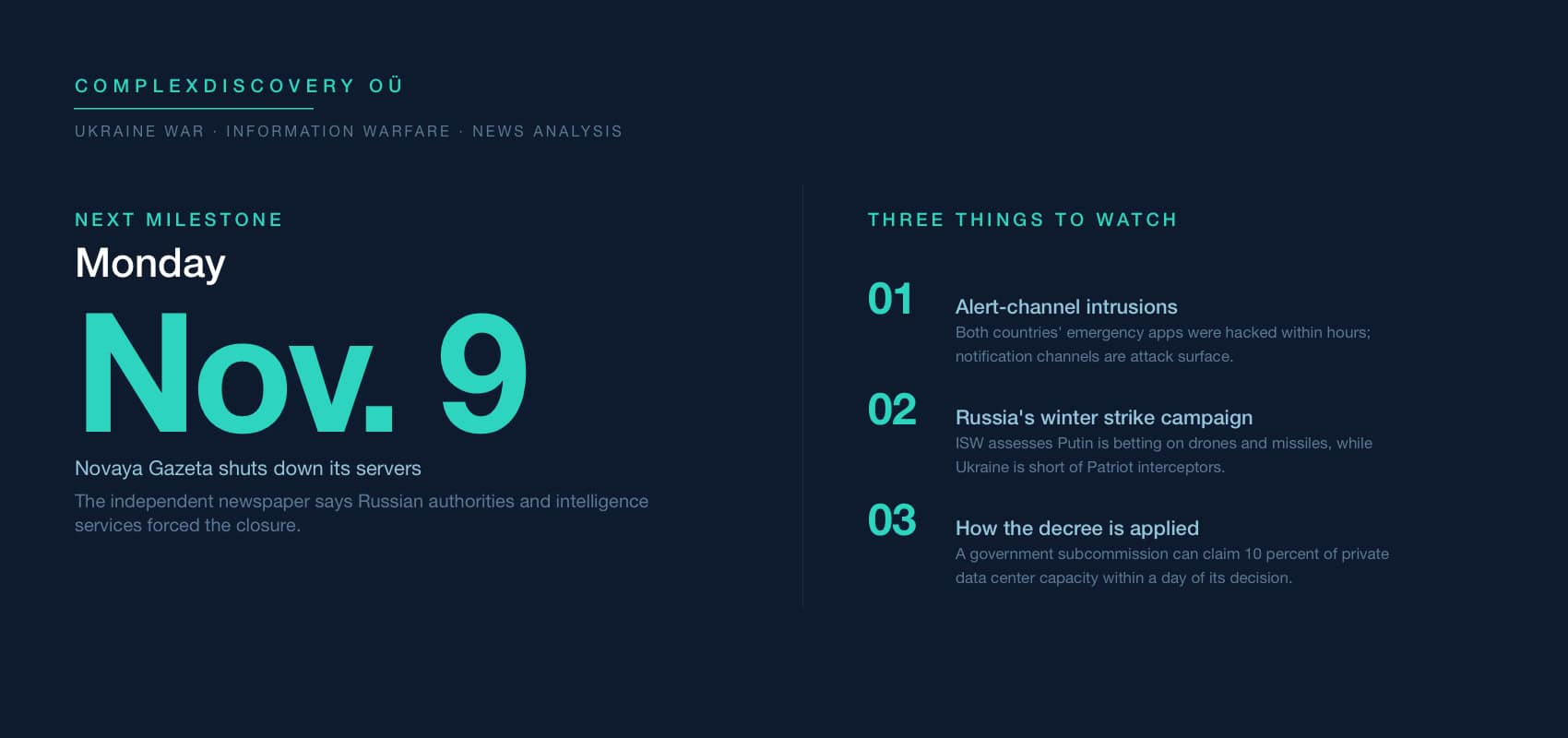
Control of information inside Russia tightened in the same four days. Novaya Gazeta, the independent newspaper whose then-editor Dmitry Muratov shared the 2021 Nobel Peace Prize, announced Oct. 30 that it will cease operations on Nov. 9, saying Russian authorities and intelligence services had forced the editorial staff to stop. “We will shut down the servers and leave,” Editor-in-Chief Sergei Sokolov said in a video statement reported by Al Jazeera, after authorities searched his home earlier in October. ISW tied the closure to the Kremlin’s years-long campaign to dominate Russia’s information space and the story told about the war.
On Nov. 2, Putin signed a decree ordering private data center operators in Russia to reserve 10 percent of their space and capacity, the independent outlet Meduza reported. The Russian business daily Kommersant reported that a government subcommission can direct that capacity to Russian information resources owned by Russian citizens and companies. Operators may keep using it until it is called on but must hand it over within a day of a subcommission decision, according to Kommersant. The subcommission will set maximum compensation and, with Federal Security Service (FSB) approval, can authorize temporary use of foreign data centers. Meduza reported that the decree has entered into force, gives owners 10 days to comply and responds to “unfriendly actions by certain foreign states.”
In October, Ukrainian drones hit data centers run by Yandex, Sber and VK, Meduza reported. ISW read the decree as a push to spread Russian data infrastructure out, including to third countries that Ukrainian drones cannot reach. It also cited a senior executive who told the business daily Vedomosti that Rostelecom is negotiating underground data centers with Nornickel at a cost 30 to 40 percent higher than above-ground sites.
Why authentication is not the same as truth
Data centers, alert apps and newsrooms all generate records, and records are what courts, regulators and investigators eventually test. Under Federal Rule of Evidence 901(a), a party offering an item must produce “evidence sufficient to support a finding that the item is what the proponent claims it is.” The rule sets a threshold for identity, not a finding that the content is true, and an authenticated item can still be excluded on other grounds. A screenshot of the Nov. 1 alert could, in principle, be authenticated as exactly what it appears to be, a message the app displayed, while everything it said was false.
International investigators have written down standards for this kind of work. The Berkeley Protocol on Digital Open Source Investigations, a joint publication of the Human Rights Center at the University of California, Berkeley, and the U.N. Office of the High Commissioner for Human Rights launched in December 2020, sets minimum professional standards for identifying, collecting, preserving, verifying and analyzing online information. The Human Rights Center says the protocol has been translated into all U.N. languages and is used by Ukrainian prosecutors who are documenting alleged Russian war crimes.
For security teams, the alert hack argues for treating notification channels as attack surface, with out-of-band confirmation paths and logs preserved well enough to reconstruct what was pushed, when and by whom. Information governance leaders should map where their records physically sit, because the Russian decree shows a state can claim capacity in private facilities within a day. Discovery practitioners can borrow ISW’s distinction directly, coding each item in a review as a claim, an observation or a verified fact, and preserving the provenance that lets a court tell them apart.
The Oreshnik message was gone within about an hour, but the records of how it reached Ukrainian phones will outlast it only if someone preserved them. When the next spoofed alert, fabricated encirclement or convenient narrative lands in a matter you are handling, will your evidence show only what was claimed, or what can be proven to have happened?
News sources
- Russian Offensive Campaign Assessment, Nov 2, 2026 (Institute for the Study of War)
- Russian Offensive Campaign Assessment, Nov. 1, 2026 (Institute for the Study of War)
- Russian Offensive Campaign Assessment, October 31, 2026 (Institute for the Study of War)
- Russian Offensive Campaign Assessment, October 30, 2026 (Institute for the Study of War)
- Rule 901. Authenticating or Identifying Evidence (Legal Information Institute, Cornell Law School)
- About (Institute for the Study of War)
- Berkeley Protocol on Digital Open Source Investigations (Human Rights Center, University of California, Berkeley)
- Ukraine’s air raid alert system hacked, Russian system targeted hours later (Kyiv Independent)
- Nearly 800 people evacuated from Oleshky, Melania Trump says, as Kyiv, Moscow withhold figures (Kyiv Independent)
- Zelensky Confirms Ukraine Retaliated Against Russian Cyberattack by Hacking Moscow’s Emergency Alert App (Kyiv Post)
- Cyberattacks trigger false emergency alerts in Ukraine and Russia (AFP and Reuters via Arab News)
- Death toll from Russian airstrikes on Komyshuvakha rises to 29 (Ukrainska Pravda)
- Putin orders private data centers in Russia to reserve 10% of their capacity for the state (Meduza)
- Путин подписал указ о резервировании 10% мощностей ЦОДов (Kommersant, in Russian)
- Владельцев ЦОДов обязали резервировать 10% площадей и мощностей для поддержки российских информресурсов (Novosti IT-kanala, in Russian)
- Russia ‘forces’ closure of investigative newspaper Novaya Gazeta (Al Jazeera and AFP)
- What do we know about Russia’s new ballistic missile, Oreshnik? (Al Jazeera, Nov. 22, 2024)

Assisted by GAI and LLM Technologies
Additional reading
- Kyiv says Starshield speeds are back, but who capped them is still disputed
- Diesel license, Starshield cap and intelligence warnings strain US support for Ukraine
- Drones hit two Yandex data centers, and a Kremlin decree sets terms for state management
- A cell tower near Lyman and Russia’s fight over its own war record
- How a general’s walk across a bridge tested Putin’s claim to Svyatohirsk
- Germany names Russia for the Leipzig drone, and keeps most of its evidence out of view
- Estonia scrambled jets over a drone no official has identified
- Russia leans on drones and dissent-proofing as fuel crisis bites
- Senate passes Graham sanctions act, shifting Russia pressure from policy to statute
Source: ComplexDiscovery OÜ

ComplexDiscovery’s mission is to enable clarity for complex decisions by providing independent, data‑driven reporting, research, and commentary that make digital risk, legal technology, and regulatory change more legible for practitioners, policymakers, and business leaders.