
Editor’s Note: On Nov. 16, 2026, the Commerce Department’s Bureau of Industry and Security (BIS) released an interim final rule, “Addressing Remote Access to Advanced Semiconductors,” which it said Treasury and the National Security Council wrote and directed. Effective on scheduled Federal Register publication Nov. 19, it requires a license to ship advanced chips, and computers containing them, to any data center worldwide when the shipper knows the facility provides over 12 million “aggregate TPP,” the summed processing performance of covered chips, to companies headquartered or ultimately parented in Macau or Country Group D:5, the U.S. arms-embargoed group that includes China. Shippers are expected to collect each data center’s customer ownership checks, and a data center that will not or cannot supply them is a red flag that presumptively gives the shipper knowledge unless resolved. The rule will also require licenses for Indonesia, Malaysia, Singapore, Thailand and Brazil, except where the ultimate consignee or end user is headquartered or ultimately parented in the United States and the shipper files monthly reports.
For cybersecurity, data privacy, compliance and eDiscovery professionals, its diligence files, notices and reports are records regulators, auditors and litigants may seek. Watch the comment period and the 90-day licensing window.
Content Assessment: Commerce makes overseas data centers answer for who rents their advanced chips
Information - 92%
Insight - 91%
Relevance - 94%
Objectivity - 91%
Authority - 90%
92%
Excellent
A short percentage-based assessment of the qualitative benefit expressed as a percentage of positive reception of the recent article from ComplexDiscovery OÜ titled, "Commerce makes overseas data centers answer for who rents their advanced chips."
News Analysis – Artificial Intelligence Beat
Commerce makes overseas data centers answer for who rents their advanced chips
ComplexDiscovery Staff
The next export-control question for an overseas data center is not where its chips came from but who is renting the compute they run. A Commerce Department rule announced Nov. 16 turns that question into a licensing condition for chip shippers and data center operators alike, and every answer it requires leaves a paper trail.
The Bureau of Industry and Security (BIS) released the interim final rule, “Addressing Remote Access to Advanced Semiconductors,” on Monday in a 132-page version on its website. The bureau’s announcement said the rule was “written by and at the direction of the Department of Treasury and the National Security Council” and described it as addressing remote access to advanced chips and servers. BIS issued it without prior notice and comment, citing Section 1762(a) of the Export Control Reform Act of 2018 (ECRA), and Jeffrey I. Kessler, undersecretary for industry and security, signed it. CyberScoop’s Derek B. Johnson reported that the interim final designation lets Commerce bypass much of the ordinary rulemaking process.
That shortcut also sets the calendar. The rule went on public inspection at the Federal Register at 4:15 p.m. EST the same day, in a 117-page copy, with publication scheduled for Nov. 19. The rule takes effect on publication, and if publication holds to schedule its 60-day comment period would close Jan. 19, 2027, because the 60th day falls on the Martin Luther King Jr. Day holiday and Federal Register rules move such deadlines to the next business day.
The text itself holds a vocabulary trap for anyone reading it. Readers searching the new provisions for “AI” will mostly come up empty. Citing Executive Order 14434, the rule uses “Super Intelligence,” abbreviated SI, in its new descriptions and definitions, keeping “AI” mainly in the names of rescinded rules, a BIS division and a submission web address.
What the new data center control prohibits
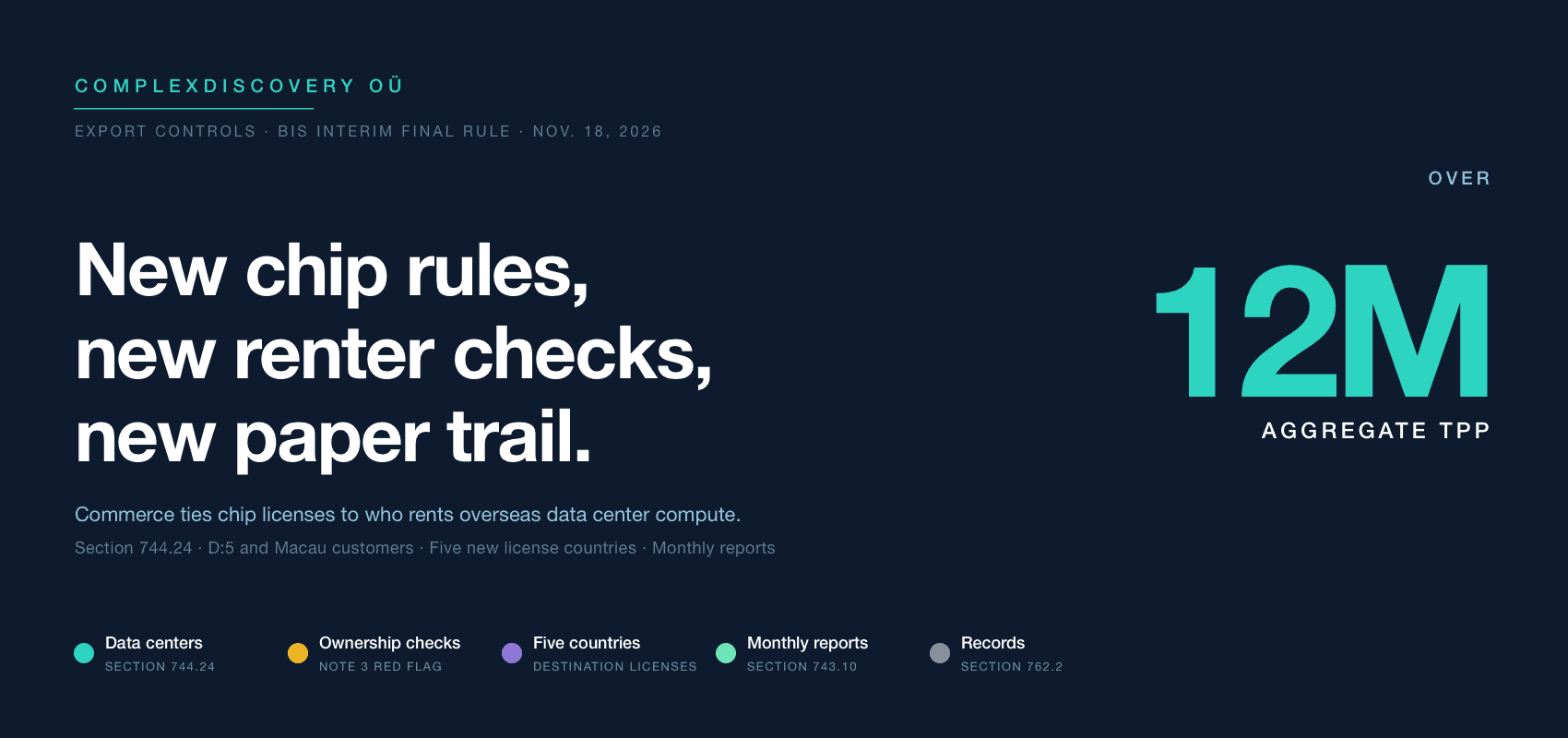
At the center of the rule sits a new end-use control, Section 744.24 of the Export Administration Regulations (EAR). It requires a license to export, reexport or transfer in-country advanced chips in Export Control Classification Number (ECCN) 3A090 (except 3A090.c), plus related .z items, software and technology. It also covers the computers, electronic assemblies and components in ECCN 4A090 that contain those chips. The license requirement applies when the shipper has “knowledge” at the time of shipment that the items are headed to a data center, anywhere in the world, serving certain companies. Those are companies headquartered in, or with an ultimate parent headquartered in, Macau or a Country Group D:5 destination, and the data center must provide or plan to provide them access to over 12 million “aggregate TPP” of computing power. Aggregate TPP is the summed total processing performance of a group of covered chips or commodities. D:5 is the EAR’s group of U.S. arms-embargoed countries, which includes China.
Knowledge in the EAR is a broader standard than certainty. The regulations define it to include awareness of a high probability that a circumstance exists or will occur, an awareness inferred from conscious disregard of known facts or from willful avoidance of them.
The 12 million threshold counts compute delivered at one site or across “linked data centers,” a term the rule defines to include digitally linked infrastructure as well as physically connected facilities. The preamble also extends the reach to intermediaries through what it calls the “for an entity” language, though the regulatory text itself speaks of compute provided “to or for” covered companies. That language applies, the preamble says, where there is knowledge that a data center serves a non-D:5 customer, through remote access, on behalf of a D:5 company. The preamble names three ways that customer can act: training models for the D:5 company, participating in that training or providing models to it.
That structure decides who carries the burden. The rule reaches remote use through the hardware, attaching the license requirement to items shipped to a data center. Whether a license is needed turns on what the shipper knows about the compute’s eventual users, and the rule does not declare cloud access itself an export. Baker McKenzie lawyers Janet K. Kim, Alison J. Stafford Powell, Bruce J. Linskens and Alexandre Lamy wrote in a January client post that, historically, BIS “has not broadly regulated mere remote access” to controlled items. They added that 2025 BIS guidance warned that supplying compute for model training to D:5 or Macau parties could trigger the EAR’s Part 744 catch-all controls.
Diligence now runs through the data center
Note 3 to the new section tells shippers how to show they lack that knowledge. A shipper should be ready to collect, and later produce, information from the foreign data center about its “know your customer” checks. Those checks include whether any customer is directly or indirectly owned or controlled by persons located or headquartered in, or with an ultimate parent headquartered in, Macau or a D:5 destination. A foreign data center that declines or is unable to supply that information “shall be considered a red flag that presumptively provides you with ‘knowledge,'” the rule says, unless the shipper resolves the flag before proceeding. In the preamble, BIS says it expects foreign data centers to vet their own customers closely enough that corporate restructurings or spinoffs cannot be used to get around the controls.
The obligation also travels downstream with the hardware. The prohibition applies whether or not the party now holding the items took part in the original shipment, and a later switch from a permitted use to a prohibited one counts as an in-country transfer that needs authorization. A shipper that exports covered items after publication without a license, because it had no knowledge of a prohibited use and no other EAR license requirement applied, must still notify the recipient. The notice tells the recipient that BIS must authorize any use of the items to supply over 12 million aggregate TPP to D:5 or Macau companies. It must also state that the transferor, such as the data center operator, is the party that needs that authorization and must follow the EAR’s know-your-customer guidance.
Operators already serving D:5 or Macau companies at the volumes the rule targets face a clock. Any such data center that wants to continue must obtain a license within 90 days of the effective date “or face future export restrictions,” the rule says. On a Nov. 19 publication, the 90th day falls Feb. 17, 2027, and applications under the section are reviewed case by case. One carve-out applies when compute goes only to a “commercial recommender system.” The rule defines that as a tool “exclusively designed and exclusively used to rank, filter, or suggest commercial products, services, or content to users based on user behavior, transaction history, or item attributes.” Using the carve-out requires a submission to BIS naming the D:5 or Macau company, the total processing performance supplied to it and the diligence performed. The definition excludes any system that generates novel text, images, audio, video, software or other content, along with any system that incorporates such a model.
Five countries and a monthly reporting duty
The rule’s second control is geographic, and it applies to shipments into the named countries whatever their end use. Once the rule takes effect, a license will be required to export, reexport or transfer advanced computing items to or within Indonesia, Malaysia, Singapore, Brazil and Thailand, which the rule describes as presenting “a higher-than-normal risk of diversion.” The secretary of commerce may add countries after consulting the secretary of state or the president’s national security adviser. Applications will be reviewed case by case, including on the effectiveness of each destination’s export control regime and its coordination with BIS on enforcement.
An exclusion applies when the ultimate consignee or end user is headquartered in the United States, or has its ultimate parent there, but only if the exporter, reexporter or transferor files reports under new Section 743.10. Each report identifies the parties to the transaction, the ultimate parent of the ultimate consignee and end user, the ultimate destination and any separate end users, each product’s ECCN, name, SKU, total processing performance and quantity, and the shipment date. Reporting is monthly, and each report is due by the first business day of the month after the transaction it covers.
For buyers, the review policy matters as much as the license requirement, because it shapes how readily data centers and other recipients in each destination can obtain covered chips. The rule sets that policy for its requirement covering Country Groups D:1, D:4 and D:5 and the United Arab Emirates. Under that requirement, a UAE shipment needs no license when the ultimate consignee and all end users are approved UAE entities the EAR lists as cleared for the covered items. Applications involving D:5 destinations, Macau or entities headquartered or ultimately parented there face a presumption of denial, apart from a case-by-case path for exports of certain lower-performance commodities bound for end users in China or Macau. Applications for D:1 and D:4 destinations, excluding those also in Country Groups A:5 or A:6, and for the United Arab Emirates face a presumption of approval. Those presumptions govern the destination-based requirement; data center licenses under Section 744.24 are reviewed case by case.
The D:1, D:4 and D:5 requirement also clears away the previous administration’s framework. It takes the place of the worldwide license requirement imposed by the Biden-era AI Diffusion Rule of January 2025, which the new rule formally rescinds along with the October 2024 rule that created Data Center Validated End-User authorization. The rescission removes the country tiers, that authorization and ECCN 4E091, the control on model weights.
The paper trail investigators will ask for
Each of these obligations leaves a document behind. The rule revises Section 762.2(b)(60) of the EAR’s recordkeeping provisions to list Section 744.24, bringing records relating to the new data center control within the EAR’s retention requirements. In practice that is likely to include the diligence files, ownership checks, recipient notices and recommender-system submissions the section calls for. BIS’s Paperwork Reduction Act analysis estimates a net annual increase of about 970 submissions and 440 burden hours in one information collection. That estimate reflects the new Section 743.10 reports, net of reporting eliminated with rescinded license exceptions, and BIS separately expects about 100 additional license applications a year.
Those documents may become evidence in a later enforcement action, voluntary self-disclosure or internal investigation. In its discussion of the related Section 744.23 control, the preamble already directs entities in violation toward voluntary self-disclosure under Section 764.5. For eDiscovery and information governance teams, the records worth anticipating are a data center’s customer-ownership file, an exporter’s memo resolving a red flag and a month’s Section 743.10 report. Each is a business record with a regulatory purpose that regulators, auditors and litigants may seek, and its completeness will matter.
What legal and eDiscovery buyers should ask now
Completeness starts with the parties the rule regulates directly: exporters, reexporters, transferors and data center operators. Customers are likely to meet it through their providers, because Note 3 expects shippers to obtain each data center’s customer diligence and the preamble expects data centers to perform it. Legal departments, law firms and eDiscovery service providers running review, transcription or generative workloads outside the United States can prepare with three questions. Where do their training and inference workloads physically run, is that capacity resold through a reseller or marketplace, and what ownership information will the provider request of them?
Security and vendor-risk teams should be ready for ownership questionnaires. Organizations with ownership links to Macau or a D:5 country should expect closer questioning, since the diligence turns on direct or indirect ownership or control rather than on where a customer operates. Buyers of capacity in the five named countries should also confirm whether their providers rely on the U.S.-headquarters exclusion, because that exclusion depends on monthly reports filed by someone else.
What remains unsettled
Some answers buyers will want were not yet in the rule as of Nov. 18. Beyond pointing to the EAR’s existing know-your-customer guidance, Section 744.24 and its preamble discussion do not set out a method for verifying ultimate ownership of resold capacity. The text also does not say whether the 12 million aggregate TPP threshold is measured per customer or across all covered customers of a data center. The prohibition speaks of companies in the plural, while the recommender-system submission asks for the processing performance supplied to a single named company.
Congress’s parallel effort also remains in motion. On Jan. 12, 2026, the House passed the Remote Access Security Act, H.R. 2683, by a 369-22 vote. The bill would amend ECRA to authorize controls on remote access itself, and it was referred to the Senate Banking, Housing and Urban Affairs Committee. Rep. John Moolenaar, R-Mich., chairman of the House Select Committee on China and a cosponsor, said in the committee’s release that day that the bill “makes it clear that cloud compute is subject to U.S. export control law.”
Whatever Congress does with the bill, the rule already puts the renter question to the data center and asks for the answer in writing. Legal and eDiscovery teams face the same question from the other side of the contract: if a regulator, an auditor or opposing counsel asked tomorrow who was renting the compute behind your AI workloads, which file would answer it?
News Sources
- Addressing Remote Access to Advanced Semiconductors (Office of the Federal Register, public inspection)
- Addressing Remote Access to Advanced Semiconductors (Bureau of Industry and Security)
- BIS Issues Rule Addressing Remote Access to American Super Intelligence Technology (Bureau of Industry and Security)
- 15 CFR 772.1: Definitions of terms as used in the Export Administration Regulations (EAR) (Electronic Code of Federal Regulations)
- 1 CFR 18.17: Effective dates and time periods (Electronic Code of Federal Regulations)
- Supplement No. 1 to Part 740: Country Groups (Electronic Code of Federal Regulations)
- House Passes Bipartisan Legislation to Limit Adversaries’ Remote Access to Critical Technology (House Select Committee on the CCP)
- Commerce moves to place new restrictions on sale of AI chips abroad (CyberScoop)
- US House Passes Remote Access Security Act (Baker McKenzie)





Assisted by GAI and LLM Technologies
Additional reading
- Johnson Controls agrees to pay $5 million over alleged security plan gaps in federal contracts
- Officials tie FAA ground stop to contractor router work, not hackers, but the specific fault is still undetermined
- Notion AI chats surface in Fireworks breach, testing what zero retention covers
- France ties October supermarket fridge sabotage to Iran’s IRGC and seeks arrest warrants
- ENISA’s update advisory turns the patch pipeline into an evidence trail
- Britain’s cyber agency warns of a possible surge, and its own incident figures raise a question
- Supermarket freezer attacks reach at least six European countries, and the record linking them to US base failures stays thin
- Microsoft finds 2 North Korean groups using ARTEX, a tool that alone cannot name an attacker
- With over 40 percent of the record Binance theft frozen, getting it back becomes a legal project
- Estonia’s cyber authority saw no state-sector PHP crisis as three state institutions shut or restricted services
- AI recording spreads in Estonian health care as the regulator says the audio needs its own legal basis
Source: ComplexDiscovery OÜ

ComplexDiscovery’s mission is to enable clarity for complex decisions by providing independent, data‑driven reporting, research, and commentary that make digital risk, legal technology, and regulatory change more legible for practitioners, policymakers, and business leaders.