

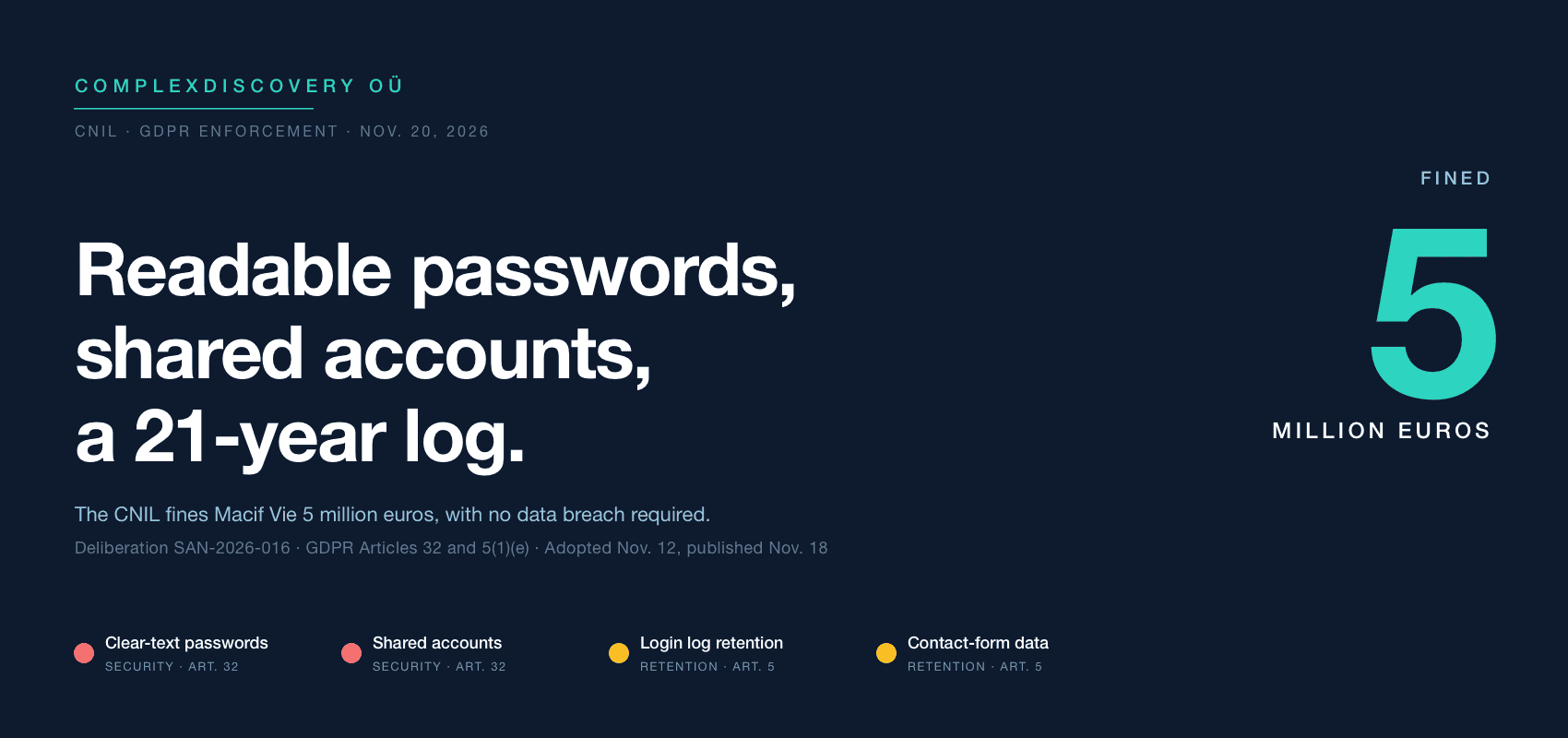
Editor’s Note: France’s data protection authority, the Commission nationale de l’informatique et des libertés (CNIL), published a decision on Nov. 18, 2026, fining Macif Vie, the Macif mutual insurance group’s life insurer, 5 million euros under the General Data Protection Regulation (GDPR). The CNIL did not name the company; Macif confirmed the identity to Agence Radio France. The CNIL’s sanctions committee found that Macif Vie stored the passwords of over 1.8 million customers in readable form and let eight employees share one account into a database of about 1.3 million clients. At the 2024 inspection, a login table also held data going back 21 years, including passwords kept since 2019 for 8,628 customers, despite the company’s own one-year retention policy. Macif said none of its customers’ data had been disclosed; the committee held that leaving the data vulnerable was itself a breach of the GDPR’s security duty.
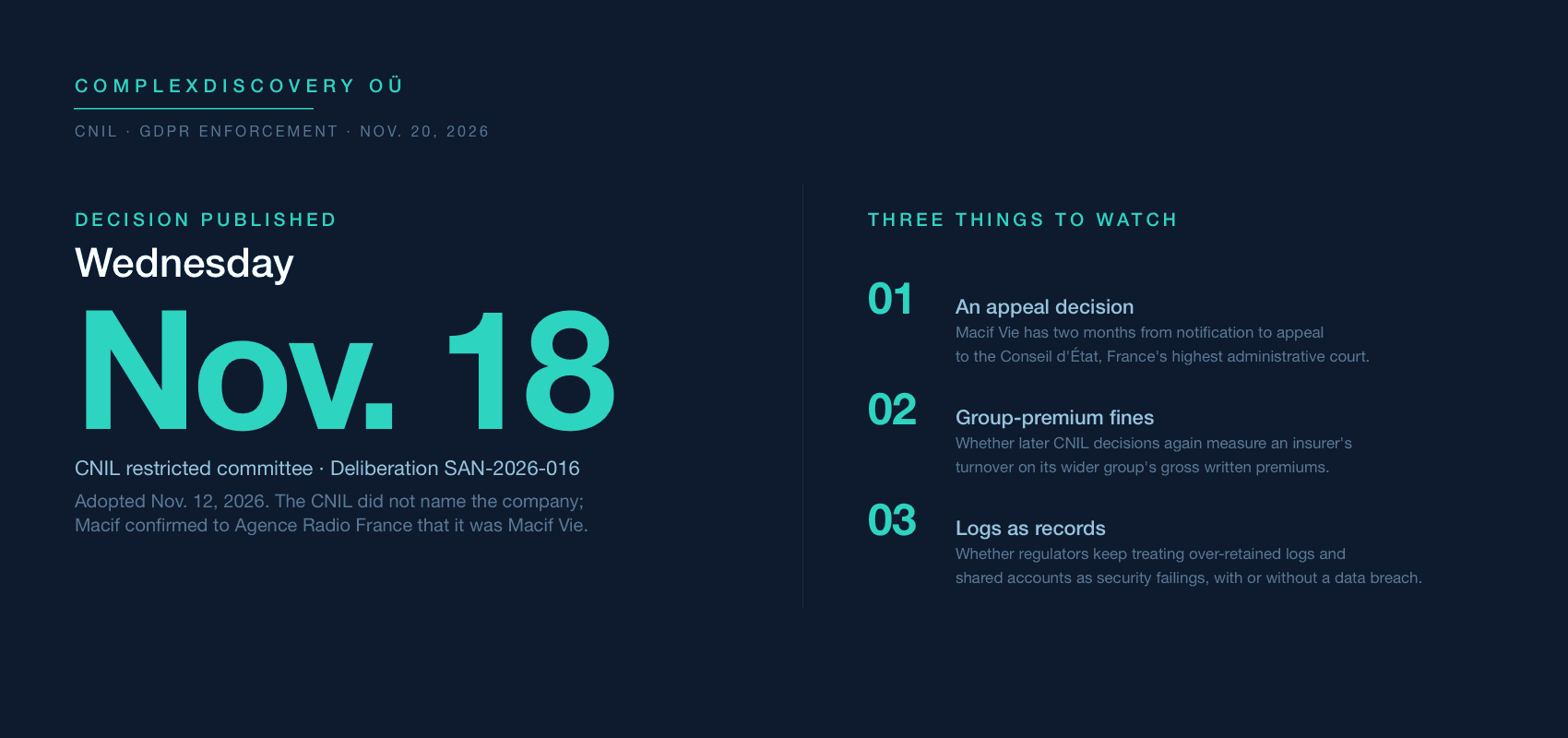
For cybersecurity, data privacy, compliance and eDiscovery professionals, the decision shows retention discipline limiting security risk and treats shared accounts as an audit-trail failure, since a shared login cannot show which employee altered or deleted a record. Watch whether Macif Vie appeals to the Conseil d’État, France’s highest administrative court, within two months of notification.
Content Assessment: CNIL fines Macif Vie 5 million euros over clear-text passwords and a 21-year login log
Information - 92%
Insight - 91%
Relevance - 90%
Objectivity - 90%
Authority - 92%
91%
Excellent
A short percentage-based assessment of the qualitative benefit expressed as a percentage of positive reception of the recent article from ComplexDiscovery OÜ titled, "CNIL fines Macif Vie 5 million euros over clear-text passwords and a 21-year login log."
News Analysis – Cybersecurity Beat
CNIL fines Macif Vie 5 million euros over clear-text passwords and a 21-year login log
ComplexDiscovery Staff
A login table that French life insurer Macif Vie kept to trace connection attempts and detect fraudulent access also held its customers’ passwords in readable form, and its oldest entry dated to 2003. On Nov. 18, 2026, France’s data protection authority published the decision that turned that table into a 5 million euro fine.
The Commission nationale de l’informatique et des libertés (CNIL) did not name the company in its decision. The same day, Macif, the French mutual insurer, confirmed to Agence Radio France that the fine was imposed on the Macif group’s life insurer, Macif Vie, formerly known as Mutavie. The CNIL’s restricted committee, the body that imposes the agency’s sanctions, adopted deliberation SAN-2026-016 on Nov. 12. It found breaches of two provisions of the General Data Protection Regulation (GDPR): the security duty in Article 32 and the storage-limitation principle in Article 5(1)(e). The CNIL said the committee published its decision as a teaching tool, to remind businesses of the rules on securing password-protected data, and saw no need in this case to name the company.
What makes the case worth a close read is that the finding does not depend on an attacker. The company told the committee that no security incident had compromised any data, and it argued that it had moved quickly to correct problems after the inspection. The committee did not treat that as a defense, holding that clear-text storage made the data vulnerable whether or not an attacker ever exploited it. It added that customers could have suffered serious harm had a malicious outsider gained entry. Macif made the same point publicly once the decision was out. “We want to reassure our customers that none of their data has been disclosed,” the company told Agence Radio France in a statement, adding that it had taken note of the CNIL’s decision.
How the passwords sat in the open
The case began with an alert the CNIL received on Dec. 27, 2023, about how Macif Vie stored customers’ passwords and the answers to the security questions that open its online client spaces. Inspectors went on site on May 14, 2024, and found that the passwords of over 1.8 million customers, the credentials for the company’s online client spaces, were stored in clear text. Of those, 730,289 also appeared in clear text in the connection-logging table.
The fix for how passwords were stored came in two steps, and the first one drew criticism of its own. On July 18, 2024, the company told the CNIL by email that it had introduced a hash function called ora_hash, which the committee described as obsolete. It was applied without a salt, a random value generated separately for each password before hashing so that identical passwords do not produce identical stored hashes. Only on April 25, 2026, after the sanction report had been issued, did the insurer move to a function the committee considered state of the art; the company described it as Argon2 with a salt. The CNIL’s summary frames the breach as running from the inspections until the sanction procedure was opened, and notes that the company strengthened its security while the proceedings were under way.
Those passwords mattered because of what sat behind them. The committee said the client spaces could contain financial data. It also found full bank account numbers (IBANs) in a separate contact-form table, though it accepted that this table could not be reached with a customer’s password. The rapporteur’s original allegation that health data sat behind the passwords was later dropped, as was a claim about weak password-composition rules, because the insurer already locked accounts after repeated failed attempts at the time of the inspections.
Eight people, one account
The second Article 32 finding concerned the insurer’s own staff rather than its customers. A generic application account, shared by eight people, gave access to a customer database covering about 1.3 million clients with active life insurance contracts. The same eight people shared an administrator account for a data-visualization tool. The corrective steps came well after the inspection: the insurer set up named individual accounts in November 2025 and deactivated the shared administrator account on April 22, 2026.
The company contested the finding, and the committee was not persuaded. In its reasoning, only individual accounts let an organization trace the access and actions of each operator, and shared credentials made it far harder to attribute an action to a person, including identifying who deleted or altered a record. The CNIL’s public summary added that this traceability matters in particular during an investigation after a security incident or data breach.
For eDiscovery and incident response teams, that reasoning has a second edge. A log that records “generic account” against a deletion cannot answer who deleted it, and that is a question any post-incident investigation, internal or adversarial, has to answer.
Where retention and security overlapped
The retention breaches were not contested, and they overlap with the security findings in a way that should concern any records manager. Messages submitted through the insurer’s contact form, some containing bank details, sat in an active database dating back to November 2010, over 13 years before the inspection. The CNIL called that retention excessive for messages whose requests had already been dealt with.
The logging table was the sharper problem. The company’s own policy set a one-year retention period for connection data. In practice, the table had held customer usernames and passwords for as long as 21 years, including data entered on Feb. 3, 2003, and passwords held since July 11, 2019, for 8,628 customers. The committee pointed to that gap between written policy and actual practice when it assessed negligence and found the company had been particularly negligent at a minimum.
The same table therefore sat inside both findings, though the two remain legally distinct. For the 8,628 customers whose passwords it had kept since July 2019, holding data past the one-year limit meant readable credentials stayed on file years longer than the company’s own policy allowed. Deleting on schedule would have shrunk that exposure, but it could not have cured the separate security failure of writing passwords into a log in readable form. Defensible disposition worked here as a security control in its own right, one that limits how much damage another failure can do.
How the committee sized the fine
The rapporteur first proposed a 9 million euro fine calculated on the group’s revenue, then revised the proposal to 7 million euros after the company responded. At the committee’s Oct. 15 hearing, a lawyer for Macif Vie disputed the allegations as not matching the facts, the legal news service MLex reported. The committee set 5 million euros. It treated Macif Vie and the wider group to which it belongs, which the decision does not name, as a single economic unit. The company argued that no capital link tied the group to the insurer, and the committee answered with the insurer’s full ownership by a group entity and the group’s dominant influence.
To measure the group’s turnover, the committee used its gross written premiums for 2025, following European Data Protection Board guidance that points insurers to premiums in place of net turnover; the figure itself is redacted. It rejected the company’s request to use insurance revenue as defined in the IFRS 17 accounting standard, because the insurer keeps its accounts under French standards. The CNIL said the amount reflected the gravity of the breaches, the number of people affected and the company’s financial capacity.
That last factor is where group figures carry weight under EU case law. The decision cites two rulings of the Court of Justice of the European Union, Deutsche Wohnen (C-807/21) and ILVA (C-383/23). In ILVA, decided in February 2025, the court held that the turnover of the whole undertaking, which can include a parent group, sets a GDPR fine’s ceiling and must also be weighed in assessing the recipient’s actual economic capacity. The ceiling the committee stated was 20 million euros or 4 percent of worldwide annual turnover, whichever is higher, so the 5 million euro fine sat well below it.
The committee issued no compliance order. The rapporteur had sought one under Article 32, backed by a daily penalty for delay, but the committee found that the company had come into compliance on every breach before the decision.
What practitioners should take from it
The decision lands the same week the CNIL announced 38 sanctions under its simplified procedure, issued between June and October 2026 and totaling 302,800 euros. About a dozen of them addressed security failings, including weak password rules, shared generic accounts and outdated SHA-1 hashing. The insurer’s case also follows the CNIL’s January 2026 decision fining France Travail, the national employment agency, 5 million euros over a breach of job seekers’ data. Because France Travail is a public body, the CNIL said, its fine was set within a fixed range rather than against turnover. The insurer drew the same amount in a case the committee decided on the vulnerabilities themselves.
Teams should inventory every table that captures authentication events and confirm that none stores passwords or other authentication secrets, and they should retire shared administrative and application accounts in favor of named ones. They should also test whether written retention schedules are actually executed against logs and contact-form stores rather than merely published. The decision states that it can be appealed to the Conseil d’État, France’s highest administrative court, within two months of its notification. Macif’s statement to Agence Radio France did not say whether the company would appeal.
Macif Vie built its login table to catch fraudulent access, and by the time inspectors arrived it held data reaching back two decades and readable copies of over 700,000 customer passwords. How many organizations could say with confidence that their own logs hold only what their retention policy says they should?
News Sources
- Délibération SAN-2026-016 du 12 novembre 2026 (CNIL via Légifrance)
- Conservation des mots de passe clients en clair : la CNIL prononce une sanction de 5 millions d’euros (CNIL)
- La CNIL a prononcé 38 nouvelles sanctions en procédure simplifiée depuis juin 2026 (CNIL)
- Data breach: FRANCE TRAVAIL fined €5 million (CNIL)
- La Cnil inflige une amende de 5 millions d’euros à l’assureur Macif Vie “en raison de l’insuffisance des mesures prises pour la sécurité des données” (Agence Radio France via franceinfo)
- Macif Vie risks €7m fine in French privacy case over password protection (update*) (MLex)
- Higher Not Lower: CJEU Ruling On EU GDPR Fines & Definition Of ‘Undertakings’ Brings Welcome Clarity (Clyde & Co)
- Quite the “undertaking”: CJEU considers the calculation of administrative fines under Article 83 of the GDPR (McCann FitzGerald)
- ECJ: Overall Turnover of Entire Company Group Decisive for Fine Calculation if GDPR Was Infringed (eucrim)





Assisted by GAI and LLM Technologies
Additional reading
- Johnson Controls agrees to pay $5 million over alleged security plan gaps in federal contracts
- Officials tie FAA ground stop to contractor router work, not hackers, but the specific fault is still undetermined
- Notion AI chats surface in Fireworks breach, testing what zero retention covers
- France ties October supermarket fridge sabotage to Iran’s IRGC and seeks arrest warrants
- ENISA’s update advisory turns the patch pipeline into an evidence trail
- Britain’s cyber agency warns of a possible surge, and its own incident figures raise a question
- Supermarket freezer attacks reach at least six European countries, and the record linking them to US base failures stays thin
- Microsoft finds 2 North Korean groups using ARTEX, a tool that alone cannot name an attacker
- With over 40 percent of the record Binance theft frozen, getting it back becomes a legal project
- Estonia’s cyber authority saw no state-sector PHP crisis as three state institutions shut or restricted services
- AI recording spreads in Estonian health care as the regulator says the audio needs its own legal basis
Source: ComplexDiscovery OÜ

ComplexDiscovery’s mission is to enable clarity for complex decisions by providing independent, data‑driven reporting, research, and commentary that make digital risk, legal technology, and regulatory change more legible for practitioners, policymakers, and business leaders.