

Editor’s Note: EU-INC campaign leaders Andreas Klinger, Iwona Anna Biernat, Simon Schaefer and Vojtech Horna asked the European Commission on Nov. 19 to withdraw and resubmit its EU Inc. proposal at Helsinki’s Slush conference, in a session Bloomberg’s Shona Ghosh moderated. The March 2026 proposal lets founders using EU templates register an optional company within 48 hours for up to 100 euros. Campaigners say changes by member governments in the Council of the European Union would leave it short of a standard investors trust.
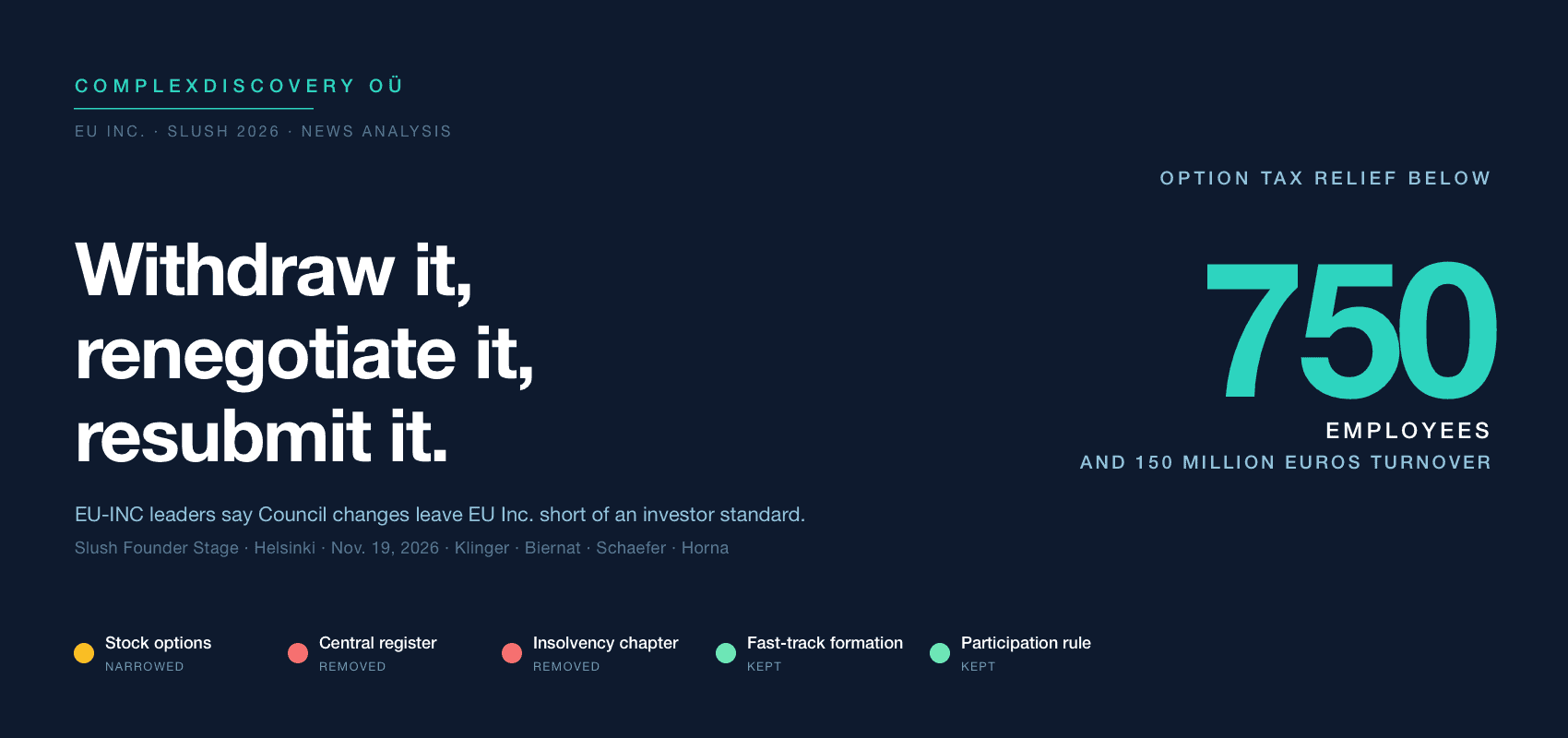
The Council, which says it supports the proposal’s aims, limits stock option tax relief to warrants issued while a company has fewer than 750 employees and 150 million euros or less in turnover and drops a planned central company register, law firm Matheson says. Michael McGrath, the EU justice commissioner, told the Brussels news site Rapporteur the Commission is ready to work with lawmakers to preserve the proposal’s ambition.
For cybersecurity, information governance and eDiscovery teams, the outcome will shape how remotely formed companies are secured, which country’s retention and insolvency rules apply and which records show where a company is managed. Final talks await the European Parliament’s position.
Content Assessment: Startup campaigners at Slush ask European Commission to withdraw and resubmit EU Inc. proposal
Information - 93%
Insight - 92%
Relevance - 90%
Objectivity - 93%
Authority - 94%
92%
Excellent
A short percentage-based assessment of the qualitative benefit expressed as a percentage of positive reception of the recent article from ComplexDiscovery OÜ titled, "Startup campaigners at Slush ask European Commission to withdraw and resubmit EU Inc. proposal."
News Analysis – Technology Beat
Startup campaigners at Slush ask European Commission to withdraw and resubmit EU Inc. proposal
ComplexDiscovery Staff
Four leaders of EU-INC, a campaign whose volunteers drafted a law for a pan-European startup company, asked the European Commission at Slush in Helsinki on Nov. 19 to withdraw and resubmit its EU Inc. proposal.
Their reason fits in one word they returned to throughout the 30-minute session: standard. A company form that investors do not recognize on sight, they argued, simply becomes one more entry in Europe’s already crowded list of national legal entities. They said changes made by the Council of the European Union push EU Inc. toward that outcome.
From a Brussels petition to a regulation
The Founder Stage session, titled “Release Notes on EU Inc.: What’s In, What’s Out and What’s Next,” put the campaign’s leadership on one stage in a conversation moderated by Shona Ghosh, a senior technology editor at Bloomberg News. Andreas Klinger, who founded the first-check fund Prototype, Simon Schaefer and Vojtech Horna are three of the campaign’s original co-initiators, and the fourth, investor Philipp Herkelmann, was not on the panel. Schaefer is also founding president of the advocacy group Startups for Europe, and Horna is chief communications officer at Tesonet and a co-lead of EU-INC. Iwona Anna Biernat, co-lead and head of legal strategy at EU-INC and chief operating officer at Project Europe, completed the panel. She led the creation of the campaign’s original legal proposal.
The campaign began as a petition launched in Brussels on Oct. 14, 2024, which TechCrunch reported had drawn about 11,000 signatures within two weeks. It called for an EU Inc. entity under the 28th regime, an optional EU-wide legal framework beside the 27 national systems, which Mario Draghi and Enrico Letta had each promoted in 2024 reports on competitiveness and the single market. Horna told the Slush audience the petition now has 26,000 signatories. He said the campaign took off because it did not end with a letter: volunteers drafted a legislative proposal and delivered it to the Commission.
Schaefer said he believed the Commission received that draft in January 2025. On March 18, 2026, the Commission proposed its own EU Inc. regulation, an optional company form that would exist alongside national ones. Under its fast-track route, founders using standard EU template articles of association could register an EU Inc. company within 48 hours at a cost capped at 100 euros, with no minimum share capital. They would file once through an EU-level interface that connects national business registers. Founders who draft their own articles would face a five-working-day registration deadline instead.
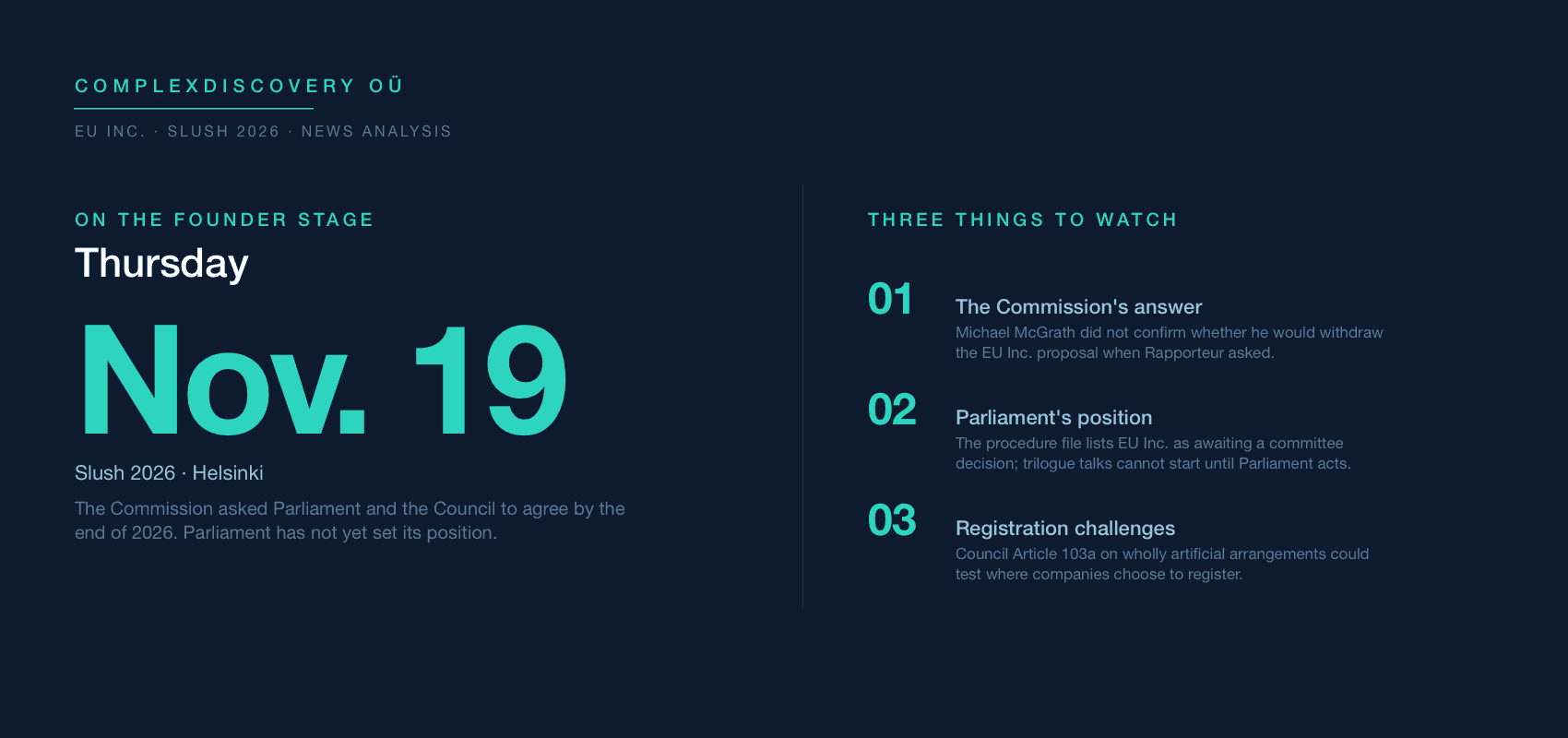
The proposal also let founders choose the member state of registration without requiring the company’s central administration or principal place of business to sit in that same country. It offered an optional employee stock option scheme with harmonized deferred taxation, and it set the EU interface on a path toward a central digital register for EU Inc. companies. The Commission asked Parliament and the Council, the two institutions that adopt EU laws, to agree by the end of 2026.

What the Council kept, and what it cut
That timetable now runs through the Council, whose member-state ambassadors approved a negotiating mandate on Oct. 23, according to the Council’s meeting record and the Irish government, which holds the rotating Council presidency. The Council said it supports the proposal’s main objectives. Its text lets member states delay or refuse registration on anti-money laundering, counterterrorism financing or other criminal grounds under national law, and it gives governments 21 months to implement the regulation.
The fast-track route survives, with its 48-hour deadline now excluding weekends and public holidays, according to an analysis by the Irish law firm Matheson. The same analysis says the Council removed the proposed central register and took away the digital share register’s constitutive effect, so a register entry would no longer by itself complete a transfer of ownership. The Irish government described the share register change as a simplification.
The stock option change drew the sharpest reaction on stage. Under the Council text, as Matheson summarizes it, the harmonized tax provisions cover only warrants issued while a company has fewer than 750 employees and annual turnover of 150 million euros or less. Biernat said that cap would make it “really hard to attract scale-ups to this structure.” Klinger said it punishes Europe’s fastest-growing companies, describing a founder who reaches a 100 million milestone within six months and is then told to slow down, stop hiring and spend months on the stock option rules.
On employee participation, the issue holding up Parliament, the Council kept the Commission’s rule that an EU Inc. company follows the participation regime of the country holding its registered office, the Irish government said. The Council added a mechanism that each member state may choose to apply when an EU Inc. company registered elsewhere exceeds that state’s participation thresholds through a branch operating there, according to Matheson.
The Council also removed Chapter X of the Commission’s text, a fast, digital procedure for winding up insolvent EU Inc. companies that qualify as innovative startups, according to an analysis by Freshfields. Those companies would instead fall under national and EU insolvency law. EU-INC and Startups for Europe said in a Nov. 19 statement that dropping the central register leaves 27 national registers in place, keeping the fragmentation EU Inc. was supposed to end. The groups also said the Council gave national authorities more room to challenge a founder’s choice of registration country.
Why the campaigners want a withdrawal
Klinger explained why that registration change matters most by pointing to Delaware, where a company can keep its office in San Francisco and its registration in Delaware. Under the Council’s changes, he said, that free choice is no longer freely available, so the standard hubs that made Delaware the default cannot emerge. “It’s not about making it convenient,” Klinger said. “It’s about creating a standard that every investor knows.”
The Council text does not end that choice outright. Matheson describes a new Article 103a addressing what the text calls wholly artificial arrangements, along with reinforced preventive controls that let authorities stop the clock on a registration. The campaign’s concern is that those tools give authorities room to second-guess where a company registers.
The campaign wants to stop the file before it reaches a trilogue, the three-way negotiation in which the Commission, Parliament and Council seek a provisional agreement that Parliament and the Council must then formally approve. Klinger said he expects that round to pit Parliament and the Council against the Commission, which is why the campaign wants a new text worked out with member states before any three-way talks begin.
Ghosh asked whether it would be better to pass something now and revise it later. Schaefer answered, “Hell no.” He said the campaign had already accepted many compromises and had cut its demands to a minimum viable product, with a true competitor to Delaware as its guiding goal.
Any trilogue must wait for Parliament, which needs its own negotiating position first, and as of Nov. 21 Parliament’s procedure file still listed the proposal as awaiting a committee decision. Its Legal Affairs Committee could not agree on rapporteur René Repasi’s draft report on Oct. 19, Euronews reported, after members split over workers’ rights.
The Commission’s response so far stops short of withdrawal. Michael McGrath, the EU justice commissioner who leads the Commission’s work on EU Inc., told Rapporteur, a Brussels-based EU news site, that the Commission stands ready to work closely with the Council and Parliament to preserve the proposal’s ambition.
Others close to the file split on the remedy. Ann Mettler, a member of the European Innovation Council governing board, told a Commission conference on Nov. 10 that withdrawing the proposal would be better than adopting a weak version, Science Business reported. The same outlet said the Commission’s industry chief, Stéphane Séjourné, had urged national ministers this fall not to water the text down. Also at Slush, a declaration from over 35 European tech leaders backed EU Inc. as part of a broader call for capital mobilization and regulatory reform, Tech.eu reported.

Estonia, e-Residency and a disclosure
When Ghosh asked who was watering the proposal down, Schaefer pointed to ministries of economy and justice and to the permanent representations in Brussels rather than heads of state. He said resistance comes from both ends of the spectrum. “Estonia is the one furthest along in doing what we’re asking for and is of course worried that what comes out of the European Union is worse than what they already have,” he said. At the other end, he said, smaller countries object to the Commission pursuing tax changes through a regulation on the legal basis it chose.
Estonia’s case rests on e-Residency, the government program that has let eligible applicants around the world start and run an Estonian company online since 2014. Liina Vahtras, the program’s managing director, argued in a June 2026 paper for the Robert Schuman Foundation that EU Inc. should be piloted in Estonia because the country already runs most of what the proposal offers.
That debate is not abstract for this publication. ComplexDiscovery OÜ has been registered in Estonia since 2020, and two members of its team are e-residents of Estonia, so the publication has a direct interest in how the file ends.
What changes for security, records and discovery teams
Whichever version of the form survives, Biernat drew its limits plainly. EU Inc. standardizes corporate structure, she said, but it does not let a company sidestep labor costs or the taxes it owes where they are due. For compliance teams, that means an EU Inc. company would combine harmonized corporate rules with the national company law of its registration state for anything the regulation does not cover. Employment, most taxation and, under the Council text, insolvency would stay national, with the stock option scheme’s harmonized tax treatment as the main exception.
That mix carries practical weight for information governance. In the fast-track liquidation procedure for solvent companies, an appointed keeper must hold the company’s books and records for six years after the company is removed from the business register, according to the Freshfields analysis of the Council text. Records managers should map retention to the member state of registration and to every state where the company employs people or files taxes, rather than assuming a single schedule travels with the company. Because EU Inc. companies register in the national register of their registered-office state and the Council text drops the planned central register, records teams should not expect a single EU-level repository of company filings.
The digital design raises the security stakes as well. The Commission’s model lets founders form a company and file through an EU-level online interface, and it sends company data automatically to authorities under the once-only principle. When a company can be formed remotely within 48 hours, the credentials used to form and file for it deserve the controls of privileged access, including strong authentication, logging and a short list of authorized signers. The Council said it tightened controls throughout the company life cycle to guard the single market against abuse, a sign that member states see risk in fast, remote formation.
For litigators and eDiscovery professionals, the open questions concern evidence. If authorities use the new tools against wholly artificial arrangements, disputes over a company’s registration choice will turn on documents showing where the company is managed, what it does there and why it registered where it did. Companies that register in one state and operate in another should keep contemporaneous records of that decision.

A test written in San Francisco
Biernat tied those practical questions back to investors with a benchmark for success. Y Combinator invests only in companies incorporated in four jurisdictions, the United States, Canada, Singapore and the Cayman Islands, and asks companies incorporated elsewhere to create a parent company in one of them. EU Inc. works, she said, when Y Combinator and any local investor feel comfortable investing in an EU Inc. company.
Schaefer cited a study, apparently from the International Monetary Fund, that he said projected an impact of about 3 percent of GDP in less than 10 years. A July 2026 IMF departmental paper estimated that a comprehensive 28th regime covering company formation, financing and insolvency could raise EU GDP by about 3.3 percent after 10 years, according to a summary by the Athens think tank ELIAMEP. That paper modeled a broader regime than the EU Inc. text now under negotiation. The Commission’s Joint Research Centre, counting only savings from simpler procedures, projected a cumulative EU GDP gain of 712 million euros over the first 10 years in its higher-investment scenario and called that estimate conservative.
Horna closed the session with a lesson about where power sits. The campaign assumed the EU institutions would bring national capitals together, he said, but much of the decision still rests with member states, so he urged founders and investors to press their own governments. Whether the Commission resubmits the text or the file moves toward trilogue once Parliament acts, the founders’ test from Helsinki still applies. Will the EU Inc. that emerges be a standard a San Francisco investor accepts without asking for a flip to Delaware, or one more entity for European lawyers to explain?
News sources
- Proposal for a Regulation on the 28th regime corporate legal framework: EU Inc. (COM(2026) 321 final) (European Commission via EUR-Lex)
- 28th regime corporate legal framework: EU Inc. (procedure file 2026/0074(COD)) (European Parliament Legislative Observatory)
- EU Inc.: A new harmonised corporate legal regime (European Commission)
- EU Inc.: making business easier in the European Union (European Commission)
- EU Inc: Council adopts position on a new EU corporate law for innovative companies (Department of Enterprise, Tourism and Employment, Ireland)
- Summary record, Permanent Representatives Committee (ST 14723/26) (Council of the European Union)
- Release Notes on EU Inc.: What’s In, What’s Out and What’s Next (Slush)
- The macroeconomic impact of the 28th Regime corporate legal framework (European Commission Joint Research Centre)
- Toward a 28th European Enterprise Regime: A Single Rulebook to Enable Cross-Border Scale-Up in Europe (International Monetary Fund)
- The Y Combinator Deal (Y Combinator)
- Frequently Asked Questions (Y Combinator)
- EU-INC calls on von der Leyen to withdraw and re-table EU Inc proposal (Tech.eu)
- EU Inc initiators call for full reset of startup-booster proposal (Rapporteur)
- €100B in company value, one shared ambition: European tech leaders demand political reform at Slush (Tech.eu)
- Call to scrap EU Inc proposal widens (Science Business)
- Scrap EU Inc proposal, EIC board member says (Science Business)
- Can EU Inc still make business easier? Ask the Euronews AI chatbot (Euronews)
- Entrepreneurs and investors launch EU Inc. in a push for a single pan-European startup entity (Tech.eu)
- Founders and VCs back a pan-European C-corp, but an EU Inc has a rocky road ahead (TechCrunch)
- Breite Startup-Koalition fordert Einführung der EU Inc (Trending Topics)
- EU Inc.: Council mandate removes the insolvency chapter from the 28th regime proposal (Freshfields)
- EU Inc: Council adopts negotiating position under Ireland’s presidency (Matheson)
- EU Inc. and the 28th Regime: Europe’s Scale-Up Test: How Legal Design Will Shape the Usability of a European Company Form (ELIAMEP)
- EU Inc: A Vision for a Unified European Corporate Structure (Orrick)
- ‘Bloomberg News’ Names Shona Ghosh As A Senior Tech Editor (MediaPost)
- Pilot EU Inc in Estonia, where it is already working (Robert Schuman Foundation)
- Slush 2026 brings a smaller, sharper bet on European startups to Helsinki (ComplexDiscovery)

Assisted by GAI and LLM Technologies
Additional reading
- Välimäki and Donahue tell DECOI x Borderland founders to test in Ukraine and plug into NATO’s data layer
- Days before Slush, an attack on Estonian drone maker Threod raises the stakes for defense tech
- Before the Abu Dhabi talks, a claimed Rosstat leak and hacked alert apps test what can be confirmed
- Spoofed nuclear alert caps four days of Ukraine war assessments that separate claims from evidence
- Kyiv says Starshield speeds are back, but who capped them is still disputed
- Diesel license, Starshield cap and intelligence warnings strain US support for Ukraine
- Drones hit two Yandex data centers, and a Kremlin decree sets terms for state management
- A cell tower near Lyman and Russia’s fight over its own war record
- How a general’s walk across a bridge tested Putin’s claim to Svyatohirsk
- Germany names Russia for the Leipzig drone, and keeps most of its evidence out of view
- Estonia scrambled jets over a drone no official has identified
- Russia leans on drones and dissent-proofing as fuel crisis bites
- Senate passes Graham sanctions act, shifting Russia pressure from policy to statute
Source: ComplexDiscovery OÜ

ComplexDiscovery’s mission is to enable clarity for complex decisions by providing independent, data‑driven reporting, research, and commentary that make digital risk, legal technology, and regulatory change more legible for practitioners, policymakers, and business leaders.