

Editor’s Note: Legal AI took another step from search box to dialogue at RelFest London, where Relativity made aiR Assist and no-code custom analyses generally available and folded conversational, citation-backed access to case data into RelativityOne as a standard capability. CEO Phil Saunders framed the day around a “readiness gap” between fast AI adoption and slower governance maturity, and pitched an end-to-end, defensible platform as the answer.
For cybersecurity, data privacy, regulatory compliance and eDiscovery professionals, the stakes sit in that governance claim. As generative and agentic tools take on relevance, privilege and classification work, the open question is whether their outputs survive scrutiny from a court, a regulator or a board. Much of the keynote evidence was vendor-reported, which raises the value of independent testing.
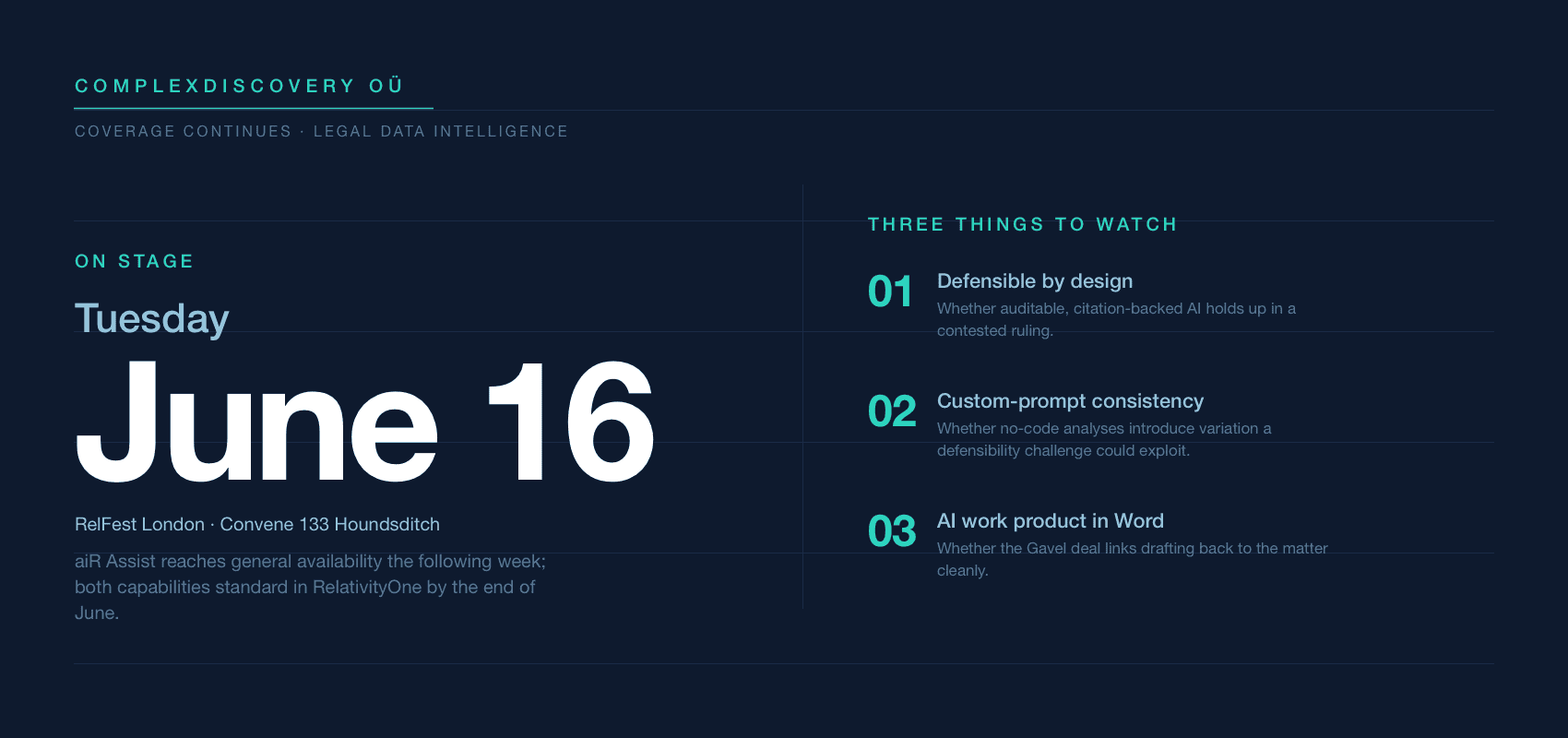
Watch three things next: whether “defensible by design” holds up in a contested ruling, how custom prompting affects review consistency, and whether the Gavel acquisition pulls AI-generated work product into Microsoft Word without breaking the chain of custody back to the matter.
Content Assessment: Relativity bets legal teams will talk to their data, not just search it
Information - 92%
Insight - 90%
Relevance - 92%
Objectivity - 88%
Authority - 90%
90%
Excellent
A short percentage-based assessment of the qualitative benefit expressed as a percentage of positive reception of the recent article from ComplexDiscovery OÜ titled, "Relativity bets legal teams will talk to their data, not just search it."
Industry News – eDiscovery Beat
Relativity bets legal teams will talk to their data, not just search it
ComplexDiscovery Staff
Relativity wants legal teams to move beyond keyword search and begin asking evidence questions in natural language. The Chicago-based company used its RelFest London opening keynote Tuesday to move two of its most closely watched AI tools toward general availability, and to argue that conversational, governed access to case data is becoming table stakes in eDiscovery.
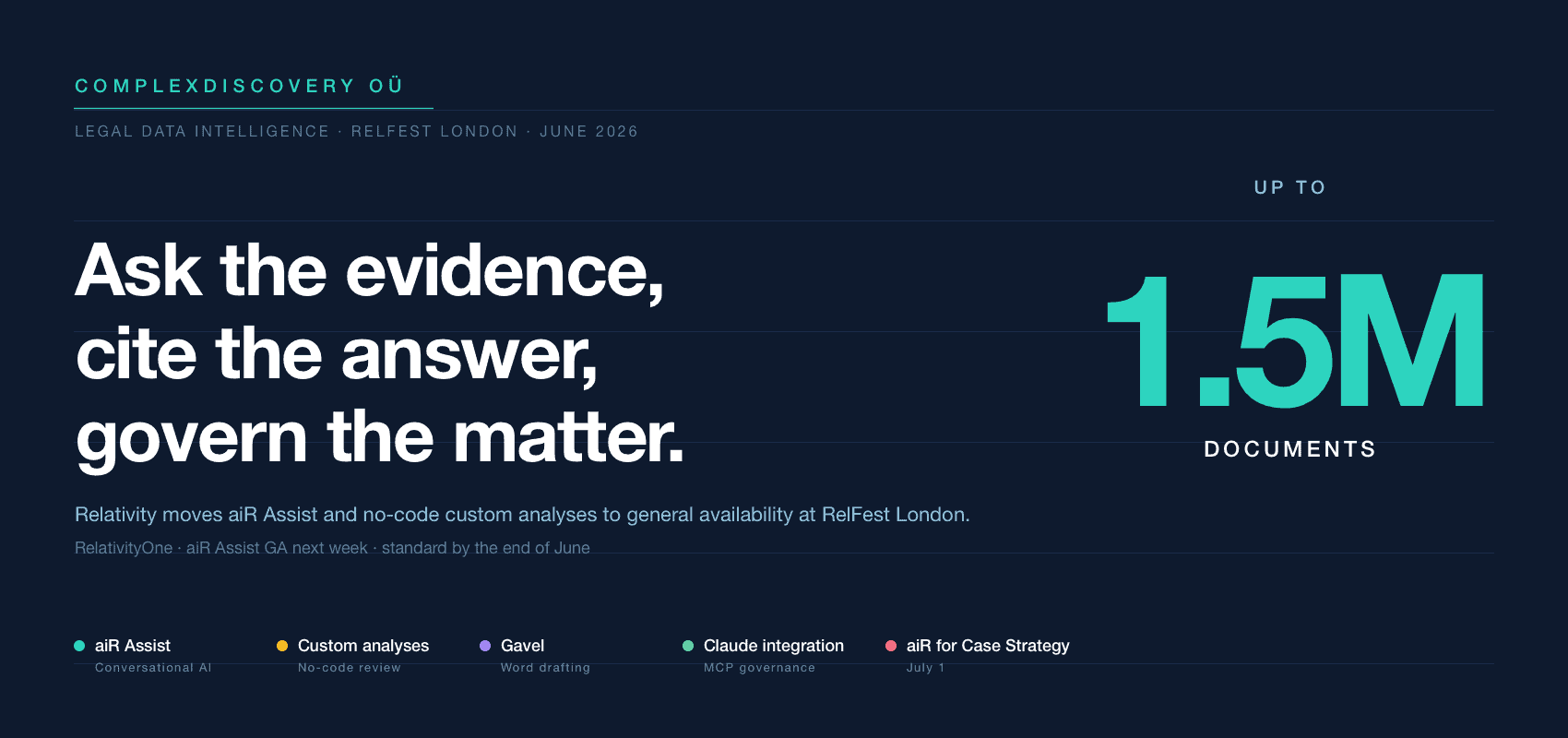
Relativity said aiR Assist and custom analyses in Relativity aiR for Review are reaching general availability. Elise Tropiano, senior director of product management at Relativity, told the London audience that aiR Assist “is becoming generally available to you next week for use in both repository and review workspaces.” The company also said both capabilities are expected to be standard RelativityOne capabilities by the end of June. The releases land in a market where competing providers are pushing generative and agentic review tools while buyers continue to test cost, speed, accuracy and defensibility claims.
Conversational access arrives at scale
aiR Assist lets legal teams ask plain-language questions of their data and receive citation-backed answers, with the stated goal of surfacing facts the moment data enters RelativityOne. Tropiano described it as a conversational experience that lets any team member ask natural-language questions and analyzes hundreds of thousands of documents, soon millions, to produce an answer grounded in citations. The company said aiR Assist supports up to 300,000 documents per index and 1.5 million documents per workspace.
“aiR Assist and custom analyses represent a meaningful advance in how legal teams put AI to work, not as a layer on top of legal data, but as a native part of RelativityOne,” said Phil Saunders, chief executive officer of Relativity. “Almost any AI solution can read a document. Almost none can be the single, auditable source of truth for every piece of data in your matter.”
That framing points at the defensibility question now dominating the category. As agentic and generative tools take on relevance calls, privilege screening and even draft privilege logs, courts and regulators want to see how a machine reached a conclusion. Chief Product Officer Chris Brown, in his seventh RelFest London, made the same argument on stage. “This isn’t Chatbot AI,” Brown said, describing review where “the thinking and the doing are happening in the same platform. It’s traceable, it’s grounded and it’s explainable.”
Naming the readiness gap
Saunders built the keynote around what he called the readiness gap, the distance between how fast legal teams are adopting AI and how prepared they feel to govern it. He pointed to Relativity’s 2026 general counsel report, which he said put average preparedness at 2.4 out of 5, even as AI use, by his account, moved from 44 to 87 percent. Enterprise data, he said, reached about 150,000 petabytes in 2025 and is heading above 200,000 this year.
Regulation is tightening at the same time, Saunders said, citing the EU AI Act, divergent UK and EU data frameworks, and an April ruling in Australia where federal courts required disclosure when lawyers used AI in their work. “The compliance ratchet is indeed tightening,” he said. His prescription leaned on the company’s history of remaking its own products: “iterating and evolving is not as good or important as transforming,” he said, adding that “an end-to-end system that’s governed and defensible is the table stakes to address the readiness gap.”
Saunders also framed the moment as a shared one for the industry. “All of us knows more than one of us,” he said, urging customers to learn from each other’s best practices. He acknowledged that customers “won’t do it all with” Relativity, pointing to “a plethora of other tools” in the market. Relativity turned 25 this spring, he noted, before closing with a line he returned to twice: “Hey folks, we’re just getting started.”
Custom analyses open the review playbook
The second release, custom analyses in aiR for Review, lets teams define their own document-review analyses through no-code natural-language prompts rather than relying only on Relativity’s prebuilt categories. An iterative prompt experience allows teams to test and validate outputs before running across an entire document set.
On stage, Erica Albertson, director of AI transformation, international, walked through a synthetic construction-dispute example, instructing aiR in a single job to classify documents for prior knowledge of a hazard, flag a breach of duty, and extract the people named in safety communications, then ran image analysis across thousands of site photos and schematics. “This is AI that doesn’t just sit alongside your legal work, this is AI that is your legal work,” Albertson said.
“Custom analyses give legal teams the flexibility to define exactly what they need,” said Andrew Milauskas, chief operating officer at Page One, Inc., in materials distributed by Relativity. “One legal team may need to identify key information from medical records, another may need to classify workplace communications, another may be looking for evidence of construction defects.” Chris Haley, vice president of practice empowerment for aiR, tied the flexibility back to trust. “AI only works if it’s correct, accurate, verified, and validated by you,” Haley said, pointing to validation workflows built into Review Center.
aiR for Review reached general availability in September 2024. Relativity has since folded it, along with aiR for Privilege, into standard RelativityOne pricing and packaging, a shift the company announced at Relativity Fest in October 2025 alongside all-inclusive per-gigabyte pricing that eliminated per-seat user fees. Custom analyses build on that foundation.
Proof points from the EMEA floor
Georgia Foster, who leads Relativity’s international region, used her keynote slot to argue that adoption is already deep in Europe, the Middle East and Africa. Over 60 percent of EMEA customers have used aiR, she said, and RelativityOne is set to exceed six petabytes in the region in 2026, roughly triple the volume of three years earlier.
Foster cited customer results the company presented on stage. Herbert Smith Freehills, she said, ran aiR across about 100,000 documents in 12 hours and saved 286 lawyer days; Interpath reported 75 percent cost savings, 70 percent time savings and over 98 percent accuracy on non-relevant documents; and Baker McKenzie completed a whistleblower investigation in four days. Those figures were presented by Relativity and reflect customer accounts rather than independent measurement.
“I wonder whether one day lawyers could finally get their weekends back,” Foster said. “I think we’re closer than we think.”
Many surfaces, one platform
Brown anchored the product showcase in platform scale. RelativityOne now has over 240,000 active users, over 37,000 active workspaces and over 93 petabytes of data across over 31 countries, he said. He put aiR’s output at over 180 million high-value results last year and over 375 million so far this year, on a path toward over a billion, and said the company invested over $180 million in research and development this year.
Two announcements pushed the platform onto surfaces outside Relativity, and here the roadmap turns more speculative. Brown said Relativity has partnered with Anthropic to bring a Claude surface to RelativityOne, letting administrators stand up matters, shape workspaces and manage access by asking in plain language while the work runs in the platform, “audited to the user who actually ran it.” Data, he said, stays in the platform.
The company also tied the day to its June 12 acquisition of Gavel, an AI-native drafting platform used by thousands of legal professionals. “With Gavel, we’ll close that gap,” Brown said, describing a future in which lawyers open, edit and collaborate in Microsoft Word while every change syncs back to the matter in RelativityOne. Relativity framed the Word integration as a plan rather than a shipped feature. Through Rel Labs, the investment arm it launched in October 2025, the company has backed litigation-focused startups including Courtroom, a courtroom-simulation platform, Patlytics, a patent intelligence tool, and Advocacy, which raised $3.5 million in March 2026 with backing from Fenwick & West and Rel Labs. aiR Assist will also power interactive memo drafting in aiR for Case Strategy, which the company said joins the standard RelativityOne offering beginning July 1.
What practitioners should track
The competitive backdrop is sharpening. Generative review has moved into the mainstream, and rival platforms are pushing agentic features and simpler, consumption-based pricing of their own. Industry survey data cited in recent eDiscovery coverage suggests reported use of generative AI has risen sharply, from about 12 percent two years earlier to roughly 37 percent in the latest reported cycle, though methodology and sample details warrant review before the figure is treated as a market-wide benchmark.
Much of what Relativity put on stage was vendor-reported: platform metrics, customer time-and-cost savings and macro data points came from the company and its customers, not from independent measurement. Relativity, the customers it cited and other vendors were not independently contacted for this report. For cybersecurity, information governance and eDiscovery teams, the practical questions are familiar even as the tools change. How well do citations trace back to source documents? Can outputs be reproduced and explained to a court? Does custom prompting introduce inconsistency that a defensibility challenge could exploit? Relativity is betting that keeping AI, governance and human review inside one environment answers those questions better than bolting AI onto legal data after the fact. Will conversational, auditable access become the baseline expectation for legal AI, or will buyers demand proof that “defensible by design” survives its first contested ruling?
News sources
- Relativity Fest 2025: Relativity Announces Generative AI Solutions for Legal Review to Be Standard in Cloud Offering (PR Newswire)
- Relativity Acquires Gavel to Extend its AI Platform for Legal Data Intelligence into Microsoft Word (PR Newswire)
- Making Administration Conversational with RelativityOne and Claude (Relativity Blog)
- Relativity Invests in 2 Legal Tech Startups Via New Funding Arm Rel Labs (Law.com)
- Litigation Startup Advocacy Announces $3.5M Investment, With Backing From Fenwick & West, Rel Labs (Law.com)
- Relativity Announces General Availability of Relativity aiR for Review at 15th Annual Relativity Fest (PR Newswire)
- Relativity Puts ‘aiR for Case Strategy’ On General Release (Artificial Lawyer)
- Relativity Expands AI Platform for Legal Data Intelligence with Conversational AI and No-Code Custom Document Analyses | Newsroom (Relativity)





Assisted by GAI and LLM Technologies
Additional Reading
- Europe’s off-channel reckoning: HaystackID bets COMET on a messaging crackdown crossing the Atlantic
- HaystackID brings AI privacy and discovery stack to Dublin as European compliance pressure mounts
- The New Face of Discovery: HaystackID’s CoreFlex Brings AI, Slack, and Enterprise Data into One Legal Workflow
- Show Your Work: HaystackID Brings eDiscovery Rigor to AI Governance
- Redefining Global Advisory: How Jeff Shapiro’s London Leadership Anchors HaystackID’s 2026 European Strategy
- HaystackID Names Chad Pinson CEO as Hal Brooks Becomes Executive Chair
Source: ComplexDiscovery OÜ
ComplexDiscovery’s mission is to enable clarity for complex decisions by providing independent, data‑driven reporting, research, and commentary that make digital risk, legal technology, and regulatory change more legible for practitioners, policymakers, and business leaders.