

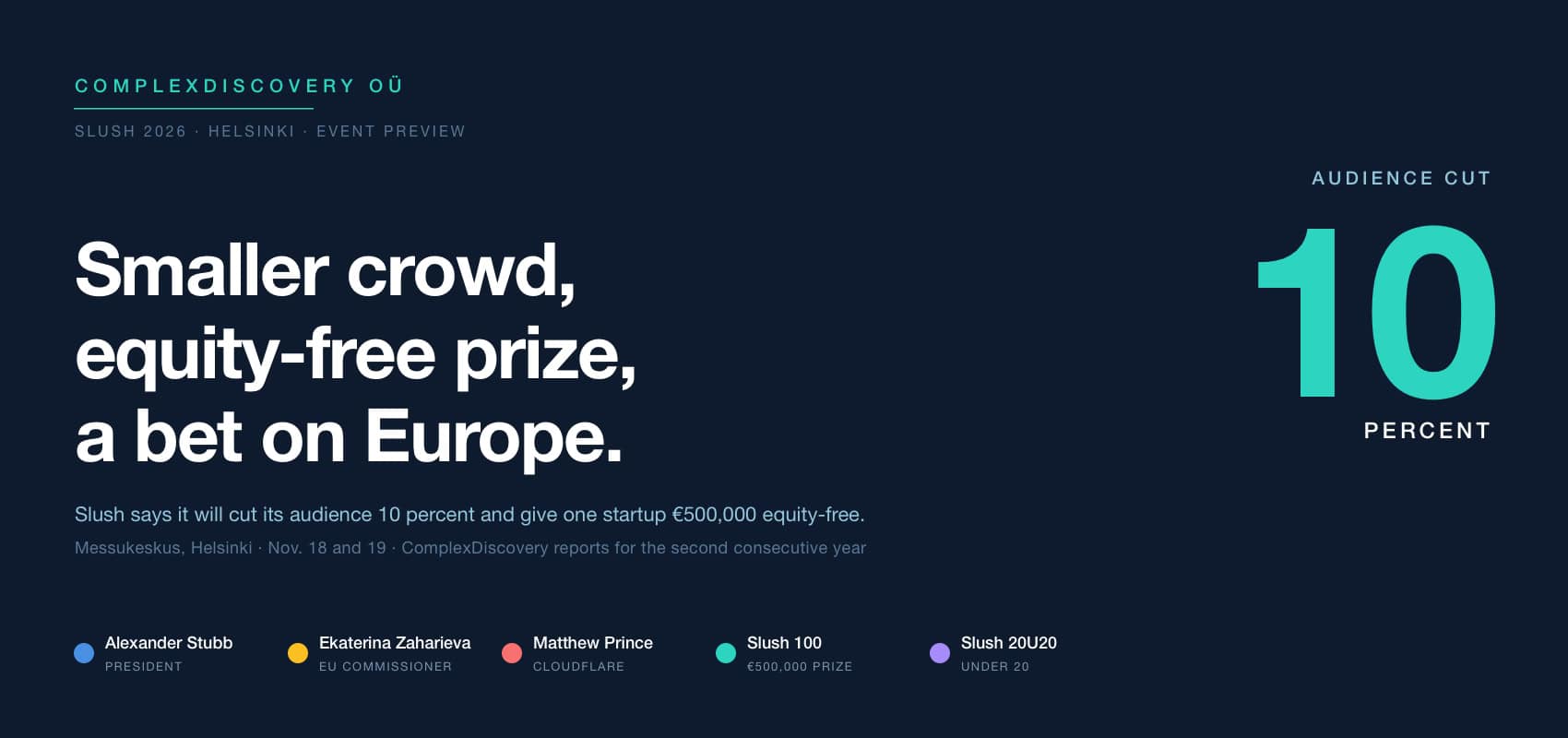
Editor’s Note: Slush will cut its Helsinki audience by 10 percent this year and award its Slush 100 winner €500,000 without taking equity, organizers have said ahead of the Nov. 18 and 19 event.
Finland’s president, Alexander Stubb, and European Commissioner Ekaterina Zaharieva appear on the published speaker list. For cybersecurity, data privacy, regulatory compliance and eDiscovery professionals, the more telling names include founders from Tines, Aikido Security, Wordsmith and Lexroom. They share the program with DoNotPay’s Joshua Browder, whose company operates under a 2025 Federal Trade Commission order barring unsupported claims that its service performs like a real lawyer. Organizers of the EU-INC movement will also speak while the Commission’s EU Inc. proposal remains before Parliament and the Council.
ComplexDiscovery will report from Slush for a second consecutive year, testing which on-stage claims, from legal AI adoption figures to the organizer’s own fundraising research, arrive with evidence attached.
Content Assessment: Slush 2026 brings a smaller, sharper bet on European startups to Helsinki
Information - 93%
Insight - 94%
Relevance - 90%
Objectivity - 90%
Authority - 92%
92%
Excellent
A short percentage-based assessment of the qualitative benefit expressed as a percentage of positive reception of the recent article from ComplexDiscovery OÜ titled, "Slush 2026 brings a smaller, sharper bet on European startups to Helsinki."
Industry News – Technology Beat
Slush 2026 brings a smaller, sharper bet on European startups to Helsinki
ComplexDiscovery Staff
Finland marks the International Day for Failure today, a custom that began in 2010 when a student group at Aalto University proposed celebrating failure instead of lamenting it, Yle reported. Five weeks from now, a startup event that Aalto says its student community helped spark will test how far that appetite for risk can carry European technology.
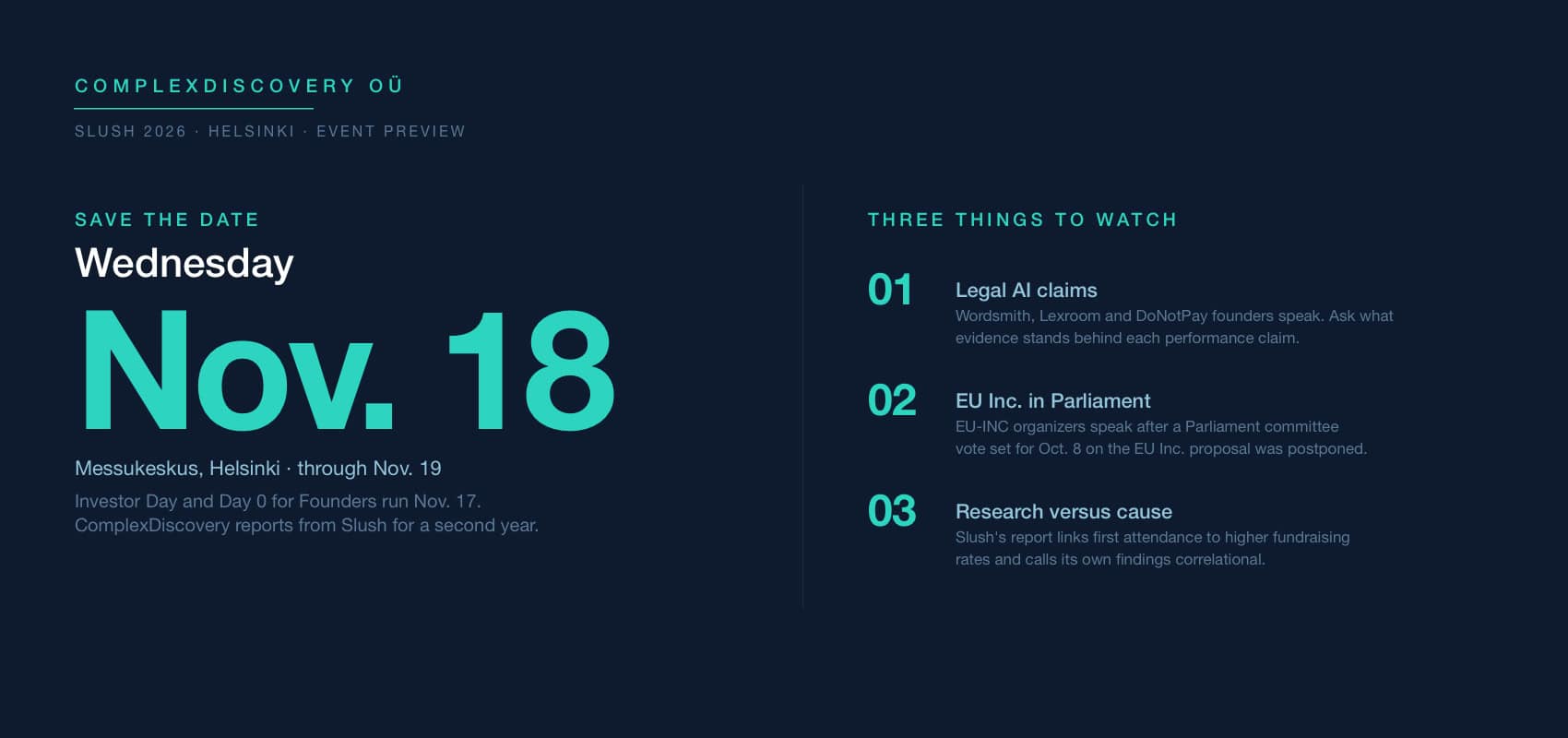
Slush 2026 runs Nov. 18 and 19 at Messukeskus, the Helsinki Expo and Convention Centre, with Investor Day and a founders’ program on Nov. 17. The organizers have branded this edition a bet on Europe. The program published so far pairs that slogan with a sitting head of state, a European commissioner, a deliberately smaller crowd and a rebuilt startup competition. ComplexDiscovery will attend and report from Slush for the second consecutive year.
A smaller crowd, by design
Behind that program sits an unusual organizer. Slush is a not-for-profit owned by the Startup Foundation, a Finnish foundation that receives most of any profit the event makes, according to the organization’s own description. It began in 2008 as a 250-person gathering. Its 2026 FAQ projects 5,800 startups and 3,300 investors, and its homepage advertises 12,000-plus attendees, 200-plus speakers and 600-plus side events across what Slush calls Slush Week. Students and recent graduates run the operation, supported by a volunteer corps that Slush’s own pages put at between 1,600 and 1,800 people.
Selectivity runs through the whole event. Slush says it does not pay speakers and speakers do not pay it, and every company seeking to attend must complete an application that the Slush team reviews personally.
This year the headcount is smaller on purpose. When Slush named Noora Saksa chief executive on Jan. 27, it said the 2026 event would cut its audience by 10 percent to better serve its core of early-stage startups. Personal recommendations will tailor the experience to each company’s growth stage, the announcement said. Saksa, who first joined Slush as a volunteer in 2021, framed the stakes in economic terms. “Startups are our best bet for GDP growth in Europe,” she said in the announcement. She also set a goal there of at least two European technology companies in the global top 10 by market capitalization by 2050.
Announcements that set the 2026 program
The same rethinking reached Slush 100, the pitch competition whose earlier formats date to the event’s 2008 founding year. This year’s winner receives €500,000 with no equity taken, replacing the €1 million investment from venture firms that winners received from 2022 through 2025, according to Slush. “A flat €1M at a fixed valuation and standard terms no longer fits most startups,” Saksa said. Dropping the investor-led model also opens the contest to founders from outside Europe and the U.S., Slush said. From over 1,400 applicants, Slush named 100 companies and then 20 semifinalists, who pitch on the Startup Stage on the first morning before three finalists compete for the prize.
Slush also created Slush 20 Under 20, a program for builders who have not yet turned 20. The first list, published this month, names 20 people from over a dozen countries, the youngest of them 15, who together have raised over €10 million from venture investors, according to Slush. Anthropic, Index Ventures and Sifted support the program. “Europe’s first €1T company could be founded by a teenager,” Saksa said.
Off the stage, Slush has changed address. Since July, it has worked from Kasvutalo, or Growth House, in Helsinki’s Kamppi district. That is the new name Slush and the startup community Founders House gave to Sähkötalo, an Alvar Aalto building completed in 1973 as head office of the city’s electricity utility. A Sept. 2 release counts about 50 companies and communities in the building, around 30 of them startups, investors and startup communities. “Every leading tech hub in Europe has its own startup district,” Saksa said in the release.
Who is on stage, and why practitioners should listen
Those year-round moves feed a November program whose speakers are now partly public. Slush has published what it calls its first batch of 2026 speakers and says the stage program is full. The roster includes two officeholders, Alexander Stubb, Finland’s 13th president, and Ekaterina Zaharieva, the European commissioner for startups, research and innovation. It also features Jessica Livingston, co-founder of Y Combinator; David Silver, former lead of DeepMind’s reinforcement learning team and now chief executive of Ineffable Intelligence; and Matthew Prince, co-founder and chief executive of Cloudflare.
Beyond Prince, cybersecurity professionals will find two security-company founders on the list. Eoin Hinchy ran security operations for 15 years at companies including eBay, PayPal and DocuSign before co-founding Tines, according to his Slush biography, and Madeline Lawrence is co-founder of Aikido Security. Legal technology arrives through Ross McNairn, whose company Wordsmith builds AI software for corporate legal departments. Paolo Fois of Lexroom is also listed, and his Slush biography says over 15 percent of Italian legal proceedings pass through Lexroom, without explaining how that share is measured. The third legal name is Joshua Browder of DoNotPay, whose speaker biography describes the service as “the world’s first robot lawyer.”
That phrase has a regulatory history. In a September 2024 complaint, the Federal Trade Commission (FTC) alleged that DoNotPay did not test whether its AI lawyer service performed at the level of a human lawyer. The commission voted 5-0 on Jan. 16, 2025, to approve a final order, which the agency announced Feb. 11. The order requires DoNotPay to pay $193,000 and bars it from claiming its service performs like a real lawyer without sufficient evidence to back that up, according to the FTC. For eDiscovery and information governance teams weighing AI vendors, the lesson reaches beyond one company, because a federal regulator has already required one legal AI provider to support its performance claims with evidence. Every vendor claim heard in Helsinki deserves the same scrutiny.
Company law has its own advocates on the program. Simon Schaefer, Iwona Anna Biernat and Vojtech Horna appear for EU-INC, a movement Schaefer co-founded in late 2024, according to his Slush biography. The European Commission has since proposed an EU-level company form under the EU Inc. name, which it describes as optional and digital by default. In its March 18 release presenting the proposed regulation, the Commission called on the European Parliament and the Council to agree on it by the end of 2026. In Parliament, the file has hit a delay: a vote in the legal affairs committee planned for Oct. 8 was postponed, with a new date around Oct. 19, Agence Europe and Table.Briefings reported.
Attendees planning their days should know that Slush’s public pages, as reviewed Oct. 13, list speakers and opening hours but not a session-by-session schedule. The media page says the agenda launches in the fall, and for 2025 Slush published its full stage agenda on the Slush Platform, the same online tool attendees use to book meetings. The main event opens with the Slush 2026 Opening Show at 10 a.m. Nov. 18.
What Slush’s own research claims, and what it cannot
Whatever the final schedule, Slush’s sales pitch rests on research it publishes itself. The Slush Startup Report 2026, released in May with data partner Dealroom, compared 2,108 European companies that first attended Slush in 2022, 2023 or 2024 with 229,866 European peers matched on founding year, country and growth stage. Every company in the Slush group was founded in 2016 or later and had not reached a Series B round when it first attended. After that first attendance, 26.4 percent of the Slush companies raised institutional capital, against 7.5 percent of benchmark peers measured over what the report calls the equivalent post-2022 period, which the report presents as a 3.5-times premium. On investor quality, 5.6 percent of the Slush companies were backed by a fund in the top 0.1 percent of Dealroom’s global investor ranking, against 0.8 percent of peers.
Readers should weigh those figures against the report’s own caveats. The two groups start in different places. Nearly half the Slush companies, 48 percent, had no institutional backing when they first attended, while 89 percent of the benchmark companies were bootstrapped. The report acknowledges that already-backed companies raise money at higher rates in both groups, which is why its aggregate premium exceeds the premium within either subgroup. Among companies with no outside funding at first attendance, 17 percent of the Slush group raised venture capital afterward, against 5.6 percent of peers. Among those already backed, the rates were 35 percent and 23.2 percent. Its methodology also concedes that matching cannot account for how ambitious, well connected or ready to raise the attending companies already were. The findings are correlational, the report says, and its matching “cannot separate who attends from what attending does.” The report closes by telling readers the data suggests the trip is worth taking, which marks it as research produced by the organization that sells the tickets.
Two other Slush studies frame this year’s message. In a February survey of 310 Finnish founders and operators, 53 percent of respondents said they were considering or actively planning to move business operations abroad, and 56 percent named general attitudes and culture as obstacles to growth. Slush says the respondents represent about 10 percent of Finland’s active startups. It sent 10 reform proposals to Prime Minister Petteri Orpo, who said his government would review them in its April budget framework discussions. An October 2025 study with Dealroom and Accel found that 68 of 459 former full-time Slush staff members, or 15 percent, had gone on to found companies.
Finland’s stage carries geopolitical weight
Slush makes its case for European founders from a city whose venues carry their own history. Investor Day on Nov. 17 takes place at Alvar Aalto’s Finlandia Hall on Töölö Bay, where Slush’s Investor Day page promises over 2,000 venture investors. Leaders of 35 states gathered there for the 1975 Conference on Security and Co-operation in Europe. They signed the Helsinki Final Act on the summit’s last day, Aug. 1, 1975, according to the Finnish Heritage Agency and Switzerland’s National Museum.
Finland’s own position has shifted since then. It became NATO’s 31st member on April 4, 2023, and Stubb took office as president on March 1, 2024. Helsinki also hosts the European Centre of Excellence for Countering Hybrid Threats, which counts 35 participating states, all of them members of the EU or NATO. For security teams with Finnish operations, the country’s Cybersecurity Act, which implements the EU’s NIS 2 Directive, began phasing in obligations for covered entities on April 8, 2025, according to Traficom. Those entities then had until May 8 of that year to register and until July 8 to establish risk-management procedures, although public administration entities received no separate transition period for that risk-management obligation, the agency said.
The technology record behind the event runs deep. Linus Torvalds, who enrolled at the University of Helsinki in 1988, started work on the kernel later named Linux in the fall of 1991, according to the Computer History Museum. Satellite company ICEYE, whose co-founder Rafal Modrzewski is on the 2026 speaker list, launched its technology in Finland and now serves defense clients worldwide, according to Slush’s Helsinki page.
What ComplexDiscovery will be watching
ComplexDiscovery’s coverage from Helsinki last year followed similar threads, examining how Harvey scaled domain-specific legal AI, how the BORDERLAND gathering approached dual-use defense technology, and what data provenance meant for information governance teams. Four threads stand out for 2026. The first is evidence: when legal AI founders cite adoption or accuracy figures on stage, record the claim and its basis, because statements made on stage can resurface in sales materials and procurement files. The second is corporate form: if EU Inc. advances, counterparties incorporated under a new EU-level form are likely to raise registry and records questions for diligence and discovery teams, in this publication’s assessment. The third is resilience, because defense, space and infrastructure companies on the program, ICEYE among them, work in sectors where cybersecurity, export controls and data sovereignty overlap.
The fourth is timing. Two of the 20 Slush 100 semifinalists build products around sensitive information: Foundation Clinic, which Slush lists as “the health-data platform for European healthcare,” and GraceX, pitched as “your company’s brain” with privacy built in. In this publication’s assessment, companies at that stage are where security, information governance and discovery needs first take shape, which makes Slush a place for providers in those fields to see what early-stage clients will ask of them.
The International Day for Failure, as Yle describes it, aims to take the stigma out of mistakes so that people feel free to create and innovate. Slush is now asking Europe to place a larger bet on its own builders, while its own research concedes it cannot separate the founders who walk in from what the room itself does for them. Which claims made on Helsinki’s stages next month will your organization be ready to verify before it relies on them?
News Sources
- Slush 2026 | Helsinki, Nov 18-19 (Slush)
- Slush FAQ (Slush)
- Event Info (Slush)
- Slush | About Us (Slush)
- Media at Slush (Slush)
- Noora Saksa appointed as new Slush CEO (Slush)
- Slush 2026 is a Bet on Europe (Slush)
- Slush’s new €500,000 bet (Slush)
- Slush 100 (Slush)
- Meet our generation’s most exceptional outliers: Slush 20U20 (Slush)
- Slush and Dozens of Startups Are Building Helsinki’s New Growth Hub (Slush)
- Speakers (Slush)
- Investor Day (Slush)
- Why Aalto & Slush Matter More Than Ever (Aalto University via Slush)
- Slush ♡ Helsinki (Slush)
- Finnish Founder Survey Results (Slush)
- Slush Alumni Founder Factory report (Slush)
- FTC Finalizes Order with DoNotPay That Prohibits Deceptive ‘AI Lawyer’ Claims, Imposes Monetary Relief, and Requires Notice to Past Subscribers (Federal Trade Commission)
- Cybersecurity Act passed by Parliament, obligations under the NIS 2 Directive enter into force 8 April 2025 (Traficom)
- Finland joins NATO as 31st Ally (NATO)
- What is Hybrid CoE? (European Centre of Excellence for Countering Hybrid Threats)
- Commission presents proposal for EU Inc.: unlocking the full potential of the Single Market for Europe’s entrepreneurs (European Commission)
- Slush Impact Report Series: Slush Startup Report 2026 (Slush Research)
- EU Inc. marks major win for startups as Commission unveils 28th regime proposal (Tech.eu)
- Video: Why does Finland celebrate failure? (Yle News)
- Lack of agreement among European Parliament rapporteurs leads to postponement of committee vote on 28th regime (Agence Europe)
- EU Inc.: Deal in Committee on Legal Affairs falls through over co-determination (Table.Briefings)
- Three sweltering days in Helsinki (Finnish Heritage Agency)
- 1 August 1975: from Bern to Helsinki (Swiss National Museum)
- Linus Torvalds (Computer History Museum)
- European Commission Proposes ‘EU Inc.,’ A New Corporate Entity for EU Companies (Greenberg Traurig)
- Lessons from Slush 2025: How Harvey Is Scaling Domain-Specific AI for Legal and Beyond (ComplexDiscovery)
- How Finland Is Reshaping Defense: BORDERLAND at Slush 2025 (ComplexDiscovery)
- Data Provenance and Defense Tech: IG Lessons from Slush 2025 (ComplexDiscovery)





Assisted by GAI and LLM Technologies
Additional reading
- Tallinn Digital Summit 2026 puts the agentic state to the test
- Nine months across Europe’s tech-sovereignty arc, from Tallinn to London
- The flame and the frontier: how Estonia carries a 1919 victory into a tense 2026
- Estonia aims to be first to give AI agents official digital IDs
- Parliament hits pause on high-risk AI rules and bans nudifier apps
- Europe’s AI labeling rules arrive with a voluntary code and a hard deadline
- AI is becoming an advisor, and it is rewriting how buyers find you
- What marketing confidence actually looks like
- When credibility comes first, capability sells itself: The case for news-led marketing
- The one question that reveals whether your marketing plan is actually a plan
- How Prompt Marketing Is Redefining Thought Leadership In The AI Era
- Raising The Age Ceiling: How AI Is Extending Executive Leadership
- Staying Curious: One Practical Defense Against Creative Burnout
- From Longbows To AI: Lessons In Embracing Technology
- 20 Ways Creative Professionals Battle Burnout And Find Fresh Ideas
- 14 Points For Brands To Consider Before Making Sociopolitical Statements
Source: ComplexDiscovery OÜ

ComplexDiscovery’s mission is to enable clarity for complex decisions by providing independent, data‑driven reporting, research, and commentary that make digital risk, legal technology, and regulatory change more legible for practitioners, policymakers, and business leaders.