

Editor’s Note: The Federal Trade Commission has written 75 percent recall and precision floors into instructions issued with a recent civil investigative demand and a merger second request, for parties using technology-assisted review (TAR) or artificial intelligence-assisted review, according to an Oct. 7 analysis by Bryan M. Marra of the law firm Arnold & Porter.
Recall is the share of responsive documents a review finds; precision is the share of documents marked responsive that truly are. The reported instructions also set a minimum cutoff score of 0.50, the score at which a document counts as responsive, and parties using AI-assisted review must disclose the tool, its underlying model and all prompts given to it. ComplexDiscovery located no FTC document describing the instructions, and the agency’s public Model Second Request, its template for merger information requests, revised in January 2024, asks for recall and precision statistics without setting a minimum.
For cybersecurity, information governance and eDiscovery teams, the terms reach collection timing, platform capabilities and prompt records that some parties argue are protected attorney work product. Watch for published agency language, negotiated modifications and any court test of whether the instructions can be enforced.
Disclosure: Rob Robinson, founder and managing editor of ComplexDiscovery OÜ, also serves as chief marketing officer of HaystackID, a provider of eDiscovery services, including AI-assisted document review. HaystackID, which published its own account of the FTC instructions on Oct. 13, 2026, had no role in the preparation of this article, which does not rely on that account and is based solely on publicly available information. ComplexDiscovery OÜ is an EDRM Guardian Partner, and Robinson sits on EDRM’s Global Advisory Council, where EDRM lists Tara Emory and Maura Grossman, whose paper the article cites.
Content Assessment: FTC instructions set 75 percent recall and precision floors for TAR and AI review, law firm reports
Information - 92%
Insight - 92%
Relevance - 94%
Objectivity - 91%
Authority - 90%
92%
Excellent
A short percentage-based assessment of the qualitative benefit expressed as a percentage of positive reception of the recent article from ComplexDiscovery OÜ titled, "FTC instructions set 75 percent recall and precision floors for TAR and AI review, law firm reports."
News Analysis – eDiscovery Beat
FTC instructions set 75 percent recall and precision floors for TAR and AI review, law firm reports
ComplexDiscovery OÜ Staff
The Federal Trade Commission has written 75 percent recall and precision floors for technology-assisted and artificial intelligence-assisted review into a recent civil investigative demand and a merger second request, a law firm analysis reports.
The analysis names no FTC document, and the model second request the agency posts publicly still asks parties to supply recall and precision statistics without setting a number they must reach.
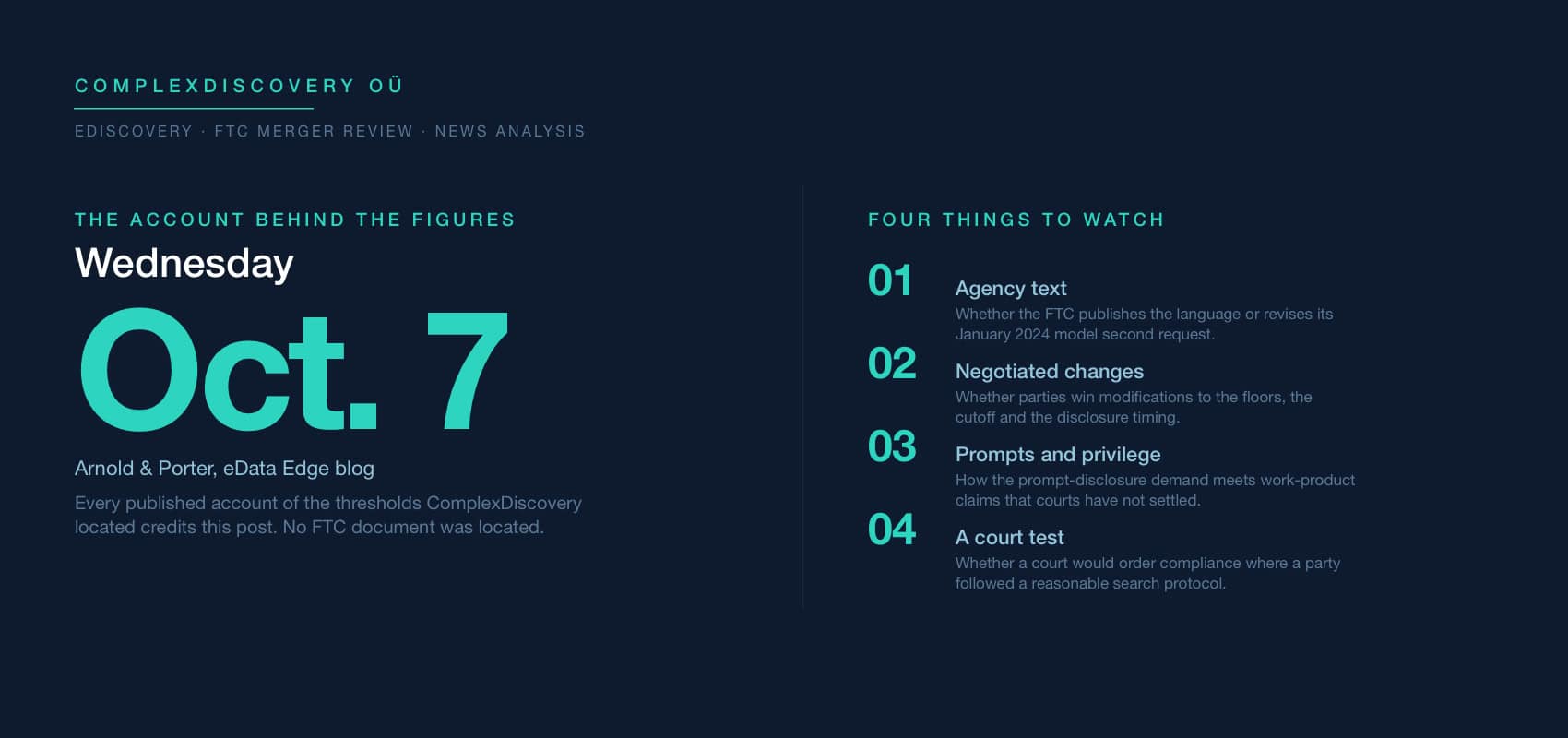
Bryan M. Marra, a senior attorney in Arnold & Porter’s Washington office, described the instructions in an Oct. 7 post on the firm’s eData Edge blog, writing from the side of parties that respond to compulsory process. He wrote that the FTC had issued them as investigational subpoenas in a civil investigative demand (CID) and in a merger second request investigation. In his account, they tighten the conditions for technology-assisted review (TAR) and give AI-assisted review its first definition. The post does not date either the CID or the second request, name either investigation or quote the instruction text at length. Every published account of the specific thresholds that ComplexDiscovery located credits Marra’s post, including republications on Mondaq and The Legal 500. That means every figure attributed to the instructions below rests on a single account.
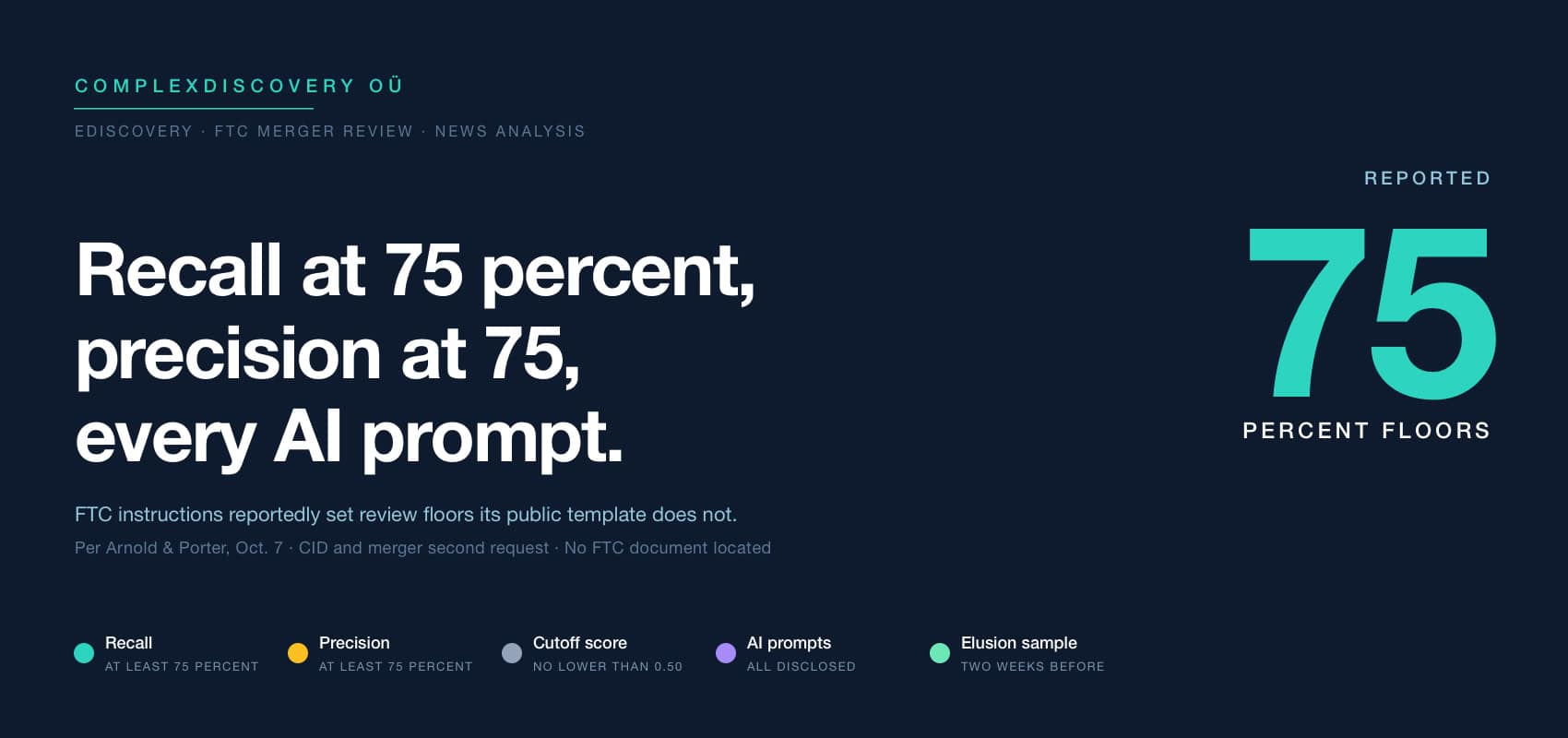
Reported terms run from recall to prompts
Recall measures the share of responsive documents a review actually finds, while precision measures the share of documents marked responsive that truly are. Recall must reach at least 75 percent, measured to plus or minus 3 percent at a 95 percent confidence level, according to Marra. Precision must also reach at least 75 percent, a requirement he described as “the first time the FTC has required a set precision” and a break from agency practice that had centered on recall. Parties must disclose the cutoff score that separates responsive from nonresponsive documents, which he said is likewise new, and that score can be no lower than 0.50.
Those numbers come wrapped in a schedule. Disclosures describing the technology, the workflow and the subject matter experts who will train the system are due at least one week before any training or review starts. Each expert must be “a full-time employee of the firm managing the response,” Marra wrote. The same filing must report which kinds of documents will go through TAR or AI and which file types are set aside for special handling, with particular rules for ephemeral messages, text messages and linked, or modern, attachments.
Training cannot begin until every custodian has been collected and FTC staff have had the opportunity to review and confirm the disclosures. In Marra’s reading, the sequencing “seems aimed at discouraging TAR 1.0 in favor of TAR 2.0/Continuous Active Learning.” A calendar of planned rolling productions is due within a week after training starts, and a pre-production elusion sample, delivered as the sample itself rather than as summary statistics, is due at least two weeks before compliance.
Validation also carries consequences under the reported terms. Parties typically offer the FTC a look at a null set when using TAR, Marra said, and the instructions now formalize that practice. A party must retrain the model when the FTC concludes that the validation shows deficiencies, and it must make supplemental productions if the agency’s review of the sample changes the process.
Generative and other AI tools face a further list. A party must name the tool, version, provider and underlying model, and report how often the AI and human reviewers agreed on a statistically valid sample, broken down by classification category. It must disclose all prompts or review protocols given to the AI, along with relevance scores and rationales for every produced document where those exist.
Two limits reach both technologies, by Marra’s account. No analytics, email threading and search terms among them, may shrink the population before deduplication or before TAR or AI runs unless the FTC agrees to the specific process. Nor may manual review or search terms strip out documents identified as responsive by predictive coding, “except to the extent required to identify privileged information, including PII, SPII, and SHI.” Marra said that rule formalizes a position the FTC and the Justice Department have historically taken. The post does not expand those acronyms, although the agency’s model second request separately defines “Sensitive Personally Identifiable Information” and “Sensitive Health Information.”
FTC’s public template still sets no number
The agency’s own posted template asks for less. The FTC’s Hart-Scott-Rodino (HSR) Resources page links a Model Second Request marked “Revised January 2024.” Its Instruction I 5 asks a party using any form of technology-assisted review to confirm that subject matter experts will review the seed set and training rounds and to supply “recall, precision, and confidence-level statistics (or an equivalent).” The same instruction calls for a validation process that lets Commission staff review statistical samples of documents the algorithm marked nonresponsive, and it sets no minimum for any statistic. A text search of the 27-page document on Oct. 30 found no reference to artificial intelligence.
That model is a template, while Marra described instructions attached to particular investigations. Until the agency publishes the language or revises the template, the public description of the floors that ComplexDiscovery located traces to a law firm’s summary of instructions for which it found no public copy.
Why a precision floor may be hard to plan for
Meeting the floors may prove harder than stating them. Marra warned that the thresholds could prove difficult to satisfy, since precision turns heavily on the particulars and richness of a given collection and tends to move against recall. Tuning a system to find more responsive documents usually sweeps in more nonresponsive ones, so a party asked to hold both measures at 75 percent has less room to give up one to gain the other.
The reported margin-of-error language leaves a second question open. If 75 percent is the required point estimate, a measured recall of 75 percent passes. If it is instead the bottom of the confidence interval, a party needs a point estimate near 78 percent, on this article’s reading of the margin as 3 percentage points. Marra’s account does not say whether the 75 percent requirement applies to the point estimate or the lower confidence bound.
Sample size compounds the uncertainty. Under the textbook normal approximation, a ComplexDiscovery calculation shows, estimating recall near 75 percent within 3 percentage points at 95 percent confidence takes about 800 responsive documents in the validation sample. In a collection where 5 percent of documents are responsive, finding that many by simple random sampling means drawing about 16,000 documents on average. Other estimation designs exist, and the instructions as reported do not prescribe one.
The cutoff floor raises a parallel question for generative tools, because the account does not say what scale the 0.50 figure sits on. A stipulated order entered in July in the Northern District of California already anticipates AI systems that generate “scores, probabilities, classifications, or decision boundaries.” A tool that returns a category rather than a score, in this article’s reading, offers no evident 0.50 to report. Teams expecting a second request should ask their platform providers now whether a tool can report agreement by category, export per-document rationales and state precision at a defined cutoff, the outputs the reported instructions list.
Two court orders stop short of recall and precision floors
Two federal orders on AI review this summer stopped short of the reported floors, for different reasons. In Schulte v. LinkedIn Corp., a putative antitrust class action in the Northern District of California, Magistrate Judge Laurel Beeler declined on June 30 to compel LinkedIn to disclose further metrics on its use of Relativity aiR. The plaintiffs had sought elusion estimates, a document error rate and a count of the people validating the generative AI product’s predictions.
The court found that the interim electronically stored information (ESI) order required only disclosure that LinkedIn would use technology-assisted review. A 204,444-document target population, without a more specific showing of deficiency, did not justify discovery on discovery. LinkedIn had told the plaintiffs that it used no seed or training set and that aiR was making final responsiveness calls, with human quality-control review of samples.
A week later, Magistrate Judge Robert M. Illman entered a stipulated ESI order in James v. Cerebras Systems Inc., a putative class action in the same district, whose AI appendix tracks several of the FTC’s reported disclosures. It requires each model’s identity, version and hosting environment, disclosure of all prompts and instruction sets, and redlines of prompt changes within three business days. Validation results must report recall and precision, and the sample of documents the AI excluded as nonresponsive must be sized at a 95 percent confidence level with a 2 percent margin of error. Its only performance expectation is that elusion not exceed 3 percent, and it sets no recall or precision floor. Proprietary prompts may be withheld if logged with particularity and offered for attorneys’-eyes-only inspection.
Prompt disclosure meets an unsettled work-product question
That trade-secret carve-out points to a sharper edge in the reported FTC terms, which, as Marra describes them, call for all prompts with no stated exception for proprietary material. Marra said some parties have argued that prompts, scores and rationales are attorney work product because they reveal legal strategy. A paper by Tara Emory and Maura Grossman, which ComplexDiscovery covered in July as forthcoming in the Columbia Science and Technology Law Review, argued that properly developed review prompts can reflect an attorney’s “factual investigation, mental impressions, and case strategy.” In most cases, the authors wrote, validating the results serves transparency better than exposing the prompts.
Outside document review, one federal court this month declined to treat AI material as categorically protected. On Oct. 21, Magistrate Judge Marty Fulgueira Elfenbein of the Southern District of Florida ruled in Fontainebleau Florida Hotel, LLC v. Botach, a dispute over discovery of a defamation defendant’s AI communications. As to Request Nos. 1, 3, 4 and 7, the order turned away his blanket claim of work-product protection. The order left room for document-specific claims that name the withheld material and explain the protection claimed. It read United States v. Heppner, a Southern District of New York decision, as denying protection to AI material a represented defendant generated without counsel’s direction.
The same order read Warner v. Gilbarco, Inc., an Eastern District of Michigan decision, as accepting that AI-assisted preparation for litigation can qualify for protection and that working through an outside AI tool need not waive it. None of the decisions described here involved review prompts demanded by a federal agency during an investigation.
Negotiate, comply or explain
Marra’s post lays out the practical routes in the meantime. Parties may go back to search terms and manual review, particularly where the review population is small; negotiate compromises with FTC staff; or proceed under a protocol they consider reasonable while giving a statement of reasons for noncompliance. He said the last route carries risk in a second request, where the FTC may dispute that a party has substantially complied and so delay the closing of the transaction. He added that a federal court’s willingness to order compliance is uncertain where a party has followed a reasonable protocol for search and review.
For counsel who expect a second request or CID, the reported terms argue for preparation before either one arrives. Confirm that the review platform can produce the metrics and artifacts the instructions list, and plan for training to wait on complete custodial collection. Keep prompt revision histories and rationale exports in a form that can be logged or produced, and identify in advance the full-time employees who would serve as subject matter experts.
The FTC’s posted template asks a party to show its recall and precision, and if Marra’s account is accurate, the agency has started telling some recipients what those numbers must be. ComplexDiscovery found no public copy of those instructions, and a party that does not follow them as written can negotiate, fall back to search terms or explain itself, which in a second request risks a compliance dispute. When the next second request arrives, will a team’s review platform be able to show 75 percent on both measures for the collection in front of it, and will counsel already know which prompts it is prepared to hand over?
News sources
- Request for Additional Information and Documentary Material Issued to [Company] (Federal Trade Commission)
- HSR Resources (Federal Trade Commission)
- Order on Discovery Letter Brief AND Order on Discovery Letter Brief AND Order on Discovery Letter Brief: #203 in Crowder v. LinkedIn Corporation (N.D. Cal., 4:22-cv-00237) (Schulte v. LinkedIn Corp. order, U.S. District Court for the Northern District of California via CourtListener)
- Order on Stipulation: #74 in James v. Cerebras Systems Inc. (N.D. Cal., 4:25-cv-09361) (U.S. District Court for the Northern District of California via CourtListener)
- 2026-10-21-fontainebleau-florida-hotel-v-botach.pdf (U.S. District Court for the Southern District of Florida via Servient)
- FTC Issues Rigorous Requirements on Using AI-Assisted Review or Technology-Assisted Review to Respond to Investigational Subpoenas (Arnold & Porter, Oct. 7, 2026)
- FTC Issues Rigorous Requirements On Using AI-Assisted Review Or Technology-Assisted Review To Respond To Investigational Subpoenas (Arnold & Porter via Mondaq, Oct. 11, 2026)
- FTC Issues Rigorous Requirements On Using AI-Assisted Review Or Technology-Assisted Review To Respond To Investigational Subpoenas (Arnold & Porter via The Legal 500, Oct. 11, 2026)
- Tara S. Emory and Maura R. Grossman: GenAI Prompts in eDiscovery: Protected Work Product or Not? (ACEDS)
- Prompt privacy: new scholarship argues GenAI review instructions are attorney work product (ComplexDiscovery)

Assisted by GAI and LLM Technologies
Additional reading
- Waterloo and Elevate researchers say Redgrave’s aiR study compared two different tasks
- Complete look: ComplexDiscovery OÜ’s 2025 to 2030 eDiscovery market size mashup
- The workstream of eDiscovery: Considering processes and tasks
Source: ComplexDiscovery OÜ

ComplexDiscovery’s mission is to enable clarity for complex decisions by providing independent, data‑driven reporting, research, and commentary that make digital risk, legal technology, and regulatory change more understandable for practitioners, policymakers, and business leaders.