

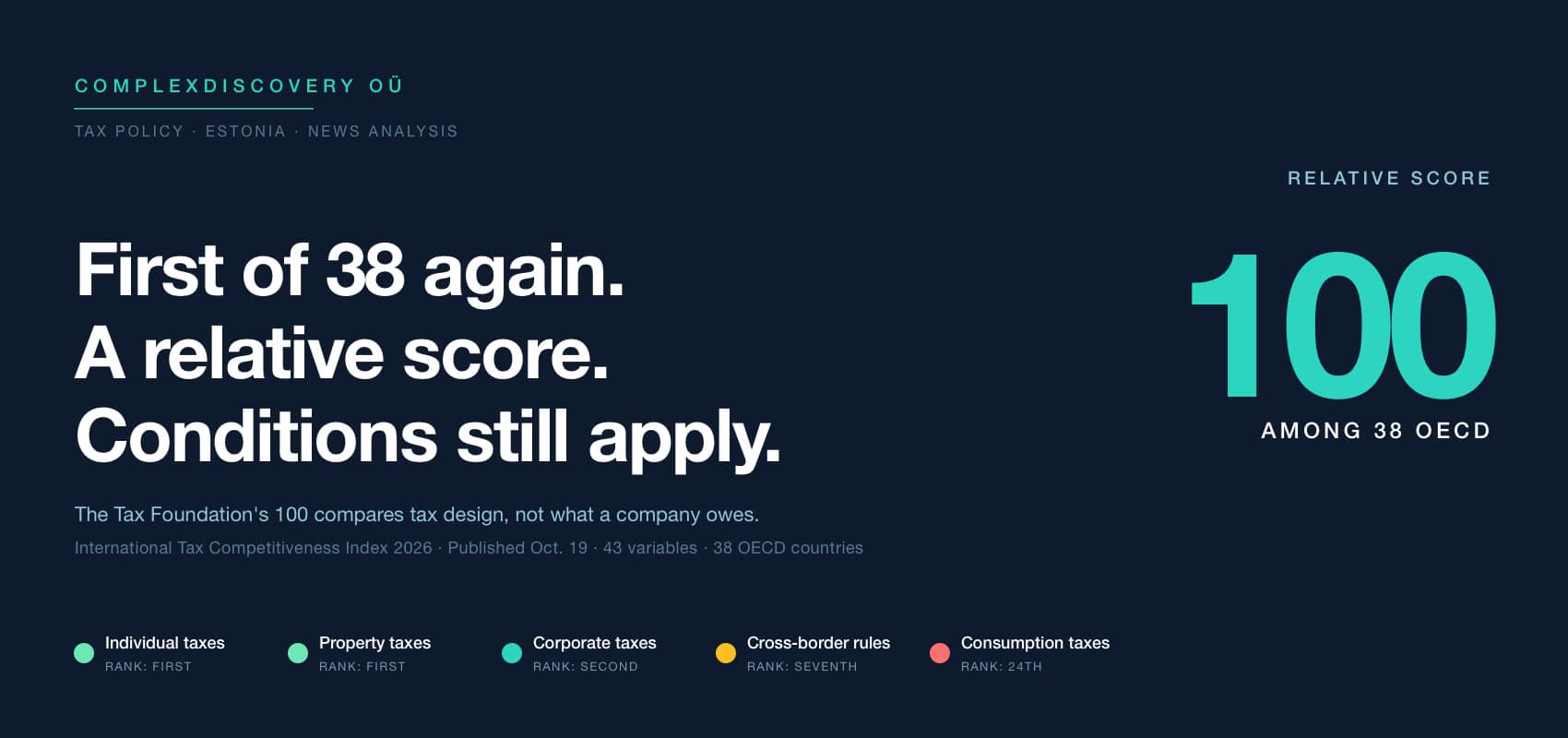
Editor’s Note: The Tax Foundation, a U.S. tax policy nonprofit, ranked Estonia first among 38 OECD countries in its 2026 International Tax Competitiveness Index, published Oct. 19, for what it counts as the 13th straight year. The score of 100 is relative, marking the best tax design among those countries, not a tax rate or burden. The report’s authors, Alex Mengden and Luis Zarka, attribute Estonia’s top score to four features: a 22 percent corporate tax charged only on distributed profits, which Estonia’s tax board states as 22/78 of the net payout; a flat 22 percent income tax; a land-only property tax; and the treatment of foreign profits. Estonia ranks 24th on consumption taxes and seventh on cross-border rules. OECD data separately put Estonia’s 2025 tax wedge for a single, childless worker on the average wage at 42.6 percent, eighth highest in the OECD.
For cybersecurity, information governance, compliance and eDiscovery professionals, the practical issue is evidence: Estonia’s tax board says Estonian tax residency does not automatically exempt a company from taxation in other countries where it does business or earns income. Watch how companies document where they are managed, how they classify payments and what supports any foreign-tax relief.
Disclosure: ComplexDiscovery OÜ is an Estonian company, and its founder and managing director is an Estonian e-resident.
Content Assessment: Estonia leads tax competitiveness ranking, with caveats for cross-border businesses
Information - 93%
Insight - 94%
Relevance - 90%
Objectivity - 90%
Authority - 92%
92%
Excellent
A short percentage-based assessment of the qualitative benefit expressed as a percentage of positive reception of the recent article from ComplexDiscovery OÜ titled, "Estonia leads tax competitiveness ranking, with caveats for cross-border businesses."
News Analysis – Digital Residency Beat
Estonia leads tax competitiveness ranking, with caveats for cross-border businesses
ComplexDiscovery Staff
Estonia ranks first among 38 OECD countries in the Tax Foundation’s 2026 International Tax Competitiveness Index, released Oct. 19, extending a first-place run the publisher counts at 13 consecutive years.
The score attached to that rank, 100, is easy to misread, because it compares Estonia’s tax design with those of 37 other countries rather than measuring what any company owes.
The index is a Tax Foundation publication by Alex Mengden, an economist at the U.S. tax policy nonprofit, and Luis Zarka, a 2026 transatlantic tax fellow there. The Organization for Economic Cooperation and Development (OECD) supplies the comparison group and some underlying data; the ranking is the foundation’s. The foundation says its mission is to improve lives through tax policies “that lead to greater economic growth and opportunity,” and the index rates tax codes for what the authors call competitiveness and neutrality.
What the Tax Foundation index measures
The 2026 report scores 43 variables in five categories: corporate income tax, individual taxes, consumption taxes, property taxes and cross-border tax rules. Results are relative to the best performer, and the methodology states that “a score of 100 does not signify the absolute best possible tax code but the best tax code among the 38 OECD countries.” The score is therefore neither a tax rate nor an effective tax burden.
None of the five categories is built to test whether a country raises enough revenue. A July 2025 International Monetary Fund staff paper put Estonia’s revenue about 6 percentage points of gross domestic product below European advanced economies at the same income level, using 2023 data, largely by policy choice.
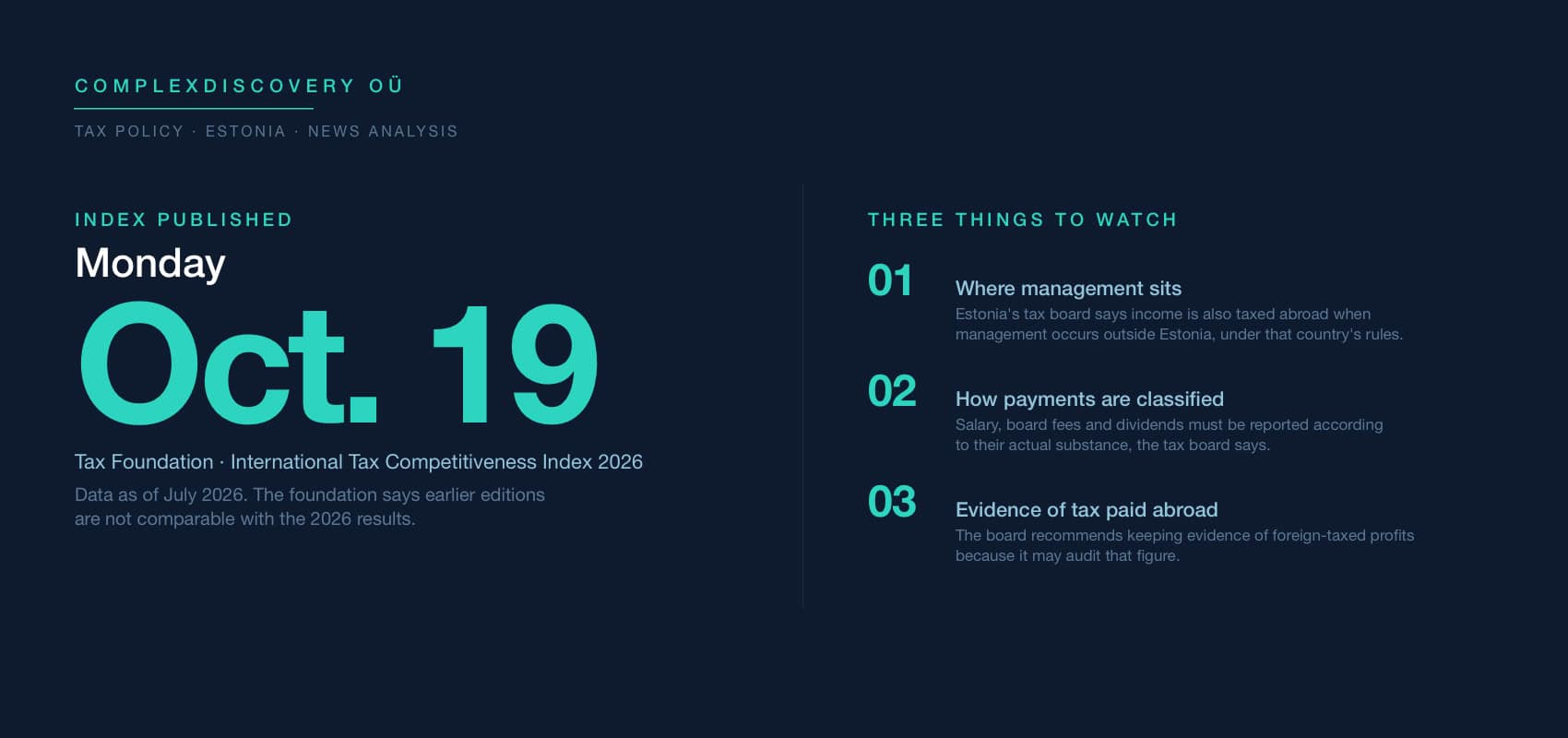
The ranking also carries a date stamp: the report uses data available as of July 2026, and the authors warn that rapid reforms may not be reflected. Because each methodological change is applied to prior years, the foundation says earlier editions are not comparable with the 2026 results, and its own year-over-year table, built on the revised method, shows Estonia first with the same score in 2025.
Why Estonia’s tax design scores well
The authors trace the top score to four features: a 22 percent corporate tax applied only to distributed profits, a flat 22 percent individual income tax that excludes dividends, a land-only property tax and a territorial treatment of foreign profits.
The first feature needs unpacking. Estonia’s Tax and Customs Board lists the 2026 corporate income tax as 22/78, calculated on the net amount a company distributes, and says profit is taxed when distributed rather than when earned. The 22 percent rate and the 22/78 formula are one rate stated two ways. Assume a company earns 100 euros of pretax profit, makes no other taxable payments and distributes everything. It can pay a 78-euro dividend, and 78 times 22/78 yields 22 euros of tax, which is 22 percent of the profit and about 28.2 percent of the dividend.
Deferral is not the same as no company tax. The Income Tax Act still taxes a resident company’s gifts, donations, entertainment costs, and expenses unrelated to its business, and it taxes fringe benefits separately. Within the corporate category, Estonia ranks second behind Latvia and 11th on the rate, so its score rests on cost recovery, where it ranks first, and on incentives and complexity, where it ranks second.
Where the scorecard turns weaker
First place overall does not mean first in every category. Estonia ranks 24th on consumption taxes, including 31st on the rate subcategory, reflecting a 24 percent standard value-added tax rate, and 13th on the tax base. It ranks seventh on cross-border tax rules. The country profile lists three weaknesses: tax treaties with 62 countries against an OECD average of 75, a territorial system “limited to European countries,” and thin capitalization rules among the more stringent in the OECD.
The territorial point needs reconciling, because the report’s overview describes an exemption for 100 percent of foreign profits “with few restrictions.” Its appendix codes the exemption as limited to European Union and European Economic Area members and Switzerland, and Estonian law sets conditions. The tax board says a resident company pays tax on its worldwide income, deferred until distribution. Under Section 50 of the Income Tax Act, a company can pass on a dividend tax-free if it came from a company liable to income tax in a European Economic Area state or Switzerland. The Estonian company must have held at least 10 percent of the paying company’s shares or votes when it received the dividend, among other conditions, and companies in non-cooperative jurisdictions are excluded. Dividends from outside the European Economic Area and Switzerland can still qualify. The same holding applies, plus one additional requirement: foreign tax must have been withheld from the dividend or levied on the profit behind it.
Once a dividend leaves the company, shareholders face their own rules. Since 2025, Estonia generally taxes dividends only at the company level, so an individual receiving a dividend taxed at 22/78 faces no further Estonian withholding. The tax board warns, however, that an e-resident individual in most cases cannot use the company’s Estonian tax for double-tax relief at home, because a different person, the company, paid it. Company-level-only taxation has a transitional exception: dividends a company received that were taxed at the former 14/86 rate through 2024 carry a 7 percent withholding when passed on to individuals.
Labor-tax burden and causation are separate questions
On wages, the OECD’s Taxing Wages research offers a different measure. Its 2026 country note puts Estonia’s tax wedge for a single, childless worker on the average wage at 42.6 percent in 2025, eighth highest among members, against an OECD average of 35.1 percent. That measure divides income tax plus employee and employer contributions, less family benefits, by total labor costs. The index’s wage-tax variables instead track the top statutory rate, the income where it starts and the ratio of marginal to average tax wedges. The authors use that ratio so the overall weight of labor taxes drops out. The two measures answer different questions for different years.
Nor does the ranking show what the design causes. The report acknowledges that much besides taxation shapes economic performance, while maintaining that taxation matters to a country’s economic health. In that IMF staff paper, Irina Bunda and Tibor Hanappi judged the distributed-profits tax (DPT) probably less distorting than a conventional corporate income tax, since it mostly reaches rents, meaning profit above a normal return. They also flagged volatile revenue and arbitrage risks, and asked “whether the DPT system is still the main factor in attracting investment to Estonia.”
Records behind the deferral
What the ranking cannot score is where exposure lies for cross-border technology and professional-services firms. A company founded under Estonian law is an Estonian resident. The tax board states, however, that “Estonian tax residency does not automatically exempt companies from taxation elsewhere in the world where business is carried on or where the Estonian company earns income.” It adds that income “is also taxed abroad” when management occurs outside Estonia, under that country’s rules, and its example of a company run from abroad says that company “will probably have a permanent establishment” in the foreign country.
Classification is the next pressure point. When one person is owner, board member and employee, the tax board says salary, board fees and dividends must be reported “according to their actual substance.” Board fees draw Estonian income tax and social tax wherever the work occurs. Only an A1 certificate issued in the recipient’s home country, confirming social security coverage there, removes the social tax. Where profits taxed at a foreign permanent establishment support a tax-free dividend, the company must still report them in Estonia, and the board recommends keeping evidence of the amount taxed abroad because it may audit that figure. In an April 2026 article on their firm’s website, Karl Joonas Kendla and Kristjan Nõges of the law firm Lepmets & Nõges advise assessing permanent-establishment risk at least once a year and documenting business activities in writing.
The number 100 tells a board how Estonia’s rules compare, but whether they deliver for a particular company depends on board minutes, payment records and evidence of tax paid abroad. If your organization’s tax position rested on proving where its decisions were made, could your records show it?
News sources
- International Tax Competitiveness Index 2026 (Tax Foundation)
- International Tax Competitiveness Index 2026 (Tax Foundation, full report PDF)
- Estonia Tax Rankings | 2026 International Tax Index | Tax Foundation (Tax Foundation)
- Tax rates | Estonian Tax and Customs Board (Estonian Tax and Customs Board)
- Tax liabilities of companies established by e-residents | Estonian Tax and Customs Board (Estonian Tax and Customs Board)
- Taxation of dividends | Estonian Tax and Customs Board (Estonian Tax and Customs Board)
- Income Tax Act-Riigi Teataja (Riigi Teataja)
- Taxing Wages 2026: Estonia (OECD)
- Options to Strengthen the Tax System in Estonia (International Monetary Fund)
- Tax Foundation: About Us | About the Tax Foundation (Tax Foundation)
- Permanent Establishment Risk for E-Residents Explained (Lepmets & Nõges)





Assisted by GAI and LLM Technologies
Additional reading
- Estonia tops Rumavi’s 2026 relocation index as institutions beat sunshine
- European investors see a strong pipeline and a capital gap at home
- Nine months across Europe’s tech-sovereignty arc, from Tallinn to London (ComplexDiscovery)
Source: ComplexDiscovery OÜ

ComplexDiscovery’s mission is to enable clarity for complex decisions by providing independent, data‑driven reporting, research, and commentary that make digital risk, legal technology, and regulatory change more legible for practitioners, policymakers, and business leaders.