

Editor’s Note: A relocation index published at the turn of July hands Estonia first place among 192 countries and territories, two tenths of a point ahead of Singapore, and the reasons read like a governance brief: banking access, business opportunity and property rights for non-citizens. Rumavi, the flat-fee advisory behind the ranking, runs six weighting profiles over one dataset, and the Entrepreneurs and Digital Nomads tables split accordingly, Singapore and Estonia for founders, Malaysia and Portugal for remote workers.
For cybersecurity, privacy, compliance and eDiscovery professionals, the story sits underneath the scores. Estonia’s e-Residency program reported €124.9 million in 2025 state revenue and, by its own count, now accounts for about one in five new Estonian companies, while Estonian observers flag dividend timing, inactive firms and financial-crime warnings beneath the record, and a planned card-free identity rollout raises the stakes for remote verification. The piece walks the six rankings, the Baltic and Eastern European results and the caveats that should travel with both.
Watch three things next: whether 2026 revenue normalizes, how the cardless rollout handles identity proofing, and what the 2027 edition does to the Baltics’ lead.
Disclosure: ComplexDiscovery OÜ is an Estonian company, and its editor is an Estonian e-resident.
Content Assessment: Estonia tops Rumavi's 2026 relocation index as institutions beat sunshine
Information - 94%
Insight - 93%
Relevance - 90%
Objectivity - 90%
Authority - 92%
92%
Excellent
A short percentage-based assessment of the qualitative benefit expressed as a percentage of positive reception of the recent article from ComplexDiscovery OÜ titled, "Estonia tops Rumavi's 2026 relocation index as institutions beat sunshine."
Industry News – Digital Residency Beat
Estonia tops Rumavi’s 2026 relocation index as institutions beat sunshine
ComplexDiscovery Staff
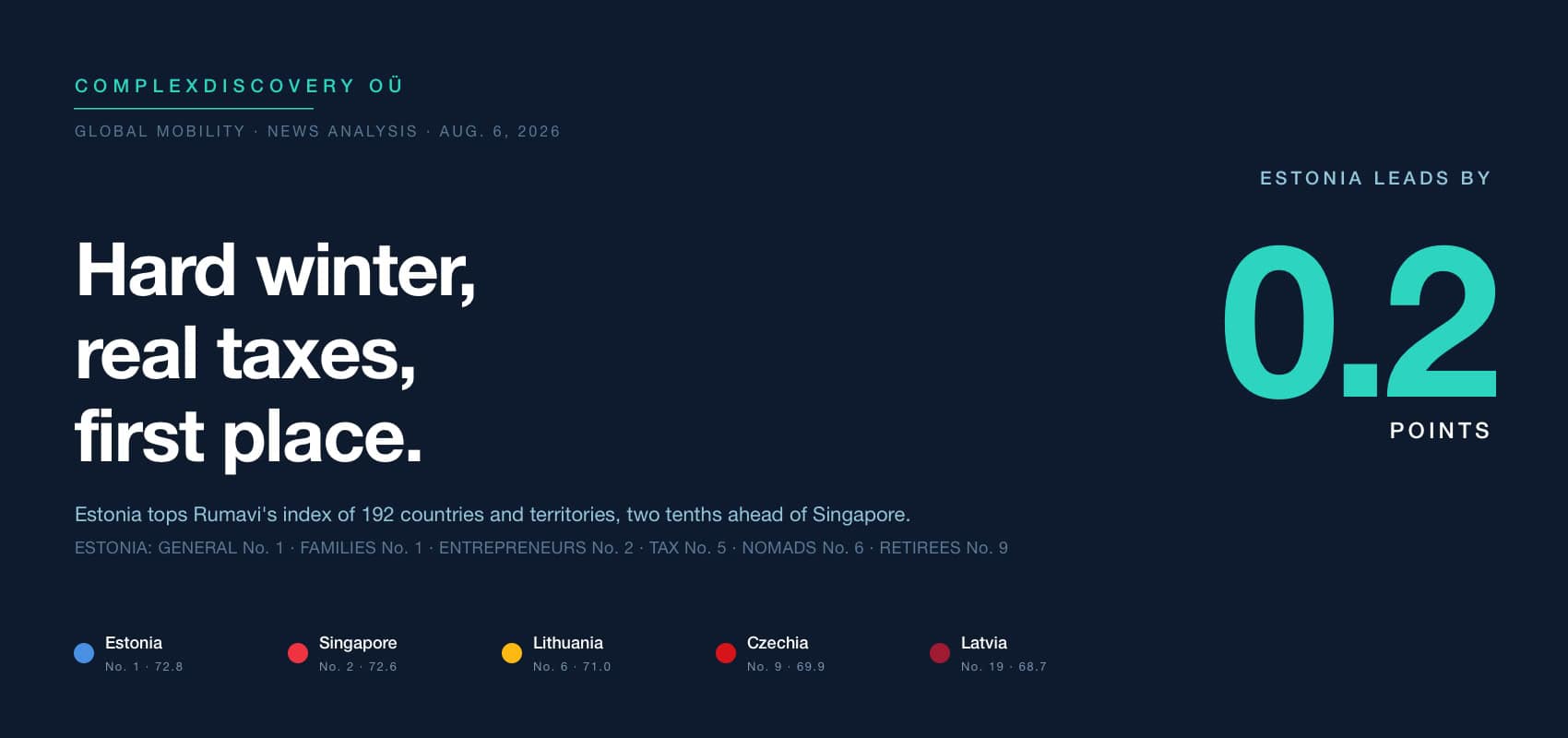
Estonia ranks first of 192 countries and territories in the Rumavi Global Relocation Index 2026, edging Singapore by two tenths of a point on standout scores for banking, business opportunity and property rights. The margin is thin. The geography is not: Lithuania lands sixth and Czechia ninth, and the winner is a Baltic state with a hard winter and real tax rates rather than any of the sun-and-low-cost destinations that usually headline relocation lists.
Inside the index and who publishes it
The 2026 edition, dated June 30 in Rumavi’s methodology, rates all 192 on 24 metrics sorted into four pillars the publisher labels financial and tax, livability and health, safety and stability, and settling and opportunity. Each metric is normalized to a 100-point scale, and the same dataset is reweighted six ways to produce separate rankings for six relocation profiles: General, Retirees, Digital Nomads, Families, Entrepreneurs and Tax-Friendliness. The reweighting is not the whole design, though: retiree and digital nomad scores also carry a separate visa-access bonus, two points for restrictive programs and four for accessible ones, and Estonia’s nomad visa earns the two-point tier.
The methodology page discloses its limits as well. About 127 of the 192 countries have strong to full coverage across the index’s institutional metrics while 65 carry lower-confidence ratings, and 31, mostly micro-states, sit outside the Global Peace Index entirely, so they lack a conflict-risk value and are scored on the remaining 23 metrics. A digital nomad’s ranking leans on connectivity, cost and short-stay visa ease; an entrepreneur’s on rule of law and banking, according to the category descriptions.
Rumavi is not a research institution. It is a flat-fee property and relocation advisory founded by Alexander Linton, a chartered accountant, with a practice concentrated in Southeast Asia, Hong Kong, Japan and the United Arab Emirates. The firm says it takes no commissions and has no stake in where clients land, and it publishes the source behind each figure on its country pages. Readers should still treat the index as vendor-published research: the methodology, the weighting and the normalization are Rumavi’s own, and the firm discloses no external audit of the results. Nor is there a track record to check them against; neither Rumavi’s pages nor the press coverage references any earlier edition. The rankings drew pickup from Euronews, Time Out and Business Standard in late July and early August, which makes the fine print worth reading before the headline hardens into fact.
In the general ranking, Estonia’s 72.8 leads Singapore at 72.6, Malaysia at 72.0, Portugal at 71.6 and Taiwan at 71.4. Lithuania sits sixth at 71.0, Hong Kong seventh, St. Kitts and Nevis eighth, Czechia ninth and Malta 10th. Three of the 10 best places to move, by this count, sit in Central and Eastern Europe.
How Estonia edged Singapore
Estonia’s case rests on the plumbing of doing business. The index gives the country 99 of 100 for currency and banking, 96 for business opportunity and 90 for property rights for non-citizens, and its settling and opportunity pillar score of 82.0 is the strongest of its four.
Safety and stability follows at 81.0. For a state on NATO’s eastern flank, the natural question is whether that figure survives contact with the map; the index’s answer is arithmetic rather than argument, scoring Estonia 82 for rule of law, 83 for political stability and 79 for conflict risk, and leaving readers to weigh those numbers against their own view of the region. Estonia also places first among 192 in the Families ranking, second for Entrepreneurs, fifth for Tax-Friendliness, sixth for Digital Nomads and ninth for Retirees. No profile drops it out of the top 10.
The weaknesses are just as legible. Climate comfort scores 20.1 of 100, foreign income tax treatment 58 and general affordability 62, the three metrics the index itself flags as watch-out areas. Estonia wins on institutions, not weather or bargains.
Tax design pulls its weight here. Estonia levies a flat 22 percent personal income tax and charges corporate income tax only when profits are distributed, at a 22/78 rate on the net amount, according to the Estonian Tax and Customs Board. Retained and reinvested earnings go untaxed, a structure founders have long prized for cash flow. The standard value-added tax rate stands at 24 percent. Linton said in comments reported by Business Standard that what wins in the index is defensible, well-governed tax efficiency rather than the lowest nominal rate, which helps explain why Estonia places fifth for Tax-Friendliness while charging real taxes.
Digital plumbing beneath the ranking
The ranking lands on fertile ground. Estonia’s e-Residency program, which lets foreigners establish and run a company in the European Union entirely online, reported €124.9 million in state revenue for 2025, an 87 percent increase over the prior year, against about €10 million in program costs. Erkki Keldo, Estonia’s minister of economy and industry, said the program returned over €12 for every euro invested last year. As of early 2026, when the program reported its 2025 results, it counted over 135,000 e-residents from 185 countries, over 39,000 companies established since its 2014 launch, and 5,556 new companies in 2025 alone. The program says e-residents now start about one in five new Estonian companies.
The program itself stresses what the status is not: an immigration route. E-Residency confers no visa, no residence permit and no right to live in or enter Estonia or the European Union. The entry route is separate: Estonia launched what it describes as the European Union’s first digital nomad visa in August 2020. The current version requires €4,500 in gross monthly income and allows a stay of up to one year, a threshold that filters for established remote earners rather than budget travelers.
Liina Vahtras, managing director of the e-Residency program, said the physical ID card has become the program’s main bottleneck and that a card-free, fully mobile version could lift company formation by at least 20 percent and add €3 million to €9 million a year in tax revenue. Professionals tracking digital identity should watch that rollout: remote verification at national scale is a cybersecurity undertaking as much as a convenience.
The fine print on a record year
The record deserves scrutiny, and Estonian observers have supplied it. Silver Tambur, co-founder and publisher of Estonian World, wrote in late January, as the record was announced, that the 2025 revenue spike was partly a timing artifact: companies accelerated dividend payouts into early 2025 to capture Estonia’s expiring lower rate, front-loading receipts in a way program officials acknowledged and growth rates are unlikely to repeat. He also described concentration beneath the headline number. Citing official statements and past program figures, he put the number of e-resident firms paying any tax at all in a recent year at about 2,000, against roughly 29,000 companies started by early 2024, some 22,000 of them still in existence and roughly half genuinely active. The attribution model behind the revenue total has been reviewed and accepted by the National Audit Office, he noted, but privacy rules keep the underlying tax data aggregated, leaving outsiders unable to verify it independently.
The sharper flags in his piece concern financial crime: repeated warnings from Estonia’s Financial Intelligence Unit that frictionless digital company formation invites money laundering and sanctions evasion, pressure that has already led Estonia to tighten screening and, following Russia’s full-scale invasion of Ukraine, stop taking new applications from citizens of Russia and Belarus. Going cardless could expand the attack surface too. “A mobile-first system will live or die by cybersecurity, fraud controls and the credibility of remote biometrics,” he wrote. None of this undoes the ranking. It does mean the professionals most likely to act on it, including the compliance, governance and legal teams that inherit cross-border entities and their records, should read Estonia’s success the way the index itself asks to be read: metric by metric, source by source.
Baltic neighbors and the wider eastern map
Lithuania makes the strongest supporting argument for the region. It ranks sixth overall at 71.0, fourth for Families, seventh for Entrepreneurs and 10th for Digital Nomads, with currency and banking at 99.0, green space at 90.4 and property rights for non-citizens at 90.0. Latvia trails at 19th overall with 68.7, held back by an entrepreneurs rank of 29 and a nomads rank of 27, though it posts a housing affordability score of 87.0, above Estonia’s 82, and matches its Baltic neighbors’ 90.0 on property rights for non-citizens. The Baltic winter taxes all three: climate comfort scores run 19.3 in Latvia, 20.1 in Estonia and 23.3 in Lithuania.
The eastern spread widens in the category rankings. For digital nomads, Croatia places ninth and Lithuania 10th, with Romania 11th, Bulgaria 13th and Hungary 19th, and Georgia, on the Black Sea’s eastern shore in the Caucasus, reaches fourth. For entrepreneurs, Czechia ranks 15th, Latvia 29th, Poland 32nd, Hungary 35th and Romania 38th. The split tracks the weighting: where institutions carry it, as in the Entrepreneurs table, Estonia and Lithuania pull far ahead of the rest of the region; where cost and connectivity carry it, as with the nomads, the field compresses and Southeastern Europe closes the gap.
What mobile professionals can take from the data
The category tables reward different strategies. The Entrepreneurs ranking, which weights business climate, rule of law, banking, the startup ecosystem and English access, puts Singapore first at 79.2 and Estonia second at 78.6, with Lithuania seventh at 75.3. Rumavi says that framework favors institutional reliability over bargain living. The Digital Nomads ranking, which the publisher says leans on connectivity, affordability, lifestyle, street safety and short-stay visa ease, crowns Malaysia at 79.1, then Portugal at 77.0 and Thailand at 75.4, with Estonia sixth at 73.5. Founders optimizing for institutional depth and nomads optimizing for cost will land in different hemispheres, and the index is built to show that.
For anyone weighing a move, the practical reading order runs backward from the marketing: start with the country page, check the source attached to each metric, then test the claims that matter against primary records such as tax authority rates, visa income thresholds and property rules for non-citizens. An index cut six ways is a screening tool, not a decision, and its publisher also sells flat-fee relocation advice, a commercial interest in the territory it maps. The machinery does not bind every reader equally: EU citizens can already settle anywhere in the bloc, so the visa metrics chiefly concern third-country nationals, and the index’s global reach is the point. Business Standard’s coverage led with India placing 100th overall and 73rd for digital nomads, a hint at who is doing the math.
Rumavi plans the next edition for 2027, Estonia plans its card-free e-Residency push, and the dividend surge that flattered 2025 will either normalize or repeat. Which signal will matter most for where mobile professionals and their data actually settle: the rankings, the tax code or the security of the identity layer underneath it all?

News sources
- Best Countries to Move to in 2026 (Rumavi)
- Estonia country page (Rumavi)
- Entrepreneurs ranking (Rumavi)
- Digital Nomads ranking (Rumavi)
- Lithuania country page (Rumavi)
- Latvia country page (Rumavi)
- This Baltic state was just named the world’s best place to relocate to in 2026 (Euronews)
- Estonia tops global relocation rankings; India placed 100th in 2026 index (Business Standard)
- Estonia Named Best Country to Relocate to in 2026 Index (Time Out)
- E-residents generated a record €125 million state revenue in 2025 (e-Residency)
- Estonian e-residency program brought in €125 million in 2025 (ERR News)
- Estonia’s e-residency posts record revenues, but the small print matters (Estonian World)
- Tax rates (Estonian Tax and Customs Board)
- Digital Nomad Visa (e-Residency)
- Index methodology (Rumavi)
- Benefits of becoming an e-resident (e-Residency)
- About RUMAVI (Rumavi)





Assisted by GAI and LLM Technologies
Additional reading
- European investors see a strong pipeline and a capital gap at home
- Nine months across Europe’s tech-sovereignty arc, from Tallinn to London (ComplexDiscovery)
- The flame and the frontier: how Estonia carries a 1919 victory into a tense 2026 (ComplexDiscovery)
- Estonia aims to be first to give AI agents official digital IDs (ComplexDiscovery)
- Britain bets billions on sovereign AI as London Tech Week opens (ComplexDiscovery)
- Ireland’s AI regulator role gets a hard look at Dublin Tech Summit (ComplexDiscovery)
- When you can’t trust the evidence: deepfakes force a forensic reckoning in Dublin (ComplexDiscovery)
- Latitude59 final day in Tallinn: AI sovereignty, a driverless permit and €450,000 to three startups (ComplexDiscovery)
- Estonia opens Latitude59 with sandbox framework for legal exemptions (ComplexDiscovery)
- FutureLaw 2026 closes: hard truths, the billable hour, and what gets built next (ComplexDiscovery)
- FutureLaw 2026 opens in Tallinn with a sharp question: who governs the governors? (ComplexDiscovery)
- The Sovereignty Paradox: Europe’s $4 Trillion Tech Dilemma at Slush 2025 (ComplexDiscovery)
- How Finland Is Reshaping Defense: BORDERLAND at Slush 2025 (ComplexDiscovery)
- Kaja Kallas Warns of Democracy’s Algorithmic Drift at Tallinn Digital Summit (ComplexDiscovery)
- Defending the Digital Frontier: European Nations Forge Resilience Against Relentless Cyber Warfare (ComplexDiscovery)
- Tallinn Digital Summit 2025 to Focus on Secure AI Futures, Cyber Resilience, and Digital Transformation (ComplexDiscovery)
Source: ComplexDiscovery OÜ

ComplexDiscovery’s mission is to enable clarity for complex decisions by providing independent, data‑driven reporting, research, and commentary that make digital risk, legal technology, and regulatory change more legible for practitioners, policymakers, and business leaders.