

Editor’s Note: The Federal Trade Commission’s Premerger Notification Office logged 202 reported transactions in October 2026 under the Hart-Scott-Rodino (HSR) Act, according to preliminary agency data, up 4.7 percent from September’s 193 but 6.0 percent below October 2025’s 215 as fiscal 2027 began. The Bureau of Economic Analysis estimated third-quarter economic growth at a 3.4 percent annual rate, while the Federal Reserve held its target range at 3.75 percent to 4 percent on Oct. 28, with two members favoring an increase.
Enforcement developments showed several possible paths for pending deals. PlayPower abandoned its purchase of rival playground maker BCI Burke eight days after the FTC and 12 states sued. The FTC proposed a consent order for Publicis Groupe’s acquisition of LiveRamp, which closed Nov. 2 while the order awaited final approval. The Justice Department closed its second request review of FOX’s roughly $22 billion Roku deal on Nov. 6, the same day FOX completed the acquisition. Semafor reported that the FTC may sue to block Cintas’s $5.5 billion bid for UniFirst, although the commission had not voted.
For eDiscovery providers, the article presents an illustrative range of second request demand and explains why productions must remain defensible through priority review, full compliance and possible litigation.
Content Assessment: October HSR reported transactions edge up to 202 as fiscal 2027 opens below last year's pace
Information - 93%
Insight - 94%
Relevance - 92%
Objectivity - 92%
Authority - 92%
93%
Excellent
A short percentage-based assessment of the qualitative benefit expressed as a percentage of positive reception of the recent article from ComplexDiscovery OÜ titled, "October HSR reported transactions edge up to 202 as fiscal 2027 opens below last year's pace."
News Analysis – Antitrust Beat
October HSR reported transactions edge up to 202 as fiscal 2027 opens below last year’s pace
ComplexDiscovery Staff
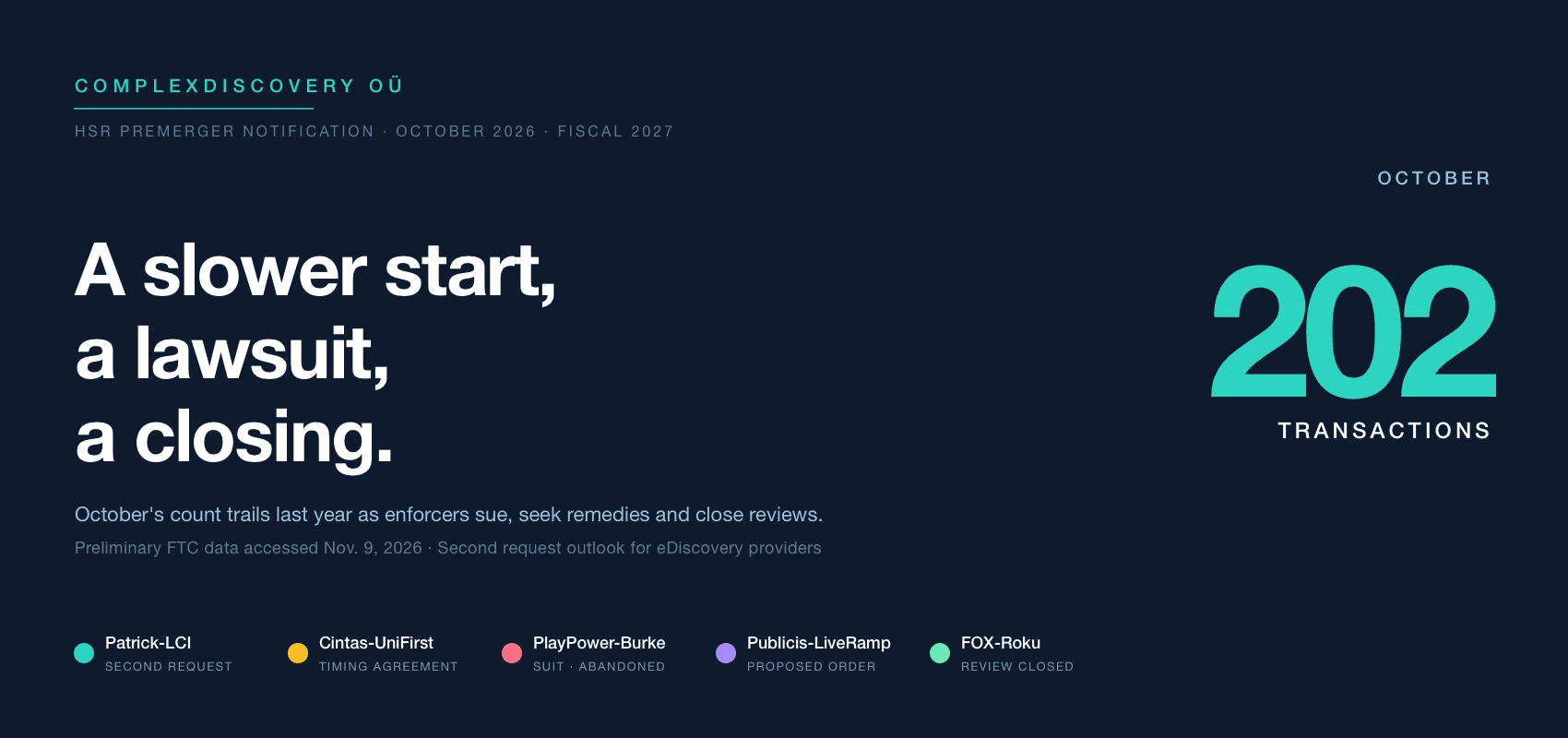
Reported premerger transactions ticked higher in October, but fiscal 2027 began at a slower pace than the year before it. The Federal Trade Commission’s Premerger Notification Office logged 202 reported transactions in October 2026 under the Hart-Scott-Rodino (HSR) Act, according to preliminary data on the agency’s website accessed Nov. 9, up 4.7 percent from September’s 193.
The first count of the new fiscal year trails October 2025’s 215 by 6.0 percent, a comparison between two preliminary figures, since the FTC has not yet published its fiscal 2026 annual report. Against October 2024’s final count of 184 from the fiscal 2025 annual report, October 2026 is 9.8 percent higher. The FTC labels every monthly figure preliminary until the annual report for its fiscal year revises it. Those revisions can be sizable: fiscal 2025’s preliminary monthly postings summed to 2,101 before the annual report settled the year at 2,006, about 4.5 percent lower.
A modest rebound that stays below last year’s average
October’s count landed in the lower half of the range fiscal 2026 established. Over the 12 months that ended in September, monthly counts ran from a low of 180 in January to a high of 271 in August, and the year closed at 2,555 preliminary transactions, the largest total since fiscal 2022. That works out to an average of about 213 a month, a pace October missed by roughly 11 transactions.
The recent sequence shows a market settling after a late-summer spike. August’s 271 gave way to 193 in September and 202 in October, putting the three months from August through October at 666 transactions, below the 697 recorded from July through September. On a trailing 12-month basis, covering November 2025 through October 2026, the preliminary total stands at 2,542, just under fiscal 2026’s 2,555 because October 2026 came in below October 2025.
One month does not set a fiscal year’s direction, and fiscal 2026 shows why: it opened at 215, dipped to 180 by January and still finished with the largest total since fiscal 2022. The economic data and the deal market supply context for October’s softer start, though neither explains it directly.
HSR Act Merger Transactions Reported - FY 2027 (1)
HSR Act Merger Transactions Reported - FY 2026 - September 2026
A fast-growing economy, sticky inflation and a split Fed
The macro backdrop does not point to retreat. Real gross domestic product grew at a 3.4 percent annual rate in the third quarter of 2026, up from 2.2 percent in the second quarter, according to the Bureau of Economic Analysis (BEA) advance estimate released Oct. 29. The BEA attributed the gain to increases in investment, consumer spending and government spending, partly offset by lower exports. Real final sales to private domestic purchasers, a gauge of underlying private demand, rose 4.9 percent in the same advance estimate, compared with 4.6 percent in the second quarter.
Inflation tells a less settled story. The personal consumption expenditures (PCE) price index rose at a 2.1 percent annual rate in the third quarter, down from 5.0 percent in the second, and prices excluding food and energy rose 2.5 percent, the BEA reported. Those are quarterly figures at an annual rate. A different measure, in the BEA’s September personal income and outlays report released the same day, showed the PCE price index up 3.6 percent from a year earlier and core prices up 3.1 percent. Real disposable personal income fell 0.3 percent in the month. The BEA’s September trade report, released Nov. 4, put the goods and services deficit at $105.0 billion, with the year-to-date deficit down 12.2 percent from the same period in 2025.
The Federal Reserve met before those releases and split over its next step. On Oct. 28, the Federal Open Market Committee held its target range at 3.75 percent to 4 percent, saying “economic activity is expanding at a strong pace” and “inflation remains elevated.” Two members, Lisa D. Cook and Beth M. Hammack, dissented because they preferred a quarter-point increase, which shows that part of the committee favored further tightening after its Sept. 16 increase. The available data do not show whether the decision, or expectations ahead of it, affected October’s count.
The deal market shows a split of its own, with value and count moving apart. Global M&A value rose 27 percent year over year to $4.44 trillion in the first nine months of 2026, close to the 2021 record, according to Mergermarket data published by ION Analytics. Deal count slipped 1 percent to 32,419 over the same period. Deals of $10 billion or larger made up a record 35 percent of value, and ION Analytics described a marked third-quarter slowdown. In the United States, announcements fell 1.7 percent from August to 1,201 in September, and private equity deal value dropped 23.6 percent from August to $28.1 billion, according to FactSet. The 10-year Treasury yield stood at 4.94 percent on Oct. 30, according to Federal Reserve Bank of St. Louis data. These measures cover global announcements and financing conditions, while the HSR count covers U.S. transactions at the notification stage, so they are context for October’s total rather than an explanation of it. Whatever shaped the count, the deals already before the agencies drew a wide range of responses in October and the days after it, from a lawsuit to negotiated remedies to a closed investigation.
Enforcers sue, seek remedies and close reviews
The FTC took a mid-market deal to court in October, and the buyer walked away within days. On Oct. 19, the commission voted 2-0 to sue in the U.S. District Court for the Northern District of California to block PlayPower’s acquisition of rival playground manufacturer BCI Burke. The complaint alleges the deal would eliminate head-to-head competition in a U.S. market where five companies hold 85 percent to 90 percent market share. PlayPower is owned by private equity firm Platinum Equity, and 12 state attorneys general joined the complaint. On Oct. 27, the FTC’s Bureau of Competition said PlayPower had abandoned the deal. Director Daniel Guarnera said it would have cut major competitors from five to four and given PlayPower’s owners control of over 30 percent of the relevant market. Arizona Attorney General Kris Mayes said that “within a week of our filing, PlayPower walked away from this deal.”
A larger fight may follow. Cintas and UniFirst each received an FTC second request on June 11 on Cintas’s proposed acquisition of its uniform rental rival, and each certified substantial compliance on Oct. 2, according to an Oct. 6 Cintas Form 8-K. The same day, the companies agreed with the FTC not to close before Dec. 11 unless the agency notifies them in writing before then that it has closed its investigation. Cintas said it still expects the deal to close before the end of 2026. On Oct. 27, Reuters reported that Semafor, citing people familiar with the matter, said the FTC has indicated it will sue to block the $5.5 billion deal; Reuters noted the commission had not yet voted. Two days later, Seeking Alpha reported that the FTC had not told Cintas it plans to sue.
Earlier in the process, second requests continued to issue at both agencies. Patrick Industries and LCI Industries, which withdrew their August HSR notifications and refiled them Sept. 9, each received a second request from the Justice Department’s Antitrust Division on Oct. 9, according to Patrick’s Form 8-K. Sanara MedTech and MiMedx Group each received an FTC second request on Oct. 15, according to Sanara’s filing. In both cases, the request extends the waiting period until 30 days after the parties substantially comply, unless the agency ends it earlier or the parties agree to extend it.
Other reviews turned on remedies and commitments rather than lawsuits. On Oct. 19, the same day it sued over PlayPower, the FTC accepted for public comment a proposed consent order covering Publicis Groupe’s $2.2 billion acquisition of LiveRamp. For five years, the order would require nondiscriminatory access to LiveRamp’s services, firewalls around LiveRamp customer data and an independent compliance auditor. LiveRamp said in a Nov. 2 Form 8-K that the acquisition was completed that day. The FTC order remains subject to final approval after public comment. On Oct. 30, the DOJ said Vistra and Cogentrix had decided on their own to sell a gas-fired plant in Rumford, Maine, and that it would continue to monitor the sale. The statement said the division’s investigation involved reviewing thousands of documents, performing economic modeling and conducting extensive interviews with industry participants. On Nov. 6, after the reporting month closed, the division ended its investigation of FOX’s roughly $22 billion acquisition of Roku, saying it had issued second requests to both companies and concluded the deal was not likely to harm competition. FOX committed to keep carrying rival content on Roku for at least three years, and it said in a Form 8-K that it completed the acquisition the same day.
The DOJ also described a working division of labor with the states. In an Oct. 29 release, the Antitrust Division said that since January it had partnered with the California and Tennessee attorneys general on consent decrees covering regional cement and asphalt markets. It also referred asphalt investigations to New York, Pennsylvania and New Jersey, whose attorneys general reached their own settlements. Associate Attorney General Stanley E. Woodward Jr. said the department “will sometimes exercise its discretion to investigate local transactions,” and that for mergers of national importance it “will generally form its own views of the appropriate resolution of an investigation.”
Filing-stage enforcement remains in view. The DOJ’s proposed $250 million civil penalty against KKR, which the department called the largest civil penalty ever assessed for violating the HSR Act, requires approval by the U.S. District Court for the Southern District of New York. That approval follows a 60-day public comment period under the Antitrust Procedures and Penalties Act, and as of Nov. 9, the DOJ’s case page listed the judgment as proposed. KKR said in an Aug. 26 Form 8-K that it strongly disagrees with the Antitrust Division’s characterization and believes it acted in good faith at all times under its prior filing process. The maximum HSR civil penalty remains $53,088 under 16 CFR 1.98(a), assessed per day of violation. Filers continue to use the pre-February 2025 HSR form, and the FTC has said its aim is to publish any notice of proposed rulemaking by the end of 2026, according to DLA Piper. For the teams that collect, review and produce the documents behind these reviews, the month brought a slower start to the fiscal year and a reminder of how far a review can go once it deepens.
What the shifts mean for eDiscovery providers
October’s count supports only a rough planning range. As an illustrative scenario rather than a forecast, fiscal 2025’s second request rate of 2.1 percent, applied to October’s 202 transactions after adjusting to eligible transactions, yields about four second requests. Fiscal 2024’s 3.0 percent rate yields about six. Those rates compare requests issued in a year with transactions reported that year, so they do not measure the odds for October’s filings, and not every request becomes outside provider work. Second requests issue during the initial waiting period and extend it, and parties that withdraw and refile, as Patrick and LCI did, push the timing back.
The month’s enforcement news argues for building every production as if it may be tested later, whichever way a review ends. PlayPower walked away eight days after the FTC sued, Cintas and UniFirst face a possible challenge after certifying compliance, and the DOJ’s Vistra statement describes thousands of documents reviewed alongside economic modeling and interviews. For parties that opt into the DOJ’s targeted second request process, Hogan Lovells Cadwalader advises framing the priority production’s custodians, data and time periods around the issue the division considers decisive. The firm also advises running a parallel full-compliance workstream, because the division can still require full or modified compliance. That favors flexible capacity, defensible privilege logs and reproducible review decisions. Capacity plans should also allow for the DOJ’s coordination with state attorneys general, which may bring parallel state requests in some local matters.
What to watch as fiscal 2027 takes shape
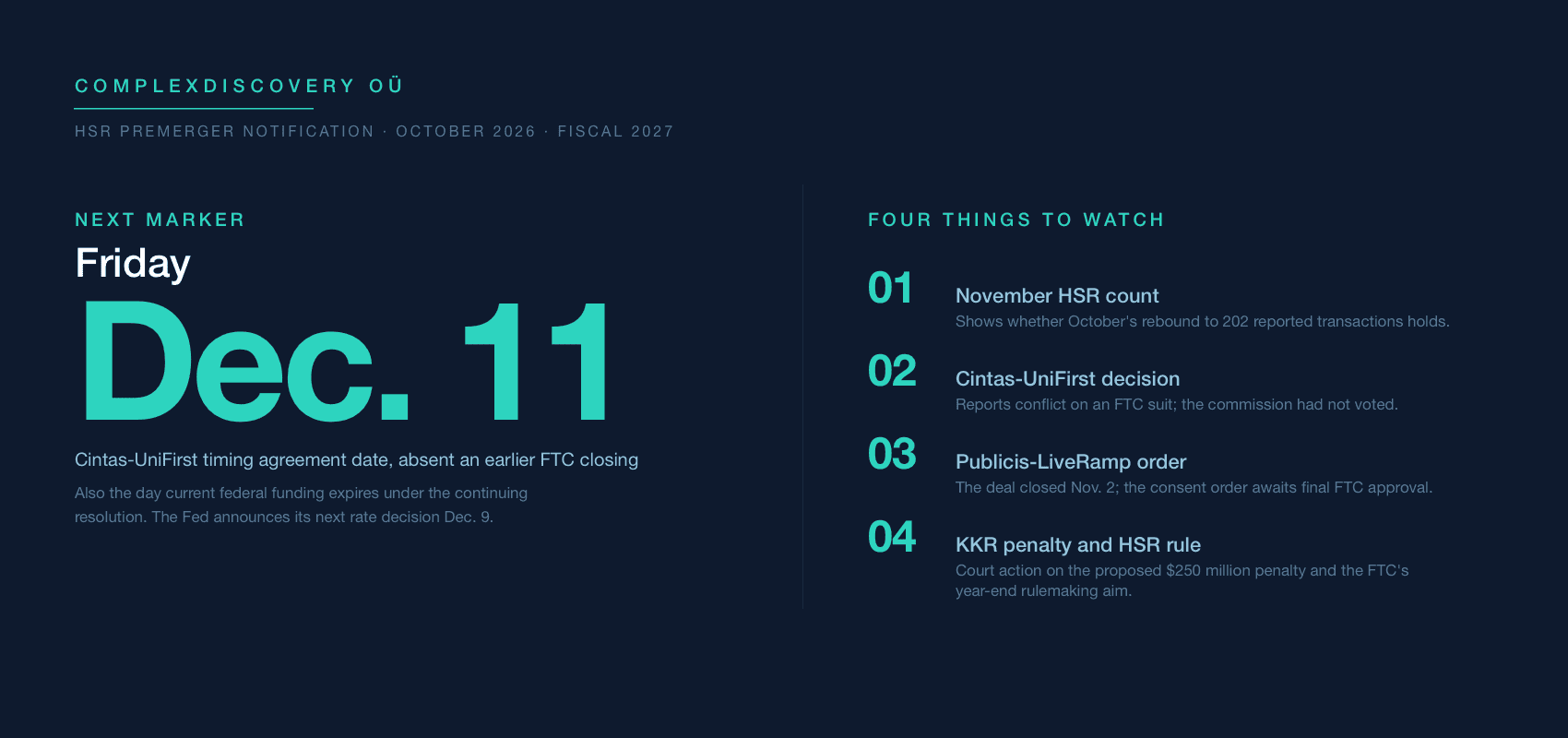
The FTC’s November count will show whether October’s rebound holds. The BEA’s second estimate of third-quarter GDP and its October personal income and outlays report are scheduled for Nov. 25, and October trade data follow Dec. 8. The FOMC announces its next decision Dec. 9, two days before current government funding expires Dec. 11 under the continuing resolution Congress passed in late summer. Dec. 11 is also the earliest closing date in the Cintas-UniFirst timing agreement, absent an earlier FTC closing notice. On the enforcement side, watch for an FTC vote on that deal and the end of the 30-day comment period on the Publicis-LiveRamp order and any final FTC action on it. Court action on the KKR proposed final judgment and the HSR notice of proposed rulemaking the FTC has targeted for year-end are the other markers.
With October’s count below last year’s and the agencies suing, seeking remedies and closing reviews within weeks, can your team take a second request from a narrow priority set to full compliance, or to court, without starting over?
HSR Act Merger Transactions Reported - Expanded





News sources
- Premerger Notification Program (Federal Trade Commission)
- Hart-Scott-Rodino Annual Report for Fiscal Year 2025 (Federal Trade Commission and Department of Justice)
- Hart-Scott-Rodino Annual Report, Fiscal Year 2024 (Federal Trade Commission and Department of Justice)
- FTC and DOJ Issue Fiscal Year 2025 Hart-Scott-Rodino Annual Report (Federal Trade Commission)
- GDP (Advance Estimate), 3rd Quarter 2026 (U.S. Bureau of Economic Analysis)
- Personal Income and Outlays, September 2026 (U.S. Bureau of Economic Analysis)
- U.S. International Trade in Goods and Services, September 2026 (U.S. Bureau of Economic Analysis)
- Release Schedule (U.S. Bureau of Economic Analysis)
- Federal Reserve issues FOMC statement (Federal Reserve Board, Oct. 28, 2026)
- Federal Reserve issues FOMC statement (Federal Reserve Board, Sept. 16, 2026)
- The Fed: Meeting calendars and information (Federal Reserve Board)
- Megadeals propel M&A toward nine-month record despite third-quarter slowdown: M&A highlights 9M26 (ION Analytics)
- Flashwire US Monthly (FactSet)
- Market Yield on U.S. Treasury Securities at 10-Year Constant Maturity, Quoted on an Investment Basis (DGS10) (Federal Reserve Bank of St. Louis)
- FTC Sues to Block PlayPower’s Acquisition of Rival Playground Manufacturer Burke (Federal Trade Commission)
- FTC Bureau of Competition Statement on Termination of PlayPower’s Acquisition of Rival Playground Manufacturer Burke (Federal Trade Commission)
- Playground equipment companies end merger plans after Arizona joins lawsuit (AZFamily)
- FTC Order Preserves Competition in Digital Advertising Ecosystem as Part of Publicis’s Acquisition of LiveRamp (Federal Trade Commission)
- Form 8-K (LiveRamp via SEC EDGAR, Nov. 2, 2026)
- Form 8-K (Cintas via SEC EDGAR, Oct. 6, 2026)
- Form 8-K (UniFirst investor relations, June 12, 2026)
- CINTAS TO ACQUIRE UNIFIRST IN $5.5 BILLION TRANSACTION THAT EXPANDS SERVICE CAPABILITIES, ENHANCES WORKDAY SOLUTIONS AND ADVANCES INDUSTRY INNOVATION (Cintas and UniFirst via SEC EDGAR, March 11, 2026)
- FTC to sue to block Cintas-UniFirst deal, Semafor reports (Reuters)
- UniFirst/Cintas spread narrows on report FTC hasn’t indicated it will block deal (update) (Seeking Alpha)
- Form 8-K (Patrick Industries via SEC EDGAR, Oct. 13, 2026)
- Form 8-K (Sanara MedTech via SEC EDGAR, Oct. 15, 2026)
- Justice Department Provides Update on Collaboration with State Attorneys General on Review of Local Mergers (Department of Justice)
- Justice Department’s Statement on Its Investigation of Vistra’s Acquisition of Cogentrix (Department of Justice)
- Statement of the Department of Justice Antitrust Division on the Closing of Its Investigation of the Merger of FOX and Roku (Department of Justice)
- Form 8-K (FOX via SEC EDGAR, Nov. 6, 2026)
- KKR Agrees to Pay Record $250M Penalty for Serial Violations of Federal Premerger Review Law (Department of Justice)
- United States v. KKR & Co. Inc., et al.; Proposed Final Judgment and Competitive Impact Statement (Department of Justice via Federal Register)
- U.S. v. KKR & Co. Inc., et al. (Department of Justice)
- Form 8-K (KKR via SEC EDGAR, Aug. 26, 2026)
- Justice Department Resumes Targeted HSR Merger Review Process (Department of Justice)
- The Antitrust Division’s return to targeted Second Requests: Real milestones, modest relief, but no reason to wait (Hogan Lovells Cadwalader)
- 16 CFR 1.98: Adjustment of civil monetary penalty amounts. (Electronic Code of Federal Regulations)
- Pre-2025 HSR rules to stay in place for now, new proposed changes expected by end of 2026 (DLA Piper)
- Congress Extends Government Funding Through December 11 (Harvard University Office for Federal Relations)
- September HSR reported transactions slip to 193 as fiscal 2026 closes at 2,555, its largest total since 2022 (ComplexDiscovery)
Assisted by GAI and LLM Technologies
Additional Reading
- HSR Act Reporting: A ComplexDiscovery Chronology
- FTC Annual Competition Reports (Hart-Scott-Rodino Act Reports)
Source: ComplexDiscovery OÜ

ComplexDiscovery’s mission is to enable clarity for complex decisions by providing independent, data‑driven reporting, research, and commentary that make digital risk, legal technology, and regulatory change more legible for practitioners, policymakers, and business leaders.