

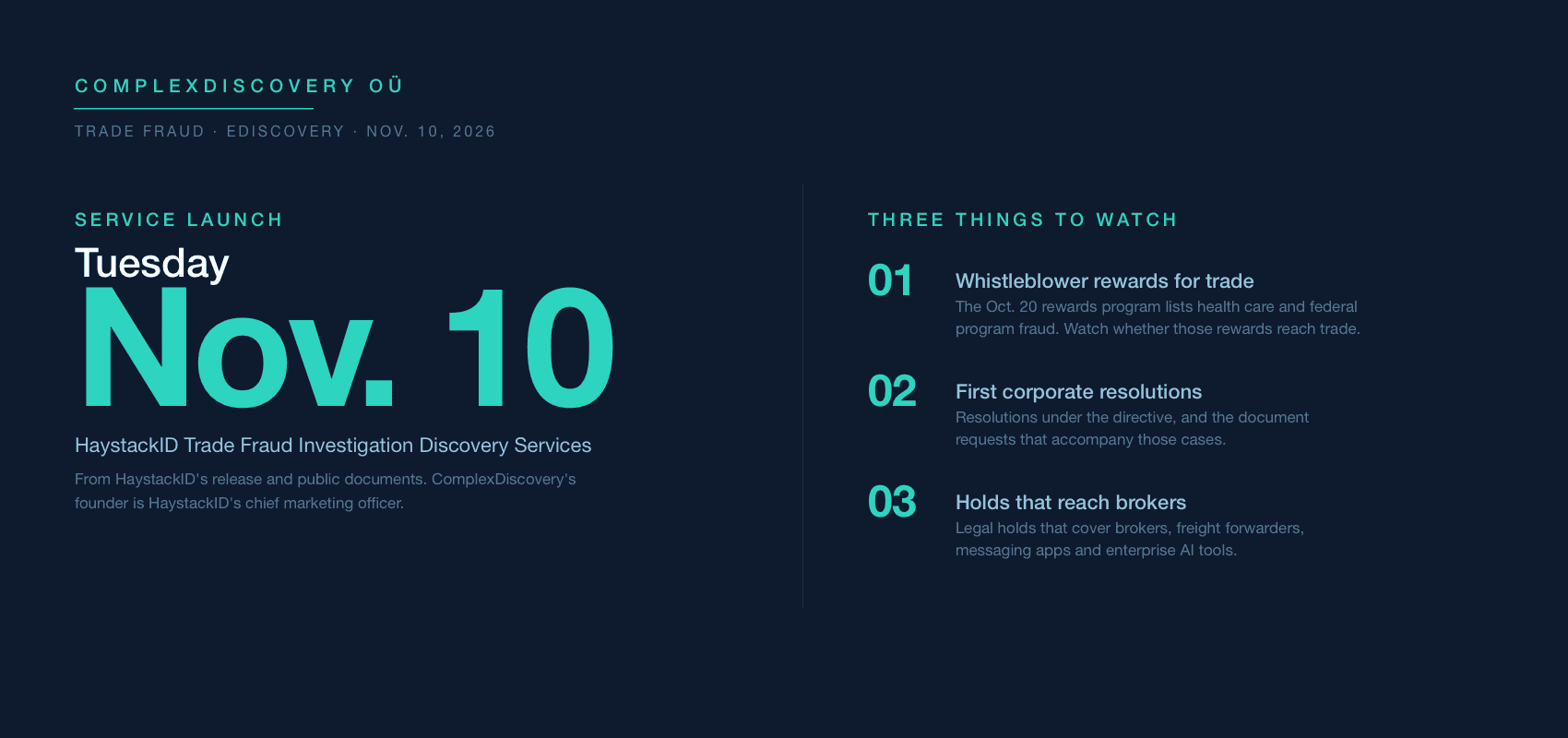
Editor’s Note: HaystackID, a provider of data, forensic and managed review support for investigations, formally launched Trade Fraud Investigation Discovery Services, available now, on Nov. 10, 2026. It targets companies and outside counsel responding to subpoenas, civil investigative demands and qui tam (whistleblower) matters involving suspected tariff fraud. HaystackID says it tests each customs entry against the invoices, factory and shipping records behind it, with generative artificial intelligence (AI) outputs validated by its experts and counsel.
The launch follows the Justice Department’s July report that its Trade Fraud Task Force passed $1 billion in recoveries, penalties, forfeitures and publicly charged losses, a composite that includes allegations. An Oct. 1 internal directive from its National Fraud Enforcement Division lists tariff evasion among four corporate enforcement priorities. The division’s Oct. 20 whistleblower rewards program covers health care fraud and fraud on federal programs and benefits, not trade offenses; a separate Criminal Division pilot covers trade, tariff and customs fraud.
For cybersecurity, information governance and eDiscovery professionals, the test is whether entry data, messages and AI tool records can be found, preserved and explained. Watch whether the division extends its new rewards to trade fraud and what the first corporate resolutions require.
Disclosure: Rob Robinson, founder and managing editor of ComplexDiscovery OÜ, is chief marketing officer of HaystackID and is the media contact named on the company’s Nov. 10 news release. ComplexDiscovery’s coverage draws on that release, HaystackID’s service page and public government documents, and ComplexDiscovery has not independently tested HaystackID’s capability claims.
Content Assessment: HaystackID formally launches trade fraud discovery service as Justice Department widens customs enforcement
Information - 92%
Insight - 93%
Relevance - 92%
Objectivity - 86%
Authority - 90%
91%
Excellent
A short percentage-based assessment of the qualitative benefit expressed as a percentage of positive reception of the recent article from ComplexDiscovery OÜ titled, "HaystackID formally launches trade fraud discovery service as Justice Department widens customs enforcement."
Industry News – eDiscovery Beat
HaystackID formally launches trade fraud discovery service as Justice Department widens customs enforcement
ComplexDiscovery Staff
HaystackID on Tuesday formally launched Trade Fraud Investigation Discovery Services, which it says are available now to help companies and outside counsel respond to trade fraud subpoenas, civil investigative demands and qui tam matters.
The pitch rests on a single test. HaystackID’s service page says a trade fraud investigation “often turns on whether” what an importer declared to U.S. Customs and Border Protection (CBP) matches the invoices, factory records and shipping records behind each entry.
That test has carried more weight over the past 14 months. The Justice Department launched a cross-agency Trade Fraud Task Force with the Department of Homeland Security (DHS) on Aug. 29, 2025. In July, the department said the task force’s enforcement milestone marked a “strategic pivot from administrative fines to criminal and civil accountability.” On Oct. 1, the department’s National Fraud Enforcement Division made schemes involving tariff evasion, the importation of goods or services, or forced labor one of four priorities for its corporate investigations.
What the federal enforcement record shows
The task force’s headline number came July 14, when the department said the task force had passed $1 billion in “civil and criminal recoveries, penalties, forfeitures, and publicly charged losses” in under a year. That is a composite scorecard rather than a cash total, because charged losses are amounts alleged in charging documents, which by themselves do not establish losses proven or money collected.
The release did not itemize the total. It did name two newly announced Chicago cases among the contributors, in which prosecutors charged the operators of two gold jewelry importers with falsely declaring the countries of origin of their goods. A separate CBP figure, over $2.1 billion in commercial trade penalties assessed in fiscal 2026 as of the release, came “in addition to” the enforcement behind the milestone, the release said.
The same release introduced A Resource Guide to Trade Fraud Enforcement, a joint DOJ and DHS reference dated July 2026. The guide states that it creates no rights or defenses enforceable at law, does not offer legal advice and does not limit either department’s enforcement intentions or litigating positions.
Where the July release counted results, the October directive set instructions. Directive 26-12, issued Oct. 1 by Assistant Attorney General Colin McDonald, says division prosecutors will take an “aggressive, all-tools approach” to the division’s priorities in health care, government, tax and trade fraud. It names 10 factors on which division personnel “must place great weight” when recommending outcomes in corporate matters, including whether to bring charges or negotiate a plea or other agreement. The directive is an internal instruction to division staff rather than a regulation, and it calls those factors a non-exhaustive list.
Two passages in the directive bear directly on discovery. It says the division is generating leads and opening investigations “at a rapid pace” by drawing on “data analytics through the National Fraud Detection Center and partner components.” It also says the division’s policies must encourage and protect disclosures by whistleblowers, including those who took part in the criminal conduct. Division leadership, working with law enforcement partners, is directed to design programs that give whistleblowers incentives to bring forward credible information.
Lawyers at Gibson Dunn, including F. Joseph Warin and Matthew Axelrod, read those passages together in an Oct. 13 client alert. They noted that trade appears twice on the priority list, since the third priority’s “external revenue” means customs, duties and tariffs under an Aug. 18 rule defining the division’s jurisdiction. Companies should expect that employees “will have an incentive to report externally first” and that the division’s analytics “may surface the same conduct independently,” the firm wrote. In its view, both developments shrink the time a company has to self-report and still receive full credit under the department’s Corporate Enforcement and Voluntary Self-Disclosure Policy.
Why whistleblowers and penalties shape the evidence
Nineteen days after the directive, on Oct. 20, the division announced its Fraud Whistleblower Incentive Program, which pays $10,000 to $30,000 for information leading to criminal charges. Its eligibility rules are narrower than the directive’s language on protecting participants, because the program page says information must come from “individuals who did not actively participate in the fraud.” The program’s listed coverage is federal health care offenses and fraud on programs run by eight agencies, from the Agriculture Department to the Small Business Administration, and neither the announcement nor the program page lists trade or customs offenses.
Trade tips have other channels. The Criminal Division’s Corporate Whistleblower Awards Pilot Program lists trade, tariff and customs fraud among the areas it covers. Under that pilot, a whistleblower may be eligible for a percentage of forfeited assets when a tip leads to a successful prosecution that includes forfeiture, and the department said participants in the new program remain eligible for it.
Since its launch, the task force has encouraged whistleblowers to use the qui tam provisions of the False Claims Act (FCA), which let private whistleblowers sue on the government’s behalf. Those suits already account for most FCA settlement and judgment dollars. For the fiscal year that ended Sept. 30, 2025, the Civil Division reported $6.89 billion in FCA settlements and judgments, and $5.34 billion of it, about 78 percent, came in qui tam suits filed that year or earlier. Whistleblowers also filed a record 1,297 qui tam suits during the year. Those figures cover every FCA matter, and the department said over $5.7 billion of the total related to health care.
FCA cases over evaded duties typically involve what the Resource Guide calls a reverse false claim, meaning a knowing failure to pay money owed to the government, such as customs duties. The guide says the knowing standard covers actual knowledge, deliberate ignorance, willful blindness and reckless disregard, and that the act reaches anyone who knowingly causes a violation. Under that standard, an underpayment alone does not establish FCA liability.
Administrative exposure runs on a separate track. Section 592 of the Tariff Act of 1930, as the Resource Guide summarizes it, bars bringing goods into the country through material false statements, omissions or acts. Its penalty scales with whether the violation stemmed from negligence, gross negligence or fraud. For a fraudulent violation, the civil penalty can reach the domestic value of the merchandise.
HaystackID’s release lists further fronts. They include criminal smuggling and customs fraud statutes, forced labor enforcement under the Uyghur Forced Labor Prevention Act, competitor claims under the Lanham Act and Federal Trade Commission enforcement involving deceptive “Made in USA” claims.
How HaystackID describes the engagement
Across those fronts, HaystackID casts itself as the data side of the investigation team. The company says it takes direction from outside counsel, with the stated aim of preserving privilege and work-product protections. According to the release, every engagement draws on Global Advisory consultants, project managers, certified forensic examiners and managed reviewers, and HaystackID acts as the central data source for the matter’s forensic accountants and compliance experts.
The work begins with scoping. HaystackID says its team translates the government’s request into a data plan, then hands counsel validated estimates of burden and cost for negotiating scope with the agency. Preservation extends to Microsoft 365, enterprise resource planning and customs platforms, phones and messaging apps.
One preservation target stands apart from the rest. HaystackID’s TRACE Suite preserves enterprise artificial intelligence (AI) interactions, which the service page says include Microsoft 365 Copilot and ChatGPT sessions in cases where staff may have relied on AI to classify, value or source goods.
The preservation stakes are statutory as well as procedural. Under Section 551 of Title 18 of the U.S. Code, willfully concealing or destroying an invoice, book or paper relating to imported merchandise after an inspection has been demanded is a crime. So is concealing or destroying such a record at any time to suppress evidence of fraud.
Chad Pinson, HaystackID’s chief executive officer, framed the offering as a match for the government’s tools. “Enforcement agencies are applying data analytics and AI to millions of entry records to find anomalies, and the companies they investigate need the same capability on their side of the table,” Pinson said in the company’s news release. Government documents support the substance of that claim. A White House report on transshipment published in August says AI is already in use in CBP’s targeting systems, for anomaly detection and in advanced analytical models, and Directive 26-12 refers to “state-of-the-art technology, and data analytics.” Neither document gives a count of the entry records the government analyzes.
Testing each entry against the commercial record
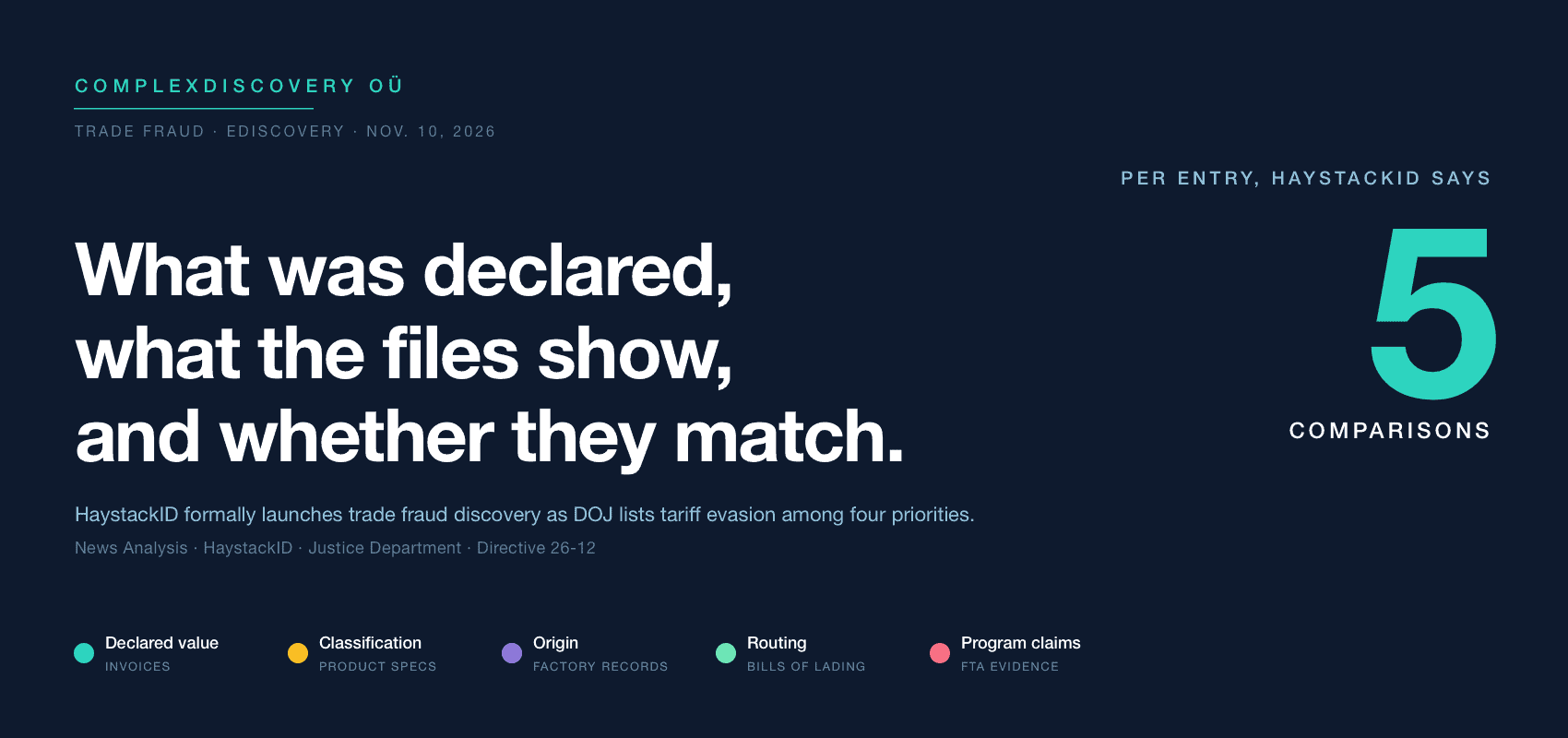
The reconciliation itself is the core of the offering. HaystackID’s service page lists five comparisons run entry by entry. Declared value is tested against commercial invoices and payment records, and Harmonized Tariff Schedule classification against product specifications and technical evidence. Country of origin is checked against factory and production records, routing against bills of lading and shipping records, and trade program claims against eligibility evidence such as free trade agreement rules-of-origin documentation.
HaystackID Case Insight and CaseBot, the company’s generative AI tools, are meant to identify the key people, issues and documents, while specialists tie each discrepancy back to the records it came from. The company says its experts and counsel validate AI outputs through sampling and quality metrics.
The same analysis is aimed at evidence that helps the company. The service page lists reasonable care policies and consultations with customs professionals, records of substantial transformation at third-country facilities, and engineering documents that support a declared classification.
Ashish Prasad, HaystackID’s vice president and general counsel, leads the company’s trade fraud program, according to the release. “Trade fraud investigations now move on civil and criminal tracks at the same time, and a company rarely gets a second chance to show the government it took the inquiry seriously,” Prasad said in the release. “Our job is to help counsel build a record that is complete enough to answer the agency and precise enough to surface the mitigating evidence a narrow review can miss.”
Review capacity, prior disclosure and accountability
All of that material still goes to reviewers. HaystackID says its managed review operation can call on over 35,000 reviewers, and its service page says quality control reviewers check up to 10 percent of each reviewer’s prior-day work. The company also offers contract data lawyers who draft protocols for electronically stored information, prepare burden analyses for scope discussions and build privilege logs under the supervision of outside counsel.
The release ties the entry analysis to prior disclosure, a Section 592 mechanism that limits penalties for companies that come forward first. A disclosure qualifies only if it is made before, or without knowledge of, the start of a formal investigation of that violation, and a company relying on lack of knowledge must prove it. The statute treats an investigation as starting on the date, as CBP records it in writing, when CBP discovered facts or received information that led it to believe a violation might have occurred.
CBP’s regulation also sets content requirements: the disclosure must identify the merchandise and the entries involved, explain the false statements, omissions or acts, and supply the correct information. That is where HaystackID places its entry analysis, saying it can pinpoint which merchandise and entries a potential disclosure would cover, with the legal call left to counsel.
A qualifying disclosure brings two protections. The merchandise is not seized over the disclosed violation, and for a fraudulent violation that affected duties, the penalty is capped at the lawful duties, taxes and fees of which the government was or may be deprived. The cap holds only if the company tenders the unpaid amount at disclosure, or within 30 days after CBP notifies it of the calculation or a longer period CBP allows.
Nate Latessa, HaystackID’s chief revenue officer, pitched the arrangement as a single line of accountability. “General counsel facing a trade fraud inquiry want one accountable partner from the first strategy session through the final production,” Latessa said in the same release. “Every engagement has a defined team and a single point of escalation, so legal teams can focus on strategy and agency communications while we manage the data.”
Where counsel and compliance teams should start
For legal and information governance teams, the practical work starts before any subpoena arrives. Teams should know where entry data lives, from Automated Commercial Environment exports to customs broker files. They should also confirm that legal hold procedures reach brokers, freight forwarders, the messaging applications that carry supplier conversations and any enterprise AI tools staff use for classification or sourcing.
Records of reasonable care deserve the same attention. The Resource Guide says an importer of record must use reasonable care to give CBP the information needed to assess duties, and classification decision trees, ruling requests and broker correspondence are the documents that can show it.
The capability claims in this launch are HaystackID’s own, drawn from its release and service page, and ComplexDiscovery has not independently tested them or compared them with other providers’ offerings. Professionals should watch for whether the division extends whistleblower incentives to trade fraud, the first corporate resolutions under the directive and the document requests that accompany those cases.
That brings the question back to the entry. When the government’s analytics or a former employee reaches a customs declaration first, will the company’s own records already explain it, or will the company be assembling that explanation under subpoena?
News Sources
- Trade Fraud Investigation Discovery Services (HaystackID)
- Departments of Justice and Homeland Security Partnering on Cross-Agency Trade Fraud Task Force (U.S. Department of Justice)
- Trade Fraud Task Force Surpasses $1 Billion in Recoveries and Charged Losses in Less Than One Year (U.S. Department of Justice)
- Directive 26-12: Corporate Enforcement in the Fight Against Fraud (U.S. Department of Justice, National Fraud Enforcement Division)
- Justice Department Announces Innovative Whistleblower Rewards Program to Combat Fraud (U.S. Department of Justice)
- Fraud Whistleblower Incentive Program (WHIP) (U.S. Department of Justice, National Fraud Enforcement Division)
- Whistleblower Awards Pilot Program (U.S. Department of Justice, Criminal Division)
- A Resource Guide to Trade Fraud Enforcement (U.S. Department of Justice and U.S. Department of Homeland Security)
- The Great Transshipment Scam (The White House)
- 19 U.S. Code § 1592: Penalties for fraud, gross negligence, and negligence (Legal Information Institute, Cornell Law School)
- 19 CFR § 162.74: Prior disclosure. (Legal Information Institute, Cornell Law School)
- 18 U.S. Code § 551: Concealing or destroying invoices or other papers (Legal Information Institute, Cornell Law School)
- False Claims Act Settlements and Judgments Exceed $6.8B in Fiscal Year 2025 (U.S. Department of Justice)
- Fraud Statistics: Overview, October 1, 1986 to September 30, 2025 (U.S. Department of Justice, Civil Division)
- DOJ’s Fraud Division Issues Corporate Enforcement Directive: Continuing to Carve Out a Wider Lane (Gibson Dunn)




Assisted by GAI and LLM Technologies
Additional reading
- HaystackID’s agentic CaseBot flags missing evidence but is not intended to confirm absence
- Ransomware logs and Copilot memory put AI agent records on the eDiscovery agenda
- 5th Circuit reassigns Mississippi DEI case after judge’s orders cite fabricated parties, quotations and a nonexistent case
- An AI agent can write the story, but EU law asks whether a human reviewed it
- An Oxford tutorial for newsroom leaders who must learn faster than the news
- An Oxford tutorial for cybersecurity, governance and eDiscovery
- Estonia aims to be first to give AI agents official digital IDs
- Parliament hits pause on high-risk AI rules and bans nudifier apps
- Europe’s AI labeling rules arrive with a voluntary code and a hard deadline
- AI is becoming an advisor, and it is rewriting how buyers find you
Source: ComplexDiscovery OÜ

ComplexDiscovery’s mission is to enable clarity for complex decisions by providing independent, data‑driven reporting, research, and commentary that make digital risk, legal technology, and regulatory change more legible for practitioners, policymakers, and business leaders.