
Editor’s Note: A brief, dismissive workplace exchange can reveal a work-life imbalance that months of routine concealed. This leadership analysis opens with an intentionally generalized workplace scenario in which a routine exchange carries a dismissive undertone and produces friction where clarity was expected. The disproportionate sting that follows becomes the article’s starting point: outsized reactions are not diagnoses, but they can signal investments people have stopped tracking. The argument is anchored in evidence, including WHO and ILO estimates attributing 745,000 deaths in 2016 to long working hours and Gallup’s 2020 finding that 28 percent of U.S. employees in its research experienced burnout very often or always. The relevance for business professionals is direct: exchanges like these are common across modern knowledge work, and always-on cultures normalize the gradual overextension the piece describes, one reasonable exception at a time.
Watch for the central tool, a personal audit triggered by a disproportionate reaction, and consider running one before circumstances run it for you.
Content Assessment: The conversation that is never about work-life balance
Information - 90%
Insight - 90%
Relevance - 88%
Objectivity - 92%
Authority - 90%
90%
Excellent
A short percentage-based assessment of the qualitative benefit expressed as a percentage of positive reception of the recent article from ComplexDiscovery OÜ titled, "The conversation that is never about work-life balance."
Industry News – Leadership Beat
The conversation that is never about work-life balance
ComplexDiscovery Staff
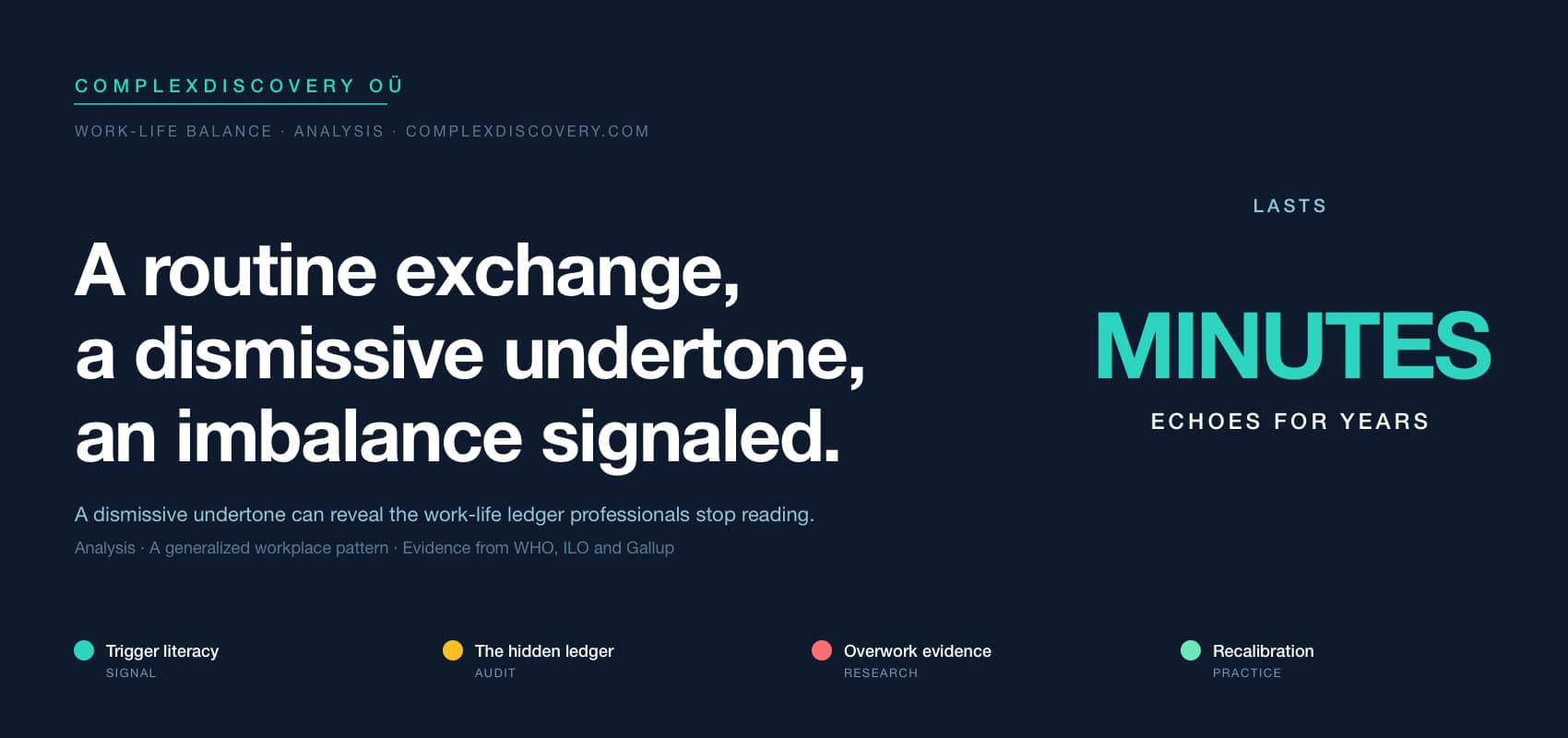
Work-life balance problems rarely announce themselves as crises. They surface through triggers: small exchanges that sting out of proportion to the moment. Learning to read those triggers is a first step toward correcting the imbalance they may reveal, and the analysis that follows examines one such trigger in detail.
The exchange is brief. The realization it sets off can run for years.
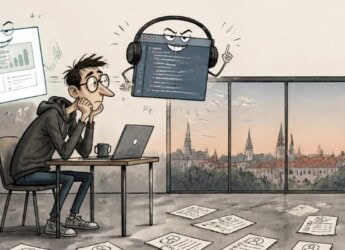
Consider a familiar workplace pattern. A routine conversation carries a dismissive undertone and produces more friction than clarity. On the surface, little of consequence appears to have happened. Yet the interaction lands harder than expected and continues to echo after the work moves on. The conversation is not about work-life balance. Nobody says the word balance. What matters is not the wording or the participants, but what the reaction makes visible.
Why a small dismissal lands so hard
What lingers is not the response itself. It is the professional’s own reaction. The sting feels out of all proportion to the moment, and the disproportion is not proof of anything, but it is information worth examining. A reaction of that depth may reflect deep investment in a way of working, a habit built over years and challenged in a brief moment. It may also carry fatigue, insecurity or history that has nothing to do with balance. Whether anyone was right on that day is a separate issue. Either way, the reaction can prompt an inventory of how much of a person has been routed into the work: the hours, the attention, the standards, the identity. Read that way, the dismissal functions like a receipt. It itemizes what has been paid and shows, in a single line, what the return can look like on any given day.
The ambiguity matters, too. A dismissive undertone is harder to address than open conflict because both meaning and intent remain contestable. The exchange can be explained away as routine even while its effect remains.
Here is the uncomfortable part. Imbalance is nearly invisible from the inside. When work expands, it expands gradually, one reasonable exception at a time, and each exception resets the baseline. Nobody experiences the drift as drift. They experience it as commitment. It often takes a casual dismissal, delivered without malice, to make the accounting visible. The exchange does not establish how the organization values the work, but it can expose the risk of expecting recognition to rise in direct proportion to personal investment.
An audit most professionals postpone
The productive response is the inventory that usually gets postponed. Where have the hours actually gone over the past year? What has been quietly deprioritized to fund them? The answers are rarely dramatic, which is precisely what makes them dangerous. Sleep trimmed at both ends. Exercise converted from routine to aspiration. Conversations with family compressed into logistics. Interests that once defined a person reduced to browser bookmarks. None of these are decisions. All of them are choices, made by default, one deferred evening at a time.
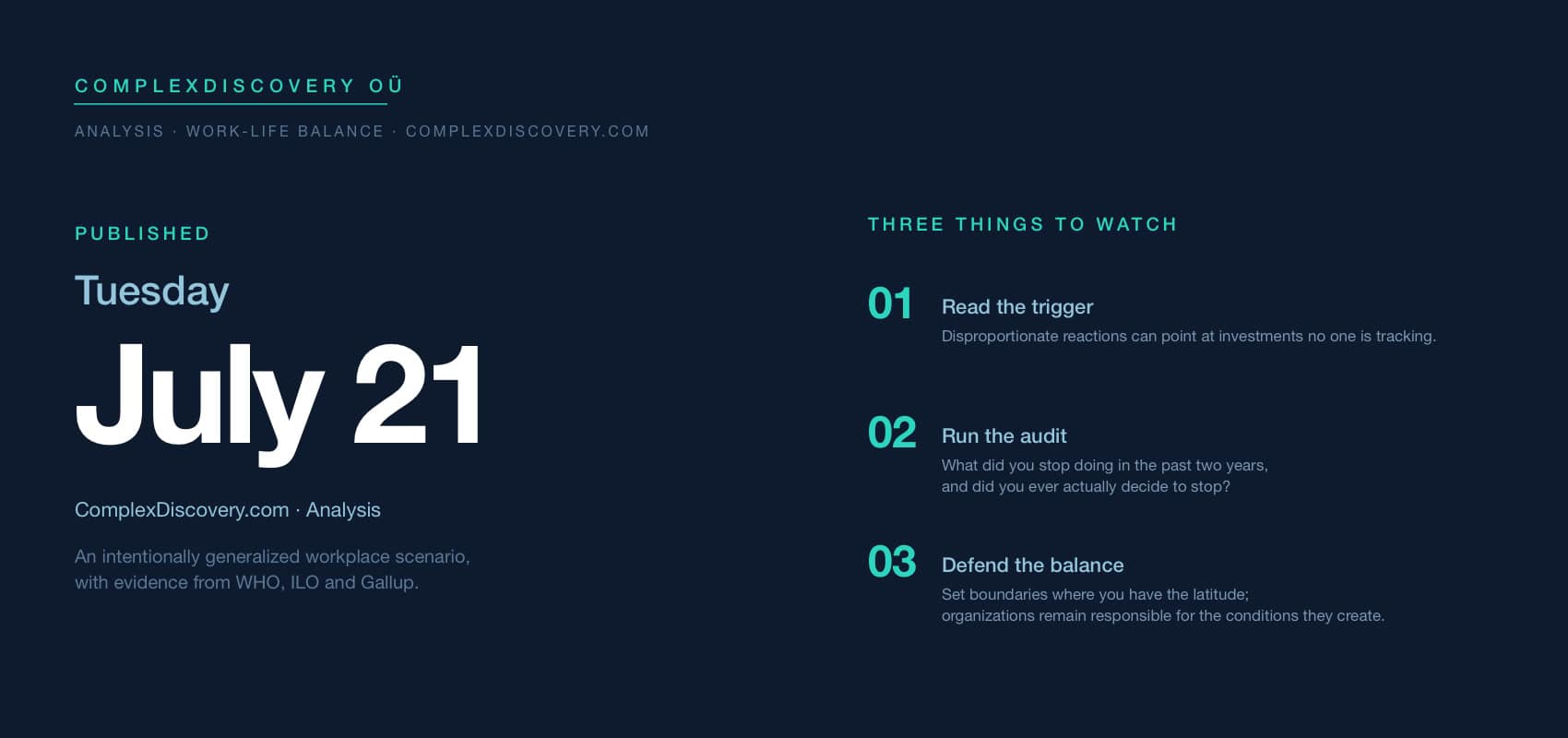
The tells follow familiar patterns. Always-on availability framed as responsiveness. An identity fused to a job. Depletion treated as the normal cost of serious work. If any of those sound familiar, run the inventory before a brief exchange runs it for you. Start with one question: what did you stop doing in the past two years, and did you ever actually decide to stop?
What the evidence says about overwork
The research on long working hours is blunt. In the first global analysis of its kind, published in 2021, the World Health Organization and the International Labour Organization estimated that working at least 55 hours a week accounted for 745,000 deaths from stroke and ischemic heart disease in 2016. Compared with a 35-to-40-hour week, working at least 55 hours was associated with an estimated 35 percent higher risk of stroke and a 17 percent higher risk of death from ischemic heart disease. “Working 55 hours or more per week is a serious health hazard,” Maria Neira, director of the WHO’s environment, climate change and health department, said when the estimates were released.
Gallup’s U.S. workplace research adds a second dimension. In 2020, Gallup reported that 76 percent of employees in its research experienced burnout at least sometimes and 28 percent experienced it very often or always, with burnout risk climbing sharply past 50 hours a week. Gallup’s data carries a twist worth sitting with: employees’ experience of their workload had a stronger influence on burnout than hours alone. That finding helps explain why workplace context matters: dismissive communication may compound the strain of long hours, although Gallup did not test dismissiveness as a distinct cause of burnout.
Recalibrating without retreating from the work
The exchange does not create the underlying imbalance, and that matters. The dismissal may be a trigger rather than the underlying cause, and blaming the trigger lets a person skip a harder look: some of the imbalance is a set of choices that stopped being noticed. Not all of it, though. Workload design, staffing, management behavior, autonomy and workplace norms also shape burnout risk, and organizations and managers remain responsible for the conditions they create. What individuals can do is defend their boundaries where they have the latitude to do so, because a system under pressure will accept all the surplus offered to it.
Recalibration looks concrete rather than dramatic. Working hours get edges again, and the edges get enforced. Availability becomes a decision instead of a reflex. Identity gets rebuilt around things that have nothing to do with a title. And colleagues, partners and projects get evaluated by a new tell: whether routine interactions support clarity, trust and professional respect. Commitment to the work stays. What changes is its size, which becomes proportional to what the work actually returns.
The cheapest tuition a career can charge
Viewed this way, the dismissive exchange is a gift, however unpleasant. It is the least expensive possible tuition for a lesson that usually costs people their health, their relationships or both. The alternative instructors, the WHO’s mortality tables among them, charge far higher rates.
So the takeaway is not “work less,” advice so generic it changes nothing. It is this: pay attention to the moments that hurt more sharply than they should. Disproportionate reactions are not diagnoses, but they can be signals. They may point toward an investment that has stopped being tracked or a ledger that has gone unread. The imbalance you cannot see may be the one a brief exchange eventually makes visible.
When was the last time a small moment stung out of all proportion, and what was it trying to tell you?
News sources
- Long working hours increasing deaths from heart disease and stroke: WHO, ILO (World Health Organization)
- Global, regional, and national burdens of ischemic heart disease and stroke attributable to exposure to long working hours for 194 countries, 2000-2016 (Environment International)
- Employee burnout: The biggest myth (Gallup)
- Long working hours kill 745,000 people a year, WHO/ILO study finds (CNBC)
- ILO and WHO: Long working hours can increase deaths from heart disease, stroke (AIHA)
- Working 55 hours a week increases risk of death: UN (Gulf News)

Assisted by GAI and LLM Technologies
Additional reading
- One hexagon, three industries, two feet: a brand lesson in sneakers
- The Planning Paradox: an Oxford-style tutorial tests why business plans fail
- An Oxford tutorial for newsroom leaders who must learn faster than the news
- An Oxford tutorial for cybersecurity, governance and eDiscovery
- Estonia aims to be first to give AI agents official digital IDs
- Parliament hits pause on high-risk AI rules and bans nudifier apps
- Europe’s AI labeling rules arrive with a voluntary code and a hard deadline
- AI is becoming an advisor, and it is rewriting how buyers find you
- What marketing confidence actually looks like
- When credibility comes first, capability sells itself: The case for news-led marketing
- The one question that reveals whether your marketing plan is actually a plan
- How Prompt Marketing Is Redefining Thought Leadership In The AI Era
- Raising The Age Ceiling: How AI Is Extending Executive Leadership
- Staying Curious: One Practical Defense Against Creative Burnout
- From Longbows To AI: Lessons In Embracing Technology
- 20 Ways Creative Professionals Battle Burnout And Find Fresh Ideas
- 14 Points For Brands To Consider Before Making Sociopolitical Statements
Source: ComplexDiscovery OÜ

ComplexDiscovery’s mission is to enable clarity for complex decisions by providing independent, data‑driven reporting, research, and commentary that make digital risk, legal technology, and regulatory change more legible for practitioners, policymakers, and business leaders.