
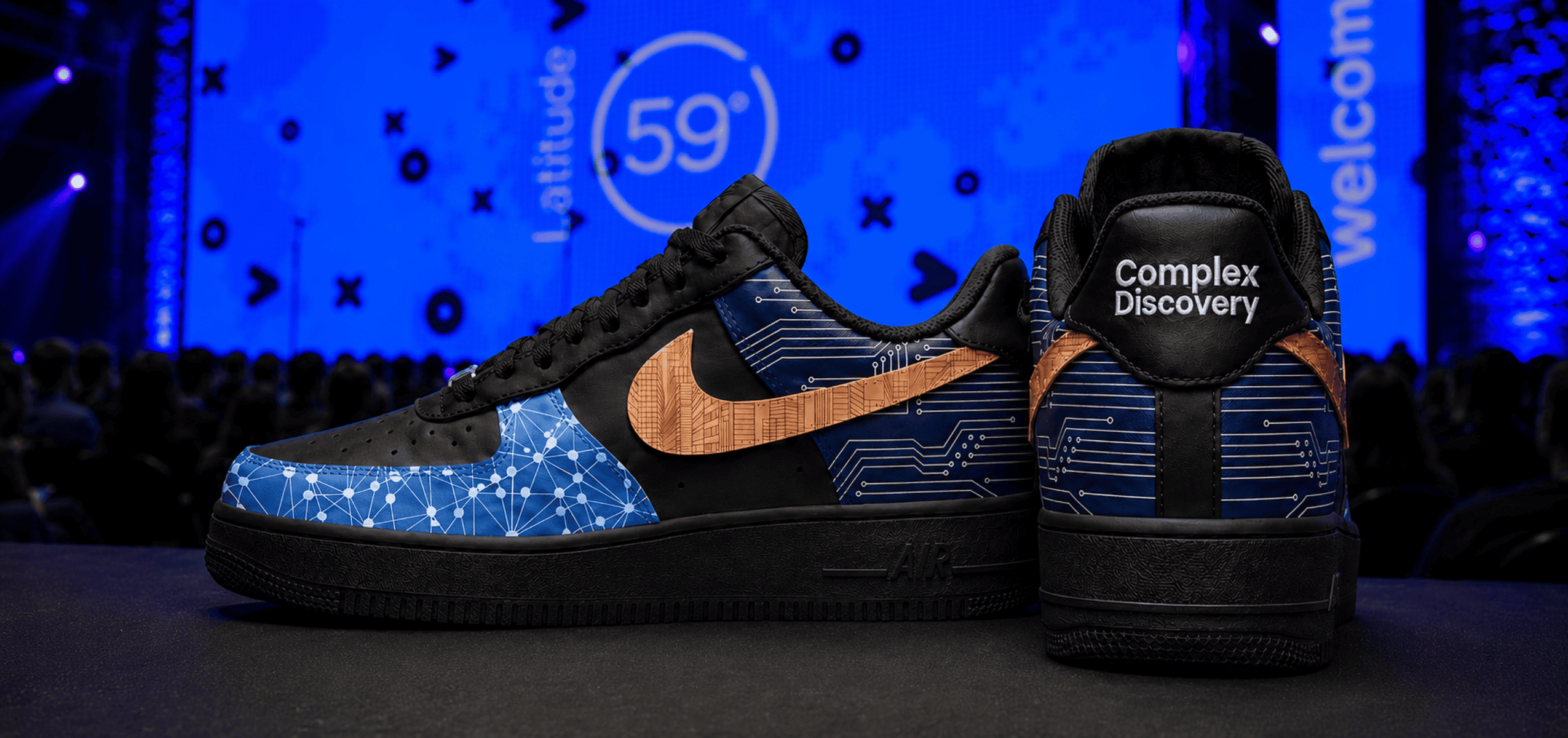
Editor’s Note: This first-party brand story gives readers a live marketing exercise to examine. ComplexDiscovery OÜ has translated its hexagon brand system—circuit board, connectivity nodes, and city skyline—onto independently customized Nike Air Force 1 Low sneakers, with “Complex Discovery” pressed on both heel tabs. The shoes are not for sale, and no purchase or contribution mechanism exists. Instead, the article applies the four-jobs marketing framework published by ComplexDiscovery founder and managing director Rob Robinson through Forbes Communications Council. It identifies credibility as the initiative’s single center of gravity: an intended demonstration that a substance-first organization can execute disciplined brand work, with awareness as a possible adjacent effect. For marketing and communications professionals, the takeaway is the discipline itself: one initiative, one declared job, and, in this specific case, an honest acknowledgment that the outcome remains unmeasured. The closing addendum turns that principle into a set of prompts for auditing initiatives that rely more on vibe than design.
AI-assisted composite editorial image created from actual photographs of the customized shoes and the Latitude59 stage. The shoes and stage were not photographed together in the depicted scene.
Content Assessment: One hexagon, three industries, two feet: a brand lesson in sneakers
Information - 93%
Insight - 93%
Relevance - 90%
Objectivity - 88%
Authority - 94%
92%
Excellent
A short percentage-based assessment of the qualitative benefit expressed as a percentage of positive reception of the recent article from ComplexDiscovery OÜ titled, "One hexagon, three industries, two feet: a brand lesson in sneakers."
Industry News – Leadership Beat
One hexagon, three industries, two feet: a brand lesson in sneakers
ComplexDiscovery Staff
A brand is what a market can recognize before a word is spoken. From its inception in 2010 until ComplexDiscovery began phasing in the hexagon in December 2022, the magnifying glass served as the publication’s identifying mark. Since then the hexagon has carried that recognition. Now it also extends to a pair of shoes.
ComplexDiscovery OÜ, the Tallinn-based independent digital publication and research organization covering cybersecurity, information governance, and eDiscovery, has commissioned independently customized Nike Air Force 1 Low sneakers that translate its hexagon logo, panel by panel, into wearable form. The shoes form a brand object, not merchandise: they are not offered for sale, and no purchase or contribution mechanism exists. What the project offers instead is an intended demonstration of how a small independent publication approaches brand discipline.
A logo that walked off the page
The design is a direct transposition of the brand system ComplexDiscovery introduced on Dec. 16, 2022. That logo carries three interlocking sections: a circuit board for cybersecurity, rendered in deep navy (#0E2E4A); a field of connected nodes for information governance in signal blue (#016494); and a skyline of modern buildings for legal discovery in terracotta and sand (#C24C3A and #F5C99F). At its center sits a teardrop that the publication says represents satisfaction and success when protocols are properly applied, and fear and folly when they are not.
Complex Discovery Logo - New Overview
Each panel of the sneaker picks up one of those sections. Circuit board traces run across the heel and quarter panels in navy. A constellation of white nodes and connecting lines covers the toe box in governance blue. The Swoosh itself carries the building lattice in the logo’s terracotta and sand tones, so the mark that Nike made famous becomes, on this pair, the legal discovery panel of the hexagon. “Complex Discovery” is pressed in white across both heel tabs, set in a rounded face that echoes the brand’s Poppins Bold typography. The base of the shoe stays black, which lets the three brand patterns read the way they do on the logo: distinct sections, one connected system.
ComplexDiscovery commissioned the project and supplied the brand system the design draws from; an independent customizer executed the design and fabricated the shoes.
Four jobs and one center of gravity
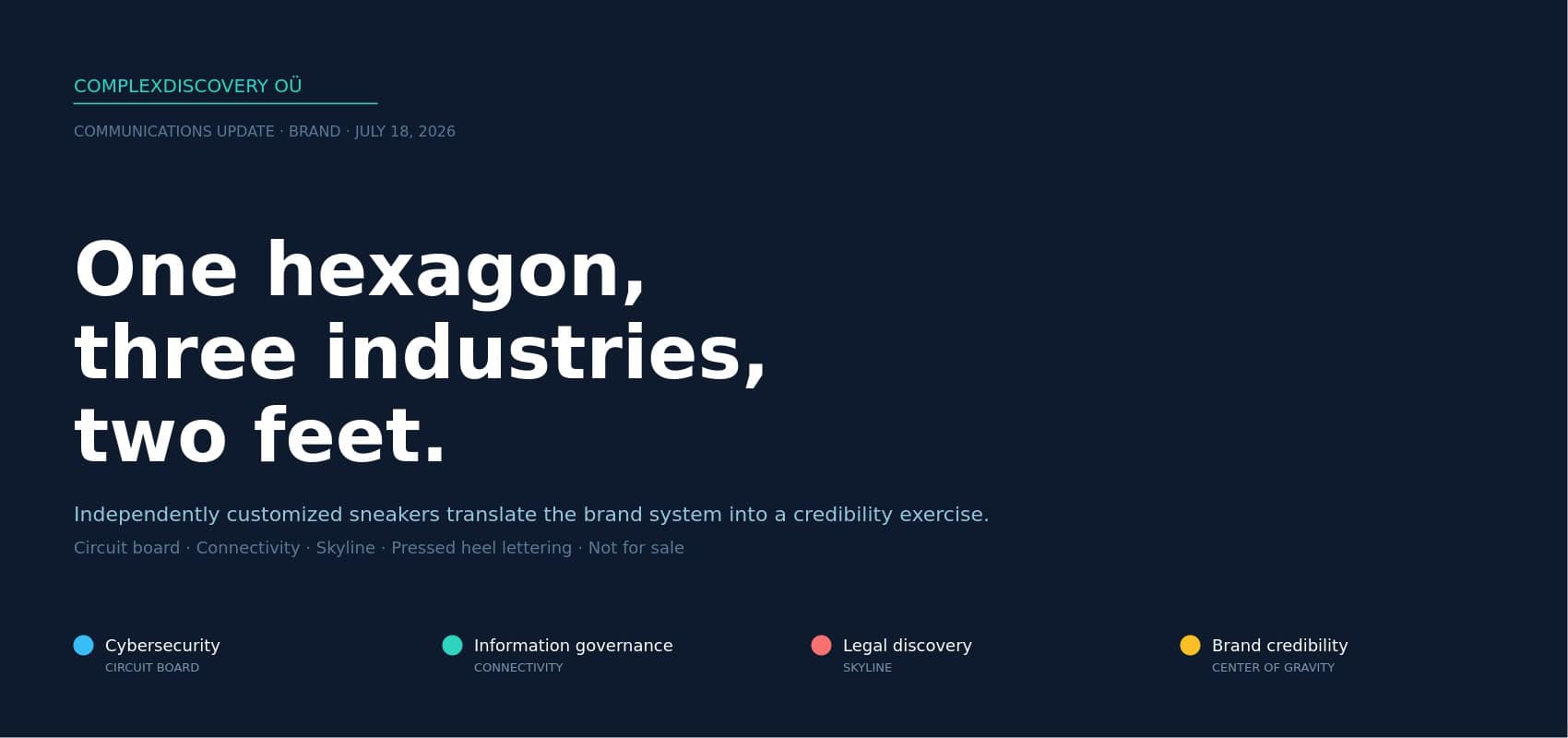
Why would a trade publication make a shoe? The publication’s editorial rationale came earlier this year in a Forbes Communications Council commentary by ComplexDiscovery founder and managing director Rob Robinson. That piece argues marketing performs four distinct jobs: awareness, credibility, demand generation, and integration, and that any initiative worth funding must be designed around exactly one. The test is a single question: “What is it designed to do?”
ComplexDiscovery classifies the project as a credibility initiative: an effort to demonstrate that the publication can apply the brand discipline discussed in its own marketing commentary. That classification describes the project’s intended purpose, not a measured outcome. The working hypothesis is that organizations built on substance are sometimes assumed to lag on brand because they do not lean on flashy colors and heavy design, and that the cleanest answer to the assumption is doing the brand work in public. Awareness may follow as an adjacent effect. But the discipline of the framework is refusing the temptation to claim every job at once: the shoes are designed as a credibility exercise, and nothing about them asks the reader to act. Absent a planned measurement of whether exposure changes how target readers assess the publication’s brand discipline, the shoes stand as an illustrative application of the framework rather than a completed case study. The credibility at stake is brand-execution credibility; customized footwear cannot validate reporting accuracy, editorial independence, or authority, which rest on the journalism itself.
The message pressed into the heel
The shoes also carry the publication’s operating philosophy. The ComplexDiscovery Operating Manifesto, published July 27, 2025, commits the newsroom to measuring itself by “consistency, utility, and contribution” rather than rankings, mentions, or likes. It invokes sisu, the Finnish practice of resolve under difficulty, and vacilando, the Spanish idea that the journey shapes the traveler. A publication that covers digital risk for a living chose to put its identity on an object built for walking. The symbolism is not subtle, and it is not meant to be.
The brand now operates across every register a reader encounters: color in the design system, message in the manifesto, meaning in the hexagon’s three industries and the teardrop between them, and now a physical object that carries all three into rooms where the publication cannot otherwise go.
What other brands can borrow
The transferable lesson is not the footwear, and it is not limited to publishing. For any business built on substance, in legal technology and security or far beyond them, the sequence is the same: a brand system precise enough to survive translation onto a new surface, an operating philosophy that gives the object meaning, and a framework honest enough to assign the initiative one job. A brand that has color, message, and meaning can put them on almost anything. The test is whether the initiative knows what it is designed to do.
The hexagon began as a mark on a masthead. It now moves at walking speed. Where should it show up next?
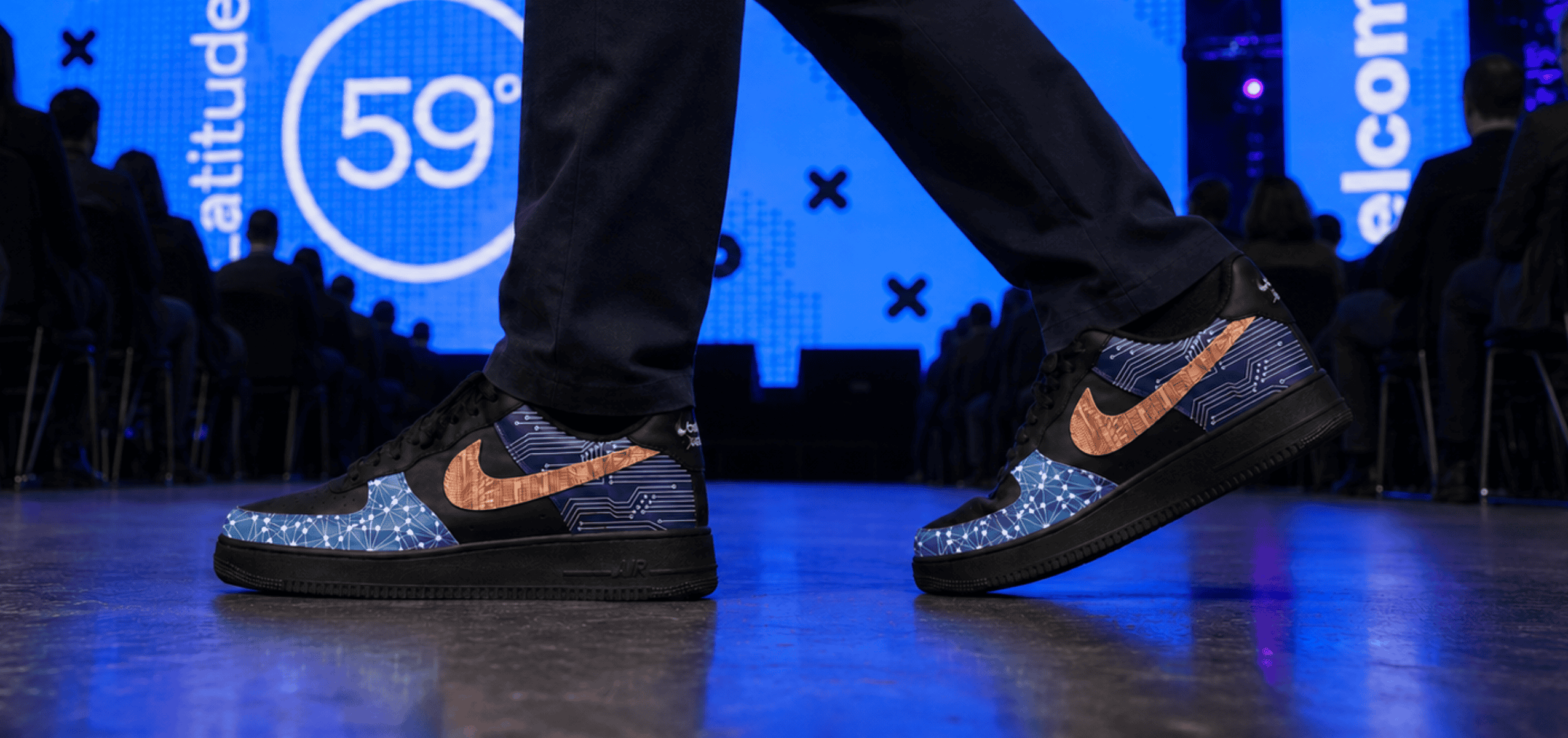
AI-assisted composite editorial image created from actual photographs of the customized shoes and the Latitude59 stage. The shoes and stage were not photographed together in the depicted scene.
Addendum: eight questions for vibe-heavy initiatives
The framework cuts both ways. If a substance-first organization can be wrongly assumed to lag on brand, an initiative rich in color and panache can be wrongly assumed to be marketing. These eight questions help distinguish a designed initiative from a styled one. They are prompts rather than a validated scorecard, and plenty of colorful work answers them well. Several weak answers, particularly an inability to name the initiative’s primary job and measurement, may indicate that styling is substituting for strategy.
The prompts run in sequence. Name the initiative’s one job and its one primary measurement; an answer that needs a compound sentence, or a dashboard that measures everything, is the first sign that a center of gravity is missing. Strip away the color, the motion, and the production values and see whether a message remains, because when nothing does, the styling was the message. Trace whether the work extends the organization’s existing design system or invented a look for the occasion, since invented looks build recall for the campaign rather than the brand. And ask whether anyone on the team can say what each visual decision represents, because choices no one can explain are decoration.
The harder prompts follow. An initiative that claims demand generation needs a direct line from impression to mechanism, and buzz is not a mechanism. A real decision can show its selective neglect: name what was deliberately not funded so this could be, because if nothing was declined, it was an addition rather than a decision. The last prompt is the vibe test itself. If an initiative’s best defense is how it feels, it has a mood. Moods are real assets, but they are not centers of gravity, and a board should not fund one without deconstructing what the vibe actually provides.
final-complexdiscovery-eight-questions-sheet
The sneaker project answers the framework’s first question: it can name the job it is designed to do. Whether the market recognizes the intended brand discipline remains unmeasured, and that distinction between declared purpose and demonstrated effect is the point every initiative must confront.
Disclaimer: The shoes are independently customized Nike Air Force 1 Low sneakers. The customization is not affiliated with, endorsed by, or sponsored by Nike Inc.
Sources and reference materials
- Entering the Hexagon? ComplexDiscovery’s Cybersecurity, Information Governance, and Legal Discovery Logo (ComplexDiscovery)
- The ComplexDiscovery Operating Manifesto: A Commitment to Clarity and Contribution (ComplexDiscovery)
- The Question That Reveals If Your Marketing Plan Is Actually A Plan (Forbes Communications Council)
- About ComplexDiscovery OÜ (ComplexDiscovery)

Assisted by GAI and LLM Technologies
Additional reading
- The Planning Paradox: an Oxford-style tutorial tests why business plans fail
- An Oxford tutorial for newsroom leaders who must learn faster than the news
- An Oxford tutorial for cybersecurity, governance and eDiscovery
- Estonia aims to be first to give AI agents official digital IDs
- Parliament hits pause on high-risk AI rules and bans nudifier apps
- Europe’s AI labeling rules arrive with a voluntary code and a hard deadline
- AI is becoming an advisor, and it is rewriting how buyers find you
- What marketing confidence actually looks like
- When credibility comes first, capability sells itself: The case for news-led marketing
- The one question that reveals whether your marketing plan is actually a plan
- How Prompt Marketing Is Redefining Thought Leadership In The AI Era
- Raising The Age Ceiling: How AI Is Extending Executive Leadership
- Staying Curious: One Practical Defense Against Creative Burnout
- From Longbows To AI: Lessons In Embracing Technology
- 20 Ways Creative Professionals Battle Burnout And Find Fresh Ideas
- 14 Points For Brands To Consider Before Making Sociopolitical Statements
Source: ComplexDiscovery OÜ
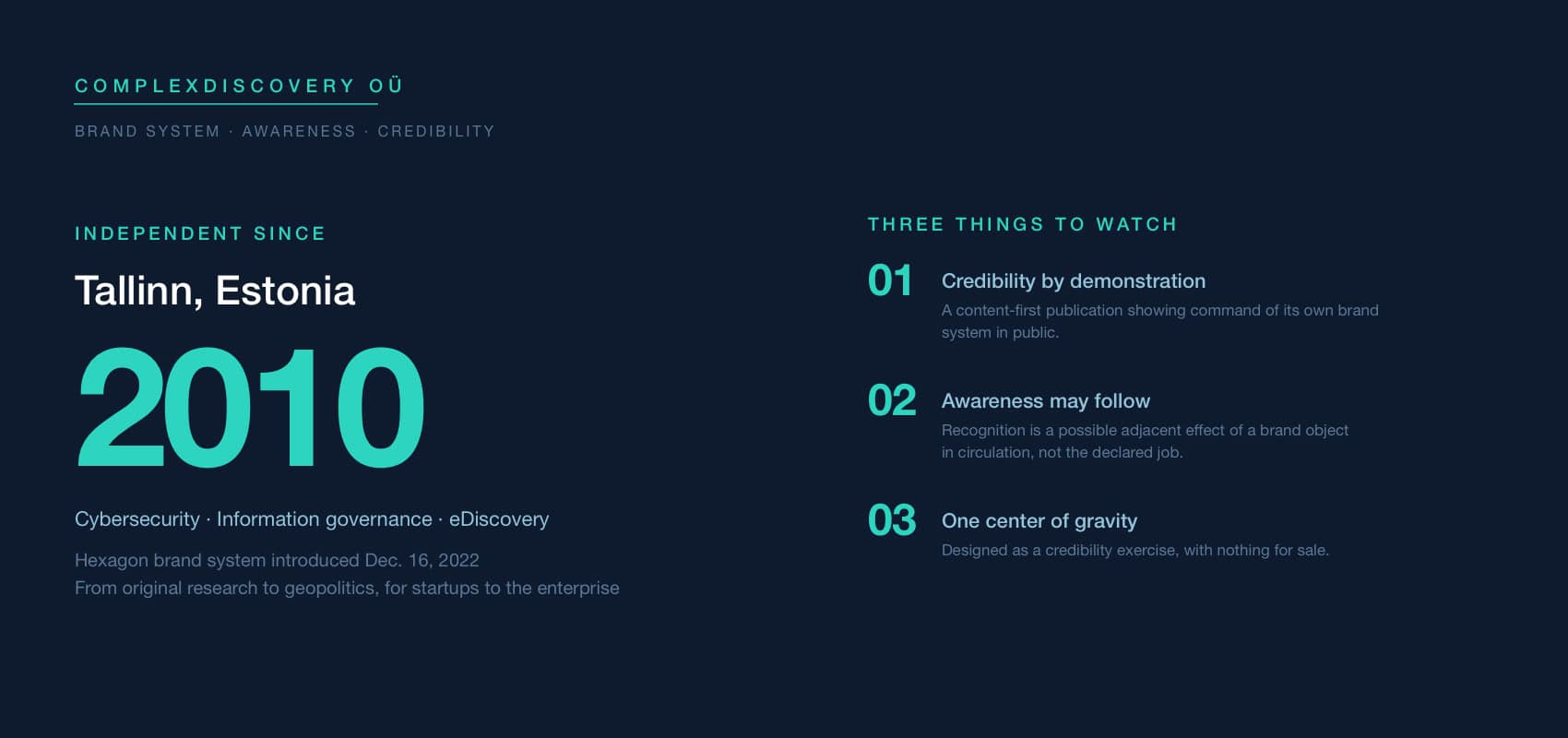
ComplexDiscovery’s mission is to enable clarity for complex decisions by providing independent, data‑driven reporting, research, and commentary that make digital risk, legal technology, and regulatory change more legible for practitioners, policymakers, and business leaders.