
Editor’s Note: A keynote that never mentioned a single legal technology product may prove the most useful talk at LegalTechTalk 2026. John Saiz, former chief technologist at NASA’s Johnson Space Center, used the Columbia disaster to show how a long run of success can quietly mute dissent and bury risk inside layers of management, a familiar pattern that precedes many breaches, sanctions and governance failures.
For cybersecurity, data privacy, regulatory compliance and eDiscovery professionals, the relevance is direct. The control that lapses without consequence, the escalation that dies in middle management, the legal hold that goes out late: these are not technology defects. They are cultural ones, and they map precisely onto the normalization of deviance that NASA paid for twice. Programs governed by audit obligations, preservation duties and breach-notification clocks depend on the frontline voice reaching a decision-maker before a loss occurs.
Watch for leaders who treat culture as a control. The organizations that shorten the path from the analyst to the executive, and that reward the dissenting voice rather than the on-schedule consensus, are the ones that will absorb the next shock. Saiz’s closing line is the one to keep: don’t forget about the people.
Content Assessment: Success bred complacency: a NASA warning for security and discovery leaders
Information - 94%
Insight - 95%
Relevance - 95%
Objectivity - 96%
Authority - 97%
95%
Excellent
A short percentage-based assessment of the qualitative benefit expressed as a percentage of positive reception of the recent article from ComplexDiscovery OÜ titled, "Success bred complacency: a NASA warning for security and discovery leaders."
Industry News – Leadership Beat
Success bred complacency: a NASA warning for security and discovery leaders
ComplexDiscovery Staff
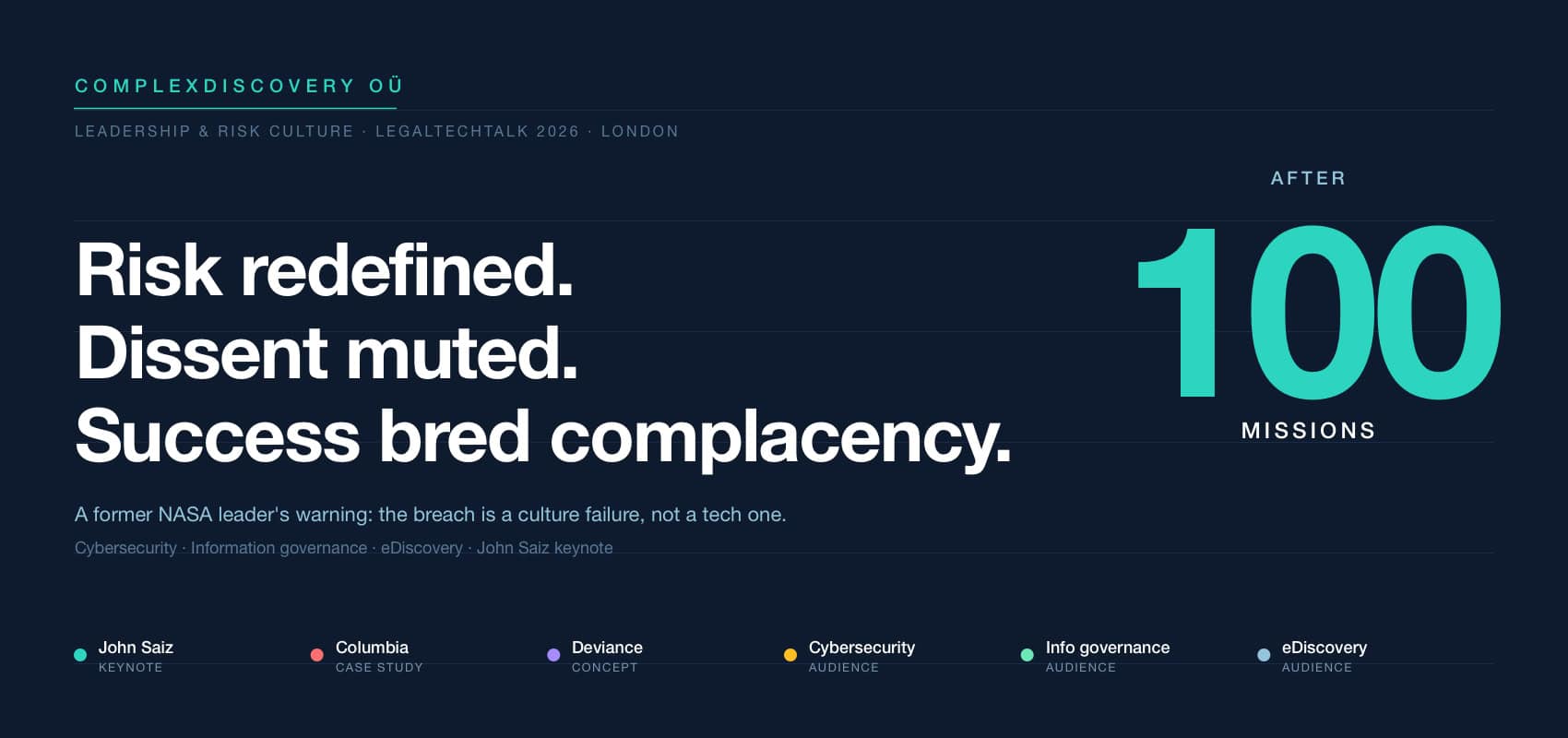
“Risk was gradually redefined as acceptable. Dissent was muted. Success bred complacency.”
That sentence, delivered to legal technology professionals from about 80 countries, was not a verdict on any law firm or security program. It was John Saiz describing how NASA lost a space shuttle, and why the people who run cybersecurity, information governance and eDiscovery functions should hear it as a warning for their own organizations.
Saiz, a former senior technology leader at NASA’s Johnson Space Center, opened LegalTechTalk 2026 in London. He did not talk about the technology that took a picture from the far side of the moon, which is what the colleague who invited him to speak had asked him to do. He talked about people, and about the slow cultural drift that turns a long record of wins into the conditions for catastrophe.
A five-year story in 17 minutes
Saiz set out to compress a five-year story into 17 minutes. He walked the audience through Columbia, the orbiter that broke apart on re-entry on Feb. 1, 2003, killing all seven astronauts aboard. He had known and worked with two of them. It had been 23 years, he said, and the loss was still painful to discuss.
NASA had been burned before. Challenger broke apart shortly after launch on Jan. 28, 1986. Both times, the agency recovered with formidable engineering. After Columbia, it redesigned bolt catchers, added heater strips to feed lines, upgraded the camera systems that monitor each launch, and placed sensors inside the wings, the project Saiz himself worked on, climbing into the wing cavities to install wireless acoustic emission sensors. The fleet returned to flight in about two and a half years.
The engineers in the room had noticed something uncomfortable. Two and a half years was about how long the Challenger recovery had taken, too. “Are we just going down the same path?” Saiz recalled the workforce asking. The rocket science was solvable; give a rocket scientist an equation and the answer comes back. The people problem was harder, and it was the people problem that the investigators kept circling.
How deviance becomes normal
The Columbia Accident Investigation Board, made up of astronauts, military officers, physicists and engineers, issued its report in Aug. 2003. Saiz distilled its cultural findings to a phrase the board drew from sociology: the normalization of deviance.
Columbia University sociologist Diane Vaughan coined the term in her 1996 study of the Challenger launch decision, defining it as the gradual process through which an unacceptable practice or standard becomes acceptable. When a deviation from the rule repeats without disaster, it quietly becomes the organization’s new norm. NASA had flown about 100 shuttle missions by the time of Columbia. Confidence hardened into comfort. The shuttle was asked to operate outside its certification range, and a record of success made that feel reasonable.
The board faulted NASA for reliance on past success as a substitute for sound engineering, and for organizational barriers that stifled professional disagreement and blocked the flow of safety information. For a security or governance leader, the test that follows is uncomfortable but simple: name the control your team has quietly stopped enforcing because nothing has gone wrong yet. The expired access review that keeps slipping. The legal hold that went out late and caused no visible harm. The retention shortcut that saved a week. Each is a small redefinition of acceptable risk, and each is invisible precisely because it has not yet produced a loss.
The layers between the alarm and the decision
Schedule pressure made the drift worse. NASA was racing to finish the International Space Station, and because it is a public agency, any cost overrun was visible to taxpayers. Flights were turning around every four to six weeks. Under that pressure, Saiz said, decision-making shifted subtly to favor group consensus over the individual voice expressing a dissenting opinion.
Then came the structural problem. A mature agency, by then 30 to 40 years old, had added layer upon layer of management control. “Those additional layers of management made it difficult for the people at the coalface to elevate the issues,” Saiz said. Compartmentalization, the quiet accumulation of filters between the person who sees the problem and the person who can act on it, is where his diagnosis lands hardest on corporate leadership.
The analyst who flags an anomaly, the records manager who questions a retention schedule, the associate who urges a legal hold usually sits several reporting layers below the executive empowered to respond. Every layer is a filter, and every filter is a chance for the signal to be softened, reframed or dropped. Leaders who actually want the signal can shorten the path: build a route for a frontline analyst or paralegal to escalate a concern without it being pre-digested by three intermediaries who each have a reason to keep the project on schedule.
What the breach and the spoliation sanction share
Here is the translation Saiz invited his audience to make. A breach, a spoliation sanction or a compliance miss is often not only a technology failure. Each often traces back to a warning the organization had already been handed and chose not to hear, a concern raised one reporting layer too far below the person who could have acted on it.
Saiz was candid that the middle is where good intentions die. Executives tell their people to challenge convention, he said, “but the problem is middle management.” Those managers are conflicted, because the same leaders who ask them to encourage dissent are also telling them to make the delivery next week. The message a frontline employee actually receives is the one their direct manager reinforces, not the one on the leadership slide.
In security, information governance and eDiscovery, the cost of not listening is counted in breaches, regulatory sanctions and lost client trust rather than in lost spacecraft. The stakes look different. The failure mode is identical.
Three translations from rockets to risk
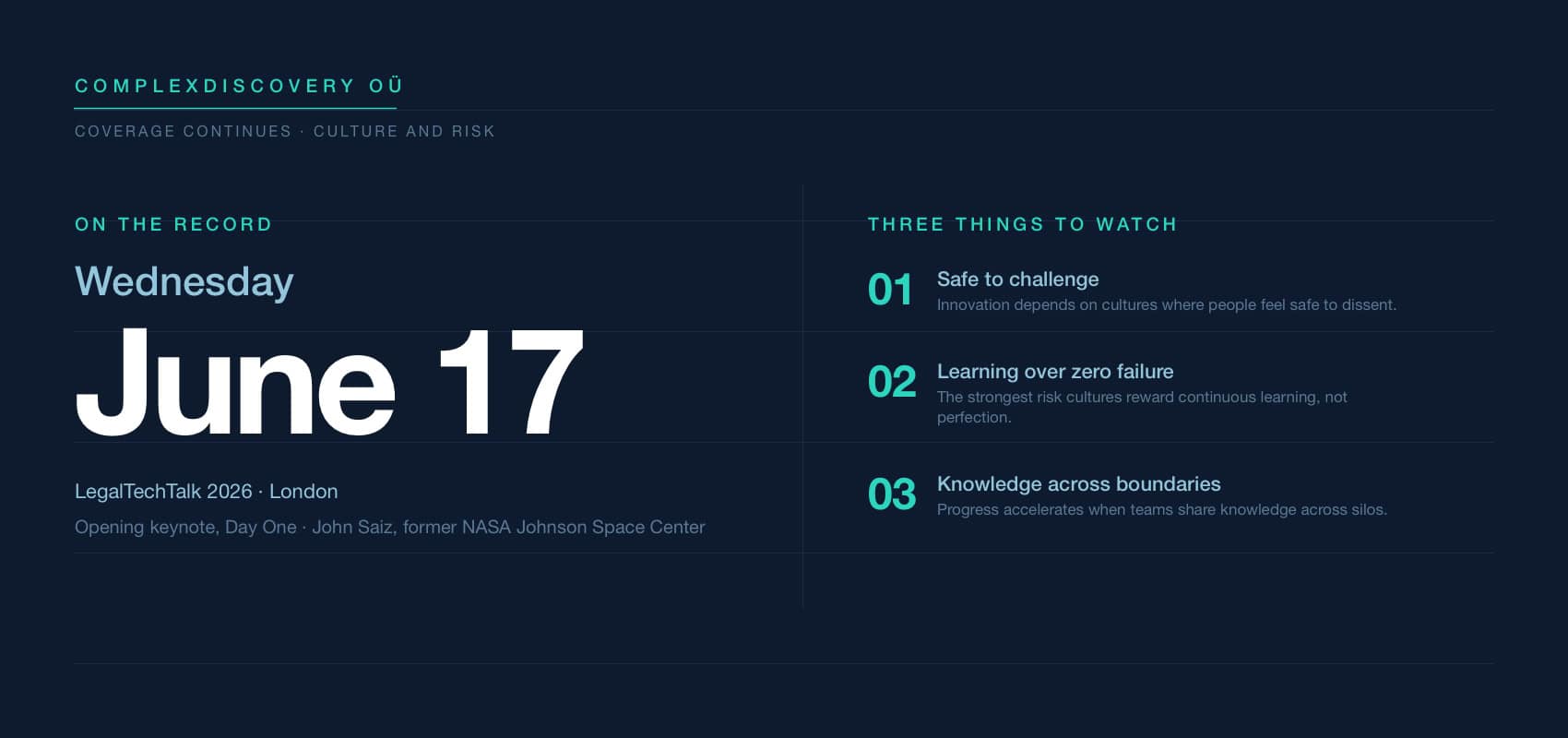
Saiz offered three lessons he called rockets-to-roads translations. Innovation depends on cultures where people feel safe to challenge. The most effective risk cultures are built on continuous learning rather than on a demand for zero failure. And progress accelerates when knowledge moves freely across boundaries.
The second lesson deserves attention from a profession where the consequences of failure can be catastrophic and the instinct is therefore to forbid failure outright. Saiz’s argument is that a zero-failure mandate does not produce zero failure. It produces hidden failure, the kind that surfaces only after the foam strike, the missed preservation notice, the unreviewed access grant. The practical alternative is to design scenarios where teams can take calculated risks and learn from small, survivable mistakes, tabletop exercises and red-team drills among them, so the organization builds the muscle to surface problems before they compound.
The third lesson speaks to compartmentalization directly. At Johnson, Saiz built creative spaces and put collaboration centers where people from different departments would collide, at the cafeteria and at building entrances. He pushed open innovation to reach problem-solvers outside the fence line, and he revived institutional storytelling, bringing in the veterans the agency called gray beards to recount how earlier programs had solved the same problems. For a governance program, the equivalent is straightforward: have security, legal and records teams review the same incident in one room rather than passing it down a chain, so the knowledge that prevents the next failure does not die at a departmental boundary.
Don’t forget about the people
The fixes worked. After return to flight, the shuttle completed 22 more missions without a fatal accident, ending with Atlantis on mission STS-135 in July 2011. The space station was finished and remains in operation today, a point Saiz made with deliberate emphasis on the word international.
His closing instruction stripped the lesson to its core. “Don’t forget about the people,” he said. The people built the organization. Encourage them to challenge convention, to experiment with new approaches, to pursue meaningful change.
The question Saiz left hanging is worth carrying back to every security operations center, governance committee and discovery team in the room and beyond: which dissenting voice in your organization has already gone quiet, and what has its silence cost you that you have not yet measured?
News sources
- Columbia Accident Investigation Board Report, Volume One (NASA)
- How the Challenger Disaster Became a Case Study of the ‘Normalization of Deviance’ (Columbia Magazine)
- Remembering the Columbia STS-107 Mission (NASA)
- STS-135: The Final Mission of the Space Shuttle Program (NASA)
- John Saiz, Former NASA JSC Chief Technologist (LinkedIn)
- Opening keynote, featuring John Saiz (former NASA Johnson Space Center), introduced by Bradley Collins (LegalTechTalk) (LegalTechTalk live session, Day One, June 17, 2026, author’s session notes and transcript)





Assisted by GAI and LLM Technologies
Additional Reading
- At LegalTechTalk, the password is blueberry hot dogs
- Relativity bets legal teams will talk to their data, not just search it
- Europe’s off-channel reckoning: HaystackID bets COMET on a messaging crackdown crossing the Atlantic
- HaystackID brings AI privacy and discovery stack to Dublin as European compliance pressure mounts
- The New Face of Discovery: HaystackID’s CoreFlex Brings AI, Slack, and Enterprise Data into One Legal Workflow
- Show Your Work: HaystackID Brings eDiscovery Rigor to AI Governance
- Redefining Global Advisory: How Jeff Shapiro’s London Leadership Anchors HaystackID’s 2026 European Strategy
- HaystackID Names Chad Pinson CEO as Hal Brooks Becomes Executive Chair
Source: ComplexDiscovery OÜ

ComplexDiscovery’s mission is to enable clarity for complex decisions by providing independent, data‑driven reporting, research, and commentary that make digital risk, legal technology, and regulatory change more legible for practitioners, policymakers, and business leaders.